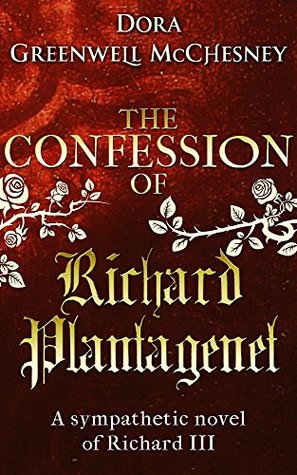
 With the Wars of the Roses being one of my favourite periods of history, I like to read everything I can find on the subject. This novel by Dora Greenwell McChesney – an author completely new to me – sounded particularly intriguing because it was published in 1913, making it the oldest Wars of the Roses novel I have read, coming sixteen years before even Marjorie Bowen’s Dickon (1929).
The Confession of Richard Plantagenet begins with the Yorkist victory at the Battle of Tewkesbury in 1471 and ends with Richard III’s defeat at Bosworth Field in 1485. Between these two events we are given not so much a confession as a fairly straightforward account of Richard’s life, showing the circumstances which led to him taking the throne following the death of his brother, Edward IV, and then leading us through the key moments of his own brief reign.
As this is described on the front cover as ‘a sympathetic novel of Richard III’, I was interested to see how McChesney was going to tackle the many controversies surrounding Richard, such as the death of Henry VI and, of course, the disappearance of his nephews, the Princes in the Tower. Well, this novel does show Richard either directly or indirectly committing some of the crimes of which he has traditionally been accused, but always for good and noble reasons or because he has been left with no other choice.
I can appreciate that because she was writing what was surely one of the earliest pro-Ricardian novels, McChesney (like Marjorie Bowen with Dickon) was trying to counteract the more widely held view of Richard as an evil, hunchbacked murderer, but I think she went too far the other way, with the effect that Richard comes across as blameless and almost saintly. Still, it was interesting because the approach taken in this novel is slightly different from others I’ve read. This is why I’m happy to keep on reading about the same historical people and events again and again – because each different author offers a different set of opinions, ideas and interpretations.
If you have never read about this time period before, however, I probably wouldn’t recommend starting here. McChesney seems to assume the reader has at least some prior knowledge, so if you’re not already familiar with the background to the Wars of the Roses and the names and relationships involved, you might find the plot difficult to follow, especially in conjunction with the style in which the book is written.
Like a lot of older historical fiction novels, the language McChesney uses is archaic and flowery, particularly in the dialogue. As someone who reads all sorts of historical fiction, from the latest releases to books written hundreds of years ago, I always find it interesting to see how trends in the genre have changed. McChesney’s dialogue feels very outdated today, but personally I liked it once I got used to it and thought it added to the atmosphere of the novel.
Despite the flaws I have mentioned I enjoyed reading this version of Richard’s story and I’m sure it won’t be long before I find myself picking up yet another one!
I received a copy of this book for review via NetGalley.




 She Reads Novels