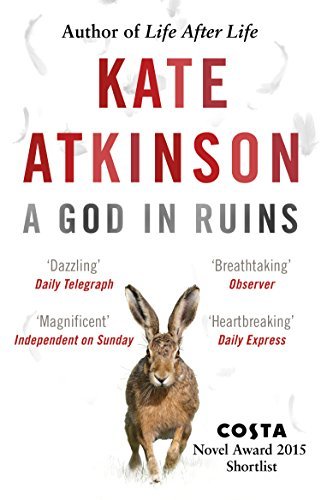
 It’s been nearly three years since I read my first Kate Atkinson novel, Life After Life, in which Ursula Todd lives her life over and over again, each new life giving her a chance to alter decisions and mistakes made in the one before. Since then I’ve been catching up with Atkinson’s Jackson Brodie mystery series (I only have one of those left to read) but last week I decided it was time to pick up her latest novel, A God in Ruins, and reacquaint myself with the Todd family.
A God in Ruins is not exactly a sequel to Life After Life – it can be better described as a ‘companion novel’ – and both do stand alone. There are some similarities between the two novels, but there’s also a big difference. While Life After Life follows several different versions of the same person’s life, A God in Ruins concentrates on someone who lives just one life: his name is Teddy Todd and he is Ursula’s younger brother.
Teddy’s story is told in non-chronological order, so that a chapter about his childhood is followed by one set towards the end of his life and then another describing his time as a World War II bomber pilot (there are several wartime chapters interspersed throughout the novel). We also get to know Teddy’s wife, Nancy (who was literally the ‘girl next door’), their daughter, Viola, and grandchildren, Sunny and Bertie. The stories of each of these people unfold gradually, chapter by chapter, and the non-linear timeline means that we are sometimes given hints of something that has happened in the past or will happen in the future but have to wait until later in the book for a revelation. Flashbacks and ‘flashforwards’ often happen in the middle of a paragraph or even a sentence, which I found intriguing rather than confusing.
I enjoyed A God in Ruins but didn’t love it as much as I loved Life After Life, maybe because it felt less innovative without the device of one person living many different lives. Still, many of the same themes are here: life and death, fate and the ways in which our actions in the present can have big consequences in the future, and, of course, the effects of war. I mentioned that there are several chapters on Teddy’s experiences piloting a Halifax bomber during the war. I didn’t initially find these sections very engaging (in the words of Nancy, Teddy’s wife, “Let’s talk about something more interesting than the mechanics of bombing”), but eventually I was drawn in and started to enjoy those chapters as much as the others.
My favourite thing about Kate Atkinson’s writing is the way she creates characters who feel so real and believable – even if some of them are not easy to like, they are still interesting and fully developed. Viola, for example, is a cold and bitter person, unable to offer her children any love and affection, and as her father grows older, resenting every minute of the time she has to spend caring for him. At first it seems that there is no reason for Viola’s selfish behaviour, but later in the novel we learn of something that happened in her childhood that could provide an explanation.
I also liked all the little literary references Atkinson slipped into the story. I was particularly pleased to see that Teddy was an Anthony Trollope reader! As for the ending of the book, I think it’s probably best if I say nothing at all – other than that it’s one of those endings people will either love or hate. Personally, I thought it was perfect; it changed the way I felt about the entire book and left me with a lot to think about, which is what all good novels should do.




 She Reads Novels