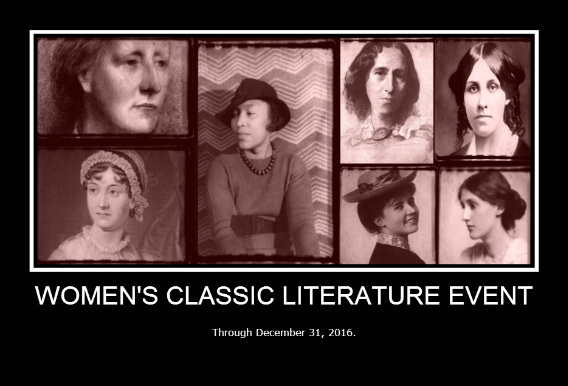
 From now until December 2016 I am participating in the Women’s Classic Literature Event hosted by The Classics Club. You can read more about it in this post (which includes my answers to the introductory survey) and I have already made a good start, having read My Ántonia by Willa Cather a few weeks ago. I’m hoping to read lots of other women’s classics over the next year – and as historical fiction is my favourite genre, I’m particularly interested in reading historical novels by classic female authors.
I have already read several, many of which I have reviewed on my blog, and I thought I would list some of them below.
 George Eliot
Most of George Eliot’s novels were set in her recent past, so not quite contemporary but not truly historical either (Middlemarch, for example, was published in the 1870s but set in 1829-32). She did, however, write one novel set in Florence during the Italian Renaissance – this was Romola, which I read earlier this year. It wasn’t an easy read but I did enjoy it.
Daphne du Maurier:
Du Maurier is usually associated with gothic suspense, but many of her novels are historical fiction. The King’s General is set in seventeenth century Cornwall during the English Civil War and follows the story of Honor Harris and her relationship with the King’s General in the West, Richard Grenvile. Jamaica Inn, one of du Maurier’s best known novels, is set in the early 1800s and is an atmospheric story of smugglers, shipwrecks, and the inhabitants of a lonely inn on Cornwall’s Bodmin Moor. Hungry Hill is a family saga covering five generations of the Brodrick family who live at Clonmere Castle in Ireland and whose fortunes revolve around the copper mine on Hungry Hill.
And there are others: The House on the Strand is a dual timeline novel in which part of the action takes place in the 14th century and The Glass-Blowers is based on the lives of du Maurier’s own ancestors who lived through the French Revolution. Mary Anne, which I haven’t read yet, is set during the Regency, and Frenchman’s Creek, also still to be read, is set during the reign of Charles II.
 Madame de Lafayette
Published in 1678, The Princess of Cleves is thought to be the first French historical novel. It is set between 1558 and 1559 at the court of Henri II. I found the writing quite dry (although that could be the fault of the translation) but I loved the portrayal of the French court. It’s worth reading if you’re interested in French history or the early development of the novel form.
Elizabeth Gaskell
Sylvia’s Lovers is set in the 1790s in Monkshaven (a fictional English town based on Whitby, North Yorkshire). The story of Sylvia Robson and the two men who hope to marry her is played out against a backdrop of the Napoleonic Wars. I haven’t read all of Gaskell’s other books yet, but I think this is the only historical one. It’s also, in Gaskell’s own words, “the saddest story I ever wrote”.
 Baroness Emmuska Orczy
Baroness Orczy wrote many historical fiction novels, the most famous being The Scarlet Pimpernel, her adventure novel set during the French Revolution. I have tried two of the many Pimpernel sequels (there are at least ten, plus some prequels and short story collections) but so far they haven’t lived up to the original.
Virginia Woolf
The only Virginia Woolf novel I have read so far is Orlando. It could be described as historical fiction, though not in the conventional way: the protagonist, Orlando, lives for four hundred years and experiences the Elizabethan era, the Great Frost of 1608, the Restoration, the 18th century, and the Victorian period. I found this book a lot easier to read than I’d expected.
Margaret Mitchell
It’s been years since I last read it, but this list wouldn’t be complete without Gone With the Wind, Margaret Mitchell’s classic story of Scarlett O’Hara and Rhett Butler set in the American South during the Civil War.
***
These are all I can think of at the moment, though I’m sure I’ve probably read more. There are plenty of other books that I consider to be ‘classic historical fiction’ but maybe not ‘classics’ in the usual sense of the term.
Can you think of any other historical fiction novels by classic women authors? Just to clarify, the Classics Club’s definition of a classic is a book published before 1960 (although this is just a guideline and would rule out some of the du Maurier titles I’ve mentioned above). I do already have Kristin Lavransdatter by Sigrid Undset on my list to be read, but I would love some more suggestions.
And for those of you who are also taking part in the Women’s Classic Literature Event, I hope I’ve given you some ideas to consider!


 She Reads Novels