Watch the Wall, My Darling by Jane Aiken Hodge

Watch the Wall My Darling - Jane Aiken Hodge I had never heard of Watch the Wall, My Darling until it started appearing in my recommendations on Goodreads, and with such an intriguing title I knew it was a book I would have to consider reading eventually!

First published in 1966, Watch the Wall, My Darling is a gothic romantic suspense novel set on the south-east coast of England during the Napoleonic Wars. As the story begins, Christina Tretton, a young American woman whose father has recently died, is returning to her family’s ancestral home, Tretteign Grange. After encountering a gang of smugglers on the journey, Christina arrives at the Grange – also known as the Dark House – and is met by her Aunt Verity, her invalid grandfather and her handsome cousin, Ross.

Settling into her new home, Christina quickly takes control of the management of the house and the servants. Impressed with his granddaughter, old Mr Tretteign decides to change his will and leave the Grange to Christina – on the condition that she must marry either Ross or her other cousin, Richard. Christina insists that she has no intention of marrying either of them, but her two cousins, who each have their own reasons for wanting the Grange, have other ideas. Despite herself, she finds herself drawn to Ross, but soon discovers that he is involved in something very dangerous – and with England expecting a French invasion at any moment, the lives of everyone at the Dark House could be at risk.

I enjoyed this book – it was a fun, undemanding read with plenty of adventure and intrigue and a touch of romance. I kept being reminded of Daphne du Maurier’s Jamaica Inn, Georgette Heyer’s Cousin Kate and Mary Stewart’s Nine Coaches Waiting, though this is not as well written or memorable as any of those, in my opinion. The historical background didn’t feel particularly strong and Christina felt more like a woman of the 1960s than the 1800s, while I didn’t find Ross quite as fascinating and attractive as she did. The introduction of two new characters towards the end of the book didn’t really add anything to the story either. Still, with smugglers, soldiers and spies, a crumbling abbey believed to be haunted, family secrets and an inheritance to be decided, there was more than enough to keep me happy!

And if you’re wondering, the title comes from a poem by Rudyard Kipling called A Smuggler’s Song:

“Five and twenty ponies
Trotting through the dark
Brandy for the parson,
‘Baccy for the clerk;
Laces for a lady; letters for a spy,
And watch the wall, my darling, while the gentlemen go by!”

After the Sunday Papers #15

newspaper-clip-art-4 Well, this week was a lot more stressful than I’d expected, unfortunately! I was driving home from work on Wednesday when I was hit from behind while waiting at traffic lights. Nobody was injured but the back of my car was quite badly damaged – and to make things even worse, it’s a new car that I’ve only had for a week! I couldn’t believe it! The other driver was entirely at fault and her insurance company have arranged for the repairs (which could take up to two weeks) and provided me with a courtesy car, but as you can probably imagine I didn’t have much time or enthusiasm for reading and blogging for a couple of days.

Madame Bovary Readalong Things have settled down now, so I’m starting to catch up and am looking forward to telling you about some of my recent reads, including Eva Stachniak’s Empress of the Night, a novel about Catherine the Great, and Watch the Wall, My Darling by Jane Aiken Hodge, a great romantic suspense novel from the 1960s. I’m also taking part in a readalong of Madame Bovary by Gustave Flaubert this month, hosted by ebookclassics and Cedar Station. I have never read it before and have had a copy on my shelf for a while so this seemed like a good time to read it. I started it last night and have enjoyed what I’ve read so far.

I noticed on Friday that the shortlist for this year’s Walter Scott Prize for Historical Fiction has been announced. I always follow the progress of this prize with interest as historical fiction is my favourite genre. The books on the shortlist are:

Life After Life by Kate Atkinson
The Luminaries by Eleanor Catton
Harvest by Jim Crace
Fair Helen by Andrew Greig
An Officer and a Spy by Robert Harris
The Promise by Ann Weisgarber

The only one of these I have read is Life After Life, though Fair Helen sounds great and I’ll probably read The Luminaries eventually too. The winner will be announced in June.

How has your week been? I hope it’s been better than mine!

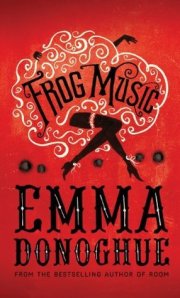
Frog Music by Emma Donoghue

Frog Music This is the second book I’ve read by Emma Donoghue – the first was Room, which I enjoyed, and since then I’ve been wanting to try one of her historical fiction novels. This new one, Frog Music, is set in San Francisco in 1876 and is based on a true crime story.

Twenty-four-year-old Blanche Beunon, once a star of the Cirque d’Hiver in Paris, is now a dancer in a San Francisco burlesque club. She lives in the city’s Chinatown with her lover, Arthur Deneve, and his friend – and former partner on the flying trapeze – Ernest Girard. One week in August, two newcomers enter their little circle. One of these is P’tit, Blanche and Arthur’s baby boy, reunited with his parents after a year of separation. Blanche has rarely even thought about her baby during his absence, but now she discovers what being a mother really means.

The other new arrival is a woman called Jenny Bonnet, just released from jail after being arrested for the crime of dressing in men’s clothes. Jenny, who makes her living from catching frogs and selling them to French and Chinese restaurants, is like nobody else Blanche has ever met and makes her think differently about herself and her life. But when Jenny is shot dead, Blanche is convinced that she herself was the intended victim. Can she find the murderer before he kills again and before she loses P’tit again forever?

The real life murder case on which Frog Music is based remains an unsolved crime to this day, but the solution Donoghue provides is believable and consistent with what we have learned about the personalities and motives of the characters involved. The author also includes a detailed Afterword in which she explains which of the characters and events in the story are factual and which are purely fictional.

While there are some very unpleasant, unlikeable people in this novel, I thought the central character, Blanche, was wonderful. Her personality is a mass of contradictions: she’s tough yet vulnerable, intelligent yet naïve, self-absorbed yet sensitive. She’s such a well drawn character and felt completely real. I loved her and desperately wanted her to find some real happiness. Her story is so sad at times – I don’t want to say too much, but the circumstances surrounding the reappearance of P’tit are shocking and heartbreaking; I found that part of the book quite painful to read. As for Jenny, she remains a secretive and mysterious character throughout the novel. It is only towards the end of the book that we (and Blanche) begin to see beneath her protective outer shell and are finally given some glimpses of the real Jenny Bonnet.

The sense of time and place is very strong. I’m not sure I’ve read a book set in 1870s San Francisco before and I found it a vivid, atmospheric setting. The action takes place during both a heat wave and an epidemic of smallpox and both have an impact on Blanche’s story. Another interesting element of the novel is the role of music. Many songs and rhymes are quoted from in the book and information on each of them is given in an appendix. I thought this really added something to the story, helping to provide context and historical background. As Blanche and the other main characters are French and often use French slang, there is a glossary provided at the back of the book too, if you need help in translating any unfamiliar words.

My only criticism of this book is that the way the story is structured could cause confusion. It follows two time periods – one in Blanche’s present, describing Jenny’s murder and its consequences; the other flashing back to the beginning of their friendship a month earlier. Gradually the two storylines converge until they are only a day or two apart and at this point it becomes slightly difficult to follow the chronological sequence of events. Sometimes we are given the date, but not always, so it’s not immediately clear which thread of the story we are reading.

One other thing I should mention is that as Blanche is an exotic dancer there are some quite graphic descriptions of her work. It was maybe a bit excessive, but I could appreciate that it was all part of who Blanche is and it would have been hard to convey the realities of her life without being explicit at times.

Frog Music is not a book that will appeal to everyone (though you could say the same about any book, I suppose) but I thought it was great and having enjoyed this one and Room I’ll be looking for more of Emma Donoghue’s books soon.

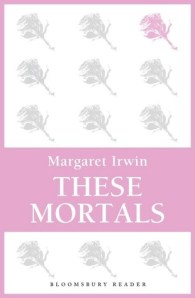
These Mortals by Margaret Irwin

These Mortals I wasn’t familiar with Margaret Irwin until a few months ago when Jane wrote about one of her other books, Still She Wished for Company. It sounded intriguing, so when I had the opportunity to read this one, which has been released this month as an ebook by Bloomsbury Reader, I decided to investigate.

These Mortals is a fantasy novel originally published in 1925, taking its title from Shakespeare’s A Midsummer Night’s Dream (“Lord, what fools these mortals be”). But it was another of his plays – The Tempest – that I was reminded of when I began to read, because like Miranda in The Tempest, the heroine in this book is the daughter of a powerful magician. Her name is Melusine and she has grown up isolated from human society, living with her father, the Enchanter Aldebaran, in his palace by the sea.

Although Melusine loves her three best friends, the Cat, the Raven and the Snake, she longs to meet other human beings like herself. One day she makes a magic ship from a shell, a rose petal and a silver pin and uses it to sail across a moonbeam to the human world beyond. Arriving in the kingdom of the Emperor Eminondas, Melusine begins to learn the ways of mortals and discovers what it means to fall in love.

This book is written in the style of a fairy tale, complete with princes and princesses, shipwrecked kings and woodcutters’ daughters, poets, magicians and talking animals. It’s all very dreamlike and it feels timeless. There are elements of other classic myths and legends too, particularly the legend of the water fairy, Melusina, who married a mortal man, Count Raymond of Poitou.

The only problem with this fairy tale atmosphere is that I felt there was a distance between the reader and the characters; they didn’t feel like real people and apart from Melusine herself, they didn’t come to life at all. I found it difficult at first to distinguish between the various members of the Emperor’s court (Princess Blanchelys, Lady Valeria, Sir Oliver and Sir Diarmid) and to remember who was in love with who. I was much more interested in Melusine’s personal story. I particularly enjoyed the scenes where she uses her magical powers – and I found myself looking forward to any appearances of the Cat, the Raven and the Snake!

There’s also some humour in the story, as there are so many aspects of human life of which Melusine has no knowledge or understanding.

“Tell me,” she said, “of that game I have heard you speak of to others, an ancient solitary game that is played with clubs by half-naked savages in the northern hills. There seems so much to tell of that game that it must surely be more exciting than any tale of love or perilous adventure.”

“Ah, there’s nothing like a good game of golf,” he said.

I suspect this was probably not the best Margaret Irwin book for me to have started with, but it was an unusual and entertaining novel and I still enjoyed it. It’s a very short book, but long enough for the story that is being told. Now I’m interested in trying some of the historical novels the author is more famous for.

Thanks to Bloomsbury for providing a review copy via NetGalley

The Crimson Ribbon by Katherine Clements

The Crimson Ribbon The Crimson Ribbon is a new historical fiction novel set during the English Civil War. As the story begins in 1646, our narrator, Ruth Flowers, is a servant in the household of Oliver Cromwell. When her mother is hanged for witchcraft, Ruth is forced to flee to London to the home of Master Poole and his daughter, Elizabeth (Lizzie), friends of Cromwell’s mother. On the journey she meets a former Parliamentarian soldier, Joseph Oakes, who has deserted after the Battle of Naseby and is hoping to become a printer’s apprentice so that he can continue the fight using words instead of violence.

Still haunted by her mother’s death, Ruth finds it difficult to trust Joseph and separates from him when they reach London, expecting never to see him again. As she settles into her new life at the Pooles’ house, Ruth becomes captivated by the beautiful Lizzie Poole and is delighted to find that Lizzie returns her love. But when Lizzie’s religious and political beliefs draw her into the conflict between King Charles I and Oliver Cromwell, the lives of both women could be in danger.

Ruth is a fictional character and her story is imagined by the author, but Elizabeth Poole was a real historical figure who really did claim to have visions and argued against the execution of King Charles I. It seems that there is not a lot of information available about Elizabeth’s life and she eventually disappears from historical records, allowing Katherine Clements to come up with an interesting conclusion to her story. In her author’s note she does explain where the story has moved away from the known facts about Lizzie.

This book is set during a fascinating period of history and one that I wish more historical fiction authors would write about. Ruth’s relationships with Lizzie, with Joseph and with Oliver Cromwell form the basis of the novel, but other subjects and themes are included too, particularly witchcraft and the witch hunts that were so common in seventeenth century England. These were superstitious times and anyone who led an unconventional life could find themselves under suspicion. Through Joseph we also learn a little bit about army life and what happened at Naseby, while Lizzie’s storyline involves prayer meetings and the writing of religious pamphlets.

As the story is narrated by Ruth in the first person, I felt that I got to know her better than any of the other characters. However, I didn’t like the character of Elizabeth Poole and this made it hard for me to understand Ruth’s love for her. It frustrated me that she continued to remain so devoted and loyal, despite the way Lizzie often treated her. Apart from this, my only problem with the book was that it was written in the present tense which I almost always dislike, although I can understand the reasons for choosing to write in that way – it does give the story a sense of immediacy and intimacy.

I did enjoy The Crimson Ribbon and as this is Katherine Clements’ first novel I will be looking out for news of a second!

Thanks to Headline for sending me a review copy of this book.

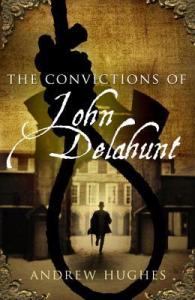
The Convictions of John Delahunt by Andrew Hughes

The Convictions of John Delahunt Imagine you’re a poor student at Dublin’s Trinity College in the 1840s. You’re newly married and living with your wife in a squalid tenement, cut off from friends and family. The future looks bleak, so when the authorities at Dublin Castle suggest that you become an informer, it seems to be the perfect solution. You will be rewarded well for any information you can give them leading to a conviction…and if you could just manage to witness a few murders, your money troubles could be over!

This is the situation in which our narrator finds himself in this wonderfully moody and sinister historical crime novel, The Convictions of John Delahunt. As the novel opens, John is sitting in a prison cell awaiting his death. We’re not sure exactly what he has done, except that it appears to involve the murder of a child. As he begins to write his final testimony, we are taken back to the origins of John’s dangerous career as an informer and discover how and why this young student of natural philosophy has been sentenced to hang.

Andrew Hughes is also the author of a non-fiction book about the residents of Dublin’s Fitzwilliam Square, Lives Less Ordinary, and so he has been able to draw on his knowledge of the city’s history to make John Delahunt’s world feel authentic and real. Because of the circles in which Delahunt moves, the focus is on the darker side of society – workhouses, grave robbing, illegal abortions, rat-killing and laudanum addiction are all explored. Dublin’s streets and alleys, taverns and parks, courtrooms and drawing rooms are all vividly described and although the language the author uses is modern enough to be accessible and easy to read, it never feels out of place with the Victorian setting.

John Delahunt himself is an intriguing narrator, though not always entirely reliable. He is certainly not easy to like – one of his first actions in the book is to tell a lie to the police that leads to a friend being found guilty of a crime he didn’t commit – yet I could still feel for him when things didn’t go according to plan and when he saw his life beginning to disintegrate around him.

A large part of John’s story revolves around his relationship with his wife, Helen, who is another interesting character – although we never get to see things from her perspective as John is narrating in the first person. At first Helen seems to be on the same wavelength as her husband, attending a hanging with him and even helping him to compile a list of friends, family and neighbours to inform on. Later in the book she experiences a personal tragedy and after this she seems to undergo a change, though because we only see her through John’s eyes, her true thoughts and emotions are not very clear.

I loved this dark and atmospheric book and was completely gripped by John Delahunt’s fascinating story (based on true events, by the way). A word of advice to potential readers – don’t start reading it in your lunch break at work or in bed when you need to be up early the next day, as you may find that you really don’t want to put it down!

Thanks to the publisher for providing a review copy via NetGalley

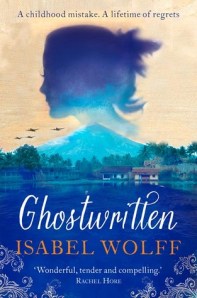
Ghostwritten by Isabel Wolff

Ghostwritten As a ghostwriter, Jenni’s job involves writing books for people who are unable or unwilling to do the writing themselves. Many of her projects include celebrity biographies and self-help guides, but some of her clients are ordinary people with extraordinary tales to tell. At a friend’s wedding she is introduced to a man who tells her about his mother, Klara, a Dutch woman who survived the Japanese internment camps in Java during World War II. Klara has said very little to her family about her wartime experiences, but as she approaches her eightieth birthday she has decided that the time has come for her story to be told. Intrigued, Jenni agrees to visit Klara at her home in Cornwall and help to put her memories down on paper.

The only problem with this new project is that the little Cornish town of Polvarth where Klara lives is a place that holds traumatic memories for Jenni, but although she is not very happy about returning to Polvarth, the temptation of hearing Klara’s story is impossible to resist. After meeting Klara and listening to her talk about her childhood, her family’s rubber plantation in Java, and the unimaginable horrors of the internment camps, Jenni is both moved and inspired. She has been going through a difficult time with her boyfriend, Rick (he wants children and she doesn’t), and she is still haunted by her own tragic past – but being with Klara gives her the strength to start facing up to her problems.

I enjoyed Ghostwritten and while I was initially drawn to it because of the Java storyline, I thought the balance of the contemporary and the historical was just right. I did prefer Klara’s storyline to Jenni’s, but ghostwriting sounds like an interesting career and I loved reading about Jenni’s work. I was also curious to find out more about the secret Jenni had spent her whole life trying to hide and her connection with a little girl called Evie who visited Polvarth years earlier in 1987.

Klara’s story, though, was fascinating, especially as I knew very little about Japanese internment camps and what conditions were like for people in Java during the war. As you would expect, some of Klara’s tales of the suffering she and the other prisoners experienced are quite upsetting to read. There are descriptions of what it was like being packed onto an overcrowded train for twenty-eight hours to be transported from one camp to another, living crammed into a house with up to one hundred other women and children, being made to stand outside in the relentless heat of the sun for hours with no shelter and nothing to drink, and worst of all finding yourself separated from a parent, a spouse or a child with no idea where they are and whether they are alive or dead.

I’ve never read anything by Isabel Wolff before, but looking at her previous work it seems that this book is a bit different from her others. I was so impressed by it. It’s not just a book about ghostwriting or Japanese internment camps, but also a book about friendship and love, about learning to forgive and to move on with life.

Ghostwritten will be published in the UK on 27th March 2014 and I hope it will be available elsewhere very soon.