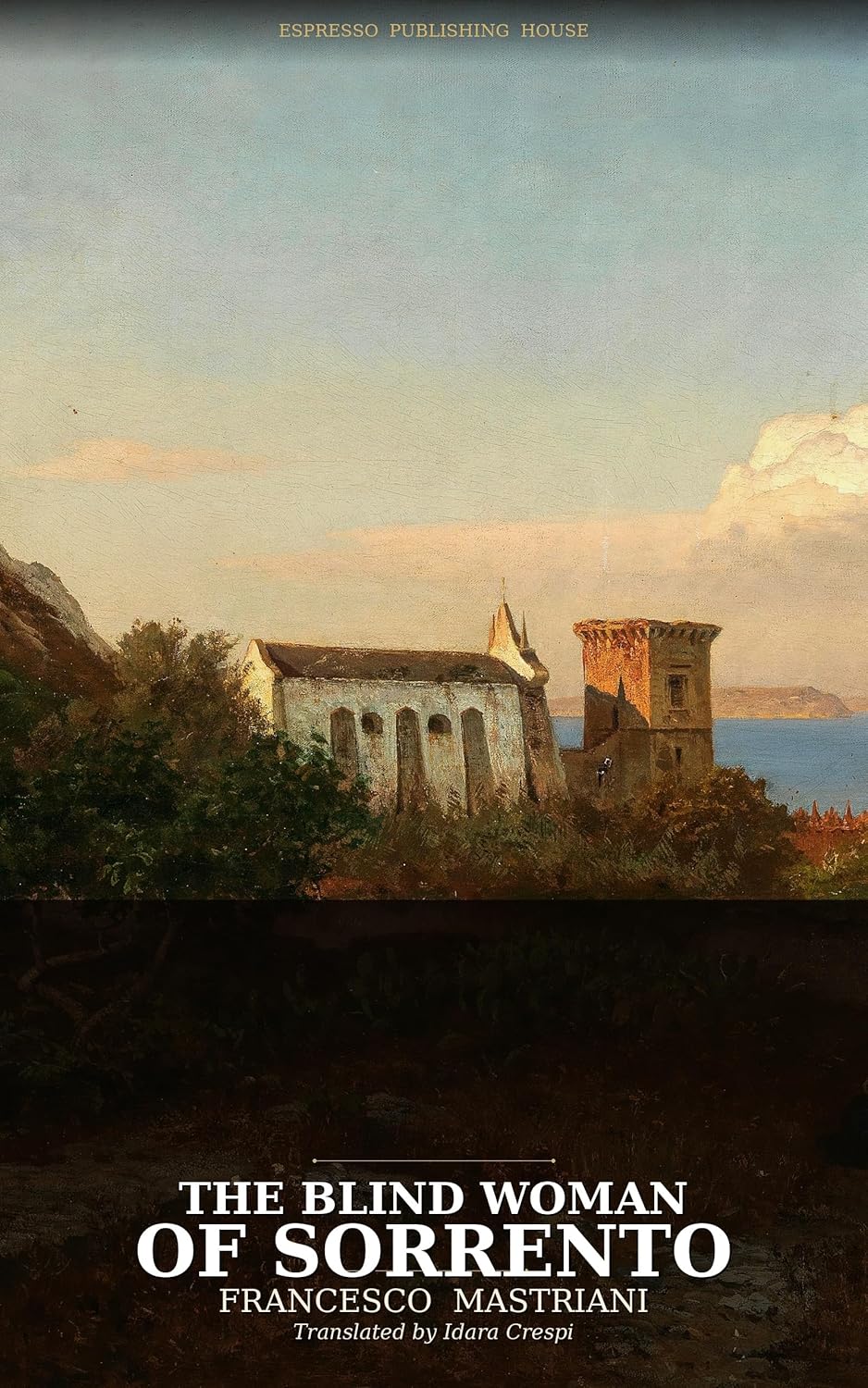
 Translated by Idara Crespi
Francesco Mastriani is a completely new author for me – I’m sorry to say I hadn’t even heard of him until I was offered a review copy of his 1852 novel, The Blind Woman of Sorrento, but it seems he was a very prolific Italian writer, producing over two hundred works of fiction during the 19th century. Espresso Publishing House, an imprint focusing on neglected foreign-language novels, have made this one available in its first modern English translation.
The ‘blind woman’ of the title is Beatrice, daughter of the Marchese di Rionero. She wasn’t born blind, but at the age of three she witnessed the brutal murder of her mother and lost her sight due to the shock and trauma she suffered. Now, seventeen years later, an English doctor, Oliviero Blackman, has arrived in Sorrento and believes he can help her to see again. Unknown to Beatrice, however, Dr Blackman is not all he appears to be. Who is he and does he have another motive for promising to restore Beatrice’s sight?
We also get to know Gaetano Pisani, the son of the man who killed Beatrice’s mother all those years earlier. Gaetano’s life has also been affected by the events of that terrible night and he can’t escape the shame and guilt of knowing that his father was hanged for murder. When he crosses paths with his father’s accomplice and gets his hands on a box of jewels stolen from the murdered woman, it seems that he may still have a chance to find redemption.
I don’t want to say much more about the plot as I would prefer future readers to discover all the twists and turns of this fascinating novel for themselves, as I did. The publisher compares it to Wilkie Collins, which is a good comparison as this book does share many of the elements you would often find in Collins’ work and other 19th century sensation novels such as murders, stolen jewels, family secrets, revenge plots and hidden identities, as well as lots of melodrama! I was particularly reminded of Poor Miss Finch, which also deals with the subject of blindness in a similar way (although that book was published twenty years after this one and the plot itself is quite different). I also think if you’ve enjoyed books by authors like Alexandre Dumas or Rafael Sabatini, there’s a good chance you would enjoy this one too.
Although I would have preferred Beatrice to have been a stronger character (she has a tendency to faint and swoon), I did find it interesting to see how Mastriani writes about her blindness. For a book published in the 1850s, he handles the topic quite sensitively, never implying that she’s any less intelligent because of her condition – on the contrary, she is more observant and perceptive than most people, with her other senses being heightened to compensate. Gaetano is also a complex character: although his actions and motives are sometimes questionable, I could never really think of him as a villain, but at the same time he’s not entirely heroic either.
I found Idara Crespi’s translation very clear and easy to read and I appreciated the translator’s note at the beginning, explaining why certain words and spellings had been chosen. There’s also an introduction, which you can read before or after the novel itself (I got more out of it reading it afterwards), a glossary and some notes on historical Naples. Naples was Mastriani’s own place of birth and both that city and nearby Sorrento are vividly brought to life through his descriptions. I thoroughly enjoyed reading this book and was entertained by it from beginning to end.


I do so LOVE this explosion in translated works – especially Classics from other countries/cultures that we’d never experience (or have heard of) otherwise. More of them I say!
Yes, I agree! I seem to have read very few Italian novels so it was good to have a chance to read this one.
I’m adding this to my next classics club list but also thanks for the link to Espresso, very useful!
It’s always good to find publishers who are bringing forgotten classics back into print!
Maybe a candidate for my next Classics Club list.
Yes, it would be perfect.
Glad you enjoyed this one, Helen. You know I love Alexandre Dumas, so good chance I would like this too. 😊
It definitely reminded me of Dumas at times, as well as other 19th century writers. I’m glad it’s been brought back into print.
So glad you enjoyed it. It did feel very well translated, but at this moment in my life, I had a hard time with the style of the book, so alas had to DNF it
Sorry you didn’t enjoy this one. I thought it was entertaining, but I can understand why not everyone would like the style!