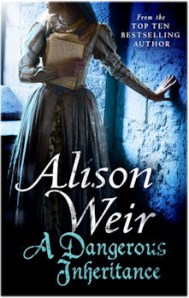
 The disappearance of the ‘Princes in the Tower’ (twelve-year-old Edward V of England and his younger brother Richard, Duke of York) remains a mystery to this day. Some believe that they were murdered by their uncle, Richard III, some suspect Henry VII or the Duke of Buckingham, and others prefer to think that one or both of the Princes managed to escape. My fascination with this mystery leads me to want to read everything I can find about it, even books like this one, written by an author whose views on the subject are entirely different from mine.
Alison Weir is an author of both historical fiction and non-fiction and A Dangerous Inheritance is one of her works of fiction. I had enjoyed a previous novel of hers, Innocent Traitor, which told the story of Lady Jane Grey, so I thought I would try this one despite knowing that Weir does not like Richard III at all and I was unlikely to agree with any conclusions she might come to.
Actually, this novel is only partly about Richard and the Princes; at least half of the book is set eighty years later and follows the story of Katherine Grey, the younger sister of the ‘nine-day queen’, Lady Jane Grey. After Jane’s very brief reign as Queen of England comes to an end when she is deposed by Mary I and beheaded, Katherine herself moves one step closer to the throne. To her disappointment, Mary is followed by Elizabeth I, who refuses to acknowledge Katherine as her heir and treats her badly. When Katherine marries the man she loves against Elizabeth’s wishes, she finds herself imprisoned in the Tower of London.
Katherine Grey’s story alternates with the story of another Katherine – Katherine Plantagenet (referred to as Kate to avoid confusion), an illegitimate daughter of Richard III. Kate loves her father and refuses to believe that he had any involvement in the disappearance of the two young princes. After Richard is defeated at Bosworth in 1485 and Henry Tudor takes his place on the throne, Kate’s loyalty to her father and her determination to clear his name could be considered treason. Several generations later, Katherine Grey discovers some letters written by Kate, learns of Kate’s connection with the princes and decides to continue investigating the mystery from within the Tower.
On the subject of the princes, I do find it fascinating that different authors and historians can begin with the same facts and come to entirely different conclusions! As nothing has ever been proven either way regarding the disappearance of the princes and the other controversies surrounding Richard III, I’m happy for it to remain a mystery. Having read quite a lot on the subject over the last few years, I personally find the pro-Richard viewpoint much more convincing than the anti-Richard one, but I can accept that we’ll probably never know the truth and that everyone is entitled to their own opinion.
For Alison Weir, although she states in her author’s note that she likes to keep an open mind, there is clearly no mystery: Richard was guilty of everything. As I was familiar with her views before beginning the book, I suppose I shouldn’t really complain! I was disappointed, though, that the main source Katherine uses in her investigations appears to be Thomas More (who was only seven years old at the time of Bosworth, is thought to have relied upon Richard’s enemy, Archbishop Morton, as his own primary source, and wrote his histories during the Tudor period, when it was obviously to his advantage to please the Tudor monarchs by discrediting their predecessors). However, as Weir explains in the author’s note, she could only use sources that would have been available to Katherine in the mid 16th century.
I did like the fact that this was a dual time period novel where both time periods were historical, rather than one being set in the present day, though I did sometimes feel that I was reading two separate stories that didn’t really belong in the same book. Apart from the fact that both main characters were Katherines and both suffered from being close to the throne, there was very little to link the two. It’s only in the final 100 pages of this 500-page book that Katherine Grey begins to investigate the mystery of the princes and parallels start to be drawn between the two storylines – some of them of a paranormal nature, which you may or may not appreciate!
Of the two, I enjoyed the Katherine Grey storyline the most. I found Katherine a much more engaging character, which is probably not surprising as she narrates in the first person while Kate doesn’t. Also, there is almost no historical information available on Kate Plantagenet, which meant that her sections of the book were largely fictional. I couldn’t help feeling that Katherine Grey’s life story would have been interesting enough to form the basis of a whole novel on its own without the addition of a second, imaginary storyline and without squeezing the Princes in the Tower into the same book as well.
Have you read anything about the Princes in the Tower? Who do you think was responsible for their disappearance?





 She Reads Novels