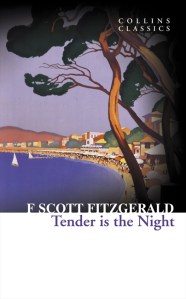
 Like many people, my first encounter with Fitzgerald was The Great Gatsby, but while I remember being impressed with his writing, I didn’t love the book the way I know so many other readers do. That must have been seven or eight years ago and I haven’t read any of his other books since then (apart from his short story, The Curious Case of Benjamin Button, which I enjoyed) so I decided it was time to try another one to see whether The Great Gatsby, despite being his most popular book, might not have been the best place for me to start.
Tender is the Night, published in 1934, is the story of the disintegration of the marriage of psychiatrist Dick Diver and one of his former patients, Nicole Warren. The novel is divided into three sections and the first is told from the perspective of Rosemary Hoyt, a young American actress spending some time in the south of France with her mother while she recuperates from an illness. One morning she goes down to the beach where she meets Dick and Nicole for the first time. Immediately attracted by their glamorous lifestyle and personal charm, Rosemary becomes captivated by both Divers.
In the second section of the book we move back in time to the beginning of Dick’s relationship with Nicole at a psychiatric clinic in Switzerland. By the time the story returns to the present again, both the reader and Rosemary can see that the Divers’ marriage is not as perfect as it first appeared. The rest of the novel follows the breakdown of their marriage as Nicole grows stronger and Dick’s life goes into a decline.
After I got past the wonderful opening scenes set on the beach, I quickly became bored. I finished the first section with a growing sense of dread at the thought of having to write a negative review of a book that I was sure must be a beloved favourite of so many other people – or worse still, having to abandon it. I’m glad I persevered because it turned out to be only the first section of the book that was a problem and after the focus switched to Dick and Nicole in the second and third parts, I found the story much more engaging.
I know there is another revised version of this book that rearranges the story chronologically and I can understand the reasoning behind that. I’m sure I would have found it much easier to get into the book if it had started with Dick and Nicole instead of Rosemary. However, I think taking Rosemary’s section away from the beginning would remove the sense of mystery – the fact that we first see the Divers through Rosemary’s youthful and naïve eyes means there is more impact when we discover that there’s actually much more to their marriage than meets the eye.
I’m aware that Tender is the Night is partly autobiographical and inspired by Fitzgerald’s own life with his wife, Zelda, who also suffered from mental illness. As I’ve never had enough interest in the Fitzgeralds to have read about their lives in any depth, the autobiographical aspect of the story didn’t have a lot of meaning for me, but I could appreciate that he was drawing on his own experiences with Zelda to give his portrayal of Dick and Nicole’s relationship a feeling of authenticity.
However, I’m not sure if I really liked this book any more than I liked The Great Gatsby. It’s a more complex, mature and emotionally moving story, but with both novels I have struggled to fully connect with any of the characters, something that is more important to me than the elegant writing and complex themes. It’s possible that if I was married I might have more understanding of Dick and Nicole – although I couldn’t identify with Rosemary either, so maybe that wasn’t the problem.
I do think Fitzgerald’s prose is beautiful (I loved the descriptions of the French Riviera, Italy and Switzerland) and this is a book that needs to be read slowly so that you can really appreciate the beauty of each sentence. If I’m going to be honest, though, the feeling of boredom I felt near the beginning stayed with me throughout the whole book. I know now that Fitzgerald is never going to be a favourite author of mine, but I’m glad I’ve at least given him a chance by reading two of his novels before coming to that conclusion.






 She Reads Novels