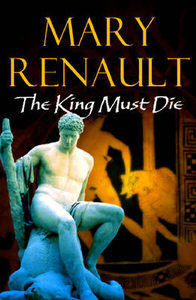
 After my post on The Odyssey last Friday, I’m staying with an Ancient Greece theme again this week – but in the form of historical fiction this time.
Beginning with his childhood in Troizen, The King Must Die tells the story of Theseus, a story which I’m sure will already be familiar to many readers. Theseus lives with his mother but has never known the true identity of his father, believing him to be the god Poseidon. When he succeeds in raising a boulder to reveal his father’s sword, Theseus learns that he is actually the son of Aigeus, the King of Athens, and sets off for Athens to find him. After an eventful journey during which Theseus becomes King of Eleusis, he arrives in Athens and meets his father at last. But when King Minos of Crete demands that fourteen young people are sent to him to train as bull-dancers, Theseus makes the decision to become one of the fourteen…and finds himself facing the Minotaur in the Labyrinth of the Palace of Knossos.
Mary Renault is an author I’ve been wanting to read for a long time and I became even more interested when I noticed that on the back covers of my Vintage editions of the Lymond Chronicles by Dorothy Dunnett, it says that Dunnett’s writing ‘inspires comparisons with Mary Renault and Patrick O’Brian’. I’ve now read some of Patrick O’Brian’s books and enjoyed them (though not as much as Dunnett) so it seemed a good idea to try Mary Renault too. However, I’ve been hesitant because, as I explained in my Odyssey post, mythology and Ancient Greece are not subjects that really appeal to me. It was finally making it to the end of The Odyssey a few weeks ago that gave me the motivation to pick up The King Must Die at last.
I was curious to see how this book could be described as historical fiction, as a story with a plot involving Poseidon and the Minotaur sounded more like mythology to me. Having read the novel, I now understand that The King Must Die is not simply a re-telling of the Theseus myth but a more realistic recreation of his life, portraying Theseus as a real human being rather than a character from Greek mythology. Most of the essential elements of the myth are here, but they are cleverly incorporated into the historical setting and given logical, plausible explanations.
My favourite part of the book was the section describing Theseus’s adventures in Knossos as a bull-dancer, learning new skills and techniques, and bonding with the other members of his team. I also enjoyed learning about the different customs and rituals of the various cultures and communities Theseus visits on his journey, including the Hellenes, the Minyans and the Cretans. There’s a fascinating author’s note at the end of the book in which Mary Renault explains how she was able to link parts of the Theseus legend to historical fact.
While I did enjoy this book, I do feel disappointed that I didn’t love it as much as I had hoped to. There was nothing specific that I disliked about the book or that I could say didn’t work for me; I certainly couldn’t fault the quality of the writing or the amount of research that must have gone into recreating Theseus’s world. It’s probably just that, as I’ve mentioned, I’m not particularly drawn to this subject or setting. I do still want to read the second half of Theseus’s story in the sequel, The Bull from the Sea!


 She Reads Novels