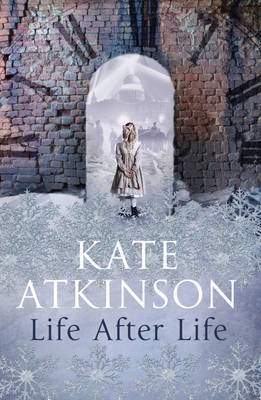
 Do you ever look back on your life and wish you had done something differently? Do you sometimes regret the decisions you’ve made and wonder what would have happened if you’d chosen another path through life? I’m sure we would all answer ‘yes’ to those questions, but unfortunately most of us only have one chance to get things right. But Ursula Todd is not like the rest of us. If things don’t work out the first time, she does have the chance to go back and try again…and again…and again.
Ursula is born one snowy night in February 1910 with the umbilical cord around her neck. Darkness falls and she dies before the doctor has time to arrive. We turn the page and it’s that same night in February 1910 again. This time the doctor is present and she survives, but this is only the beginning of Ursula’s journey through life. Every time she reaches a turning point, she must be sure to make the right decision – otherwise darkness will soon fall once more and Ursula must return to the night of her birth in 1910 and have another attempt.
As we follow Ursula again and again through some of the major events of the twentieth century – including both the First and Second World Wars (there are some very atmospheric scenes set in London during the Blitz) – she slowly grows in wisdom and learns from her previous mistakes, even without being fully aware of what is happening to her or why. Gradually she develops a sort of intuition or déjà vu that allows her to draw on her past experiences, and this is used to particularly good effect in an early sequence of chapters in which she has several attempts at preventing the maid, Bridget, from going to London and catching Spanish flu.
Apart from Ursula herself, the characters who are almost always there throughout every version of the story are the members of the Todd family – Ursula’s brothers Maurice, Teddy and Jimmy, sister Pamela and parents Hugh and Sylvie – and the servants, Mrs Glover and Bridget. Izzie, Ursula’s wild and irresponsible aunt, also plays a significant role in many of the storylines. Other characters come and go; people who are an important part of Ursula’s life in one existence barely appear at all in another and it’s fascinating to see how something as simple as a chance encounter in the street (and the way she reacts to it) could completely alter the course of her future. Sometimes Ursula is unable to change the outcome of a particular event no matter what choices she makes; on other occasions even a small action has huge consequences.
Life After Life is a very clever, complex novel; I was so impressed by it! With such an unusual and complicated plot it could have been a disaster, but it wasn’t; I thought everything worked perfectly and although I found it confusing at first, after the first few chapters I knew I was going to love the book. It’s actually much less repetitive than you might think and fortunately we don’t have to go right through the entire story from the beginning each time Ursula is reborn! I sometimes felt a bit distanced from Ursula, maybe because in each of her lives she makes different choices, has different ambitions and motives, so is not exactly the same person she was in a previous existence – but that didn’t stop me liking her and hoping things would work out better for her the next time darkness fell and she went back to that snowy February night yet again.
This is the first Kate Atkinson book I’ve read and having enjoyed it so much I will be looking out for her other books now. I understand that her earlier novels are very different to this one but I would still like to read them and would welcome any recommendations.


 She Reads Novels