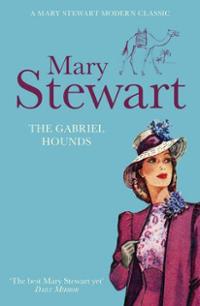
The Gabriel Hounds by Mary Stewart

The Gabriel Hounds The Gabriel Hounds is set in the 1960s and narrated by twenty-two-year-old Christy Mansel who is on a tour of Syria and Lebanon. After unexpectedly meeting her cousin Charles in a street in Damascus, they decide to visit their eccentric Great-Aunt Harriet who has lived near Beirut for several years. ‘Lady Harriet’, as she now calls herself, became a local celebrity after moving into an old, decaying palace by the Adonis River, dressing as a male Arab and modelling herself on the legendary Lady Hester Stanhope. Now over eighty years old, Harriet lives in seclusion with only her servants and her young English companion, John Lethman.

The cousins travel to the palace separately and Christy is first to arrive. She is not made to feel welcome but after a bizarre conversation with the old woman, she is allowed to spend the night there. It quickly becomes obvious that something is not right and when Charles joins her the next day they find that, in typical Mary Stewart fashion, they have stumbled upon a mystery!

Although Christy is in many ways very similar to Mary Stewart’s other heroines – beautiful, confident, brave and intelligent – I never managed to warm to her, or to her cousin Charles either. As Christy herself tells us at the beginning of the story, she and Charles both have “the ‘spoiled’ quality that we were so quick to recognise in one another; a flippant cleverness that could become waspish; an arrogance that did not spring from any pride of achievement but was, I am afraid, the result of having too much too young.” Luckily, though, the fact that I didn’t like the characters very much didn’t stop me enjoying the story and The Gabriel Hounds has joined Nine Coaches Waiting and The Moonspinners as one of my top three Mary Stewart novels so far.

As well as being an exciting page turner, I also loved the atmosphere and the unusual setting. The novel is very dated, I suppose – it’s hard to imagine young tourists like Christy wandering happily through the streets of Damascus and Beirut on their own today – but remembering that the book was written in the 1960s, they sound like fascinating places to have visited and Mary Stewart’s usual beautiful descriptions abound: the beauty of red anemones, the herds of goats grazing on the riverbanks, the scent of jasmine and roses, the fields of sunflowers grown for their oil.

The descriptions of the palace of Dar Ibrahim – with its labyrinth of dusty tunnels and corridors, wall mosaics, cracked marble floors and quiet courtyards – are wonderfully detailed and vivid, especially the scenes set in the old Seraglio, where Christy is given a room for the night. Then, of course, there’s the sound of Harriet’s saluki hounds howling in the distance as Christy explores the palace. Some parts of the book are quite creepy and there are some surprising plot twists too that made me want to immediately turn back and read previous sections again. The story also has what I’m coming to consider one of Stewart’s trademark dramatic, action-packed endings.

The final aspect of this novel I want to mention is the factual element. Lady Hester Stanhope was a real person and if you don’t know anything about her, I can almost guarantee that after reading this book you’ll be completely intrigued and will want to find out more about her amazing life, as I did. Mary Stewart has attributed a lot of Lady Stanhope’s characteristics and habits to the fictional Lady Harriet, including shaving her head and wearing a turban, and only admitting visitors to her room after dark. I’ve discovered that there’s a recent biography by Kirsten Ellis called Star of the Morning: The Extraordinary Life of Lady Hester Stanhope. Has anyone read it or is there another one you would recommend?

Children’s Classics Quiz: The Answers

As promised, here are the answers to the Children’s Classics quiz I posted last weekend. Well done to everyone who participated!

children-reading-1

1. The primroses were over.
Watership Down by Richard Adams

2. Once upon a time, sixty years ago, a little girl lived in the Big Woods of Wisconsin, in a little gray house made of logs.
Little House in the Big Woods by Laura Ingalls Wilder

3. I myself had two separate encounters with witches before I was eight years old.
The Witches by Roald Dahl

4. Roger, aged seven, and no longer the youngest of the family, ran in wide zigzags, to and fro, across the steep field that sloped up from the lake to Holly Howe, the farm where they were staying for part of the summer holidays.
Swallows and Amazons by Arthur Ransome

5. If you want to find Cherry Tree Lane all you have to do is ask a policeman at the crossroads.
Mary Poppins by P.L. Travers

6. It began with the day when it was almost the Fifth of November, and a doubt arose in some breast – Robert’s, I fancy – as to the quality of the fireworks laid in for the Guy Fawkes celebration.
The Phoenix and the Carpet by E. Nesbit

7. “Christmas won’t be Christmas without any presents,” grumbled Jo, lying on the rug.
Little Women by Louisa May Alcott

8. It was seven o’clock of a very warm evening in the Seeonee hills when Father Wolf woke up from his day’s rest, scratched himself, yawned, and spread out his paws one after the other to get rid of the sleepy feeling in their tips.
The Jungle Book by Rudyard Kipling

9. A sudden snow shower put an end to hockey practice.
Many Waters by Madeleine L’Engle

10. The first place that I can well remember was a large pleasant meadow with a pond of clear water in it.
Black Beauty by Anna Sewell

11. The little old town of Mayenfeld is charmingly situated.
Heidi by Johanna Spyri

12. This is a story about something that happened long ago when your grandfather was a child.
The Magician’s Nephew by C.S. Lewis

13. Harriet was trying to explain to Sport how to play Town.
Harriet the Spy by Louise Fitzhugh

14. The tempest had raged for six days, and on the seventh seemed to increase.
The Swiss Family Robinson by Johann David Wyss

15. When Mary Lennox was sent to Misselthwaite Manor to live with her uncle everybody said she was the most disagreeable-looking child ever seen.
The Secret Garden by Frances Hodgson Burnett

16. The Mole had been working very hard all the morning, spring-cleaning his little home.
The Wind in the Willows by Kenneth Grahame

17. “Mother, have you heard about our summer holidays yet?” said Julian, at the breakfast-table.
Five on a Treasure Island by Enid Blyton

18. A tall, slim girl, “half-past sixteen,” with serious gray eyes and hair which her friends called auburn, had sat down on the broad red sandstone doorstep of a Prince Edward Island farmhouse one ripe afternoon in August, firmly resolved to construe so many lines of Virgil.
Anne of Avonlea by L.M. Montgomery

19. The Fossil sisters lived in the Cromwell Road.
Ballet Shoes by Noel Streatfeild

20. When Mrs. Frederick C. Little’s second son arrived, everybody noticed that he was not much bigger than a mouse.
Stuart Little by E. B. White

The Poisoned Island by Lloyd Shepherd

The Poisoned Island In June 1812 the Solander returns to London from a voyage to Tahiti financed by Sir Joseph Banks of the Royal Society. The ship is carrying a cargo of rare and exotic plants destined for the Kew Gardens. But why is Banks so interested in one particular specimen? Could there have been another motive behind the voyage?

When one of the Solander’s crew is found dead under suspicious circumstances, the magistrate John Harriott and Constable Charles Horton of the Thames River Police begin to investigate. Soon more murders take place – and when he learns that all of the victims were members of the crew, Horton must find out how the deaths could be connected with the recent trip to Tahiti.

I’ve been looking forward to this since I read Lloyd Shepherd’s first novel, The English Monster, last year. When you loved an author’s debut novel there’s always the worry that their next book might be a disappointment, but that was definitely not a problem here because I thought The Poisoned Island was even better than The English Monster! Both novels are complete stories in themselves and it’s not necessary to read them in order, but they do have a few things in common. They each explore the darker side of the British Empire, trade and colonialism (it seemed clear to me that one of the messages of The Poisoned Island is a warning against the dangers of exploiting a country for its resources), they both involve the Royal Society, and there are also some recurring characters, including Harriott and Horton of the River Police.

It’s interesting to see how Horton uses methods of crime-solving that in 1812 are new and innovative. Instead of merely watching and observing or relying on witness statements, he is actively investigating the crimes, looking for clues, searching for evidence, interviewing suspects and trying to find motives. This arouses the suspicion and dislike of London’s other police constables and magistrates but Harriott has faith in him and can see the value of his detection methods. Horton’s wife, Abigail, makes a few brief appearances in the novel too and I thought she had the potential to be a great character. The fact that Abigail was so underused was the only thing that disappointed me about this book; she’s intelligent, courageous and with her interest in natural science I had expected her to play a bigger part in the story.

Interspersed with the main storyline are some chapters set in Tahiti (or Otaheite as it was known at the time) following the adventures of a young Tahitian prince and showing us what happened to the island when Europeans first arrived bringing guns, alcohol and disease with them. But while The English Monster was a dual time period novel with alternating chapters set in different centuries, The Poisoned Island concentrates on Horton and Harriott’s London with only a few flashbacks to an earlier time. Although the murder mystery forms the central plot, there’s also a lot of historical detail that helps to bring the Regency period to life. And I enjoyed learning about the Kew Gardens, the process of collecting and studying botanical specimens, and the work of Joseph Banks’ librarian, the botanist Robert Brown. I’m hoping there will be more Harriott and Horton novels, but if not I will still look forward to whatever Lloyd Shepherd writes next.

I received a review copy of The Poisoned Island from the publisher

Aurora Floyd by Mary Elizabeth Braddon

Aurora Floyd When I decided to take part in the recent Classics Club Spin I was delighted when the book chosen for me was Aurora Floyd. I have read two of Mary Elizabeth Braddon’s other books – Lady Audley’s Secret and The Doctor’s Wife – and loved them both, so I had high hopes for this one.

Aurora Floyd, like Lady Audley’s Secret, is a Victorian sensation novel which means you can expect a story filled with mystery, murder and family secrets. Aurora Floyd is a young woman who lost her mother at an early age and was raised by her father, a rich banker. We are told that the lack of a feminine influence has led to Aurora having some unsuitable and unconventional hobbies, including an obsession with dogs and horse racing. It’s this interest in horses that causes Aurora to become involved in a scandal that her father does his best to cover up.

Time passes and Aurora attracts the attentions of two very different men: the handsome, proud Cornishman Talbot Bulstrode and the loyal, loving Yorkshire squire John Mellish (one of my favourite characters). She marries one of them but it’s not long before the secrets of Aurora’s troubled past come back to haunt her. Of course I’m not going to tell you what Aurora’s secret is, and if you really don’t want to know I would also advise not reading the blurb on the back of the Oxford World’s Classics edition. It’s not all that hard to guess, admittedly, but it’s completely unnecessary for the publisher to spoil the story for people in my opinion! Even after the truth about Aurora’s past starts to become obvious, though, there are still more mysteries to be solved and plenty of suspense right until the end of the book.

I’ve mentioned that I liked John Mellish; I also loved Aurora’s uncle, Samuel Prodder, and there are some great villains too, including the governess, Mrs Powell, who is jealous of Aurora, and Steven Hargraves, who is looking for revenge after losing his position as groom for kicking Aurora’s dog. As I’ve already said, Aurora is not a typical Victorian heroine, especially in contrast to the novel’s other main female character, her cousin Lucy, who is portrayed as gentle, feminine and obedient. But while Lucy is presented as the 19th century ideal and Aurora as ‘unwomanly’, the author never sounds disapproving or judgmental of Aurora and she is by far the more interesting and engaging of the two. At first, to maintain the aura of mystery and secrecy surrounding her, we are not allowed into Aurora’s head; everything we learn about her is through either the authorial voice (Braddon, like many Victorian authors, has a habit of talking directly to the reader) or through the eyes of Talbot Bulstrode, John Mellish and various other characters. Later, after her secrets start to be revealed, we get to know her better.

In some ways Aurora Floyd is definitely a product of its time – attitudes towards class, for example, and the offensive terms used to describe Hargraves, who has what we would probably call learning difficulties today – but in other ways, Braddon’s views feel refreshingly modern. I also liked the fact that while many authors would have ended the novel with the heroine’s marriage, in Aurora Floyd the marriage takes place less than a third of the way through the book, when the story is only just beginning rather than ending:

Yet, after all, does the business of the real life drama always end upon the altar-steps? Must the play needs be over when the hero and heroine have signed their names in the register? Does man cease to be, to do, and to suffer when he gets married? And is it necessary that the novelist, after devoting three volumes to the description of a courtship of six weeks duration, should reserve for himself only half a page in which to tell us the events of two-thirds of a lifetime?

It has been a few years since I last read anything by Mary Elizabeth Braddon and I had forgotten how much I like her writing. I still prefer Wilkie Collins’ sensation novels, but Braddon’s are not far behind. I didn’t find Aurora Floyd as exciting and gripping as Lady Audley’s Secret but I think I liked the characters better in this one and am grateful to the Classics Spin for selecting such an enjoyable book for me!

A Quiz for Easter: Children’s Classics

children-reading-1 I was expecting to be posting my third monthly War and Peace readalong update this weekend, but as I’ve found myself behind with this month’s reading I’ve decided to do something different instead. I know ‘first lines’ quizzes are not exactly very original, but I haven’t seen any book bloggers post one recently so I thought this might be something fun for the Easter weekend.

I’ve listed below twenty first lines from children’s classics, all of which I remember reading when I was younger. There’s probably a slight British bias here, but I’ve tried to include some that I would expect most people to be able to guess as well as some that are much more obscure. I’ll be impressed if anybody knows all of them.

Have fun and feel free to share your answers in the comments!

***

1. The primroses were over.

2. Once upon a time, sixty years ago, a little girl lived in the Big Woods of Wisconsin, in a little gray house made of logs.

3. I myself had two separate encounters with witches before I was eight years old.

4. Roger, aged seven, and no longer the youngest of the family, ran in wide zigzags, to and fro, across the steep field that sloped up from the lake to Holly Howe, the farm where they were staying for part of the summer holidays.

5. If you want to find Cherry Tree Lane all you have to do is ask a policeman at the crossroads.

6. It began with the day when it was almost the Fifth of November, and a doubt arose in some breast – Robert’s, I fancy – as to the quality of the fireworks laid in for the Guy Fawkes celebration.

7. “Christmas won’t be Christmas without any presents,” grumbled Jo, lying on the rug.

8. It was seven o’clock of a very warm evening in the Seeonee hills when Father Wolf woke up from his day’s rest, scratched himself, yawned, and spread out his paws one after the other to get rid of the sleepy feeling in their tips.

9. A sudden snow shower put an end to hockey practice.

10. The first place that I can well remember was a large pleasant meadow with a pond of clear water in it.

11. The little old town of Mayenfeld is charmingly situated.

12. This is a story about something that happened long ago when your grandfather was a child.

13. Harriet was trying to explain to Sport how to play Town.

14. The tempest had raged for six days, and on the seventh seemed to increase.

15. When Mary Lennox was sent to Misselthwaite Manor to live with her uncle everybody said she was the most disagreeable-looking child ever seen.

16. The Mole had been working very hard all the morning, spring-cleaning his little home.

17. “Mother, have you heard about our summer holidays yet?” said Julian, at the breakfast-table.

18. A tall, slim girl, “half-past sixteen,” with serious gray eyes and hair which her friends called auburn, had sat down on the broad red sandstone doorstep of a Prince Edward Island farmhouse one ripe afternoon in August, firmly resolved to construe so many lines of Virgil.

19. The Fossil sisters lived in the Cromwell Road.

20. When Mrs. Frederick C. Little’s second son arrived, everybody noticed that he was not much bigger than a mouse.

book-clipart-3

I’ll post the answers next week.

Good luck!

Pictures at an Exhibition by Camilla Macpherson

Pictures at an Exhibition In 1942 the National Gallery in London launched its ‘Picture of the Month’ scheme. Each month one of the masterpieces that had been hidden away to protect them from bombing raids during the war would be brought out of storage and put on display. Daisy Milton, who is working in London as a typist, decides to go along every month to look at the paintings in the hope that it will give her something to look forward to and help her get through the days until the war is over. After each visit to the gallery she writes a letter to her friend Elizabeth in Canada, describing the painting and how it made her feel.

In the present day we meet Claire and her husband, Rob. When Rob’s grandmother, Elizabeth, dies she leaves him a box containing the letters she received from Daisy throughout the war. A recent tragedy has almost destroyed Claire and Rob’s marriage and Claire finds some comfort in reading Daisy’s letters and going to look at the paintings once a month just as Daisy did. As the months go by and Claire finds herself drawn into Daisy’s world she starts to see some parallels between Daisy’s life in the past and her own life in the present.

I enjoyed Pictures at an Exhibition, but although I was interested in both the wartime and modern day storylines I did prefer the wartime one because I found Daisy a much more appealing character than Claire. For a long time Claire annoyed me because she seemed so self-absorbed and unwilling to move on with her life. I had more sympathy for Rob, who came across as a kind, considerate husband who was doing his best to make their marriage work and starting to run out of patience. As Claire’s story unfolded I started to warm to her a bit more, but I would still rather have spent more time with Daisy.

My favourite thing about this novel was having the opportunity to learn about the paintings that were displayed in the National Gallery during the war. Each chapter of the book begins with a QR code that you can scan with your phone (if you have the right sort of phone) and it will take you directly to the painting, or you can look them up online yourself later if you prefer – they are all easy to find on the National Gallery website. Some were very famous paintings that I was already familiar with, such as The Arnolfini Portrait by Jan van Eyck and The Hay Wain by John Constable, but there were others I knew nothing about. It was a fascinating experience to view each of these paintings first through Daisy’s eyes and Claire’s, then to be able to look at them myself and see things in them that I might not have thought of otherwise.

Thanks to the author for sending me a review copy of this book.

Turn of the Century Salon: The Painted Veil by W Somerset Maugham

The Painted Veil Despite the attempts of her mother to arrange a good marriage for her, Kitty Garstin is in no hurry to find a husband. She’s too busy enjoying herself at parties and dances, and it’s only when she’s still unmarried at the age of twenty-five and discovers that her younger sister has become engaged to a baronet that she begins to panic. She agrees to marry Walter Fane, a bacteriologist, and moves to Hong Kong with him. Walter is shy, clever and serious and to the pretty, frivolous Kitty, he seems very cold and aloof. Although he is in love with her, she doesn’t love him in return and soon begins an affair with the charming, charismatic Assistant Colonial Secretary, Charles Townsend.

Eventually Walter learns the truth about Kitty and Charles and confronts Kitty with an ultimatum. She can either accompany him into the interior of China where he has volunteered to deal with a cholera epidemic, or he will allow her to divorce him – but only if Charles agrees to divorce his wife and immediately marry Kitty. When Kitty goes to discuss the situation with Charles, she is cruelly disillusioned by her lover and is left with no other option than to travel to Mei-tan-fu with Walter. Kitty is convinced that Walter is taking her there in the hope that she will die, but it’s here in this remote cholera-ridden city that Kitty finally begins to grow as a person and to make some discoveries about both herself and her husband.

This book was such a surprise. I think I must have formed a preconceived idea that I wouldn’t like Somerset Maugham without ever having tried any of his books or knowing anything about him, because I really didn’t expect to love this as much as I did. I’m so pleased to find that I was wrong! The Painted Veil is one of the best books I’ve read so far this year. I found Maugham’s writing much easier to read than I had thought it might be, but also filled with beauty, poignancy and emotion.

This is quite a short novel but both main characters have a lot of depth and complexity. I disliked Kitty at first – she’s selfish, spoiled and immature – but the fact that she is so flawed and makes such terrible mistakes is what makes her so human. Kitty is changed by her experiences in Mei-tan-fu and we see her mature and gain in wisdom and insight. By the end of the book, I still didn’t like her but I had a better understanding of her and I wanted her to be happy. I had more sympathy for Walter, but because we are viewing him through Kitty’s eyes, we don’t really have a chance to see the other side of his personality that we hear about – when the nuns in the convent tell Kitty how much they admire him, for example, and how tender and loving he can be with the orphaned babies there. Kitty barely knows or understands her husband at all and when she finally begins to do so, we are made to wonder whether it’s going to be too late.

There aren’t a lot of long, descriptive passages in this book but 1920s China is still portrayed beautifully and I loved this description of Kitty watching the rooftops emerging from the mist on her first morning in Mei-tan-fu:

But suddenly from that white cloud a tall, grim, and massive bastion emerged. It seemed not merely to be made visible by the all-discovering sun but rather to rise out of nothing at the touch of a magic wand. It towered, the stronghold of a cruel and barbaric race, over the river. But the magician who built worked swiftly and now a fragment of coloured wall crowned the bastion; in a moment, out of the mist, looming vastly and touched here and there by a yellow ray of sun, there was seen a cluster of green and yellow roofs. Huge they seemed and you could make out no pattern; the order, if order there was, escaped you; wayward and extravagant, but of an unimaginable richness. This was no fortress, nor a temple, but the magic palace of some emperor of the gods where no man might enter. It was too airy, fantastic, and unsubstantial to be the work of human hands; it was the fabric of a dream.

Turn of the Century Salon - March I read The Painted Veil for Katherine’s Turn of the Century Salon. This book was published in 1925 and with its portrayal of society in 1920s colonial Hong Kong and an era when many girls were still raised with the sole aim of making a good marriage, this was an ideal choice for the Salon. If you read it I would also recommend reading Shelley’s sonnet Lift Not The Painted Veil and Oliver Goldsmith’s An Elegy on the Death of a Mad Dog.