The Master of Verona by David Blixt

The Master of Verona by David Blixt The Master of Verona is set in Northern Italy in the early 14th century. At the beginning of the novel the great poet Dante Alighieri, after years of exile from Florence, has been invited to the city of Verona by its ruler, Francesco della Scala, known as Cangrande. Dante and his two sons, Pietro and Jacopo, arrive in Verona at a turbulent time for the city; not only has war broken out with Padua, but Cangrande’s heir, Cesco, has been the target of an assassination attempt.

When seventeen-year-old Pietro impresses Cangrande with his courage and loyalty, he becomes caught up in Verona’s battles with Padua and is also entrusted with trying to help protect the life of baby Cesco. As if this wasn’t enough, Pietro’s two best friends, Mariotto Montecchio and Antonio Capecelatro have both fallen in love with the same girl and an ancient feud between their two families looks set to be reignited…

This was one of the final books I read in 2012 and I finished it just in time for it to make my list of favourite books of the year. It has taken me a while to actually write this post as there’s so much going on in the novel and so many different aspects to the story, it’s difficult to know where to begin! First, there’s a link with Romeo and Juliet; although this is not a retelling of Shakespeare’s play, Blixt suggests a possible theory to explain how the feud between the Montagues and Capulets may have originated. I noticed allusions to some of Shakespeare’s other plays too, but the story could still be understood and enjoyed even if you have no knowledge of Shakespeare at all as this is just one small element of the novel.

The plot does become quite complicated and some concentration is needed at first to keep all the characters straight, especially as many of them are also referred to by their titles or nicknames (Cangrande, for example, is sometimes referred to as Francesco della Scala, the Scaliger, the Greyhound or the Capitano). However, I never had any problems understanding what was happening and could even manage to follow the battle scenes! This is a great book for those of us who like our historical fiction novels long, detailed and complex but with plenty of action at the same time. There’s always something happening, whether it’s a battle, a chase, a festival or a duel. One of the most memorable episodes of the story describes Pietro’s participation in the Palio, a dramatic horse race through the streets of Verona. It’s all breathtakingly exciting and makes the book a much quicker read than you might expect considering the length of it.

But it’s not all non-stop action; in quieter moments, the characters have lots of discussions on religion and philosophy, mainly with reference to Dante’s work – the concepts of Heaven and Hell, the significance of stars, etc – which made me wish I had actually read Dante so I knew what they were talking about! He is definitely on my list now for future reading. There are also some fascinating passages in which we see the 14th century literary world of booksellers and scribes through the eyes of Dante’s daughter, Antonia Alighieri.

Many of the characters in the book are real historical figures of the period. Cangrande, the ‘Master of Verona’ who is believed by some to be the legendary ‘Greyhound’ or saviour of Italy, is fascinating and charismatic, a complex character with several different sides to his personality. As all good historical fiction novels should, this book left me wanting to know more about the real life Cangrande. Dante himself is someone I have never read much about, so knowing very little about his life, I have no idea how accurately he was portrayed in this book. The spelling Alaghieri is sometimes used in place of Alighieri but the author explains his reasons for this both in the text of the story and in his notes at the end of the book, and again, I don’t really have enough knowledge of Dante to be able to comment on this. There are some strong and interesting female characters in the book too: I’ve already mentioned Antonia, but there’s also Katerina della Scala, Cangrande’s sister. And even little Cesco, despite being not much more than a baby, has a very strong personality of his own.

The only negative thing I can say about this book is that the dialogue felt a bit too modern at times (I’m sorry for mentioning this yet again – I feel as if I’ve been complaining about the dialogue every time I’ve reviewed historical fiction recently!) but luckily I was enjoying the story so much I could overlook the occasional word that didn’t sound right.

This book is the first in a series and I’m already looking forward to reading the second one, Voice of the Falconer!
The Private Memoirs and Confessions of a Justified Sinner by James Hogg

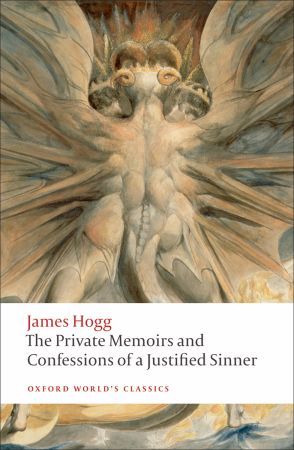
The Private Memoirs and Confessions of a Justified Sinner My sister gave me a copy of this book saying it was one of the weirdest books she’d ever read and she thought I would love it. I’m not sure what that says about my reading tastes, but she was right anyway because I did love it!

The Private Memoirs and Confessions of a Justified Sinner, published in 1824, was written by the Scottish poet and novelist James Hogg. I had never come across Hogg and his work until now and was interested to learn that he was a shepherd who taught himself to read and write and became a friend of Sir Walter Scott. This, his most famous novel, is part horror story, part murder mystery and part gothic fiction, but it also incorporates elements of religion, Scottish folklore, the supernatural and even some humour and satire.

Robert Wringhim, the ‘justified sinner’ of the title, is a young man who has been raised by his adoptive father, a Calvinist, to believe he is one of the chosen few, destined for a place in Heaven regardless of the sins he commits in life. One day he meets a mysterious stranger who calls himself Gil-Martin and who seems able to change his appearance at will. Wringhim allows the stranger to convince him that it’s his duty to “cut sinners off with the sword” and that he doesn’t need to worry about committing murder as in this case it’s the right thing to do and he is sure to be saved by God anyway. In his Private Memoirs and Confessions, he describes how he falls under the spell of the sinister Gil-Martin and how, when he begins to have doubts about his new friend, he starts to descend into madness and desperation.

Robert Wringhim’s Confession is presented as an authentic document that has been discovered under unusual circumstances a century later. It is introduced by a Narrative written by a fictitious editor which gives a supposedly factual account of Wringhim’s life and the crimes he is involved in. The Editor’s Narrative also forms the third and final section of the novel and attempts to explain how the Confession was found and what it might mean. But instead of helping to clarify the story, the Editor actually makes things more confusing and sometimes even contradicts what Wringhim has said. Neither narrative seems to be very reliable and at the end of the novel, we have to decide for ourselves what really happened. For example, it’s not clear whether Gil-Martin is a product of Wringhim’s imagination or whether he is a real person or even the Devil.

This book kept me gripped from the first page, but it was quite a challenging story to read. There was a lot of Scottish dialect and while that’s not something I usually have a problem with, many of the words used here were unfamiliar to me and I was constantly turning to the glossary at the back of the book. There were also a large number of Biblical references on almost every page and again, I found that I kept needing to refer to the notes. It wasn’t completely essential to recognise or understand all of these references, but it was important to know how the various characters were interpreting them. Finally, there are no chapter breaks – the middle section, the Confession, forms one continuous chunk of over 100 pages, making it hard to find a place to stop reading.

However, it was definitely worth having to make a bit of extra effort; this is one of the most fascinating and original classics I’ve read and I can’t believe it isn’t better known. I thought it was much better than Robert Louis Stevenson’s Dr Jekyll and Mr Hyde, which is the book it reminded me of most. I’m also surprised that, as far as I’m aware, it has never been adapted for film or television. Some parts of the novel are very visual – the atmosphere of the dark wynds and closes of Edinburgh; the description of the rainbow seen by Robert Wringhim’s brother, George; and some of the scenes where Wringhim finds himself hounded and tormented by fiends and demons. I loved this book and am very grateful to my sister for recommending it!

The Beggar King by Oliver Pötzsch

The Beggar King It’s 1662 and the Schongau hangman, Jakob Kuisl, is travelling to Regensburg to visit his sister Lisbeth who has sent him a message saying she is seriously ill. Arriving in the city, Jakob discovers that he has walked into a trap: his sister and her husband are found dead in their bathhouse and Jakob is arrested on suspicion of murder. Imprisoned and tortured, he awaits his execution in one of the city’s dungeons.

Jakob’s daughter, Magdalena, vows to help her father and sets off to Regensburg with her lover, doctor’s son Simon Fronwieser. As they begin to investigate, Magdalena and Simon meet a variety of characters including a Venetian ambassador, a raftsman, a brewmaster – and the city’s community of beggars and thieves, led by Nathan the Wise, the ‘Beggar King’ of the title. They must decide who can and cannot be trusted and come up with a plan to rescue Magdalena’s father before it’s too late.

The Beggar King is the third in a series of historical mystery/thrillers following the adventures of 17th century Bavarian hangman Jakob Kuisl and his daughter Magdalena. The first two in the series are The Hangman’s Daughter and The Dark Monk; I haven’t read either of these but starting with the third book was not really a problem as this was a complete story in itself and not dependent on things that had happened in the previous books. If I had read the others I might have got more out of the story, as there were relationships that had obviously been developing over the course of the series, but I was still able to follow what was happening easily enough.

There were things that I liked about The Beggar King and the fast-paced, action-packed story did keep me entertained, but I don’t think I will be looking for any of the others in the series. The problem I had with the book was the language used in the dialogue. Would people in the 1660s really have called each other ‘lowlife drifters’ and would they have said something like “Just my luck that I wind up in the hands of a quack like you”? A lot of the terms and phrases that were used just sounded wrong to me. I’m aware that the book has been translated into English from its original German, so it’s hard to tell how much of this is down to the original text and how much to the translation, but when I read historical fiction I like to feel that I’ve been transported back in time and because of the dialogue I did not get that feeling at all with this book. As well as the language being too modern, the way some of the characters thought and behaved also felt too modern and I found it particularly difficult to believe in Magdalena as a realistic 17th century woman.

What I did enjoy was all the information we are given on the living conditions and medical history of the time, things I always find interesting to read about. Magdalena’s lover Simon is a ‘medicus’ (physician) and she herself is training to be a midwife. Jakob Kuisl also has some medical skills – it seems that the town hangman did much more than just carry out executions and was also involved in operating the instruments of torture during the interrogation of prisoners, and ironically, was responsible for tending the prisoners’ injuries after he had finished torturing them. In this way, the hangman gained a good knowledge of human anatomy and physiology.

I also loved the setting and the descriptions of the Bavarian village of Schongau and the city of Regensburg on the River Danube where most of the action takes place. I haven’t read much, if anything, about Germany in the 17th century and I enjoyed the author’s note at the end which takes us on a journey through Regensburg and tells us more about some of the places mentioned in the novel.

Inappropriate dialogue is something that often irritates me in historical fiction, but I know not everyone will be bothered by it. Looking at other reviews of The Beggar King, it does seem that the general opinion is overwhelmingly positive and a fourth book is already on its way!

I received a review copy of this book from the publisher via Netgalley

Turn of the Century Salon: January – An Introduction

Turn of the Century Salon

During 2013 I am going to be taking part in the Turn of the Century Salon, hosted by Katherine of November’s Autumn. The idea of the salon is to read and discuss classics from the late 1880s to the early 1930s.

This month Katherine has asked a few questions to help us introduce ourselves…

What era have you mainly read? Georgian? Victorian? Which authors?

I’ve definitely read more classics from the Victorian era than any other period. I love Wilkie Collins, the Brontë sisters (all three), Thomas Hardy, Anthony Trollope, Elizabeth Gaskell, Charles Dickens, Mary Elizabeth Braddon and Alexandre Dumas.

What Classics have you read from the 1880s-1930s? What did you think of them?

When I first saw this question, I could think of very few classics I had read from this period (the only one that came instantly to mind was The Great Gatsby). Then I had a look back at my list of books read since I started blogging and discovered that I had actually read a lot more than I thought I had! Here are some of the books from the 1880s-1930s that I’ve read in the last few years (I haven’t listed all of them):

Three Men in a Boat by Jerome K. Jerome (published 1889)
Jude the Obscure by Thomas Hardy (published 1895)
Ann Veronica by H.G. Wells (published 1909)
Ethan Frome by Edith Wharton (published 1911)
The Return of the Soldier by Rebecca West (published 1918)
The Enchanted April by Elizabeth von Arnim (published 1922)
Orlando by Virginia Woolf (published 1928)
A Farewell to Arms by Ernest Hemingway (published 1929)

Name some books you’re looking forward to read for the salon.

I don’t really like making reading plans in advance as I never manage to stick to them, but here are some books I would like to read for the salon, listed in order of publication. I won’t necessarily read all of these and will almost certainly also read other books I haven’t mentioned here.

Germinal by Emile Zola (published 1885)
The Mayor of Casterbridge by Thomas Hardy (published 1886)
The Odd Women by George Gissing (published 1893)
The House of Mirth by Edith Wharton (published 1905)
A Room with a View by E.M. Forster (published 1908)
The Good Soldier by Ford Madox Ford (published 1915)
The Painted Veil by W Somerset Maugham (published 1925)

Is your preference prose? poetry? both?

Definitely prose!

The Small House at Allington by Anthony Trollope

The Small House at Allington This is the fifth of Anthony Trollope’s Chronicles of Barsetshire, a series of six novels set in the fictitious county of Barsetshire. I’ve read the first four and enjoyed them all, so I knew what to expect when I picked up The Small House at Allington. I have discussed Trollope’s writing style in my posts on the previous books in this series but will repeat that if you like Victorian authors who talk directly to the reader, who create well-rounded and nuanced characters and who fill the pages of their novels with gentle humour and insightful observations on human nature, then I would highly recommend trying the Barsetshire series.

The Small House at Allington (not to be confused with the adjacent Great House, home of the Squire of Allington, Christopher Dale) is where the Squire’s widowed sister-in-law, Mary Dale, lives with her two daughters, Bell and Lily. When Lily falls in love with Adolphus Crosbie, a friend of her cousin Bernard’s, he proposes and she accepts. After discovering that the Squire is not planning to give his niece a dowry, Crosbie begins to reconsider their engagement and during a visit to Courcy Castle he becomes engaged to another woman – Lady Alexandrina de Courcy, whose family, he hopes, will help him to rise in the world. Even after learning how she has been betrayed, Lily swears that she still loves Crosbie and will never marry anyone else, but will she change her mind when she discovers that she has another admirer?

The other man in love with Lily is Johnny Eames, a junior clerk who works at the Income Tax Office in London. At the beginning of the story, Eames is a shy, awkward young man described as a ‘hobbledehoy’ (isn’t that a great word?) and is apparently based on the young Trollope himself. As Johnny begins to gain more experience of the world and grows in confidence, will he ever find the courage to escape the clutches of his landlady’s daughter Amelia and propose to Lily?

Trollope devotes such a lot of time to introducing us to his characters – giving us every detail of their appearance and personality, describing their emotions and taking us through every step of their thought processes as they struggle to deal with the various dilemmas they find themselves facing. This has the effect of making his novels very long, but it also means that his characters feel like real, believable human beings. You won’t necessarily like all of them, but there will always be a few you can understand and identify with. Adolphus Crosbie, for example, could be seen as the ‘villain’ of the book, but he is also a complex and realistic character. He knows he’s doing the wrong thing but still can’t seem to stop himself from doing it and is punished by finding himself trapped in a loveless marriage to Lady Alexandrina.

One character I could not understand or identify with was Lily Dale! It was so frustrating that even after the way Crosbie treats her she insists that she loves him and forgives him and will think of herself as a widow for the rest of her life. I don’t know how her mother and sister managed to have so much patience with her (although being patient was maybe not the best way to deal with Lily – in Trollope’s day Lily might have seemed an admirable, romantic character but to me she came across as silly and irritating). There are some great female characters in the Chronicles of Barsetshire – Miss Dunstable, Mary Thorne, Eleanor Harding – but Lily is not one of them. I thought Bell, the other Dale sister, was a much more interesting heroine, although her storyline in which the Squire tries to convince her to marry her cousin Bernard, a man she likes but doesn’t love, is given less attention than Lily’s.

We also meet a variety of other interesting characters in this book; my favourites this time were the good-natured, well-meaning Earl de Guest, his sister Lady Julia, and the inhabitants of Mrs Roper’s boarding house in London. A few of our old friends from earlier in the series are here again too; Lady Dumbello (the former Griselda Grantly) appears in an amusing sub-plot involving Plantagenet Palliser, who I’m looking forward to reading more about in the Palliser series. There’s also a very brief appearance from Mr Harding, one of my favourite characters from The Warden and Barchester Towers, and I was disappointed that we didn’t see more of him.

It’s not often that Trollope surprises me (his plots are usually so predictable he sometimes even tells us in the first chapter what is going to happen in the rest of the book) but this time he did. While some of the characters got their happy ending – or unhappy ending in some cases – for others it felt that things had been left unresolved and so the story did not end in quite the way I would have expected at the beginning.

The Small House at Allington was apparently our former Prime Minister, John Major’s, favourite book. It isn’t mine, or even my favourite of the Barsetshire novels, but despite being irritated by Lily I did still love it and thought it was an improvement on the previous one, Framley Parsonage, which I had found slightly disappointing after the wonderful Barchester Towers and Doctor Thorne. I am now looking forward to reading The Last Chronicle of Barset and finishing the series!

Caprice and Rondo by Dorothy Dunnett

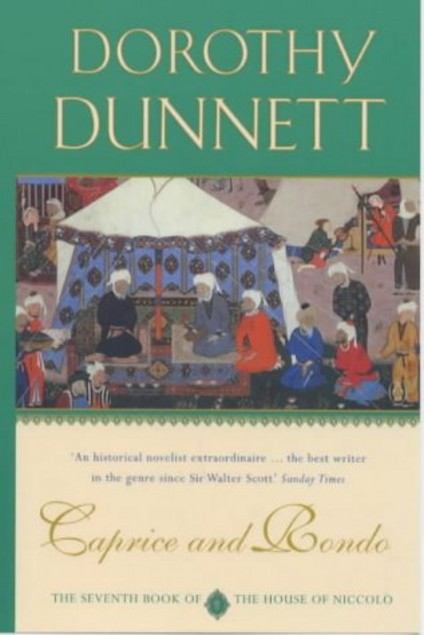
Caprice and Rondo The seventh in the House of Niccolò series and another one I enjoyed, although it was actually one of my least favourites so far. I know other readers will disagree, but in an eight-volume series it’s inevitable that there are going to be some that I don’t love as much as others and this was one of them. Before I try to explain why, I’ll repeat my usual warning that if you have not read the previous six Niccolò novels, you will encounter some spoilers below – it’s impossible to avoid them at this stage in the series!

*

At the beginning of Caprice and Rondo, we find Nicholas in exile following the revelations at the end of the previous book, To Lie with Lions. After allowing his rivalry with his wife, Gelis, to cause financial problems for his bank and almost destroy the nation of Scotland, it seems that his friends and colleagues may not be able to forgive him this time. Spending the winter drinking with the pirate Paúel Benecke in Danzig, Poland, Nicholas appears to be without aim and direction, until the opportunity arises for him to travel to Caffa on the Black Sea in the company of the mysterious Anna von Hanseyck. He is also still searching for the African gold that was stolen from his ship in Scales of Gold, as well as trying to protect Gelis and their son, Jodi, from their numerous enemies who include the former Vatachino agent, David de Salmeton.

I think part of the problem I had with this book was that we are taken to such a lot of different geographical locations and yet none of them really came to life for me as vividly as the settings in the previous books. I realise the cold, subdued atmosphere of the Danzig chapters was probably intended to match Nicholas’s mood and the state of mind he had found himself in, rather as the frozen landscapes of Russia matched Lymond’s in The Ringed Castle, but for me, this was probably the least successful of all the settings in any of the Dunnett novels I’ve read. Caffa is beautifully described, but I couldn’t help thinking the whole section of the book that took place in the Crimea felt a bit irrelevant, though maybe that’s partly because I was finding it difficult to really get interested in the intricacies of Tartar politics. I was much more interested in the other main thread of the story which involved Gelis, with the help of Tobie, visiting Thibault de Fleury and trying to unearth the truth about Nicholas’s parentage. I found myself liking Gelis again in this book after being so frustrated and confused by her since the end of Scales of Gold. I had never doubted that she and Nicholas loved each other and it’s so sad that they had wasted all those years when they could have been together as a family.

We also get a new villain in this book: Julius’s wife, Anna. I was suspicious of Anna from the beginning having learned not to trust characters who seem too good to be true, though I hadn’t guessed who she really was (or not until Adelina’s background was discussed, after which it was quite easy to make the connection) so that was a surprise. I was a bit disappointed though that our established villains, Jordan de Ribérac and Simon de St Pol, never appeared in this book.

While some new questions were raised – the identities of the six children, for example – it also felt as though a lot of things were being tied up in this book in preparation for the final one, such as the death of Nicholai Giorgio de’ Acciajuoli and the end of the mercenary company led by Astorre (I thought Astorre’s death at Nancy was one of the most moving scenes in the book). And of course, the Duchy of Burgundy itself was thrown into disarray with the Duke also losing his life in the battle of Nancy. I also, like Nicholas, finally began to have a better understanding of Ludovico da Bologna who seems to have popped up all over the place in whichever obscure corner of the world Nicholas has been visiting.

“Josaphat Barbaro, speaking of him in Persia, had said, ‘One meets him everywhere, does one not, as one might expect to see the ubiquitous God? But what one meets is not God, but one’s own conscience’.”

Although I started this post by saying this was one of my least favourite Niccolo books, ironically I also found it one of the quickest and easiest to read and I flew through it in a few days over Christmas. I’m reading Gemini now and can’t wait to see how the series concludes!

Classics Club Readathon

classics-club-readathon-january-2013

Today I’m taking part in the first ever Classics Club Readathon. The readathon starts at 8am EST, which is 1pm here, though I think I will probably have to miss the first few hours and start later in the afternoon. When I signed up for this last month I expected to have plenty of time to read today, but I now have some other commitments so I might not be able to get as much reading done as I had hoped.

I’m currently in the middle of reading The Small House at Allington by Anthony Trollope so I’m going to concentrate on finishing that before I start anything else. If I do finish it, I’ll be choosing another book from my Classics Club list to read next.

To avoid overwhelming you with extra posts I’ll be updating this post throughout the readathon.

The Small House at Allington Update 8.30pm – I’ve read another 8 chapters of The Small House at Allington and am still hoping to finish the book before the end of the readathon. I’m enjoying this one a lot more than the previous Barsetshire novel, Framley Parsonage, despite some very frustrating characters!

Update 9.00am – It’s Sunday morning, I’ve had some sleep and there are still 4 hours of the readathon to go. I am still reading The Small House at Allington and have 7 more chapters to read.

Final Update 12.30pm – I finished The Small House at Allington this morning and with the readathon almost over, I decided not to start another book. I’m quite happy with what I’ve achieved and I think immersing myself in the story for long periods enabled me to enjoy it more than I would have done if I had dragged it out over a few weeks. My thoughts on the book will follow soon!