 The year is 1500 and in the London suburb of Putney, young Thomas Cromwell lies on the ground being kicked by his father, who is drunk. Thomas recovers from the beating this time, but he knows he needs to get away from Putney before it happens again and so he runs away to sea. After returning to England several years later, Cromwell enters the service of the Lord Chancellor, Cardinal Wolsey, and begins to play an increasingly important political role. Wolf Hall follows Cromwell as he rises in power to become Henry VIII’s chief minister and helps to negotiate the King’s divorce from Katherine of Aragon and his marriage to Anne Boleyn.
This is one of those books I have thought about reading many times over the last few years but have never got around to actually doing it despite its popularity and Booker Prize success. Joining a readalong in the summer gave me the motivation to read it at last and although I didn’t keep up with the readalong schedule after the first couple of weeks I did still finish the book and am pleased to be able to say that I enjoyed it.
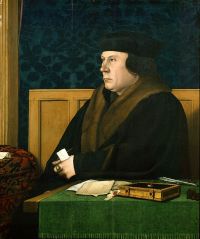
I didn’t know much about Cromwell before reading this book, but he has appeared as a secondary character in other historical novels I’ve read and he has always been portrayed very negatively – ruthless, cold and calculating. The famous portrait by Hans Holbein (shown below) does nothing to dispel this image! And so it was good to read a novel that showed Cromwell not as a villain (if anyone is portrayed as a villain in this book it’s actually Thomas More) but as an intelligent, charismatic, complex human being with both positive and negative qualities. Something that really comes across strongly is how well Cromwell has done to rise above his unhappy childhood and humble origins as the son of a blacksmith to become a confident, accomplished man people turn to for advice and leadership – one of the most powerful men in England. But while it was fascinating to read about the important historical events of the period and the political machinations that were going on behind the scenes, I also loved reading about Cromwell’s life at home. As well as his wife and children, Cromwell’s household expands over the years to include an assortment of other family members, servants, wards and employees and in Cromwell’s interactions with all of these people we see another side of his character: a kinder, more compassionate side.
 Mantel’s writing is descriptive without being flowery and she really brings her Tudor world to life. Every little piece of information she gives us, however trivial it may seem, helps to slowly build a full and vivid picture of daily 16th century life – what people ate, how they dressed, the books they read and the games they played. To say the book was well-researched would be an understatement – I couldn’t believe how incredibly detailed it was! As someone who has read a lot of Tudor novels I’m already familiar with this period and many of the historical figures who appear in Wolf Hall and I found this to be an advantage, as Mantel assumes the reader has at least some knowledge of the period. If it’s been a while since you’ve read anything about the Tudors, it might be a good idea to remind yourself of some of the historical facts surrounding Henry VIII’s divorce, marriage to Anne Boleyn and the resulting separation from Rome before you start reading.
Before I read this book I had heard a lot about Mantel’s excessive use of pronouns – specifically, the word ‘he’ being used without making it clear who ‘he’ was. I quickly discovered that it was usually safe to assume that ‘he’ was Cromwell but ‘he’ was also frequently used to refer to two or three other people who were taking part in the same conversation, which could sometimes cause confusion. The dialogue itself is modern enough to be easy to understand without feeling too inappropriate, though sometimes Mantel uses quotation marks to indicate speech and sometimes she doesn’t, leaving you to decide whether a character is speaking or just thinking. As I’m not usually a fan of experimental or quirky writing styles this was one of the reasons I had resisted reading this book for such a long time, but it actually didn’t bother me as much as I thought it might. It didn’t stop me from enjoying the book and I wish I hadn’t let it put me off.
I’m now looking forward to reading Bring up the Bodies, hopefully before the final book in the trilogy is released!




 She Reads Novels