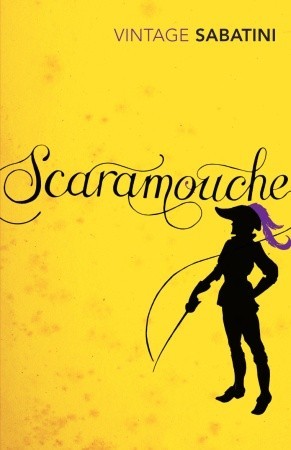
Scaramouche by Rafael Sabatini

Scaramouche is set at the beginning of the French Revolution and tells the story of Andre-Louis Moreau, a young lawyer from Britanny who has been brought up by his godfather, a man who many people believe is really his father. Andre-Louis has little interest in politics until his friend Philippe, who is passionate about the revolutionary cause, is provoked into fighting a duel with the Marquis de La Tour d’Azyr. It’s a duel Philippe has no chance of winning and when he is killed by the Marquis, Andre-Louis considers it to be murder.

Deciding that his friend’s voice must not be silenced, Andre-Louis speaks out against the privileged classes but when his speeches turn out to be much more successful than he expected, he finds himself in trouble with the law and is forced to run for his life. Joining a group of travelling actors, he takes the role of Scaramouche and discovers he has a natural talent for both acting and writing plays. First as Scaramouche, then as a fencing master and a politician, Andre-Louis sets in motion a plan for taking revenge on the man who killed Philippe.

From the wonderful opening line of this 1921 novel by Rafael Sabatini (“He was born with a gift of laughter and a sense that the world was mad”) I could tell I was going to love Scaramouche! And I did – it’s one of the best books I’ve read so far this year. The story involves a bit of everything: action, romance, history, political intrigue, humour and adventure.

Some readers might find Andre-Louis too unbelievable as a character, in the way he seems to succeed at almost everything he does, whether it’s acting, writing, orating or fencing, as well as being clever, courageous, quick-witted and charismatic. I can definitely understand this point of view, but it wasn’t really a problem for me. I thought he was a great character and I was able to suspend disbelief enough to just accept that he was good at everything! And he’s not perfect; he can be difficult to like at times and is often described by other characters as heartless (though we, as the reader, know that sometimes he’s putting on an act and not showing his true feelings). He does have flaws, he makes mistakes and his motives are not always easy to understand. His enemy, the Marquis, is another interesting character with more depth than he appears to have at first and some good qualities as well as bad ones – he’s more than just a stereotypical villain.

My favourite part of the book was the section in the middle where Andre-Louis joins the troupe of Commedia dell’Arte actors. Before I read this book I admit that I would have been unable to explain exactly what Commedia dell’Arte involved; now I know that it’s a form of improvisational theatre where the actors perform ‘scenarios’ or sketches, with each member of the group taking on one specific role. The best known of the stock characters found in Commedia dell’Arte, all of which have their own costumes and characteristics, include Harlequin, Pierrot, Pantaloon, Columbine and Scaramouche, who Wikipedia describes as a ‘roguish clown character’. Andre-Louis seems to identify with the character so much that even when he’s not acting he still sometimes thinks of himself as ‘Scaramouche’.

The events leading up to the French Revolution are central to the plot but this aspect of the book never became too overwhelming so if you don’t have much knowledge of the historical background it shouldn’t be a problem. There’s a good balance of historical detail and swashbuckling action, and there’s always something happening: a swordfight, a last-minute escape or a dramatic revelation. The fencing and duelling scenes are well written though I wished I understood all the terminology so I could fully appreciate Andre-Louis’ skill!

I’m not sure why it never occurred to me before to read Sabatini, considering he’s often compared to Alexandre Dumas, who I love. Having now read this book, I can understand the comparisons. Scaramouche has a lot in common with The Count of Monte Cristo, one of my favourite novels of all time (they are both historical adventure novels with a French setting, both have vengeance and justice as major themes and the character of Andre-Louis reminded me in some ways of Edmond Dantes). If you like Dumas or other books of this type, then I would highly recommend giving Scaramouche a try. I’ll definitely be reading more of Sabatini’s books – Captain Blood next, I think.
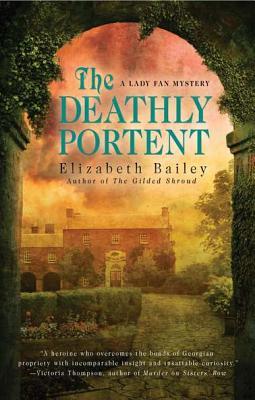
The Deathly Portent by Elizabeth Bailey

The Deathly Portent is the second in a series of historical mystery novels featuring Ottilia Fanshawe (also known as Lady Fan). The first in the series is The Gilded Shroud, but it’s not necessary to have read that one first as this is a complete story in itself.

The story is set in England during the Georgian period. Ottilia and her husband Lord Francis are riding home from a visit to Ottilia’s godmother when their coach breaks down near the village of Witherley. When they send their groom to look for the village blacksmith, they discover that Duggleby the blacksmith has been the victim of a murder – and that Cassie Dale, a young woman who has been branded a witch, is being blamed for it.

Ottilia has recently solved a mystery involving her husband’s family and is confident that she will be able to solve this one too. Believing Cassie Dale to be innocent, she begins to investigate in the hope of finding the real murderer and clearing Cassie’s name, but things soon start to become more dangerous than she had expected.

As soon as I started reading this book it reminded me in many ways of a Georgette Heyer novel – the time period, the language, the characters’ names, the dialogue – and so I wasn’t surprised to read that Heyer is one of Elizabeth Bailey’s influences. The appeal of this book for me was really the historical setting and the characters, though I did enjoy watching the mystery unfold too. There were lots of possible suspects, all with different motives for wanting Duggleby dead, and I was kept guessing until the truth was revealed at the end of the book.

One of the reasons I enjoy historical or vintage mysteries is that in the past we obviously didn’t have all the scientific methods of crime-solving that we have today and so detectives had to rely on making careful observations, hunting for clues, and talking to suspects and witnesses. And so Ottilia spends a lot of time getting to know the various residents of the village, listening to gossip and trying to make deductions from what she learns.

I loved Ottilia and Francis as a couple – they are both very easy to like and some of my favourite scenes were the ones in which they both appear together. Ottilia is a strong, intelligent character with a real enthusiasm for detective work and her husband is very supportive, although he can’t help worrying about her, particularly when he thinks she’s putting her life at risk unnecessarily. I’ll be interested to see how their relationship develops in any future novels in this series.

The events of the first Lady Fan novel, The Gilded Shroud, were referred to a few times in this book but not so much that I felt the previous novel had been spoiled. I will probably go back and read it at some point as I enjoyed meeting Lady Fan and would like to see how she solved her first mystery.

I received a copy of The Deathly Portent from the author for review.

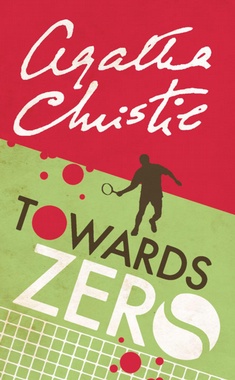
Towards Zero by Agatha Christie

Towards Zero is one of only a few Agatha Christie novels to feature the detective Superintendent Battle. There’s no Poirot or Miss Marple in this one (although there is a TV adaptation – which I haven’t seen – where Miss Marple does appear) but even without them I thought this was an excellent murder mystery novel that deserves to be more popular. The story revolves around the murder of an elderly woman, Lady Tressilian, who has invited a group of guests to her seaside home at Gull’s Point.

With this novel, Christie takes a slightly different approach to normal. Instead of beginning with a murder and then following the detective’s attempts to solve it, she chooses to spend half the book describing the backgrounds of the characters, some seemingly unconnected episodes from their pasts, and the sequence of events that lead to the murder finally being committed and the murderer’s objective being achieved (what one of the characters refers to as ‘Zero Hour’).

“I like a good detective story,” he said. “But, you know, they begin in the wrong place! They begin with the murder. But the murder is the end. The story begins long before that – years before sometimes – with all the causes and events that bring certain people to a certain place at a certain time on a certain day.”

So by the time the murder takes place halfway through the book, the characters are quite well-developed and we know a lot about each of the possible suspects. Could the murderer be the tennis player, Nevile Strange, one of Lady Tressilian’s guests? Or his beautiful wife, Kay? Or could it be his first wife, Audrey, who happens to be visiting at the same time? Maybe it’s Thomas Royde, who is secretly in love with Audrey – or Ted Latimer, a friend of Kay’s. And what about Mary Aldin, Lady Tressilian’s companion?

I thought the mystery was a difficult one to solve and I think I suspected all of the above people at some point in the story! I thought I’d figured it out once or twice but was proved wrong and there were at least two big plot twists towards the end of the book that took me by surprise. Looking back, there were plenty of clues, but plenty of red herrings too.

Towards Zero is atmospheric, very cleverly plotted, and although it’s not one of my favourite Agatha Christie novels it’s still one that I would highly recommend.

Ivanhoe by Sir Walter Scott

Sir Walter Scott is one of those authors who I’ve always felt intimidated by, for some reason assuming I would find him difficult to read. And yet, I had a feeling I would probably enjoy his books if I could just get around to actually reading them. I had no idea which book would be the best to start with, but as Ivanhoe is probably his best known novel I decided to try that one first.

Ivanhoe is set in England towards the end of the 12th century, during the reign of Richard the Lionheart, who has been away fighting in the crusades, leaving behind his brother Prince John plotting and scheming in his absence. The title character, Wilfred of Ivanhoe, banished and disinherited by his father, has just returned to England and on his return he becomes swept up in a series of adventures involving feuding Saxon and Norman noblemen, a beautiful Jewish girl, Robin Hood and a mysterious Black Knight.

Anyone with an interest in the medieval period and tales of chivalry will find that Ivanhoe has everything you would expect to see in this type of novel: jousting, sword-fighting, archery, tournaments, castles under siege, damsels in distress, bands of outlaws in the woods, and knights in shining armour. I loved it! I discovered that although Walter Scott’s writing is very descriptive and long-winded (lots of detailed descriptions of clothing and weapons etc) I didn’t have any problems understanding what was happening. The dialogue is written in an archaic style but it’s still readable and it all adds to the medieval atmosphere of the story.

I have no idea how much of the historical background is accurate but what does come across strongly is the resentment between the Saxons and the conquering Normans, as well as the tensions between Christians and Jews. Scott introduces us to characters from all four of these groups, which sets the scene for most of the conflict in the novel (the Saxons, for example, are represented by characters such as Cedric, Ivanhoe’s father, who still views the Normans as invaders more than a century after the Battle of Hastings and the Norman conquest). The attitudes of many of the characters towards the Jews are very negative, but I got the impression that this didn’t reflect Walter Scott’s own opinions. I thought he portrayed the Jewish characters themselves in quite a sympathetic way, which was good to see considering the time period in which this book was written. Rebecca, the daughter of Isaac the Jewish moneylender, was one of the strongest characters in the novel and much more interesting than the other heroine, Rowena.

I thought Ivanhoe himself was a bit of a disappointment. When he made his first appearance as the Disinherited Knight I thought he was going to be a great character, but he quickly seemed to fade into the background and was overshadowed by some of the other, more memorable characters – including the Black Knight, Wamba the Jester, Gurth the Swineherd, and the three villainous Norman knights, Front-de-Boeuf, de Bracy and Brian de Bois-Guilbert. I had never realised there was any connection between Robin Hood and Ivanhoe, but he appears in the novel under the name Locksley, and we also meet a friar living in a hermitage in the forest (Friar Tuck). Apparently Ivanhoe inspired the image of Robin Hood we have today and brought into popular use a lot of the elements of the Robin Hood legend.

So, now that I’ve read Ivanhoe and enjoyed it, which Sir Walter Scott book should I try next? Any recommendations are welcome!

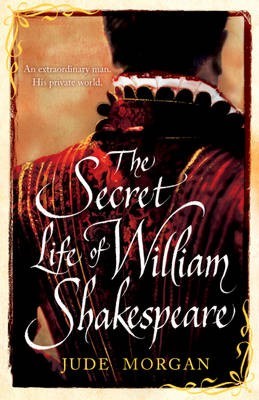
The Secret Life of William Shakespeare by Jude Morgan

I loved Jude Morgan’s books about the Brontës (The Taste of Sorrow) and the Romantic poets (Passion) so was very excited about reading this new novel on the life of William Shakespeare – and I’m pleased to say that it did live up to my expectations. Before I go any further I should point out that this book and the other two I’ve mentioned are fiction, although they do stick quite closely to the known facts about the lives of their subjects (as far as I can tell, not being an expert on any of them!)

The Secret Life of William Shakespeare opens in 1582 when we first meet Shakespeare as a glovemaker’s son from Stratford. At the age of eighteen he marries Anne Hathaway and they have three children together, but we soon learn that Will wants more out of life. He dreams of going to London and becoming an actor – and despite his father’s disapproval he sets out to turn his dream into reality.

It’s really not necessary to know anything about Shakespeare before beginning this novel and you could easily enjoy it without being familiar with any of his work. Some of his plays are mentioned, of course, but the plays are not the focus of this book. As the title suggests, the book is not just about Shakespeare the playwright but also about Shakespeare the man – his emotions, his hopes and fears, his relationships with the people around him, the things he might have said and done. Obviously we don’t know exactly what the real Shakespeare was like, but the way Jude Morgan portrays him here is believable and realistic.

Shakespeare’s relationship with his wife Anne Hathaway forms a very big part of this novel – in fact, a large proportion of the story is told from Anne’s perspective and a lot of what we learn about Shakespeare is seen through her eyes. For much of the novel Anne’s life is very separate from her husband’s – while he is in London, she stays behind in Stratford with their children. Although she understands that Will’s career is important to him, there is a sense that she has been left behind, that the ties between them are not as strong as they once were – and so there’s a sadness surrounding Anne and I did have sympathy for her. Anne’s character is very well-developed and I was interested in reading her story because I was interested in Anne herself, not just because she was William Shakespeare’s wife.

Other important characters include Shakespeare’s fellow playwrights, Ben Jonson and Christopher Marlowe, and we see the ways in which they affect and influence each other’s lives. But there’s also a large cast of other characters who appear in the novel: Will and Anne’s children, Susanna, Judith and Hamnet; the men Will meets in the theatre world; family members such as Anne’s brother Bartholomew, Shakespeare’s parents and siblings; and their friends in Stratford. By fleshing out the characters surrounding Will, we are given a better idea of the type of person Will might have been – and some of these characters also have fascinating stories of their own.

Something that is often a problem in historical fiction is dialogue – but I think the author gets the balance right in this book; the language is modern enough to be easily understandable without feeling too modern. Jude Morgan does have quite an unusual, distinctive writing style though, so if you’re new to his work it might take a few chapters to get used to it – having read a couple of Morgan’s other books in the past, I already knew that I like the way he writes. Overall I preferred the novels on the Brontës and the Romantic poets, but that’s purely because they interest me personally more than Shakespeare does. The Secret Life of William Shakespeare is a fascinating historical fiction novel with all the depth and attention to detail I’ve come to expect from Jude Morgan. I finished this book feeling that I had learned something, as well as being entertained by an interesting and compelling story.

I received a copy of this book from Headline for review

Thoughts on finishing the Lymond Chronicles

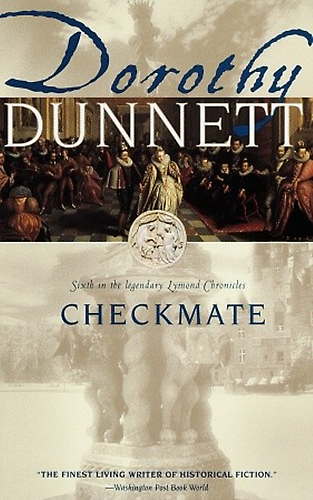
I apologise for abandoning my blog this week – I’ve been very busy both at work and at home, and any spare time I did have was devoted to finishing Dorothy Dunnett’s Lymond Chronicles. Because I read the final two books, The Ringed Castle and Checkmate so close together, rather than posting separate ‘reviews’ I decided to combine both books into the same post, along with some comments on the series as a whole.

Let’s start with the fifth book in the series, The Ringed Castle. After all the praise I’ve bestowed on the first four books it’s difficult to find new words to describe how I felt about this one, so suffice to say that it was as wonderful as the others. Russia is one of my favourite settings for historical fiction so I liked that aspect of the book, though I was equally interested in the chapters set at the Tudor court.

As with the previous novels, there’s a lot of history in this book – in the Russian sections we learn about Ivan IV, the Cossacks and the Crimean Tartars, and in the English sections we find ourselves at the centre of the conspiracies and political intrigue surrounding Queen Mary I and the future Elizabeth I. We also meet John Dee, the famous astrologer and mathematician, who is always interesting to read about, as well as another historical figure I knew nothing about: the explorer Richard Chancellor. Chancellor’s work with the Muscovy Company and as a navigator form quite a big part of the plot and I’m glad I’ve been able to learn something about his life and career. The final voyage of the Edward Bonaventure was so sad and one of the most memorable parts of the book for me.

Oh, and I loved the scene in the Hall of Revels, which finally led to the ‘Anvil Moment’ Aarti has been telling me about. And yes, it was worth waiting for!

When I started Checkmate, it was with a mixture of excitement at finding out how Lymond’s story would end and also sadness at the thought of reaching the end of the series. I was hoping to make the final book last as long as possible, but of course I couldn’t and it actually took less time to read than any of the others. In a series of unputdownable books, I found this one the most unputdownable of them all! I admit to having to cheat once or twice and flip forward a few pages, which is something I usually try not to do, but knowing from the previous books that Dorothy Dunnett had no qualms about killing off major characters, sometimes the suspense was just too much to bear.

Having said that, this wasn’t my favourite of the six books. There were parts that I loved – the chase through the streets of Lyon, the hilarious Hotel de Ville banquet, as well as finally learning the truth about Lymond’s birth – but overall I enjoyed some of the earlier books more. Still, I thought Checkmate was a great conclusion to the series and it was good to see so many of the characters from the previous books brought together in this one, including the return of Jerott, Marthe and one of my favourites, Archie Abernethy. And after The Ringed Castle, in which Lymond becomes more isolated than ever from his family, I was glad that Sybilla and Richard played such a big role in this book (it’s been fascinating to follow all the ups and downs of the relationship between Richard and Francis).

I’d like to finish by saying that I agree with all the Dorothy Dunnett readers who have been commenting on my previous Lymond posts – this is the best series of historical fiction novels I’ve ever read and I can see why so many of you have been re-reading them for decades because I’m sure I’ll be doing the same. And for anyone who has yet to read these books, I can promise you that although they’re not the easiest of reads, it’s definitely worth making the effort and getting to know Francis Crawford of Lymond, one of the most complex, charismatic, fascinating characters you’re ever likely to meet in literature. Working through the six books of the Lymond Chronicles has been one of the greatest experiences in my lifetime of reading.

Classics Challenge – April: Book Covers

This year I am taking part in a Classics Challenge hosted by Katherine of November’s Autumn. The goal is to read at least seven classics in 2012 and every month Katherine will be posting a prompt to help us discuss the book we are reading. I missed answering last month’s question, on the subject of settings, but might go back and answer that one at a later date. This month the focus is on book covers.

The classic novel I’m currently reading is Ivanhoe by Sir Walter Scott, which I’m really enjoying and finding easier to read than I had expected. Now that I’m no longer intimidated by him I’m sure I’ll be reading more of his work in the future. I’ll be posting my thoughts on Ivanhoe after I’ve finished the book.

I’m reading this novel as a free ebook and it doesn’t actually have a cover image, so instead I’m going to look at the covers of a few different editions of Ivanhoe.

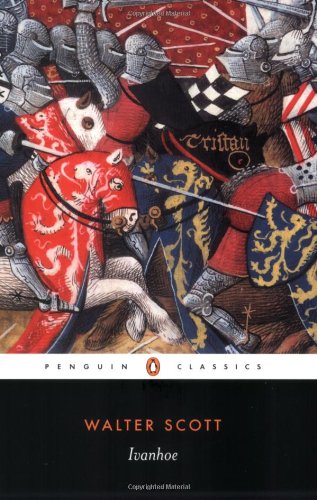
This is the cover of the Penguin Classics edition. The cover image shows ‘detail from a 15th century French illuminated manuscript showing a tournament‘.

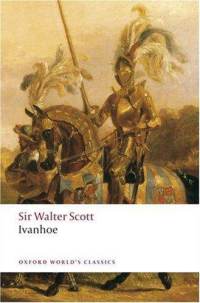
And here is the cover of the Oxford World’s Classics edition. The cover illustration is ‘Knight Enters the Lists at the Eglinton Tournament, of Archibald William Montgomery (13th Earl of Eglinton) by Edward Henry Corbauld (1815-1905)‘.

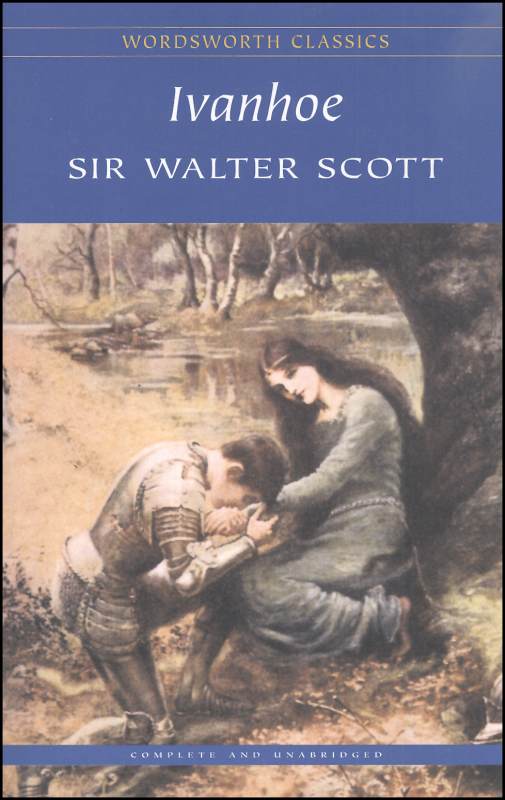
The third image I want to include here is the cover of the Wordsworth Classics edition. As you can see, this one is very different to the other two and shows ‘A medieval knight with his young lover (1898) by P. Clarke‘.

It’s interesting that only one of these three publishers has chosen to focus on the romantic aspect of the novel – if you picked up one of the other two without knowing anything about the story you would never guess there was any romance involved.

What do you think? Which of these covers would make you more likely to read the book?