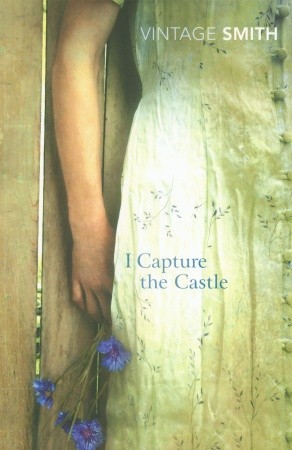
I Capture the Castle by Dodie Smith

This is a book I feel I should have read long before now, but for one reason or another I just never got round to it. So when Iris suggested a readalong in January I decided it was time I finally read it! And yes, I loved it, and really wished I hadn’t waited so long.

I Capture the Castle has one of those famous opening lines you may have heard of even without having read the book: “I write this sitting in the kitchen sink”. ‘This’ being the diary of seventeen-year-old Cassandra Mortmain, written first in a ‘sixpenny book’ then a ‘shilling book’ and finally a ‘two-guinea book’.

Cassandra lives in a crumbling castle in the English countryside with her eccentric novelist father, her glamorous stepmother Topaz who works as an artist’s model, her beautiful older sister Rose and younger brother Thomas – and Stephen, the son of one of the Mortmains’ old servants, who has become almost part of the family. Cassandra’s father wrote one very successful book, Jacob Wrestling, many years earlier but has been suffering from writer’s block ever since and the family are struggling financially. But when they meet the two rich American brothers, Simon and Neil Cotton, who have inherited the estate of which the castle is part, everything begins to change for the Mortmains.

This novel was published in the 1940s but the feelings and emotions Cassandra describes in her journal are timeless. Cassandra is having the usual problems and concerns that any teenager might have: coming to terms with growing up, falling in love, a changing relationship with her sister and other family members, and wondering what the future might hold. There are many novels with teenage narrators that deal with the same issues, but there are two things that really set this one apart: one is the unusual setting – the castle and its eccentric inhabitants – and the other is the voice of Cassandra herself.

Cassandra is such an engaging narrator, it would be difficult not to like her. Although she is very observant and perceptive, she also has an endearing innocence and vulnerability that leads one character to describe her (unfairly) as ‘consciously naïve’. Of all the things I liked about this book, it was Cassandra’s voice and personality that I loved the most. Through the pages of her journal she really does succeed in ‘capturing’ the castle and everyone who lives there. Some of the stories she shares with us are very funny, for example there’s a hilarious scene involving Rose and a big black fur coat, but along with the humour there are also some moments of sadness and poignancy. I was quite happy with the way the book ended too – not all of the loose ends are tied up, but I liked the fact that Dodie Smith chose a slightly unexpected way to finish the story.

A Midsummer Night’s Dream by William Shakespeare

This year I’m taking part in a reading project hosted by Risa with the aim of reading twelve of Shakespeare’s plays, one every month during 2012. I have not actually studied Shakespeare since I was at school and although I’ve read a few of his plays since then I’m not sure I completely understood them so this seemed like a good reading challenge for me to participate in.

A Midsummer Night’s Dream was January’s play. This is not the first time I’ve read this play; the last time was two years ago in 2010 when I read it as part of my own personal Shakespeare challenge (which was a complete failure, by the way, as I never actually got around to reading any more of his plays that year!) but I liked the idea of reading it at the same time as other people, so I was happy to read it again. This post is an updated version of my original post from 2010, with some new opinions and observations as I picked up on different things this time round than I did on my previous read.

A Midsummer Night’s Dream is thought to have been written around 1594-1596 and is classed as a comedy. There are three separate storylines woven into the plot. The first involves the upcoming wedding of Theseus, the Duke of Athens, and Hippolyta, Queen of the Amazons. A group of craftsmen (known as ‘mechanicals’) are rehearsing the story of Pyramus and Thisbe, a play they are planning to perform at the wedding.

In the second thread we meet Oberon and Titania, King and Queen of the fairies. Titania has a new little servant boy and Oberon is jealous. He and the fairy, Puck, come up with a plot to distract Titania while Oberon takes the boy away from her.

The third storyline follows Hermia (who is in love with Lysander), Helena (who is in love with Demetrius), and Demetrius and Lysander (who are both in love with Hermia). Confusing? Yes – and it gets even more complicated when the four of them get mixed up in Puck and Oberon’s scheming!

In Act I Scene 1, Lysander tells us “the course of true love never did run smooth” (one of those quotes you might have heard without even having read the play; Puck’s line, “Lord, what fools these mortals be!” is another) – and one of the central themes of the play is love and its difficulties. Here is one of my favourite quotes on the subject of love, spoken by Helena:

Love looks not with the eyes, but with the mind;
And therefore is winged Cupid painted blind:
Nor hath Love’s mind of any judgement taste;
Wings and no eyes figure unheedy haste:
And therefore is Love said to be a child,
Because in choice he is so oft beguiled.

The play begins and ends in Athens but the majority of the play is set in the nearby woods, a place free from Athenian law where anything can happen. There are a lot of allusions to the moon, fantasy and dreams which help to create a magical, dream-like atmosphere for the play and hint that the action that follows may be taking place in a fantasy world, rather than in reality. The references to the moon also suggest that the important events of the play are going to happen at night by the light of the moon (I love the way Hippolyta describes the moon as ‘like to a silver bow, new bent in heaven’).

With some of Shakespeare’s plays I find it difficult to get a real sense of the time and place, but with this one I have no problem picturing the characters running through the moonlit woods on a warm midsummer’s night while the fairies dance around them weaving their magic. The dreamlike mood is enhanced by the way much of the action takes place while various characters are sleeping. Here Oberon describes the bank where Titania sleeps. Isn’t the language beautiful?

I know a bank where the wild thyme blows,
Where oxlips and the nodding violet grows,
Quite over-canopied with luscious woodbine,
With sweet musk-roses and with eglantine.
There sleeps Titania sometime of the night,
Lulled in these flowers with dances and delight;

As in several of Shakespeare’s plays there’s also a theme of doubling and symmetry with Theseus and Hippolyta mirroring Oberon and Titania, and the two men Lysander and Demetrius being balanced by the two women Hermia and Helena. The conflict is caused by the fact that although Hermia and Lysander are in love, Demetrius also loves Hermia, leaving Helena on her own. The balance needs to be restored by Demetrius falling in love with Helena before the story can come to its conclusion. But as this is a comedy rather than a tragedy like Romeo and Juliet, it’s all very lighthearted and after all the misunderstandings have been cleared up, Shakespeare ends with the play-within-a-play (Bottom and his friends’ performance of Pyramus and Thisbe) and finally, these words from Puck…

If we shadows have offended,
Think but this, and all is mended,
That you have but slumbered here
While these visions did appear.
And this weak and idle theme,
No more yielding but a dream,
Gentles, do not reprehend:
if you pardon, we will mend:
And, as I am an honest Puck,
If we have unearned luck
Now to ‘scape the serpent’s tongue,
We will make amends ere long;
Else the Puck a liar call;
So, good night unto you all.
Give me your hands, if we be friends,
And Robin shall restore amends.

I enjoyed my re-read of A Midsummer Night’s Dream and will be reading Macbeth later this month.

January Reading Summary

February already and time for my first monthly reading summary of the year!


I discovered two new mystery series in January, both of which I would like to continue with (new to me, that is – they’ve both been around for a long time and I’ve come to them very late!) The first is Laurie R. King’s Mary Russell series; the second is Elizabeth Peters’ Amelia Peabody series. The Beekeeper’s Apprentice and Crocodile on the Sandbank were two of my favourite books of the month.


I made some progress with all of the challenges I’m participating in. For the Classics Challenge and the Victorian Challenge, I read Charlotte Brontë’s The Professor. For the Historical Fiction Challenge, I read Treason by Meredith Whitford and for War through the Generations, I read War Horse by Michael Morpurgo. And our first play for Reading Shakespeare – A Play a Month was A Midsummer Night’s Dream. I still need to post my thoughts on that one.

There were a few other books I read in January that I also haven’t had time to write about yet. I read Mansfield Park by Jane Austen for the third time and enjoyed it much more this time round than I did on my previous reads. It’s been a long time since I read Pride and Prejudice and Emma, so I’m hoping to re-read both of those soon too (I’m particularly looking forward to trying Emma again, as it’s the only Austen novel I haven’t liked and I’m curious to see if I’ll still feel the same way about it). I also read I Capture the Castle by Dodie Smith, one of those books I somehow missed out on when I was younger but I’m glad to have finally read it!

I was given the chance to read Russian Winter by Daphne Kalotay as part of a UK blog tour – you’ll be able to see what I thought of it on Monday. The last book I read in January was The Last Summer by Judith Kinghorn, a beautifully written story set around the time of the First World War. And I also made a start on Samuel Richardson’s Clarissa for a year-long group read.

How was your January?

Clarissa Group Read: My thoughts so far

Throughout 2012 I’m taking part in the group read of Samuel Richardson’s Clarissa, hosted by JoAnn of Lakeside Musing and Terri of Tip of the Iceberg. I probably won’t be posting an update every month but I thought it would be a good idea to at least post at the beginning, at the end and a few times in between.

For those of you not familiar with Clarissa, the book was published in 1748 and has over 1500 pages. The story is told in the form of 537 letters, the first being dated 10th January and the last 18th December. The idea of reading Clarissa over an entire year is so that the letters can be read on or close to the dates mentioned in the book.

January’s letters form a series of correspondence between Clarissa Harlowe and her best friend Anna Howe. In the first letter we learn that Clarissa and her family are involved in some kind of scandal and Anna wants her friend to tell her the truth about what has happened. Clarissa then replies to Anna with an account of the events that followed her family’s introduction to Mr Lovelace. At first Mr Lovelace had been interested in Clarissa’s sister, Arabella, before turning his attentions to Clarissa herself. It seems that Clarissa’s entire family disapprove of Lovelace, particularly after her brother James gets into a fight with him and is wounded. In the last of the January letters Clarissa has been given permission to visit Anna and stay with her for a few days.

I love the concept of reading each letter on the correct date, but I’ll admit I haven’t been sticking exactly to the schedule. I’m concerned that although January and February have a manageable number of letters (6 in January and 5 in February) some of the other months have a lot more to read (61 letters in March, for example). I don’t want to fall behind later in the year so I’ve been reading slightly ahead of schedule to make sure that doesn’t happen. I know this isn’t quite the idea of the group read but I think it’s the only way I’m going to have time to read the whole book before the end of December.

As I didn’t already have a copy of Clarissa I considered buying the paperback for the readalong, but in the end I downloaded the Kindle edition of the book, which is divided into 9 volumes. There are a couple of advantages to this, I think. I know from my experience of reading other books with 1000+ pages that they can be physically difficult to hold, so at least I don’t have that problem with the ebook version. And it also seems less daunting somehow to be reading 9 separate shorter volumes instead of one thick book.

I was expecting Clarissa to be a difficult book to understand as I haven’t read a lot of 18th century literature, but I actually haven’t had too much of a problem with the language. I wouldn’t describe it as an easy read and I certainly haven’t understood every word, as there are some that are no longer in use or that had different meanings in the 18th century, but I’m trying not to worry about that as long as I can still follow what’s happening. I’m enjoying the story so far and looking forward to continuing with it throughout the rest of the year!

Treason by Meredith Whitford

Treason is the story of Richard III, beginning with his childhood as the youngest son of the Duke of York and moving on through the various battles of the Wars of the Roses, the reign of his brother Edward IV, Richard’s own time as King and his eventual defeat by Henry VII at the Battle of Bosworth. The story is narrated by Martin Robsart, one of only a few fictional characters in the book. As Richard’s cousin and closest friend, Martin is present at some of the most important moments in English history.

I thought telling the story from the perspective of Richard’s fictional cousin and best friend worked very well and I could almost believe Martin had really existed. He has his own storylines, including a romance with Innogen Shaxper (another fictional character), but his main role as narrator is to share with us his observations on Richard, Edward and the others.

In Treason, Richard is not portrayed as the evil, scheming hunchback he is often believed to be, thanks to Shakespeare’s play. Instead, he is shown as being brave, intelligent, loyal to his brother, respected by his men, and a loving husband to Anne Neville. And although his reign is so tragically cut short at Bosworth, during his brief time on the throne he proves himself to be a good king. He does have a few faults, but nothing that would make me think he was a man who was capable of murdering his own nephews or committing all the other crimes he’s been accused of. On the subject of the disappearance of the ‘Princes in the Tower’, by the way, the author offers an interesting and believable theory, though not one that I personally think is very likely.

I was impressed with the depth given to the other characters too. I thought Richard’s brother George, Duke of Clarence, was portrayed more sympathetically than in other books I’ve read. He did some terrible things, but I see him more as a person who was weak and easily led, and his eventual fate was, for me, one of the saddest moments of the story. Elizabeth Woodville (Edward IV’s wife) and her family are shown in a very negative light, but it’s worth remembering that we are seeing everybody through Martin’s eyes and as his loyalties lie firmly with Richard it’s understandable that his opinions of other characters aren’t always going to be completely unbiased.

The dialogue is quite modern – too modern at times, maybe – but I know this is something which is very difficult to get exactly right in historical fiction. I find that when an author tries to make the language sound more authentic, it can either work very well or very badly! I didn’t have a problem with the dialogue in this book and I could tell that Meredith Whitford had given a lot of attention to period detail (food, clothing etc) which made the descriptions of fifteenth century life feel very convincing. Battle scenes are an aspect of historical fiction that I sometimes find difficult to follow, but there are only a few in Treason and the author makes them easy to understand by concentrating on Martin’s emotions and personal experiences of the battle rather than giving us pages and pages of military tactics.

Reading Treason was proof, if I needed it, that it’s worth looking beyond the more popular names in historical fiction and taking a chance on a book I had never heard about before. It’s a shame this book is not better known as I’m sure many readers who enjoyed books like Sharon Kay Penman’s The Sunne in Splendour or Josephine Tey’s The Daughter of Time would probably enjoy this one too. And for anyone new to Wars of the Roses fiction, this would also be a good starting point – it makes a very complicated period of history both easy to understand and fun to read about. I loved it!

War Horse by Michael Morpurgo

Despite being an avid reader as a child, I somehow missed out on Michael Morpurgo. The only one of his books that I read was Twist of Gold, at an age when I was starting to consider myself ‘too old’ for the children’s section of the library, and all I can remember is that it was about two children from Ireland who go to America to find their father during the Irish potato famine, and that it made me cry. But last week I read my second Michael Morpurgo book, War Horse, because I had decided to go to see the new Steven Spielberg film and wanted to read the book first. And War Horse, like all the best children’s books, is a book that can be enjoyed by people of all ages.

War Horse has a strong anti-war message and shows us the horrors of World War I from a very unusual perspective. The story is narrated by Joey, a young thoroughbred horse, who is bought at auction by a poor farmer from Devon. The farmer soon regrets this decision but his son, Albert, forms a special bond with Joey and trains him to work on the farm, determined to prove to his father that he hasn’t wasted his money. However, the family are struggling to pay their rent and when war breaks out in 1914, Joey is sold to an army officer as a cavalry horse. The rest of the story follows Joey’s experiences in France, first with the British cavalry and then pulling ambulances and artillery for the German army, but will he survive the war and will he ever be reunited with Albert?

Being an animal lover, I’m ashamed to admit that I had never given much thought to the suffering of the horses involved in the First World War or what happened to them after the war was over. Seeing things through Joey’s eyes gave a fascinating new perspective and has helped me to learn a little bit about an aspect of the war I had never really considered. Many of the horses serving with Joey are killed in their very first battle (the thought of leading a cavalry charge into a line of machine guns is so horrible to think about) and more of them die of hunger, illness or exhaustion after being forced to pull guns that are too heavy for them up hills and through deep mud.

I couldn’t help comparing this book to Anna Sewell’s Black Beauty, another book narrated by a horse and one of my absolute favourites from my childhood. I should point out that Joey is not a talking horse and although he does interact with other horses, including his best friend Topthorn, he never actually ‘speaks’ to them in the way Black Beauty does. And yet I found Black Beauty a much more convincing horse narrator than Joey. I kept forgetting that Joey was supposed to be a horse as I thought he sounded very much like a human narrator would. But to be fair, this is a different type of book and Joey is telling his story in a different way.

War Horse has a reputation for being very sad and emotional, and yes, I did have tears in my eyes a few times. The story never becomes too sentimental, but poor Joey does go through a lot of traumatic experiences, and of course the war itself is always distressing to read about. However, because the book is so short (it can easily be read in an hour or two) many of the characters we meet are only around for a few chapters and for one reason or another don’t appear again. This made it difficult to really form a connection with them and so the story didn’t have quite the emotional impact on me that I had been expecting. I’m sure though that if I’d been reading this book at the age of nine or ten I would probably have cried from beginning to end!

One of the things I really loved about the book was that Joey, being a horse, doesn’t ‘take sides’; he doesn’t see the British as good and the Germans bad, for example. Instead he is able to tell the story from a neutral viewpoint, something that is very rare in a novel about war. Joey meets and makes friends with soldiers in both armies and also with a French civilian and his granddaughter. And although he witnesses a lot of cruelty and destruction, he also experiences kindness and compassion from people on both sides. There’s a wonderful moment when a British soldier and a German soldier leave their trenches to meet in no man’s land. I won’t tell you why they do this, but this scene and others like it are what made this book such a powerful read.

This is my first book for the War Through the Generations challenge, which has a World War I theme this year. For anyone else participating in the challenge, I would highly recommend War Horse as a quick but very moving read.

Crocodile on the Sandbank by Elizabeth Peters

Crocodile on the Sandbank is the first of Elizabeth Peters’ Amelia Peabody books, a series of historical mystery novels set in Egypt and following the adventures of a Victorian lady with a passion for archaeology.

When we first meet Amelia at the beginning of the novel, she has recently inherited a fortune following her father’s death and is planning to use some of her money to visit Egypt. Passing through Rome on her way to Cairo, Amelia rescues a young woman, Evelyn Barton-Forbes, who has been abandoned by her lover and the two become friends and travelling companions. After they arrive in Egypt, Amelia and Evelyn meet archaeologist Radcliffe Emerson and his younger brother Walter, who are working on a dig at Amarna. The two women soon team up with the Emerson brothers to tackle a mysterious mummy who seems to be stalking them at night!

Amelia is the book’s first person narrator, but I wasn’t sure at first if I was going to like her. She has a very sharp, witty narrative voice and for the first few chapters I found her alternatively amusing and irritating. Luckily though, after I got to know her better I started to warm to her. As well as being outspoken and sarcastic she’s also brave, intelligent and loyal to her friends – and definitely not a conventional Victorian woman! Emerson is a very strong character too and I enjoyed watching his relationship with Amelia develop.

Although I am interested in history, Ancient Egypt has never been one of my favourite subjects to read about, but Amelia and Emerson are so enthusiastic about Egypt and archaeology that I ended up with more enthusiasm for the subject too. The adventures they have exploring tombs, discovering mummies and deciphering hieroglyphics all sound so fascinating!

The mystery itself wasn’t one of the novel’s strong points though. It was hard to believe that someone as intelligent as Amelia wasn’t able to immediately work out what was happening and who the villain was. But like Alan Bradley’s Flavia de Luce mysteries, I think the charm of this book was in the setting and the characters (or Amelia and Emerson, at least – the other characters didn’t have a lot of depth) rather than the mystery.

The overall tone of Crocodile on the Sandbank is light and entertaining and although I’m not completely convinced about this series yet, I did like this book enough to want to read the second one. I’ll remember to pick up The Curse of the Pharaohs next time I want to relax with another fun Egyptian adventure.