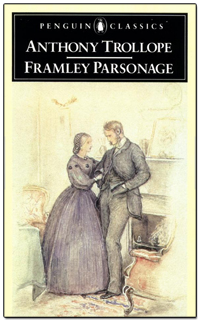
 Framley Parsonage is the fourth novel in Anthony Trollope’s Chronicles of Barsetshire series. I’ve been slowly working my way through these books during the last year and in my opinion this one is neither the best nor the worst of the four I’ve read so far.
A common question asked by people new to Trollope is whether this series needs to be read in the correct order. Well, I don’t think it’s necessary at all and I’m sure this book could be enjoyed as a first introduction to Trollope, but personally I would recommend beginning with The Warden and reading each book in the series in turn. Framley Parsonage draws together a lot of characters from the first three books, including the Grantly and Proudie families from Barchester Towers and the Thornes and Greshams from Doctor Thorne, as well as some that I hadn’t expected to meet again, including one of my personal favourites, Miss Dunstable. I’m glad I chose to read the series in order because it’s nice to be able to recognise references to people, places and events and to feel that I’m getting to know the whole Barsetshire community.
Framley Parsonage consists of two main storylines. In the first, we follow Mark Robarts, the vicar of Framley. Mark became vicar at a younger age than would normally be expected, due to the influence of his friend, Lord Lufton, and his mother, Lady Lufton of Framley Court. He is still very ambitious and to Lady Lufton’s dismay he begins to mix with unscrupulous politicians whom he believes can help him further his career. When one of these politicians, Nathaniel Sowerby, persuades him to sign his name to a note for five hundred pounds, Mark finds himself getting deeper and deeper into debt – which is not the way a respectable clergyman should behave!
The second storyline involves Mark’s sister, Lucy Robarts, who comes to live at Framley Parsonage following the death of their father. Lucy falls in love with Lord Lufton, who soon proposes to her. However, Lucy is aware that Lord Lufton’s mother does not consider her a suitable wife for her son, so she vows not to marry him until she wins Lady Lufton’s approval – even though it means sacrificing her own happiness.
I found this book harder to get into than the previous three that I’ve read – it seemed to have a very slow start and didn’t really pick up until the character of Lucy Robarts made her first appearance. But as with all Trollope’s novels, once I did get into the story I became completely absorbed in the moral dramas and dilemmas taking place. Based on the first three Barsetshire books, I had a strong suspicion that all of Mark’s and Lucy’s problems would be resolved by the end, and yet this didn’t stop me from enjoying the book and wondering exactly how those problems would be resolved. As usual, Trollope’s characters feel completely believable with understandable motives and emotions. We can have sympathy with Mark Robarts because he is not a bad person – just young and naïve. And even when a character is cast as one of the villains of the book, such as Mr Sowerby, Trollope still asks us to remember that they do have some good qualities.
Although Anthony Trollope is not my favourite Victorian author (that would be either Wilkie Collins or Thomas Hardy) he does have a wonderful warm and observant writing style all of his own and if you haven’t tried one of his books yet then I highly recommend spending some time in Barsetshire soon.


 She Reads Novels