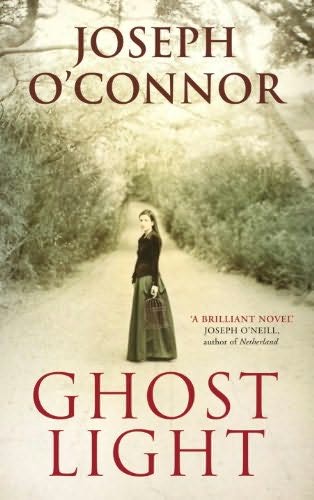
Ghost Light by Joseph O’Connor

Ghost Light tells the story of Molly Allgood, a real-life Irish actress who performed under the stage name Maire O’Neill and was engaged to the playwright John Millington Synge at the time of his death from cancer in 1909. Molly was fourteen years younger than Synge, she was a Catholic whereas he was a Protestant, and she came from a much poorer background. It seemed that almost everyone disapproved of their relationship including their parents, families and friends.

We first meet Molly in 1952, many years after Synge’s death. She’s living in poverty in London, dependent on alcohol, alone and desperate. We follow her over the course of a day as she prepares to take part in a play which is being broadcast on BBC radio and this story is interspersed with Molly’s memories of Synge and flashbacks to the early twentieth century.

As you’ve probably guessed, Ghost Light is not a happy book at all. Molly’s story is very sad, moving and poignant. The novel is written mostly in the second person, as well as following a stream of consciousness style, which made the book a bit harder to read than it needed to be, but Joseph O’Connor’s writing is undeniably beautiful and I did get used to the second person perspective after a while. There was also a chapter written in the style of a scene from one of Synge’s plays which I thought was a nice addition.

O’Connor states in his author’s note that although Molly and Synge were real people, this is a fictional story and most of the events described in the novel never actually happened. However, even if O’Connor’s Molly and Synge don’t bear much resemblance to their real-life models, they both felt completely realistic to me. Although I didn’t find Molly very likeable, I did love her narrative voice, which was bitter one minute and amusing the next, and this helped me warm to her character.

I won this book in last October’s Readathon and would like to thank Jessica of Park Benches and Bookends for providing a copy. I wish I’d had a chance to read it sooner, but my timing was actually perfect because I was in Dublin for a few days just last week and discovered some displays on Synge and Molly Allgood in the Dublin Writers Museum which I probably wouldn’t have appreciated if I hadn’t read Ghost Light!

More new book arrivals

If the WordPress scheduling feature is working correctly, you should be reading this while I’m still in Dublin. I was hoping to be able to schedule lots of reviews for while I’m away (as I still have so many to catch up on from April and May) but for one reason or another that didn’t happen. So instead, here’s an update on some of the new books I’ve received recently.

The Somnambulist by Essie Fox – With my love of anything Victorian, I’m really looking forward to this book! It’s being getting excellent reviews and I can’t wait to start reading it.

Burned by Thomas Enger – I won this book from LibraryThing Early Reviewers. It’s the first in a new crime series set in Norway.

The House by the Sea by Santa Montefiore – I received this one unexpectedly from Simon & Schuster. I’ve never read anything by Montefiore so don’t know what to expect, but it looks like a good summer read.

Before I Go to Sleep by SJ Watson – Another one that’s being getting good reviews. This book was courtesy of Transworld Publishers who really deserve a word of praise for the imaginative marketing campaign that accompanied this book (more on that when I post my review!)

Have you read any of these yet?

The Song Before it is Sung by Justin Cartwright

This is the first book I’ve read by Justin Cartwright. I was looking forward to reading it because, with my interest in World War II fiction, it sounded so interesting and also had so many glowing reviews. Unfortunately it didn’t live up to my expectations at all and I thought it was one of the most disappointing books I’ve read this year.

The Song Before it is Sung is based on the true story of the friendship between the British philosopher Isaiah Berlin and the German diplomat Adam von Trott zu Solz, who was involved in Claus von Stauffenberg’s failed attempt to assassinate Hitler in July 1944. Cartwright has changed their names to Elya Mendel and Axel von Gottberg.

Mendel and von Gottberg first get to know each other as students at Oxford in 1933. Their friendship is put to the test when Axel writes a letter to the Manchester Guardian denying claims that Jews are being badly treated in Germany. Elya, who is Jewish himself, is offended and confused by this. Their relationship is strained from this point – until von Gottberg is arrested and sentenced to death for his part in the Stauffenberg plot.

I enjoyed Axel and Elya’s story, but like many of the historical fiction novels I’ve read recently, the historical storyline is framed by a contemporary one and in this case, it just didn’t seem necessary. The present day protagonist is Conrad Senior, who met Elya Mendel many years later during his own time at Oxford. When Elya dies he leaves all his private correspondence to Conrad with the desire that he will use them to tell the story of his friendship with von Gottberg.

For me, this book would have worked better as a piece of straightforward historical fiction. The chapters about von Gottberg and Mendel were interesting and compelling, but every time I started to become immersed in their story, we were abruptly pulled back to the modern day and Conrad’s marriage problems which didn’t interest me at all. The one part of Conrad’s story that did interest me involved a piece of film showing footage of the trial at which von Gottberg was sentenced to death for his part in the conspiracy. Conrad believes that film of the actual executions still exists and decides to track it down.

Axel von Gottberg is an interesting character, but sadly Cartwright didn’t manage to bring any of the others to life for me. I couldn’t help but feel that reading this book was a lot of effort for very little reward. It wasn’t quite what I was expecting and to be honest, I probably wouldn’t have finished reading it if it wasn’t for the fact that it was the only book I had at work with me for a couple of days. Don’t let me put you off reading this book though, because I can see that a lot of people would love Cartwright’s quiet, contemplative writing style.

Have you read any of Justin Cartwright’s other novels? Maybe you can convince me that I need to give him another chance!

Temporary absence…

Just a quick note to let you know that I’ll be away for a few days. I’m going to Dublin tomorrow (the first time I’ll have been to Ireland) and will be back on Friday.

I won’t be able to respond to comments or emails, but I’m scheduling one or two posts for while I’m away. See you at the weekend!

North and South by Elizabeth Gaskell

North and South is the story of Margaret Hale, a young woman who lives with her parents at their parsonage in the idyllic village of Helstone in the south of England. When Margaret’s father decides to resign as parson and takes a new job as a tutor in the northern manufacturing town of Milton, the Hale family initially find it difficult to adapt to their new environment. It is not until Margaret meets some of the inhabitants of Milton that the town begins to feel like home. She forms a close friendship with the Higgins family – the invalid Bessy, her younger sister Mary and their father, Nicholas, who works at the cotton mill. But when the Hales also get to know Mr Thornton, a wealthy mill owner, Margaret finds herself caught in a conflict between the poor mill workers and their rich masters.

There’s also a romantic element to the novel: Mr Thornton falls in love with Margaret who unfortunately is prejudiced against what she calls ‘shoppy people’. She seems to make up her mind to dislike him before she even gets to know him because he’s a tradesman who has earned his money rather than inheriting it and is not her idea of a real gentleman. And to make things worse, Mr Thornton’s mother thinks Margaret is haughty and wants to stop her son from becoming involved with her.

Although there were also a lot of things to like about Margaret, her attitude towards Mr Thornton prevented me from really warming to her until the second half of the book when after meeting different types of people and being exposed to important social issues she begins to reassess some of her views and starts to grow as a person. By the end of the book I didn’t find her the annoying character I did at the beginning. It was interesting to see how both Mr Thornton and Nicholas Higgins also changed due to Margaret’s influence. There’s a lot of character development in this book, which was one of the things I loved about it.

The book takes place during the industrial revolution, an important and interesting period of history. It was a time of progress, allowing the factory owners to develop great wealth and the country’s economy to grow. However, the factory employees were working under appalling conditions, with absolutely no regard for their health and safety. Bessy Higgins is one example of this: she is only nineteen years old and has already developed a lung disease which she blames on inhaling ‘fluff’ from the cotton in the mill where she used to work.

Most of this industry was concentrated in the north of the country, in towns and cities such as the fictional Milton. Gaskell herself was born in London but spent most of her childhood in Cheshire and then settled in Manchester after her marriage (the town of Milton is thought to be based on Manchester), so she would have had first-hand knowledge of the northern way of life and how it may have differed from life in the south. Even today many people still have certain views and misconceptions about the differences between northern and southern England and even more so at the time when Gaskell was writing this novel, so I did appreciate the way she showed both the positive and the negative things about both regions.

North and South hasn’t become one of my favourite classics, but I did still enjoy it, although I was slightly disappointed by the way the book ended – not because I was unhappy with the outcome but because it seemed too abrupt. After reading The Moorland Cottage in February, I’ve now read the required two books to complete the Gaskell Reading Challenge, but as I’ve enjoyed both of my choices I’m sure I’ll be reading more of Gaskell’s work in the future!

May Reading Summary

Here we are at the end of another month! I didn’t read as many books as I have in previous months, but where books are concerned, quality is more important than quantity and I loved almost everything I read in May.

Favourite books read in May

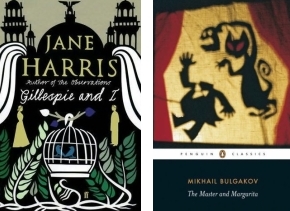
Choosing my favourites was difficult this month because, as I said, I enjoyed all nine books that I read. However, there are two that stand out from the rest: the first was Gillespie and I by Jane Harris (I posted my review yesterday) and the other was The Master and Margarita by Mikhail Bulgakov, which I hope to be posting about soon.

Other books read in May

Touch by Alexi Zentner
The Mystery of Edwin Drood by Charles Dickens
Ghost Light by Joseph O’Connor
Death in the Clouds by Agatha Christie
The Report by Jessica Francis Kane
A Word Child by Iris Murdoch
Orlando by Virginia Woolf

I’ve also been reading Dr Thorne by Anthony Trollope, a few chapters per week, and although I’m only halfway through I’m enjoying it as much as the other Trollope books I’ve read.

How was your month? Did you read any good books in May?

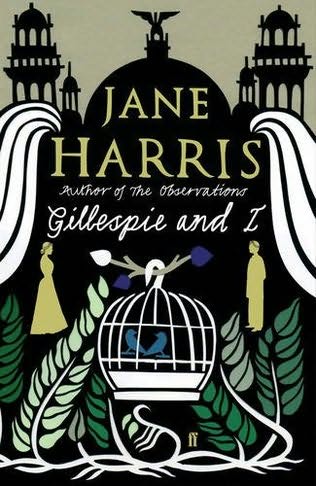
Gillespie and I by Jane Harris

I was lucky enough to win a copy of Gillespie and I through LibraryThing Early Reviewers but even if I had paid the full price for this book I would have considered it money well spent. I thought it was brilliant. It seems I’m one of the few people not to have read the first book by Jane Harris, The Observations, and I’m not sure how I managed to miss that one as it sounds like something I would love. I’ll certainly go back and read it now that Jane Harris has been brought to my attention.

But this post is about Gillespie and I. Or, I should say, Gillespie and Harriet Baxter. We first meet Harriet in 1933 as an elderly woman looking back on her life and promising to share with us her recollections of Ned Gillespie, a talented artist who was never able to fulfil his true potential. Harriet then proceeds to tell us the story of her acquaintance with the Gillespie family, whom she met in the 1880s during a trip to Scotland to visit the International Exhibition in Glasgow. She quickly becomes a friend of Ned, his wife Annie, and the other members of the family – but then disaster strikes and the lives of Harriet and the Gillespies are thrown into turmoil.

After a leisurely start, the story soon picked up pace and became very gripping. But as well as the compelling plot there were many other things that made this book such an enjoyable read. I connected immediately with Harriet’s sharp, witty and observant narrative voice. The other characters were vibrantly drawn, though the only one who never really came to life for me was Ned himself, which was the only disappointment in an otherwise excellent book. I also loved the setting. I’ve read many, many books set in Victorian London and it made a refreshing change to read one set in Victorian Glasgow instead.

Halfway through the story something happened that made me start to question everything I’d read up to that point – and even after I’d finished the book I still had questions. I was very impressed by how cleverly Jane Harris managed to control what I believed and didn’t believe at various points in the novel. I can’t really explain what I mean without spoiling the story but suffice to say there are some stunning plot twists that leave you wondering whether things are really as they seem – and this doesn’t happen just once, but several times throughout the second half of the book. At times it even felt like a Victorian sensation novel to me, which probably explains why I enjoyed it so much! Gillespie and I has been one of my favourite reads so far this year.