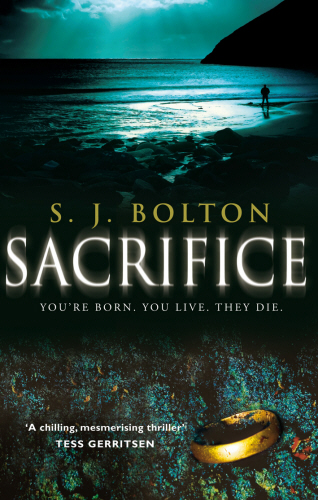
Sacrifice by S.J. Bolton

A few weeks ago I mentioned that I’d signed up for Transworld’s Great Crime Caper reading challenge. Sacrifice, the debut novel by S.J. Bolton, is the first book I received from Transworld for the challenge.

Our narrator is Tora Hamilton, an obstetric surgeon who has recently moved to the Shetland Islands with her husband, Duncan. Tora has been told that the Shetlands are ‘one of the safest places to live in the UK’, so the last thing she expects is to find a dead body in a peat bog in the field beside her new home. To make things even more shocking the body has had the heart removed and is carved with symbols which match the ancient runes on the wall in Tora’s cellar. As Tora becomes more and more determined to find out what’s going on she discovers that someone else is equally determined to put an end to her investigations.

If you’re going to read this book you should be aware that it’s very gory in places, particularly at the beginning of the novel, when Tora finds the mutilated corpse. If you can get through this part you’ll be all right because the story then becomes much less gruesome, though increasingly dark and eerie, and soon develops into a fascinating and well-structured murder mystery. Tora, with the help of police detectives Dana and Helen, uses a whole range of resources to investigate the mystery and piece information together, from medical records and birth registers to bank statements and books of folklore.

The most interesting aspect of this book for me was the Shetland setting and the exploration of Shetland myths and legends. I’ve never been to the Shetlands and have never read a book set there either, so this was something new for me, and I thought S.J. Bolton perfectly evoked the atmosphere of these remote and ruggedly beautiful islands with their jagged cliffs, flooded valleys and the Aurora Borealis illuminating the night sky.

Although the Shetlands are part of Scotland they are deeply rooted in Norse history and folklore and some of these myths and legends become integral to the story, giving it a slightly supernatural aura. There’s a scene where Tora is reading about a particular myth for the first time which really sent shivers down my spine. In fact, the whole book is genuinely quite scary. There are a few chapters that you really wouldn’t want to read if you were alone in the house at night!

On a more negative note, sometimes I felt I was being given too much information all at once when it could probably have been woven into the plot more gradually. A lot of it was also hard to believe. Tora seemed unrealistically brave, taking needless risks and sneaking around murder scenes in the middle of the night. Of course, fiction doesn’t always need to be realistic and it wouldn’t have been much of a story if Tora had reacted the way I would have done and run a mile at the first sign of danger! And none of this really mattered to me anyway because the plot was so exciting and gripping.

Sacrifice was just what I needed after reading a lot of slower paced books recently. Perfect if you’re looking for a fast-moving, atmospheric mystery with a unique setting.
E-readers: The good and the bad

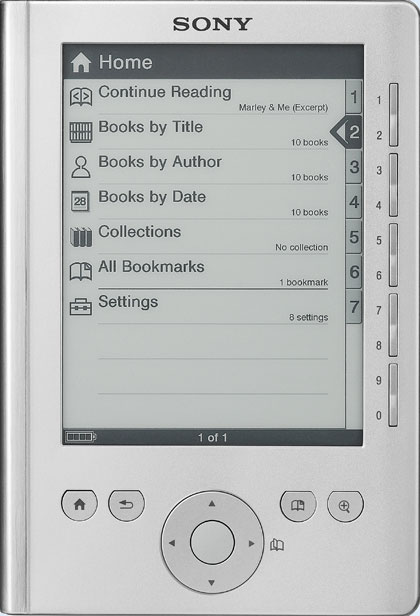
I’ve had my Sony Reader Pocket Edition PRS-300 for over six months now and thought it would be interesting to put together my thoughts on it and how it has affected my reading. I had resisted buying an e-reader for a long time because I felt guilty about doing anything that might contribute to the decline of the physical book. However, I certainly don’t seem to have acquired or read less ‘real’ books since I got my e-reader. I see it as another way to read books in addition to reading physical books, rather than instead of.

Here are some of the advantages and disadvantages of owning an e-reader. Can you think of any more?

Advantages

* They help you to save space on your bookshelves. You can store hundreds of books on an e-reader. Imagine how much shelf space they would take up!

* You can carry an ereader around with you very easily. They’re small (particularly the pocket version that I have) and weigh very little. This makes them perfect to take to work or on holiday or just in case an unexpected opportunity to read arises (I’ve lost count of the number of times I’ve ended up sitting in the car waiting for somebody, for example, and wishing I’d brought a book with me. Now I just take my reader with me when I go out in the car). And with hundreds of books stored on your reader you’ll always have plenty of choice.

* There are literally thousands of free classics and out of print books available to download online from sites such as Project Gutenberg and Girlebooks. This was one of the main reasons I originally wanted an e-reader. Having an e-reader suddenly opens up a whole world of obscure and hard to find books and the choice is overwhelming. I actually haven’t downloaded as many free classics as I thought I would simply because there’s so much choice, if that makes any sense!

* You can use Netgalley to request review copies from publishers in ebook format. I haven’t used this very often as I’m very selective about requesting books for review. It’s nice to know the option is there though, and I’ve enjoyed the few books that I have read though Netgalley.

* My local library has started offering ebooks for download. I’d be interested to know what librarians think about this service. Are we facing a future where everyone sits at home downloading library books and never actually visits the library in person? I can see good and bad points about this system, but so far it seems to be a very popular service. You have to keep the book on loan for a fixed period (you can choose either 7, 14, 21 or 28 days). After the loan period is up, the book automatically expires and can no longer be read. This is good in one way as it means you’ll never ‘forget to take the book back to the library’ and accrue an overdue fine, but it also means that you can’t return the book any sooner if you don’t like it or finish it earlier than expected.

* Most ereaders have some extra features. Mine doesn’t have many (it wasn’t really something that concerned me when I was choosing my reader as I just wanted something basic and easy to use). It is useful sometimes to be able to change the text size, though, and I like being able to bookmark pages with memorable quotes on them.

* Having an e-reader gives you instant access to books, without even having to wait for delivery. Find a book that you want online and you can start reading it in just a few minutes.

Disadvantages

* Although e-readers themselves have come down in price recently and are much more affordable now, in general the prices of ebooks are still usually more expensive than paper books. It’s up to you to decide whether it’s worth paying more for the same book or not.

* I find it hard to tell how long the ebook is going to be. Yes, it tells you how many pages there are, but the page count is usually different to the physical book and I find it difficult to visualise just from a page number how thick the book would be.

* You can’t flip back and forth in the book easily. Sometimes I like to be able to skip back a few pages, to remind myself of who a character is, for example, or to skip forwards to see how many more pages there are in the chapter. Then there are the books that have family trees or maps at the beginning or a glossary at the end. It is possible to move backwards and forwards through the book with my Sony Reader but it’s not very convenient and you really need to know the page number you’re looking for. Maybe this is easier with a different type of e-reader?

* The battery needs to be recharged regularly and once or twice the whole thing has frozen and I had to press the reset button. At least with a paper book there’s no chance of malfunctions, battery running down etc.

* Finally, in my opinion nothing beats reading and owning a real, physical book. With the e-reader you don’t get the beautiful front covers and spines to display on your shelves. You don’t get the feel of the book in your hands. And you don’t get the memories. I’m sure most of us have a favourite torn, battered old book that reminds us of our childhood!

Do you have an e-reader? What do you like and dislike about it? If you don’t have one, would you ever consider buying one?

Cleopatra’s Daughter by Michelle Moran

I was lucky enough to win a signed copy of this book in a giveaway last year. I feel bad about taking so long to read it, but it just never felt like the right time. When I eventually read it I was pleased to find that although I did have one or two problems with it, overall it was very enjoyable.

Kleopatra Selene is the daughter of the famous Queen of Egypt, Cleopatra, and her husband Marc Antony. When Antony’s army is defeated by Octavian at the Battle of Actium and Cleopatra commits suicide, ten year-old Selene and her brothers are left orphaned. Octavian takes them back to Rome with him where they join the household of his sister Octavia. On her arrival in Rome, Selene soon discovers that the city is in a state of unrest, with an unknown rebel known as the Red Eagle urging Rome’s huge slave population to rise against their masters. But Selene also has more personal things to worry about, such as going to school, falling in love and forming friendships – and through it all she hangs on to her dream that one day she will be able to return to Egypt.

I confess that I don’t know very much at all about Ancient Rome. It’s not one of my favourite periods of history to read about and although I know there are lots of historical fiction novels out there about the Romans, I’ve read very few of them. However, this was a good thing because it meant that a lot of the information in Cleopatra’s Daughter was new to me and I learned a lot of interesting facts. For example, I had never heard about the Columna Lactaria (Milk Column), a monument in Rome where mothers left their unwanted babies in the hope that someone would come and feed them.

One thing that strikes me about the Romans is the huge difference between the sophistication and advancement of their culture and the cruelty and barbarity of many of their customs. Michelle Moran does an excellent job of showing both the good side of Rome (the advanced technology, the architecture and the infrastructure of the city) and the bad side (there’s a scene where two hundred innocent slaves face being crucified because one of them has committed a crime, for example).

I did find it difficult to keep the relationships straight between the large cast of characters. This was partly because so many of them had similar names and also because most of the adults had been married at least two or three times each with several children from each marriage. Obviously this wasn’t the author’s fault though, and I did find the character list at the front of the book very useful! There are also some maps, a timeline, a glossary and an afterword explaining the eventual fate of each of the characters. All of these things were extremely helpful to someone like myself, with very little knowledge of Ancient Rome!

Although I did enjoy Cleopatra’s Daughter, it felt a bit too light for me. The characters didn’t have a lot of depth and the story didn’t affect me emotionally the way it was probably intended to. With the teenage narrator and lively writing style, I think this book would appeal to younger readers as well as adults.

Can you recommend any books about Ancient Rome that I might like better than this one?

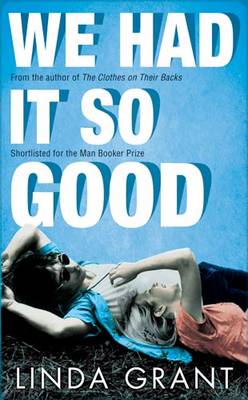
We Had It So Good by Linda Grant

Stephen Newman is getting older and is finding it difficult to come to terms with the way his life has turned out. What happened to his hopes and ambitions, to the generation that was going to change the world?

We Had It So Good follows the story of Stephen and his family over several decades during the second half of the twentieth century and the beginning of the twenty-first. At times reading this book was almost like watching one of those nostalgic television documentaries that show us snapshots of life in the 1960s and 70s. We learn about Stephen’s time at Oxford University where he met his future wife Andrea, how he made LSD in the chemistry lab, lived in a commune, went to the Isle of Wight festival and ate macrobiotic food. As we move forward through the 1980s and 1990s we see the early days of computers and the internet, and learn what it was like to be a photo-journalist reporting on the Bosnian War. And finally, we are brought right up to date with the tragedies of 9/11 and the 2005 London bombings.

As the years go by we see how Stephen and Andrea have changed over time, have had to abandon some of their dreams, and are leading more conventional lives – but with Stephen in particular there’s always that feeling of regret, that he’s settled for second-best, and he does at one point decide that “that was what life was, perennially settling for less”.

The book doesn’t have much of a plot, concentrating instead on painting a detailed and realistic portrait of the Newman family. Despite the lack of action though, there are still some moments of drama – mainly the types of small dramas that most people will experience in their lifetime – and there were even a few surprises and revelations that I didn’t see coming. The viewpoint switches from chapter to chapter allowing us to see things through the eyes of Stephen, Andrea, and several of the other characters. Sometimes I couldn’t immediately tell who was narrating, but this seemed to be intentional. The story also moves around in time, showing us the significant moments that have shaped the lives of each of the characters.

Linda Grant’s writing is of a high quality and she develops her characters in great detail from their appearance and the clothes they wear, to their likes and dislikes, hopes and fears. And yet throughout the first half of the book I didn’t feel any personal involvement in their story and always felt slightly detached from what was going on. Although the Newmans and their friends felt believable and real to me, I didn’t think I liked them enough to want to spend 340 pages reading about their everyday lives. But halfway through the book I started to warm to some of the characters and as a result, the story became more compelling. And once I had settled into the pace of the writing, I started to enjoy it.

It was interesting to see how Stephen as an American (with a Polish immigrant father and a Cuban mother) adapted to life in England, first at Oxford and then in London. And equally interesting when the family went to America and this time it was Andrea who had to readjust. I also liked reading about the relationship between Stephen and his father, Si. Stephen and Andrea’s daughter, Marianne, is another intriguing character. And this post wouldn’t be complete without mentioning Andrea’s best friend, Grace, who is quite a sad and solitary figure, still clinging to her ideals and travelling aimlessly round the world on her own, running away from her past and searching for something unobtainable. Although she’s not the most pleasant of people, with a hard, prickly personality, I was far more interested in Grace than in the Newmans.

I should point out that I’m probably not really the target audience for this book and although I did end up enjoying it, I can see that it would probably be appreciated more by readers of Stephen and Andrea’s generation. However, the book still left me with a lot of things to think about, from bigger issues such as immigration, family relationships and generational differences to the smaller ones, such as the principles behind the advertising of washing powder!

We Had It So Good was the January selection for the Virago Book Club. I received a copy from Virago for review.

Baba Yaga Laid an Egg by Dubravka Ugresic

Baba Yaga Laid an Egg is part of the Myths series by Canongate Books, in which authors retell traditional myths from around the world in a new and original way. This book by Croatian author Dubravka Ugresic takes a fresh and unusual approach to the Slavic myth of Baba Yaga.

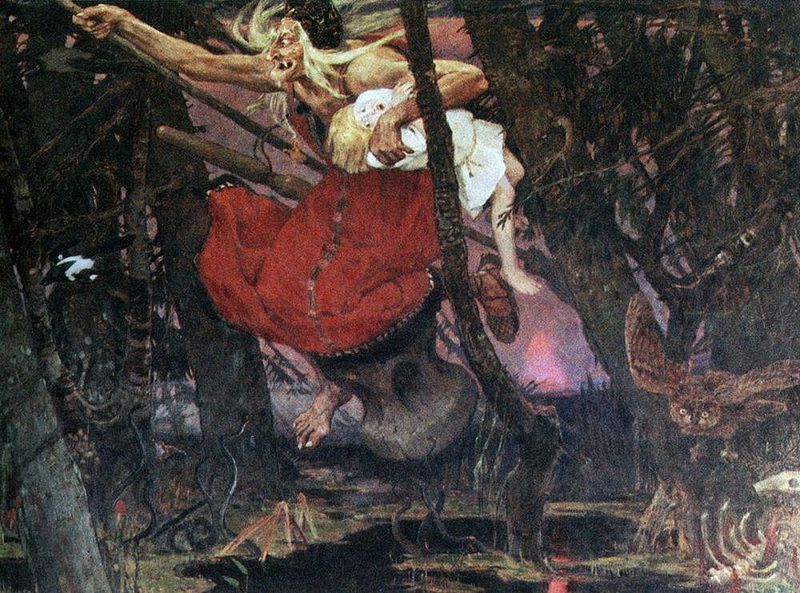
Baba Yaga (shown here in a painting by Viktor Vasnetsov – picture from Wikipedia in public domain) is usually portrayed as a hag or witch who lives in a log cabin mounted on a pair of chicken legs. She uses a giant mortar and pestle to fly through the air, kidnapping and threatening to eat small children. Although she has a terrifying appearance, Baba Yaga is also said to possess great wisdom and will sometimes give help and advice to anyone brave enough to ask.

Rather than simply reiterating this myth, Ugresic relates the myth to the lives of modern women and explores a large number of topics including ageing, feminism, love and loneliness. The book does not follow the format of a conventional novel and is divided into three separate and seemingly unconnected stories.

In the first story, the narrator travels to Varna in Bulgaria, the childhood home of her mother who is now old and ill. In the second story, we meet Beba, Pupa and Kukla, three old women who are staying together at a spa in the Czech Republic. But what is the connection between these two stories and what do they have to do with Baba Yaga? I have to admit, by this point I was starting to feel slightly confused. Yes, I had learned a lot about growing old, but how did all of these things relate to the myth of Baba Yaga? Luckily, I found the answers to my questions in the third and final section of the book.

Part 3 is presented as if a folklore expert was responding to a request for information about Baba Yaga and had been asked to explain the meaning of the first two sections. This part of the book was fascinating but began to feel like a very, very long encyclopedia entry. I previously knew almost nothing about Baba Yaga though, so it was good to learn something about the myth. I was also pleased at how well this final section pulled all the threads of the book together and helped me understand the significance of everything I had just been reading.

This book should appeal to anyone who has ever worried about growing old or anyone with an interest in mythology as it relates to feminism. I can’t honestly say that I loved this book or even that I particularly enjoyed it, but it was a very interesting concept and I’m glad I decided to give it a try.

Has anyone read any of the other Canongate Myths books. Are they similar to this one?

I’m an accessory in The Great Transworld Crime Caper!

After the success of last year’s Summer Reading Challenge, Transworld Publishers are hosting another great reading challenge for EU readers. This time there’s a crime theme, with a list of twelve crime novels to choose from.

If you’re an EU resident you can sign up for the The Great Transworld Crime Caper too! All you need to do is leave a comment on Transworld’s Between the Lines blog and start choosing your books. Transworld will then contact you for your address, they’ll send out your first book, and after you’ve read and reviewed it, you’ll receive the next one.

My three choices are:

1. Sacrifice by S. J. Bolton
2. Mistress of the Art of Death by Ariana Franklin
3. Echoes from the Dead by Johan Theorin

Who else is participating in this? Have you read any of the books I’ve chosen?

January Reading Summary

January has been a great reading month for me – much better than last January. I read twelve books and although I had mixed feelings about one or two, most of them were wonderful!

January Stats:

Books read: 12
New-to-me authors: 8
Male to female author ratio: 3:9
Publication dates: 19th century – 2; 20th century – 5; 21st century – 5
Countries visited in my reading: England, Ethiopia, USA, Italy/Ancient Rome, Croatia, Bulgaria, Czech Republic, France, Germany

~

Favourite books read in January:

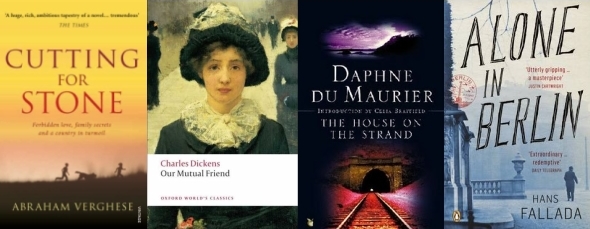
Cutting for Stone by Abraham Verghese
From my review: …even though it’s still only January, I can’t imagine I’ll be reading a lot of books this year that are better than this one.

Our Mutual Friend by Charles Dickens
From my review: Our Mutual Friend is such a big, complex novel it does require the reader to invest a lot of time and effort in it, but it was definitely worth it for me!

The House on the Strand by Daphne du Maurier
From my review: …a strange and unusual book which blends historical fiction, science fiction, time travel and psychology. I loved it!

Alone in Berlin by Hans Fallada
I haven’t reviewed this yet, but I can tell you that it was an excellent book and one that I would highly recommend!

~

Other books read in January:

Spilling the Beans on the Cat’s Pyjamas by Judy Parkinson
Major Pettigrew’s Last Stand by Helen Simonson
The Return of the Soldier by Rebecca West
The Enchanted April by Elizabeth von Arnim
Cleopatra’s Daughter by Michelle Moran – Review to follow
Baba Yaga Laid an Egg by Dubravka Ugresic – Review to follow
The Virgin Blue by Tracy Chevalier – Review to follow
Villette by Charlotte Bronte – Review to follow

~

Challenge progress:

I haven’t made a lot of progress in any of my challenges this month, but I’m not too worried about that as I have plenty of books for all three challenges on my tbr pile and am planning to read some of them in February.

Victorian Literature Challenge: 2/15
Gaskell Reading Challenge: 0/2
Historical Fiction Challenge: 1/20

This month I’m participating in a group read of Elizabeth Gaskell’s novella The Moorland Cottage hosted by Gaskell Blog, which will count towards the Gaskell Reading Challenge.

~

Other reading/blogging activities in January:

I took part in Bloggiesta the weekend of 21-23 January and although I wasn’t able to spend as much time on it as I would have liked, I still managed to accomplish a few things.
24-30 January was Virago Reading Week. I read The Enchanted April by Elizabeth von Arnim and The Return of the Soldier by Rebecca West and enjoyed them both. I had fun reading everyone else’s posts and adding lots of Viragos to my wish list!

Was January a good month for you?