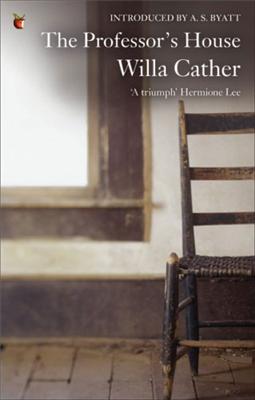
Review: The Professor’s House by Willa Cather

Willa Cather is an author I’ve heard a lot about but whose work I’ve never read until now.  I should probably have started with her most famous book, My Antonia, but something drew me to this one, The Professor’s House.

The Professor of the title is Godfrey St Peter, a man in his fifties, around the same age as Willa Cather was when she wrote this novel. At the beginning of the book, St Peter and his wife are preparing to move into their new home.  At the last minute the Professor decides that he doesn’t want to give up his old house just yet, so that he can continue to work in his old study and spend some time alone with his memories.

Most of the book revolves around St Peter reminiscing about his family and friends and coming to terms with the idea of leaving the past behind and embracing modern life.  At the forefront of the Professor’s thoughts is his former student Tom Outland, who had once been engaged to his daughter Rosamond. On his death in the First World War, Outland left everything he had to Rosamond – and this inheritance is causing trouble for the St Peter family.

If you prefer books with a gripping plot and lots of action you’ll want to avoid this one, as it was one of the slowest moving books I’ve ever read. I have to admit there were a few times during the first few chapters that I came close to abandoning it, but I kept reading because it was so well written. I would describe this as a calm, quiet, reflective book; one with such powerful, eloquent writing and beautiful imagery that it doesn’t really matter that not much actually happens.

The book is divided into three sections; the first and third are essentially character studies of the Professor and his family, particular his two daughters Rosamond and Kathleen and their husbands. The middle section is very different in both style and subject, as it tells in a flashback the story of Tom Outland’s life in New Mexico before he met the St Peter family. This story-within-a-story was fascinating but did feel slightly out of place, almost as if it had just been dropped at random into the middle of an entirely different book.

One of the things that stood out about Cather’s writing for me was the use of colour in her descriptions.

The grey sage-brush and the blue-grey rock around me were already in shadow, but high above me the canyon walls were dyed flame-coloured with the sunset, and the Cliff City lay in a gold haze against its dark cavern. In a few minutes, it too was grey and only the rim-rock at the top held the red light. When that was gone, I could still see the copper glow in the piñons along the edge of the top ledges. The arc of sky over the canyon was silvery blue, with its pale yellow moon, and presently stars shivered into it, like crystals dropped into perfectly clear water.

The Professor’s House is possibly a book I would appreciate more if I read it again when I’m older, as I found it difficult to identify with a fifty-two year old man looking back on his life. This was my first experience of Willa Cather and although I don’t think she’s going to be a favourite author, I will probably read more of her work at some point in the future.
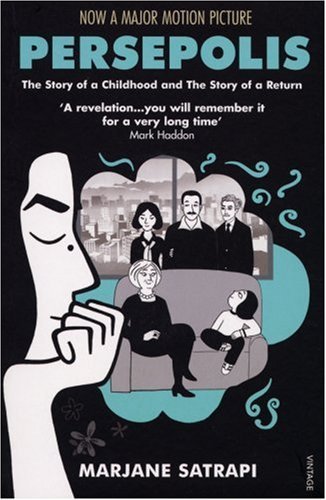
Review: Persepolis by Marjane Satrapi

This is the first graphic novel I’ve read. There, I’ve admitted it. I can’t explain why it has taken me so long to read one. It’s not that I think they’re childish or ‘not real literature’ or anything like that; it had just never occurred to me to read them and until I started blogging I didn’t even realise how popular they were. When I did decide I’d like to try one I thought a graphic memoir might be the best to start with and as I’d seen Persepolis reviewed on so many blogs it seemed a good choice. And it was, because I loved it.

This edition is actually two books in one: The Story of a Childhood and The Story of a Return. They can be bought separately but you really need to read the first book before the second.

These two books are the memoirs of Marjane Satrapi. In The Story of a Childhood she tells us what it’s like to be a child growing up in Iran during the 1970s and 80s. Due to the Islamic Revolution and the Iran-Iraq War, Iran becomes an oppressive and often dangerous place to live, particularly as Marjane develops into a rebellious teenager. Her concerned parents eventually decide that the safest option is to send their daughter away to start a new life in Europe.

Before beginning this book, I didn’t know very much at all about Iranian history and politics. I found that seeing things through a child’s eyes was fascinating and informative. Marji is an intelligent, imaginative girl and like all children she’s always curious and full of questions, so for someone who knows very little about Iran, this book offers an opportunity to learn along with Marji.

In the second volume, Marji is living in Austria, struggling to adapt to life in a country with an entirely different culture. This second book is more about the personal problems she faces with relationships, drugs and money and although I had a lot of sympathy for the situation she was in, I didn’t enjoy reading this book as much as the first one. I did find it more interesting towards the end when she finally returns to Iran several years later and finds she has as much trouble fitting back into her old life as she’d had fitting into life in Austria.

Although this was definitely a new experience for me, I was quickly able to forget that I was reading a ‘graphic novel’ and become absorbed in Marjane Satrapi’s story. The simple, stark black and white drawings were perfect and made it easy to understand what was happening. Rather than just illustrating the text, the pictures played an equally important part in telling the story.

I enjoyed this book much more than I expected to. It was a powerful and moving story, with some moments of humour too. So, if you are also new to graphic novels and unsure where to start, I have no hesitation in recommending this one to you!

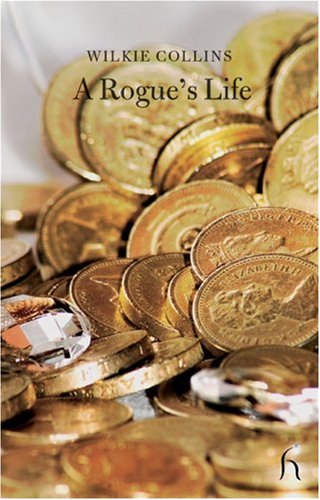
Review: A Rogue’s Life by Wilkie Collins

Frank Softly is a Rogue. Refusing to follow in his father’s footsteps and become a doctor, he has tried out a number of different careers since leaving school – and failed at them all. However, he remains optimistic and sees each failure as an opportunity to make a fresh start. Even when he is sent to a debtors’ prison he simply asks himself, “What of that? Who am I that I should object to being in prison, when so many of the royal personages and illustrious characters of history have been there before me?”

While working as a forger of old paintings, Frank meets Alicia Dulcifer in an art gallery and immediately falls in love. Unfortunately even this relationship seems likely to fail, because Alicia is the daughter of the sinister Dr. Dulcifer – a man who lives in a house with bars on the windows, never receives visitors and conducts mysterious experiments in his laboratory. Frank becomes determined to discover Dr. Dulcifer’s secret, at all costs.

As in many Victorian novels, there’s also an inheritance involved: Frank’s sister Annabella will only receive her three thousand pounds if Frank outlives their grandmother Lady Malkinshaw. This leads to some amusing situations as Annabella’s greedy husband desperately tries to prevent Frank from dying!

This was one of Wilkie Collins’ first books to be published (in 1856) and I could tell it was the work of a young, inexperienced writer – the plot was less developed than in his later books and the characters (apart from the Rogue himself) were less memorable. However, his enthusiasm shines through on every page, making this a fun, light-hearted read – but with plenty of suspense and excitement too. Although Frank Softly is dishonest, irresponsible, reckless – and definitely a rogue – he tells his story with so much humour and energy that you can’t help liking him.

Rather changeable this life of mine, was it not? Before I was twenty-five years of age, I had tried doctoring, caricaturing, portrait-painting, old picture-making, and Institution-managing…Surely, Shakespeare must have had me prophetically in his eye, when he wrote about ‘one man in his time playing many parts’. What a character I should have made for him, if he had only been alive now!

While I don’t think I would recommend this as a first introduction to his work, if you have enjoyed any of Collins’ other books there’s no reason why you shouldn’t enjoy this one too. And the short length of this book – only 150 pages – makes it a quick, fast-paced read, so anyone who has had trouble getting into one of his longer novels may find this one easier to read.

I’m going to leave you with Wilkie’s own thoughts on this novel, taken from the author’s preface:

The Rogue may surely claim two merits, at least, in the eyes of the new generation – he is never serious for two moments together; and ‘he doesn’t take long to read’.

Summer Reading Challenge: Second Hand Heart by Catherine Ryan Hyde

Vida is a nineteen year-old girl who suffers from a heart condition. She’s in hospital waiting for a transplant – time is running out, but before Vida can get a new heart, a potential donor needs to die. That donor turns out to be car crash victim Lorrie Buckner Bailey. When Lorrie’s grieving husband, Richard, decides to visit the girl who received his wife’s heart, Vida falls in love with him. But is it really Vida herself who loves Richard – or is it Lorrie’s heart?

I really enjoyed this book. It could easily have been a slushy, sentimental romance, but it manages to avoid that. Instead, it’s a fascinating and moving story which raises an interesting question: does cellular memory (where a transplanted organ retains the memories and characteristics of its previous owner) really exist?

The story is told in the first person, alternating between Vida and Richard. Vida’s section is in the form of a journal and she has a very intimate and conversational style, making her an engaging character. Through her journal entries we learn what it’s like to have spent your whole life preparing for death and the emotions that a person goes through on discovering that they now have a chance to live after all. After meeting Vida, Richard also begins to keep a journal and his story unfolds both through his diary entries and through his email correspondence with Vida and his mother-in-law Myra. I enjoyed watching the characters develop over the course of the book as Vida learns how to enjoy life for the first time and Richard learns how to move on with his own life following Lorrie’s death.

Although Vida and Richard are the characters we get to know best, I found the minor characters equally interesting – particularly Abigail, Vida’s worried, over-protective mother, and Esther, her elderly neighbour who survived life in a concentration camp during World War II.

The style of writing used in this book, with very simplistic or incomplete sentences, would usually irritate me – and it did at times – but it was actually perfectly suited to the story and helped give the impression that Vida and Richard were talking directly to the reader via their diaries. The writing style, together with the very short chapters, makes this a quick and easy read, despite it being quite a long book. There are some detailed descriptions of heart surgery but nothing too gory for those of you who are squeamish (Catherine Ryan Hyde says in her author’s note that she was given the rare opportunity to actually observe a heart operation whilst researching this book). Whether or not you believe in the theory of cellular memory Second Hand Heart is an interesting and thought provoking story.

I received a review copy of this book from Transworld Publishers as part of their Summer Reading Challenge.

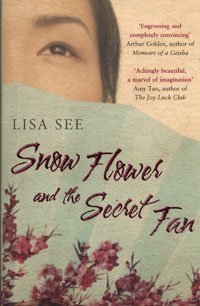
Review: Snow Flower and the Secret Fan by Lisa See

This book was recommended to me after I read Wild Swans by Jung Chang earlier this year and as I had heard a lot of good things about it, I decided to give it a try.

Lily is a Chinese girl born in Hunan Province in 1823, the daughter of a poor farmer. When she is six years old, the local matchmaker has an exciting announcement to make: if Lily’s feet are bound properly they will be the perfect size and shape, allowing her to marry well and improve the fortunes of herself and her family.

As well as arranging marriages for young girls, another job of the professional matchmaker is to find them a laotong or ‘old same’ – a special friend whose personal circumstances match in a number of different ways (e.g. same birthday, same number of siblings). Snow Flower and the Secret Fan tells the story of the lifelong friendship between Lily and her ‘old same’ Snow Flower.

If you haven’t read this book yet, I should warn you that the chapter on footbinding goes into a lot of detail, describing exactly what it involves and how much suffering the girl is forced to endure – all because small feet were considered the ideal and a girl with large feet would be virtually unmarriageable. One of the worst things about the whole process in my opinion was that it was usually carried out by the child’s mother – I just can’t imagine a mother inflicting so much pain and suffering on her daughter and even risking the girl dying from infection. If you can manage to get through this chapter though, there are plenty of other Chinese customs and traditions to learn about.

For example, did you know that Chinese women had a secret language of their own known as nu shu? This came about because women were discouraged from learning standard Chinese writing, so invented their own writing system which they then tried to keep hidden from the men. Throughout the book, Lily and Snow Flower communicate by writing messages to each other on a silk fan, using nu shu.

I also found the custom of the laotong fascinating. Most young Chinese girls had a group of ‘sworn sisters’, who would be her closest friends only until the day she married. Lily, however, was chosen to have a laotong – a girl who would remain her best friend throughout her entire life.

I thought it was sad that women were considered to be worthless and their only value to society was as a potential mother of sons. If a woman only gave birth to girls she was no use to her family. Here Lily and Snow Flower are discussing the possibility that they will both give birth to daughters.

Snow Flower smoothed her hands over her belly and in a small voice reminded me that girls are but worthless branches unable to carry on their fathers’ lines.
“They will not be useless to us,” I said. “Could we not make a laotong match for them now – before they are born?”
“Lily, we are worthless,” Snow Flower sat up. I could see her face in the moonlight. “You know that, don’t you?”

While I wouldn’t say I loved this book, I did enjoy learning about a culture so completely different to my own and I would welcome any suggestions for more historical fiction novels set in China.

New Book Arrivals

I haven’t bought any new books for a while as I’ve been running out of shelf space (as usual!) and have been trying to read some of the books that I already own or borrowed from the library, but here are a few that I’ve acquired in the last couple of weeks.

The Red Queen by Philippa Gregory – I received this from Simon & Schuster for their upcoming Red Queen blog tour (16th-20th August). They also sent me the paperback version of the previous book in the trilogy, The White Queen.

Remarkable Creatures by Tracy Chevalier – I received this book as a thank you gift from Harper Collins for participating in a readers’ panel survey. I have yet to read anything by Tracy Chevalier so I’m looking forward to it.

Second Hand Heart by Catherine Ryan Hyde – I’m taking part in the Transworld Summer Reading Challenge, where bloggers can choose four titles to be sent for review during the summer. This is the first book I’ve received for the challenge – the other three I’ve requested are After You by Julie Buxbaum, If I Stay by Gayle Forman and Prep by Curtis Sittenfeld. (I think there’s still time to sign up at the Between the Lines blog – but it’s EU residents only.)

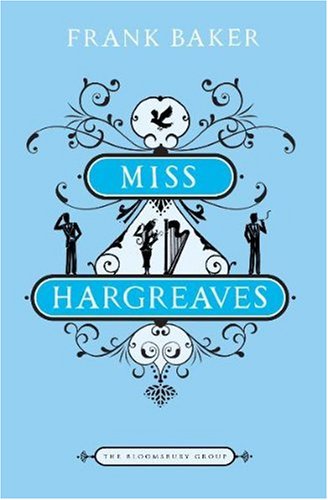
Review: Miss Hargreaves by Frank Baker

When I started to notice these Bloomsbury Group books appearing on other blogs, I knew I wouldn’t be able to resist reading them too. Not just because the covers are so pretty, but also because the stories all sound so intriguing! Miss Hargreaves (pronounced Hargrayves as we are told in the author’s note) was the one that appealed to me the most and the one I’d heard the most about – and it was the right choice because I loved it. It’s a charming tale about the power of imagination and how it can lead to an unusual and unlikely friendship.

“Henry,” I moaned, “she is exactly as I imagined.”
Limping slowly along the platform and chatting amiably to the porter, came – well, Miss Hargreaves. Quite obviously it couldn’t possibly be anyone else.

Norman Huntley has always allowed his imagination to run away with him. On a trip to Ireland with his friend Henry, they amuse themselves by inventing an imaginary eighty-three-year-old woman called Constance Hargreaves. They make Miss Hargreaves a poet and a musician; they give her a dog called Sarah and a cockatoo named Dr Pepusch – and Norman writes her a letter inviting her to stay at his home in Cornford, Buckinghamshire.

Never expecting her to accept his invitation (how could she – she doesn’t exist!) Norman is stunned when a little old lady arrives at the train station accompanied by a dog, a cockatoo, a harp – and even her own bath. It seems that Norman’s creation has come to life – and with even Henry convinced it’s all a practical joke, how will he explain Miss Hargreaves to his parents, his sister and his girlfriend Marjorie?

As the story continues, it gets more and more bizarre. I can safely say this is one of the most original and unusual books I’ve read for a long time! Miss Hargreaves is an unforgettable character – endearing and eccentric, yet ever so slightly sinister – and Norman is torn between a fatherly pride in his creation and frustration at the way she’s taking over his life. Somewhere in the middle of the novel, a gradual shift of power from Norman to Miss Hargreaves takes place, resulting in an almost Frankenstein-like situation where the creator begins to lose control of his creation. And yet Miss Hargreaves seems to be aware that there’s something different about her and that some kind of invisible bond exists between herself and Norman.

I was expecting the story to be funny and entertaining – and it is. However, there are also some very moving and poignant scenes, making the book a perfect mixture of dark and light.

There was only one aspect of this book that I could maybe have done without and that was the music. With Norman Huntley’s church organ, Cornelius Huntley’s violin and Miss Hargreaves’ harp, the musical elements of the book became a bit too much for me. However, I’m sure other readers will enjoy the organ playing scenes and they certainly add to the quirkiness and originality of the book.

Recommended

Pages: 317/The Bloomsbury Group/Year: 2009 (originally published 1940)/Source: My own copy