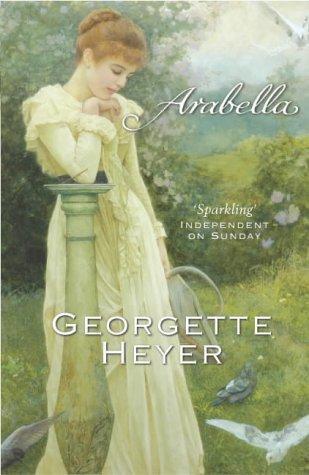
 This is my third and final book for this week’s 1949 Club, hosted by Simon of Stuck in a Book and Karen of Kaggsy’s Bookish Ramblings. Whichever year is chosen for the club, you can almost guarantee Georgette Heyer will have had a book published in that particular year – and 1949 is no exception.
The novel begins with Arabella Tallant, the eldest daughter of a Yorkshire vicar, being invited to London to stay with her godmother, Mrs Bridlington, for the season. On the way, her carriage breaks down and she seeks shelter at the nearest house, which turns out to be a hunting lodge belonging to Robert Beaumaris, one of the richest men in England. When she overhears Mr Beaumaris telling his friend that he doesn’t believe the carriage is really broken and he suspects Arabella of having her eye on his fortune, the offended Arabella impulsively decides to pretend that she’s already the heiress to a fortune of her own. She asks Beaumaris and his friend to keep this information to themselves, but when she arrives in London she’s horrified to find that the story of her great wealth is all over town…
I really enjoyed Arabella. It’s a relatively simple plot; where some of Heyer’s other books have elements of mystery or adventure or include real historical events, this one focuses mainly on the romance and although it’s easy to predict how it will end, the fun is in getting there! It helps that the hero and heroine are both so easy to like. Arabella is warm-hearted and compassionate and has been raised by her father to care about those less fortunate than herself. Beaumaris, despite his sophisticated, cynical exterior and the insensitive comment he makes during his first meeting with Arabella, also has a kind heart. He quickly sees through Arabella’s lie but instead of confronting her with it he waits for her to decide to tell him the truth herself.
Another thing that interested me (and which I found quite unusual for a Heyer novel) was the exploration of poverty and hardship, in contrast with the portrayal of upper-class Regency society. Arabella is moved by the plights of an abused climbing-boy (chimney sweep’s boy), a badly treated mongrel and a disreputable woman known as Leaky Peg, all of whom she foists – or tries to foist – onto Beaumaris, which provides most of the humour in the book! There’s also a subplot involving Arabella’s naïve, well-meaning but easily led younger brother, Bertram, who arrives in London and gets himself into trouble almost immediately. Bertram’s storyline is also quite predictable – there are a lot of similar younger brothers and cousins in Heyer’s novels! – but I didn’t mind that as I found him very endearing.
 If you’re new to Heyer, I think this could be a good place to start: the story is easy to follow, the characters are charming and likeable, and it has a classic, sparkling Regency setting. It was also a great choice for my final 1949 Club book!


🙂 Lovely.
I really enjoyed this one.
That’s wonderful. 🙂 It’s lucky she wrote so many books.
One of her best because the characters are so appealing! Plus, who among us hasn’t made an impulsive statement of dubious veracity at some point or other? And we know Mr. Beaumaris isn’t as conceited as he seems at first because he is kind to the governess.
I think Arabella’s lie was understandable and maybe some of us would have done the same under those circumstances. And yes, that was an early sign of Mr Beaumaris’ kind heart!
Fancy being Leaky Peg? what a name!
I know! Heyer comes up with some great names.
I like the idea of her broadening the spectrum of classes in this one, compared to the more privileged usually appearing in her novels. I’ve only read one of her books though, a couple of years ago when I was feeling sick (don’t they seem like perfect stuck-in-bed reading?!) but I have picked up some others second-hand with future poorly days in mind. Something to… look forward to? heheh
Yes, I think these books are perfect comfort reading if you’re not feeling well. They do sometimes touch on deeper issues as well, though, such as poverty in this book. I hope you get a chance to read more of her books (without feeling too poorly, of course!)
Well done for fitting in three books!
Thanks! I got organised this time and started early.
I recently bought three Folio Society copies of Heyer novels, and I believe this is one of them. I have only reread one so far. This poverty angle is also used in The Nonesuch to show the virtues of Patience compared to the behavior of spoiled Tiffany.
That’s a good point about The Nonesuch. I had forgotten about the poverty element in that one.
Thanks for the recommendation, as I’ve always thought I ought to try Heyer but had no idea where to begin.
There are others I’ve enjoyed more, but this one contains all the elements you would typically find in a Heyer novel so I think it would be an excellent introduction to her work!
I really enjoyed this one too – it has all the typical Heyer features, but I liked Arabella’s concern for the poor people she meets, and the dog! Makes her less shallow than some of the heroines.
Yes, Arabella is very likeable and not as silly as some of Heyer’s other young heroines. I’m glad you enjoyed this one as well!
Sounds like a very enjoyable one indeed!
Yes, it’s a great one!
I need to read this one!
I’m sure you would enjoy this one. I loved the hero and heroine!
This was my first Heyer and it won’t be my last – I loved it! Arabella and Beaumaris really won me over. I found the poverty material very sentimental, but it was nicely undercut by the ending.
I thought this would probably make a good first Heyer, so thanks for confirming it!
This sounds fun! And interesting that she wrote about poverty in it too. I’ve read three Heyers, I think, which is of course barely the tip of the iceberg.
Yes, poverty isn’t really a subject you expect to see in a Heyer novel so I found that aspect of the book interesting. I still have a lot of Heyers left to read as well – I think I’ve read about half of them so far.