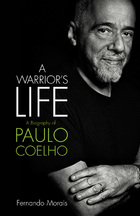
Review: A Warrior’s Life: A Biography of Paulo Coelho by Fernando Morais

Biographies are difficult to review – no matter how good the biographer’s writing might be, the success of the book really depends on how interesting the subject of the biography is. Fortunately for Fernando Morais and the reader, Paulo Coelho has evidently had a far more eventful life than the average person. The first half of the book, which dealt with Coelho’s early life, was fascinating although I found I started to lose interest nearer the end.

Paulo Coelho was born in Rio de Janeiro, Brazil, in 1947. As a teenager he was a rebel who performed badly at school and was constantly getting into trouble, insisting that all he wanted to do was read and write. His parents, not knowing what else to do with him, sent him to a psychiatric clinic where he was given electroshock therapy. Paulo later began experimenting with drugs and became involved in black magic. In 1974, he was arrested and imprisoned after being accused of subversive activities against the Brazilian government. His life reached a turning point in 1986, when he went on a pilgrimage to Santiago de Compostela, a journey that inspired one of his first major books, The Pilgrimage. Today, Coelho is one of the world’s most popular authors and has sold over 100 million copies worldwide.

Many biographers (particularly the authors of unauthorised biographies) allow their own opinions and speculations to get in the way of the facts – Fernando Morais does not do this. The book was written with the full cooperation of Paulo Coelho and Morais writes in a professional, factual style. He was given full access to Coelho’s diaries which date back to his teenage years, though he repeatedly points out that Coelho tended to fantasize in his diary entries and therefore we can’t place too much reliance on them. However, the inclusion of the diary entries, along with other fragments of Coelho’s writing, gives us a better insight into his mind.

Morais looks at every stage of Coelho’s life in so much depth it’s obvious that he spent a lot of time researching the book thoroughly. He provides a complete list of all the people he interviewed during his research including some of Paulo’s friends, family members and former girfriends. Some of Coelho’s fans may be disappointed and disillusioned as he is often portrayed in a bad light, but as the biography was published with Coelho’s blessing, he was obviously happy for us to read about the negative aspects of his character as well as the positive.

A Warrior’s Life was an interesting book to read, despite the fact that before beginning it I knew almost nothing about Paulo Coelho. I received a review copy from LibraryThing Early Reviewers and was glad to have an opportunity to read a biography I would probably never have read otherwise.

Genre: Non-Fiction (Biography)/Pages: 496/Publisher: Harper Collins/Year: 2009/Source: Received from LibraryThing Early Reviewers

Booking Through Thursday: History

Here’s this week’s question from Booking Through Thursday.

Given the choice, which do you prefer? Real history? Or historical fiction? (Assume, for the purposes of this discussion that they are equally well-written and engaging.)

Historical fiction is my favourite genre of book. If I’m reading real, factual history (even when it’s well-written) I sometimes find it boring, whereas historical fiction helps to bring the past to life in an entertaining, enjoyable way. I often find I learn a lot about historical events through reading fiction. However, it’s important to remember that it is fiction and not necessarily 100% accurate.

I very rarely read non-fiction, so if anyone would like to recommend some well-written and engaging history books it would be very much appreciated.

What about you? Do you prefer real history or historical fiction?

Review: A Christmas Carol by Charles Dickens

“Men’s courses will foreshadow certain ends, to which, if perservered in, they must lead,” said Scrooge. “But if the courses be departed from, the ends will change…”

A Christmas Carol is the one classic that almost everyone knows, even if they’ve never read the book. It’s the story of an old, money-obsessed miser called Ebenezer Scrooge who is given the chance of redemption one Christmas Eve when he is visited by the ghost of his deceased business partner, Jacob Marley. Marley warns Scrooge that unless he changes his ways, he will end up like Marley himself, doomed to wander the earth bound by heavy chains of his own making. During the night Scrooge is visited by three more spirits – the Ghosts of Christmas Past, Christmas Present and Christmas Yet to Come – who help him to understand that there are more important things in life than money: things such as generosity, compassion and kindness. The scenes Scrooge witnesses that Christmas Eve are to change his life forever and transform him into a different person.

A Christmas Carol is shorter and easier to read than most of Dickens’ other books and really is suitable for people of all ages. I loved it as a child and after re-reading it this week for the first time in years, I loved it as an adult too. No matter how many movies, cartoons or TV adaptations you may have seen, it’s still worth reading the book for the richness and humour of Dickens’ writing and for his wonderful descriptions and imagery. For example when describing the location of Scrooge’s home, hidden away in a gloomy yard, he says:

 “…one could scarcely help fancying it must have run there when it was a young house, playing at hide-and-seek with other houses, and have forgotten the way out again”.

There are great lines like this one throughout the entire book. I also loved his portrayal of a Victorian Christmas in 19th century London.

Although some readers might find it too sentimental at times, it’s easy to see why this book has become a timeless classic, as it is everything a good Christmas story should be – heartwarming, inspirational and with an important message for us all.

Recommended

Genre: Classics/Pages: 147/Publisher: Chancellor Press/Year: 1985 (originally published 1843)/Illustrations by Arthur Rackham/Source: My own copy

New Book Arrival – 23rd December 2009


Today I received Evil at Heart by Chelsea Cain which I won in a giveaway at A Bookshelf Monstrosity. Thanks Amanda!

Synopsis:

Gretchen Lowell is on the loose. A sensationalist media has turned her into a star. Her face graces magazine covers…women get “beauty killer” manicures…there are sightings of her worldwide…even kids wear t-shirts that read “Run, Gretchen.” Most shocking of all, a fan club has formed – counting the number of days Gretchen Lowell has been free.

Archie Sheridan has hunted her for a decade. He lived and breathed her crime scenes, only for her to be right there in front of him, all along. He’s suffered long and hard…and been left near death. After his last attempt to capture her went spectacularly wrong, he’s been hospitalized for months.

When a dead body is found with Gretchen’s signature heart, Archie is forced into action. Has the Beauty Killer returned to her ways – or has the cult surrounding her created a whole new evil?

Historical Fiction Reading Challenge


The Historical Fiction Reading Challenge is hosted by Royal Reviews.
I know I have already signed up for the Year of the Historical Challenge, but I wanted to join this one too because I read so much historical fiction anyway. I’m signing up for the Obsessed level – 20 books.

Challenge Guidelines (taken from the challenge post)


1. Anyone can join. You don’t need a blog to participate.

2. There are four levels:

— Curious – Read 3 Historical Fiction novels.

— Fascinated – Read 6 Historical Fiction novels.

— Addicted – Read 12 Historical Fiction novels.

— Obsessed – Read 20 Historical Fiction novels.

3. Any book format counts.

4. You can list your books in advance or just put them in a wrap up post. If you list them, feel free to change them as the mood takes you.

5. Challenge begins January 1st thru December, 2010. Only books started on January 1st count towards this challenge.

Books read for this challenge (updated March 30th 2010)

1. The White Queen by Philippa Gregory
2. The Divine Sacrifice by Tony Hays
3. The Far Pavilions by M. M. Kaye
4. Whistling in the Dark by Tamara Allen
5. Alice I Have Been by Melanie Benjamin
6. Drood by Dan Simmons
7. In a Far Country by Linda Holeman
8. O, Juliet by Robin Maxwell