Not Quite The Sunday Salon

After I started typing this week’s Sunday Salon post it occurred to me that changing my blog address means I’m no longer officially a member of the Sunday Salon and as they’re not accepting new members at the moment I’m not able to rejoin.  However, I think I’ll still continue to do Sunday Salon posts on an informal basis – it just means they won’t show up on the official feed.

I’ve been here at WordPress for a week now and so far I’m very happy with it. Apart from a few initial problems, the move from Blogger has gone quite smoothly but if you notice anything not working properly please let me know!  One thing I love is being able to reply to comments individually as it’s still not possible to do that on Blogger (unless you install a separate commenting program such as Intense Debate).

This week I’ve been reading Wild Swans by Jung Chang. I’m slightly ashamed that it’s taken me so long to get round to reading it because I’ve been hearing about it for a long time and it has been on my Amazon wishlist literally for years. Well, better late than never. I won’t say too much about it here, except that I can’t remember ever being so gripped by a non-fiction book before.  I’m almost finished so should be posting my review soon.

I also signed up for Nymeth’s 1930s mini-challenge this week. The idea is to read books ‘from, set in, or about the 1930s’. I didn’t really want to be signing up for any more challenges because I think I’m doing enough already, but this one appealed to me as the first half of the 20th century appears to be a time period that I neglect in my reading. I usually seem to read either more recent books or pre-20th century books. At the moment I don’t know exactly what I would like to read, but as the challenge runs until July 18th I’m sure I’ll have time to read at least one 1930s book!

On Monday I found an interesting article in The Times about the portrayal of women with mental illnesses in 19th century literature – the article discusses Bertha Rochester, Anne Catherick and Emma Bovary as examples.

Finally, a reminder that my Michael T. Darkow giveaway in which you can win a copy of Our Promised Land is still open. You have until Thursday 29th April to enter – see the review and giveaway post for full details.  Winners will be announced on Friday.  Good luck!

Short Story Mini-Review: An Imaginative Woman by Thomas Hardy

An Imaginative Woman by Thomas Hardy (1894)

This is the first of Thomas Hardy’s short stories that I’ve read but I would now like to read more. As you might expect from Hardy, An Imaginative Woman is well-written and descriptive but with a slightly dark and melancholy feel.

Ella Marchmill, the ‘imaginative woman’ of the title is an aspiring poet, writing under the male pseudonym of John Ivy because ‘nobody might believe in her inspiration’ if they knew she was a woman. Her husband, a gunmaker, is her exact opposite in temperament and interests. When the couple and their three children go on holiday to Solentsea in Upper Wessex, Ella becomes obsessed with the previous occupier of their lodgings – a fellow poet by the name of Robert Trewe. During their stay in Solentsea she convinces herself she has fallen in love with a man she has never even met and desperately tries to arrange a meeting with Trewe. As I don’t want to spoil the story for you I won’t reveal any more of the plot and will leave it to you to find out whether or not Ella succeeds in meeting Robert Trewe.

No, he was not a stranger! She knew his thoughts and feelings as well as she knew her own; they were, in fact, the self-same thoughts and feelings as hers, which her husband distinctly lacked; perhaps luckily for himself, considering that he had to provide for family expenses.

“He’s nearer my real self, he’s more intimate with the real me than Will is, after all, even though I’ve never seen him,” she said.

The theme of this story was actually very similar to the Mary Elizabeth Braddon novel The Doctor’s Wife which I reviewed a few weeks ago, in which a woman becomes bored with her marriage and develops an obsession with another life that exists only in her fantasies. The outcome of the two stories, however, is very different. There’s a clever plot twist at the end of An Imaginative Woman but I found the final few paragraphs a bit too harsh and cruel.

If you’d like to read this story yourself, you can find it online here.

The illustration by Arthur J. Goodman shown at the top of this post originally appeared in The Pall Mall Magazine in April 1894 and depicts Robert Trewe and Ella Marchmill – Picture courtesy of Philip V. Allingham

Have you read any of Thomas Hardy’s short stories? Which one do you think I should read next?

Childhood Memories: Ursula Moray Williams

I don’t usually review children’s books on my blog, but in my new series of Childhood Memories posts I’ll be spotlighting some of my favourite authors from my childhood, many of whom seem to have been largely forgotten today. In this first post I’m remembering Ursula Moray Williams.

Ursula Moray Williams was born in Hampshire, England on April 19, 1911. Throughout her career she wrote nearly 70 children’s books including Adventures of the Little Wooden Horse, Gobbolino the Witch’s Cat and The Good Little Christmas Tree. She died on October 17, 2006, having had one of the longest publishing careers of any children’s author.

Author Trivia:

  • Ursula had an identical twin sister called Barbara.
  • Her uncle, Sir Stanley Unwin, was the founder of the George Allen and Unwin publishing house, who published J. R. R. Tolkien’s The Hobbit in 1937.
  • She married Peter John in 1935 – he was the great-grandson of the poet Robert Southey.

Ursula Moray Williams obituary from The Independent

Wikipedia entry with bibliography

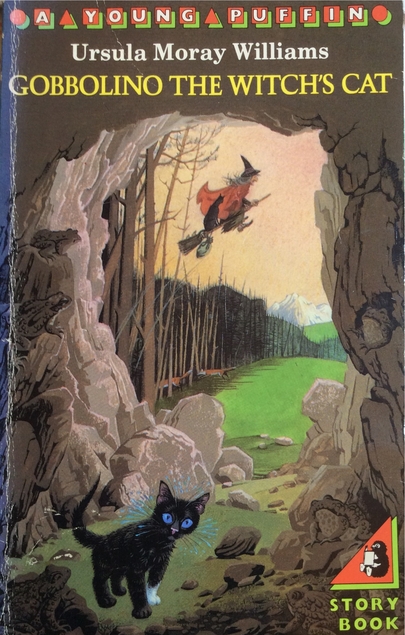
Gobbolino the Witch’s Cat was one of my favourite books as a child. I had a copy at home, but I remember reading it at school as well (where we also learned a song to go with the book – no, I’m not going to sing it for you! I was able to find it on Youtube though).

Gobbolino is a witch’s kitten, but unlike his sister Sootica who enjoys learning magic spells and flying a broomstick, he dreams of becoming an ordinary kitchen cat. When the witch notices that Gobbolino has blue eyes and one white paw (apparently a witch’s cat should be black with green eyes), she abandons him and he sets off alone in search of a warm fire and a family who will love him.  In quick succession, Gobbolino attempts to become a farmhouse cat, an orphanage cat, a show cat, a ship’s cat, a princess’s cat and a woodcutter’s cat – but every time he thinks he’s found the perfect home, his new owners discover that he’s really a witch’s cat and ask him to leave.

“Oh, why was I born a witch’s cat?  Oh, why?” thought Gobbolino when at last they were out of sight. “I could wish for nothing better than a home with such kind and pleasant people as these, but no!  Everyone turns against me, and oh my goodness, what is to become of me now?”

Gobbolino is such a lovable, kindhearted character it would be almost impossible not to like him and to want him to find the happy home he’s been wishing for!

Adventures of the Little Wooden Horse was published in 1938, a few years before Gobbolino, and was a very similar story.  The little wooden horse is a toy who doesn’t want to be sold, preferring to remain with his creator, Uncle Peder the toymaker.  When Uncle Peder becomes ill, the little wooden horse is forced to go out into the world and attempt to make his fortune – while dreaming of the day when he and the toymaker will be reunited.

Although I loved these books I used to think they were very sad, and would cry every time Gobbolino or the Little Wooden Horse had to leave yet another potential home – though I didn’t find them quite as sad when I re-read them this week in preparation for writing this post!  I think these books would be perfect bedtime stories because of the way they are structured with each chapter being a complete little story in itself.

Have you read any of Ursula Moray Williams’ books – or have you read them to your children?

Review: The Warden by Anthony Trollope

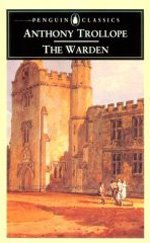
Being a lover of Victorian fiction, I have wanted to read something by Anthony Trollope for a long time but didn’t know which of his books to begin with. I’ve heard a lot about The Way We Live Now and Can You Forgive Her? but I decided to go with The Warden because it’s relatively short and I thought that if I wasn’t enjoying it I’d be more likely to finish a book with 200 pages than one with 800. Luckily, this wasn’t a problem – I enjoyed the book and wouldn’t have minded if it had been longer.

In the year 1434 John Hiram established a hospital (or almshouse) in the town of Barchester where for centuries to come, twelve elderly, infirm men could live under the care of a warden. At the time when the story takes place, Septimus Harding is the current warden and whilst the amount of money given to the old men has barely changed at all over time, the warden’s income has increased to eight hundred pounds a year. When reformer John Bold decides to investigate, Harding finds himself facing a moral dilemma.

The book really made me stop and think, because none of the characters seemed to be either completely in the wrong or completely in the right.  Although it was clearly unfair that Mr. Harding was receiving so much money, I sympathised with him because as soon as the unfairness of his position was brought to his attention he became determined to do the right thing.  As for the other main characters – John Bold and Harding’s son-in-law Archdeacon Grantly – although they are on opposite sides of the debate and have very different opinions regarding the warden’s situation, Trollope presents them both as well-intentioned people with normal human flaws.  The female characters don’t play a very big role in this book, but I loved the relationship between Mr. Harding and his daughter Eleanor.

I really liked Trollope’s writing style which is elegant, insightful and witty in a gentle way.  There are a few chapters where he departs from the main storyline to spend several pages talking about politics or the media but this is a common trait of Victorian writers.  Although it was slow moving in places, Trollope managed to keep me interested from beginning to end.  I’m sure some of his other books will be better, but this one was good enough to make me want to read more of his work.

Recommended

Publisher: Penguin Classics/Year: 1984 (first published 1855)/Pages: 240/Source: My own copy bought used

Here I am!

Hello and welcome!

To those of you who have followed me over from Helen Loves Books, you’ll see that all my old content is still here (including your comments) – I wanted a fresh start with a new name and new look, but I didn’t want to lose all those reviews I’d worked so hard on!  If you’re wondering about the new name, see the quote at the top of my sidebar (it’s not completely true because I do sometimes read the Sunday papers, but I’m much more likely to spend my Sundays with a novel).

There is one other change that you might notice – I’ve made the decision to remove my five star rating system.  From now on my reviews will not be given conventional ratings, but if it’s a book I particularly enjoyed it will be marked as either Recommended or Highly Recommended.  Other than that, everything else is the same.

To those of you who are visiting for the first time and are wondering what I’m talking about, I have just moved from Blogger to WordPress.  I’ve successfully imported my old Blogger content but there may still be some broken links or things that just don’t look right – don’t worry, I’m going to be working on tidying things up over the next few days.

I hope you all like the new blog!

Review and Giveaway: Our Promised Land by Michael T. Darkow

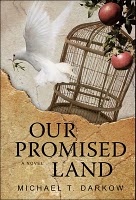
Our Promised Land by Michael T. Darkow is a book about the Israeli-Palestinian conflict over the Holy Land. Keep reading for your chance to win a copy.

My review:

Our Promised Land follows the lives of two families, each on different sides of the Israeli-Palestinian conflict. The story begins during World War II when we see Ellie Liebowisc, who is a Jew, being herded onto a train with his mother and a group of other Jews from their town, having been told that they were going to be ‘resettled’ (‘resettlement’ being a euphemism for the concentration camp and gas chamber). However, Ellie is one of the lucky ones who survives the war and makes his way to the newly created Israel, determined that his people shouldn’t have suffered for nothing.

Next we are introduced to Yasif, a Palestinian boy whose family and neighbours are growing increasingly unhappy about the arrival of the Jews. Yasif is given the chance to go and study in America, but even there he can’t escape from what is going on – and a mysterious voice refuses to let him forget…

Before I started to read this book I thought I might have difficulty understanding it, as the Palestinian-Israeli situation is a subject I know very little about. However, I felt I came away from the book with a better knowledge of the origins of the conflict and why the people involved feel the way they do.

One of the things I really liked about the book was that it is told from both the Israeli and the Palestinian viewpoint, so that the reader is able to see things from two different perspectives. Whilst I was reading Ellie’s sections of the book I felt saddened and angered by the treatment the Jews had received and I could understand his feelings. The opening scenes when he and his mother arrived at the concentration camp were very moving and stayed in my mind even after finishing the book. On the other hand, during Yasif’s part of the story I could sympathise with the Palestinians. This was a good approach for a neutral reader like myself who has no personal involvement in the conflict. The only characters I didn’t sympathise with were those who unfortunately thought the way to solve things was through violence and terrorism.

The book has an unusual structure being told in a series of vignettes, or snapshots of particular moments, moods and ideas. This means it’s sometimes necessary for the story to jump forward in time quite abruptly, but overall I think it was an effective structure. The author also provides a time line at the front of the book to help clarify the historical background.

I would recommend this book to readers who want to learn more about the Israeli-Palestinian conflict.

Publisher: Synergy Books/Year: 2010/Pages: 192/Source: I received a review copy of this book from the author.

Giveaway (Open worldwide)

Would you like the chance to win a copy of Our Promised Land? Michael T. Darkow is kindly offering 5 copies of the book to readers of this blog.

To enter, all you need to do is leave a comment on this post, including a valid email address. Only one entry per person please.

This is an international giveaway and will end on Thursday April 29th.  Good luck!

Read-a-Thon: Final Update

Well, the April 2010 Read-a-Thon is almost over. I hope everyone enjoyed it! I’ve been reading some more of The Warden this morning and am almost finished now, so my total for the read-a-thon is one and three-quarter books. I knew I wouldn’t read as much as a lot of other bloggers, so I’m quite happy with that. It was fun anyway – I took part in a few mini-challenges and was even chosen to win a prize in Hour 11!

Thanks to all the read-a-thon co-hosts, mini-challenge hosts, cheerleaders and everyone else who was involved in making this such a great event!

Hour 10 Update

Hour 10 already! The book I’m currently reading is The Warden by Anthony Trollope. I’ve been wanting to read something by Trollope for such a long time but for some reason have just never got round to it until now.

I’m going to have to go to bed soon, but since the read-a-thon doesn’t finish here until 1pm tomorrow afternoon, I should have plenty of time to continue reading in the morning. Good luck to everyone in a different time zone or who is planning to read all night!

Mini-Challenge

This hour I also took part in another mini-challenge – Where in the World Have You Read Today? hosted by nomadreader. We were asked to place a pin on a map to show the location where the book we’re reading is set, so I posted one in England which is where The Warden takes place.

Hour 6: Update

1/4 of the way through the read-a-thon now – and I’ve finished my first book, Our Promised Land by Michael T. Darkow. You can look out for my review of that one later in the week, as I’m not planning to post any reviews during the read-a-thon.

Mini-Challenge

I couldn’t resist taking part in this Mini-Challenge hosted by Bart’s Bookshelf. For this challenge we were asked to put together a sentence formed by the titles of three or four books – here’s what I came up with:


Wild Swans Haunted The Italian

I hope everyone who’s taking part in the read-a-thon is having fun. I’m going back to my books now!