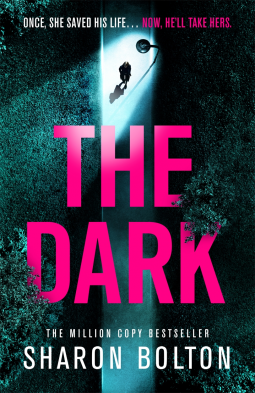
The Dark by Sharon Bolton

She’s back! After an eight year absence – during which time Sharon Bolton has written several excellent standalone crime novels – Lacey Flint has returned in possibly her darkest and most dangerous case yet. It’s the fifth book in the series and after such a long wait, I’m pleased to report that I think it’s as good, maybe even better, than the previous four.

In The Dark, Lacey is still working as a police constable for the Metropolitan Police Marine Unit, not yet ready to consider going back to her old role as a detective. When a baby is snatched from its parents and thrown into the River Thames, Lacey is there to prevent a tragedy, but the incident leaves the police and the public shocked and confused. Who would want to harm an innocent baby? They don’t have to wait long for an answer; it soon emerges that the attack was carried out by a newly formed terrorist group calling themselves MenMatter. The group believe that men’s rights are being pushed aside and that women’s freedoms need to be restricted so that ‘natural order’ can be restored. The abduction of the baby was just the first of several terrorist attacks aimed at gaining publicity for their cause.

As DCI Mark Joesbury and his team at the London Met race against time to discover who is behind MenMatter, on the streets of London tensions between men and women begin to grow. It seems the terrorists are succeeding at creating fear and division; nobody is safe, but with her heroics on the river Lacey appears to have made herself a particular target. As she and Joesburys’ team try to identify the leaders of the group, Lacey discovers that her own secrets are at risk of being exposed. Can she help bring the criminals to justice while also ensuring that Joesbury never learns the truth about her past?

The Dark has a very topical plot; I’m sure it must have been inspired by the debate surrounding the murder of Sarah Everard in the UK last year, when questions were raised over the safety of women on the streets, as well as other 21st century policing problems such as the use of the dark web to plan and launch terrorist attacks and the growing online community of ‘incels’ (involuntary celibates). The scenarios Bolton describes seem almost dystopian but also frighteningly believable and possible. However, she doesn’t try to paint all men as misogynistic or violent and fans of the series will be pleased to know that Mark Joesbury is as wonderful as ever!

As well as some heart-stopping dramatic sequences which really made me fear for some of the characters’ lives, the novel also has a mystery element, with the police trying to uncover the identity of the incel leader behind the attacks. I had my suspicions and was proved to be correct, but that didn’t take away any of the tension as I waited to see when Lacey and the others would come to the same conclusion! It was particularly fascinating to watch Georgie, one of Joesbury’s team, use her knowledge of psychology and language patterns to form theories about online identities.

Of course, one of the highlights of the Lacey Flint series is Lacey Flint herself! In this book, Lacey’s secretive nature makes her particularly vulnerable and leads her to make some decisions that at first seem stupid and reckless but are actually the result of her desperation to conceal the truth about her troubled past. I wonder if this really is the last book in the series this time; it has quite a satisfying ending but there are still plenty of loose ends that haven’t been tied up and I would love to read more. On the other hand, I also love Sharon Bolton’s standalones so will be very happy to read whatever she writes next!

If you’re new to this series, you might like to start with the first book – Now You See Me.

Thanks to Orion for providing a copy of this book for review via NetGalley.
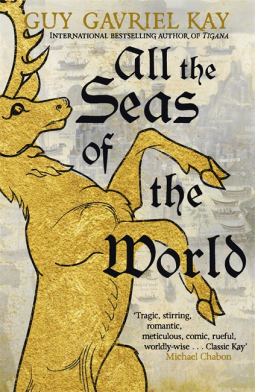
All the Seas of the World by Guy Gavriel Kay

Guy Gavriel Kay’s new novel is set in the same world as his previous two, Children of Earth and Sky and A Brightness Long Ago, but although the three books are closely linked, they are separate stories and I’m sure you could read this one as a standalone if you wanted to.

The world to which I’ve just referred is a fictional world which closely resembles the area surrounding the Mediterranean during the 15th century. Countries and cities are given different names (Italy becomes Batiara, Spain is Esperaña, Venice is Seressa) and the characters belong to one of three religions which clearly correspond to the main three religions in that part of the world at that time. The Asharites (Muslims) worship the stars, the Jaddites (Christians) worship the sun and the Kindath (Jews) worship the two moons, one blue and one white, which both shine in the sky. This third novel is set just after the Jaddite city of Sarantium has fallen to the Asharite Osmanlis, who have renamed it Asharias – like our own world’s Constantinople which fell to the Ottoman Empire in 1453 and would become Istanbul.

Some of the characters we met in A Brightness Long Ago appear again in this book, but the focus is mainly on two new characters. First, there’s Lenia Serrano, a young woman who was abducted by Asharite raiders as a child and raised as a slave. Now free, she longs to return home to Batiara but, convinced that her years in slavery will have brought shame upon her family, home is the one place she’s determined to avoid. Rafel ben Natan, our other protagonist, is a Kindath merchant whose family fled persecution in Esperaña some years earlier. Rafel’s brother has disappeared without trace, leaving Rafel responsible for his sister-in-law and her children.

As the novel opens, Lenia and Rafel have been hired by two pirate brothers to carry out the assassination of the khalif of Abeneven. Their decision to accept this assignment brings them life-changing wealth, but also has huge consequences for the balance of power between rival states, bringing the world to the brink of war.

Some readers may be put off by the labelling of Kay’s novels as ‘fantasy’, but other than the alternate names for people, places and religions, and one or two very subtle supernatural elements, this book (like most of his others) is much closer to historical fiction than it is to traditional fantasy. Setting his story in a thinly-disguised version of Renaissance Europe gives Kay an opportunity to explore that period of history while being freed from the constraints of having to stick to historical fact. However, in this particular book, there are also some obvious parallels with today’s world; exile and displacement are major themes, with various characters being forced to leave their own countries because of war, persecution or other reasons and then either searching for somewhere new to make their home or trying to find a way to return.

This is a beautifully written novel, but I do think Kay’s writing style is probably a bit of an acquired taste. Much as I like his books, I’m starting to find his habit of going off on tangents to explore the lives of minor characters and the heavy messaging around choices and the consequences of our actions very repetitive. These most recent books are not his best, in my opinion – his earlier ones seemed to have stronger plots and a tighter focus, so if you’re new to his work I would recommend starting with one of those; Tigana is my favourite and The Lions of Al-Rassan is also very good (and set in this same two-mooned world several centuries earlier). Readers who’ve already enjoyed some of his other historical fantasy novels should enjoy this one too; I did and am looking forward to reading the remaining ones I still haven’t read.

Thanks to Hodder & Stoughton for providing a copy of this book for review via NetGalley.
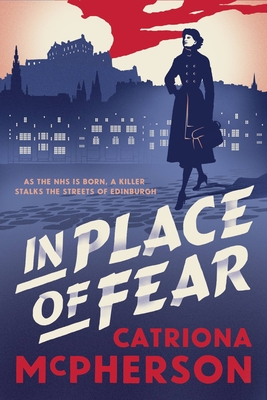
In Place of Fear by Catriona McPherson

Catriona McPherson is an author I’ve wanted to try for a while; I keep seeing her books on other blogs I follow and they always sound interesting. Her latest novel, In Place of Fear, turned out to be a good one for me to start with; it’s a fascinating historical mystery set in Edinburgh just after World War II.

It’s 1948 and Helen Crowther is about to start a new job as medical almoner for the newly formed National Health Service. Working alongside two doctors, Dr Deuchar and Dr Strasser, Helen will be making home visits to patients, giving them advice and ensuring that they get the help they need – a role similar to a modern-day social worker. She’s looking forward to the new job, but at the same time she knows there are going to be difficulties: first of all, she will have to convince the disbelieving public that healthcare under the new NHS really is free and they no longer need to worry about paying for their treatment; she also has to contend with the disapproval of her mother, who wishes she would get a job in a factory like other working class women. It comes as a relief when Dr Strasser offers Helen the upstairs flat in an empty building he owns, so that she and her husband, Sandy, can move out of her parents’ overcrowded house at last.

Helen’s marriage has not been a particularly happy one so far; Sandy has spent several years in a POW camp and since returning to Scotland has been struggling to cope with married life. Helen hopes the situation will improve now that they can be alone together, but just as she and Sandy are beginning to settle into their new home, she discovers the body of a young woman in the air raid shelter in the garden! The doctor is summoned and after examining the body he decides that it was suicide, but Helen is not convinced. Who is this young woman and how did she die? Helen is determined to find out, even though everyone else seems equally determined to cover up what has happened.

The mystery aspect of this novel takes a while to get started and never really becomes the main focus of the book until near the end when Helen begins to uncover some secrets that have remained hidden for several years. However, I thought it was a very intriguing mystery and although I had my suspicions as to who the culprit might be, I was unable to guess the other parts of the solution. Looking at other reviews of the book, it seems that a lot of readers were disappointed that the crime element wasn’t stronger but this didn’t really bother me as I was finding it so interesting to read about life in 1940s Edinburgh and the beginnings of the NHS. There’s also a heavy use of Scottish dialect which I suppose people will either like or they won’t, but I thought it added to the strong sense of time and place and I found it easy enough to follow what was being said.

A lot of time is spent on Helen’s visits to people in the community, particularly young mothers and those who are hoping to become mothers, so that she can advise them on diet and hygiene and make sure they are receiving the medical care they’re entitled to. I wasn’t familiar with the role of medical almoners before reading this book, so I found it fascinating to learn about what the job involved. Before 1948, the almoner would assess patients to decide how much they could afford to pay, but with the birth of a health service that was ‘free at the point of use’ this became unnecessary and the almoner could devote more time to actually helping the patients with their medical and welfare needs. However, Helen sometimes goes above and beyond what is required and sometimes she makes mistakes or is seen as interfering in things that are none of her business. It was watching her going about her daily work and trying to decide how to handle each difficult situation that I found particularly enjoyable, so it didn’t matter to me that the mystery was so slow to develop.

I would like to try more of Catriona McPherson’s books. If you’ve read any of them, please let me know which one I should read next!

Thanks to Hodder & Stoughton for providing a copy of this book for review via NetGalley.

This is book 24/50 read for the Historical Fiction Reading Challenge 2022.

20 Books of Summer – 2022

20 Books of Summer, hosted by Cathy at 746 Books, is a very simple idea: make a list of twenty books (there are also ten and fifteen book options) and read them during the summer months. However, it’s much more difficult than it sounds; I have taken part for the last five years and have never managed to complete it. I do usually read twenty books during the three month period – just not the twenty that were on my list! I should probably allow myself more flexibility and take advantage of the rule that says we can change our list halfway through.

This year’s 20 Books of Summer starts on Wednesday 1st June and finishes on Thursday 1st September. I have listed below the books I would like to read. These are a mixture of review copies from NetGalley, books from my Classics Club list, books for the Read Christie 2022 challenge (I’m planning to join in with the July and August Christies, but not the June one) and other books that have been waiting on my shelf for a long time.

~

1. Godmersham Park by Gill Hornby
2. The Colour Storm by Damian Dibben
3. Death on Gokumon Island by Seishi Yokomizo
4. At Bertram’s Hotel by Agatha Christie
5. Haven by Emma Donoghue
6. Pied Piper by Nevil Shute
7. Shadows and Strongholds by Elizabeth Chadwick
8. Death in the Andamans by MM Kaye
9. Summerhills by DE Stevenson
10. Fortune by Amanda Smyth
11. The Mirror and the Light by Hilary Mantel
12. A Pin to See the Peepshow by F Tennyson Jesse
13. Destination Unknown by Agatha Christie
14. The Fortune Men by Nadifa Mohamed
15. Excellent Intentions by Richard Hull
16. The Rose of Sebastopol by Katharine McMahon
17. Fool’s Quest by Robin Hobb
18. The Wolf Den by Elodie Harper
19. Something Light by Margery Sharp
20. The Flight Portfolio by Julie Orringer

~

Have you read any of these? Which should I read first? And are you taking part in 20 Books of Summer this year?

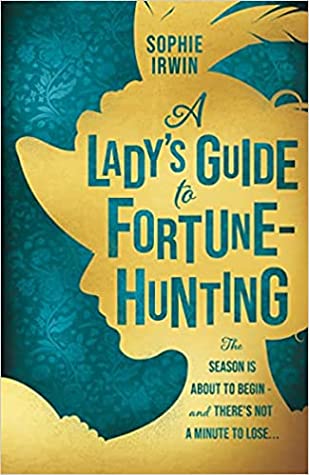
A Lady’s Guide to Fortune-Hunting by Sophie Irwin

This was a gamble for me; I don’t usually read Regency romances other than Georgette Heyer’s and I was worried that this book might be silly and derivative. However, I’m pleased to say that I found it entertaining, intelligent and thoroughly enjoyable. Although some elements of the plot undoubtedly draw heavily on Heyer and Austen and we have a heroine who in many ways resembles Becky Sharp from Vanity Fair, Sophie Irwin still manages to make the story feel fresh and engaging.

Kitty Talbot is the eldest of five recently orphaned sisters whose father has left them with a mountain of debt and in danger of losing their home. Having just been jilted by her wealthy fiancé, Kitty decides that the only solution is to find another rich man to marry – but unless she can do so within the next twelve weeks, Netley Cottage will be repossessed and the family thrown into poverty. So, accompanied by her sister Cecily, Kitty heads to London for the Season, determined to launch herself into society and find a suitable husband as soon as possible.

Once settled in London at the home of her mother’s old friend, Aunt Dorothy, Kitty sets her sights on young Archie de Lacy, who quickly succumbs to her charms. But just as Archie seems to be on the verge of proposing, his brother Lord Radcliffe arrives from his country estate – and sees straight through her plans. This is going to make finding a husband much more difficult than Kitty had expected!

Although I could predict from early in the novel how it was going to end, that didn’t make it any less fun to read. Sophie Irwin throws just about everything into the story that you would expect to find in a Regency romance: balls, dinner parties, trips to the theatre and the Vauxhall Pleasure Gardens, carriage rides, notorious gambling dens, elopements to Gretna Green and encounters with highwaymen. There are also plenty of interactions between our heroine and the man we can quickly guess is going to be the hero, allowing us to watch their relationship develop over the course of the novel.

Kitty is unashamedly open – at least to her family and friends – about her plans to marry for money. She’s ruthless and manipulative, yet it’s clear that everything she does is for the sake of her younger sisters and she is not motivated by greed or personal comfort. Even though you know that what she is doing is morally wrong, you can’t help hoping that she succeeds. I also hoped for some happiness for her sister, Cecily, who at eighteen is just a few years younger and has accompanied Kitty to London at their Aunt Dorothy’s suggestion. The bookish, intellectual Cecily is more comfortable reading poetry or visiting a museum, but she reluctantly tags along with Kitty to tea parties and dances and almost ruins her sister’s schemes by making one faux pas after another.

I noticed one or two words and phrases that don’t belong in a Regency novel (‘misgendering’ being the worst example), but the language is generally appropriate and the period is brought to life quite vividly. The book does have a lot of interesting things to say about wealth, the class system and why some people should be denied the same opportunities in life as others just because they come from a less privileged background. This gives the novel some extra depth and makes it more than just a light romance.

This is Sophie Irwin’s first novel, but I’m already looking forward to her next one.

Thanks to HarperCollins for providing a copy of this book for review via NetGalley.

This is book 23/50 read for the Historical Fiction Reading Challenge 2022.

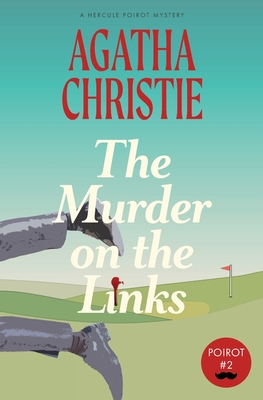
The Murder on the Links by Agatha Christie

The May theme for Read Christie 2022 is “a story set in Europe” and The Murder on the Links is the perfect choice as the story takes place almost entirely in France.

First published in 1923, this is a very early Poirot novel (just the second in the series, in fact) and one of several to be narrated by Captain Arthur Hastings. Hastings, a close friend of Poirot’s, is on his way home to England from France when he meets a girl on the train who introduces herself only as ‘Cinderella’. For Hastings, it’s love at first sight, but when they part ways he doesn’t expect to ever see her again.

The next day, Hastings learns that Poirot has just received a letter from a Mr Paul Renauld requesting him to come to his home in France as soon as possible because he believes his life is in danger. The two set off at once, only to discover that Renauld had been murdered the night before, his body found on the new golf course which is under construction near his house. There are several suspects, but when Cinderella reappears and seems to have some involvement in the murder, Hastings will have to choose between his love for her and his loyalty to Poirot.

I enjoyed this, although I don’t think it’s one of the better Poirot novels I’ve read. None of the characters are particularly memorable or appealing; her characterisation would be stronger in later books in the series – maybe at this early stage she was still concentrating on developing the character of Poirot himself. In this book he has a rival – the French detective Monsieur Giraud – and we can see the contrast between their detecting methods. Poirot refers to Giraud as ‘a human foxhound’, someone who ‘sniffs out’ clues like footprints and cigarette ends while failing to see the bigger picture or to consider motive and psychology as well as physical evidence. Meanwhile, Giraud is equally scornful of Poirot’s approach to crime-solving. I’m sure I don’t need to tell you which of the two detectives will eventually solve the mystery!

I usually like the books narrated by Hastings, who is a sort of Watson to Poirot’s Sherlock Holmes. He provides a viewpoint close to Poirot, while also being as mystified as we are by Poirot’s methods and deductions. I did find him slightly irritating in this book, with his tendency to instantly fall in love with every young woman he meets, but the romantic subplot does have a purpose as it leads to Hastings departing for Argentina, only to make occasional reappearances for the rest of the series.

Overall, this is a typically clever and entertaining Christie novel, but probably not one that I’ll be tempted to re-read. As a final note, don’t be put off by the many covers of this book that show people playing golf – apart from the golf course being the location of the dead body, golf has absolutely nothing to do with the plot!

The Dance Tree by Kiran Millwood Hargrave

Having enjoyed Kiran Millwood Hargrave’s previous book, The Mercies, I was looking forward to reading more of her work. This new novel, The Dance Tree, sounded very different, but equally intriguing. It’s set in 16th century Strasbourg during a plague of dancing – yes, dancing, which sounds harmless but, as the novel shows, is anything but.

The Dance Tree begins in 1518 and introduces us to Lisbet, a young pregnant woman, who lives with her husband and mother-in-law. Lisbet has already lost several babies and is determined to carry this one to full term; while her pregnancy advances she finds comfort in looking after the bees that provide the family’s livelihood and visiting the tree she has decorated in memory of her lost children. One day, Lisbet’s sister-in-law, Agnethe, comes home from the nunnery where she has been doing penance for the last seven years; Lisbet has no idea what the sin was that resulted in Agnethe being sent away, but she does know that her return has changed the dynamics within the household and that life will not be quite the same again.

Meanwhile, in the centre of Strasbourg, Frau Troffea walks into a market square, lifts up her hands and begins to dance. She is soon joined by more women…and more…and more, all of them dancing until the soles of their feet bleed. As the women continue to dance day after day – a desperate, frenzied dance that shows no sign of coming to an end – the authorities try to bring them under control, without success.

I knew nothing about the dancing plague before reading this book, so I found that aspect of the novel fascinating. Many theories have been put forward over the years to explain why the women danced, ranging from demonic possession or religious trance to ergot poisoning or mass hysteria. Even today, historians don’t know for sure what was behind the epidemic, but to help us understand some of the possible reasons, Kiran Millwood Hargrave provides back stories for some of the individual dancers. These stories are presented as brief chapters interspersed between Lisbet’s chapters, and although I thought they could have been better integrated into the novel as a whole, they were interesting to read.

I liked Lisbet and had a lot of sympathy for her situation, and also for her best friend, Ida, who is married to a controlling bully who belongs to the ‘Twenty One’, the group of men who rule the city. Agnethe is another intriguing character, although I found the reason for her seven-year penance too easy to guess. However, despite finding the characters interesting, I didn’t manage to form the deep emotional connection with any of them that I would have liked. I’m not sure why this should be, because Hargrave does write beautifully, except that I often find the use of present tense very distancing and I think that was the case here.

Although I didn’t love this book as much as I hoped, I would recommend Kiran Millwood Hargrave’s books to readers interested in historical fiction dealing with women’s lives in unusual settings and circumstances – in this book, the Strasbourg dancing plague, and in The Mercies, the witch trials on the Norwegian island of Vardø.

Thanks to Picador for providing a copy of this book for review via NetGalley.
This is book 22/50 read for the Historical Fiction Reading Challenge 2022.