Death in Berlin by M.M. Kaye

Death in Berlin Almost exactly a year ago I read Death in Kashmir, the first in M.M. Kaye’s series of mystery novels. I loved it – in fact, it was one of my favourite books of the year – and last week I decided it was time to try another of her Death in… novels. I chose Death in Berlin because it’s the second in the series (although the books all have different settings and characters and all stand alone).

Death in Berlin, published in 1955, is set in a Berlin struggling to recover from the devastating effects of World War II. The city is divided into zones – American, British, French and Russian – and there are ruined buildings and piles of rubble everywhere. At the beginning of the novel we meet Miranda Brand, who is on her way to Berlin with her cousin Robert and his wife Stella. Robert, an army officer, is taking up a new post there and Miranda has decided to come along for a month’s holiday, keen to have a chance to see post-war Germany. During the journey to Berlin, they and a group of other military families listen to Brigadier Brindley tell a story involving a set of diamonds stolen by the Nazis during the war – a story which has special significance for Miranda. Later that night, the Brigadier is found dead in his train compartment and when a murder investigation begins, Miranda discovers that she herself could be a suspect.

This novel has many of the same elements as Death in Kashmir – a young heroine in danger far from home, a romance with a man she’s not sure she can trust, an eerie and atmospheric setting – but this book didn’t impress me as much as the first one. It doesn’t have the stunning opening chapter that Death in Kashmir has and the characters feel less developed, to the point where I had trouble telling some of them apart. I also thought there was a lack of chemistry between Miranda and her love interest, whom I found very bland.

What I did like was the portrayal of a ruined Berlin in the aftermath of war. M.M. Kaye herself spent some time in Berlin when her husband’s regiment was stationed there, so she could draw on her own knowledge of the city while writing this novel. While it isn’t the exotic setting that 1940s Kashmir is, it does provide a great backdrop for a story of murder and mystery. Kaye really excels at creating a sense of unease and writing spine-tingling descriptions of what it feels like to be alone and vulnerable in dark, lonely surroundings – to be the only person awake in the sleeper carriage of an overnight train or to be sitting downstairs in a large, empty house and hear noises coming from upstairs.

I didn’t guess the solution to the mystery, but I did have my suspicions about various characters. I don’t think it would have been possible to work out everything, though, because a lot of information is withheld from us until the final chapters of the book. This information is provided by one of the characters who, in one very long scene near the end, sums everything up for Miranda and the reader. This is something that works well in an Agatha Christie novel, but feels a bit unnatural here.

While I didn’t like this book as much as Death in Kashmir, it hasn’t put me off wanting to read the rest of the Death in… mysteries. Death in Cyprus will probably be the next one I read, but I also have a copy of Kaye’s historical novel, Shadow of the Moon, which I’m looking forward to reading (and should really have read before now as The Far Pavilions is one of my favourite books).

Have you read any of the Death in… books? Which do you think is the best?

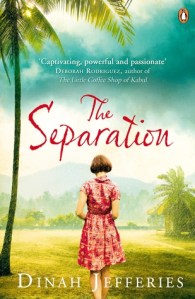
The Separation by Dinah Jefferies

The Separation Imagine that you’ve returned home from visiting a friend to find that your house is empty – your husband and children have disappeared, the servants have vanished and when you pick up the phone the line is dead. You set out in search of your family, determined to find them no matter what, but it’s not going to be an easy task because this is Malaya in 1955: a country at war.

This is what happens to Lydia Cartwright in this wonderful debut novel by Dinah Jefferies. As Lydia leaves the family home in Malacca and heads north to Ipoh believing that her husband (who works for the British Administration) may have been posted there, we discover that Alec and the two girls – Emma, aged eleven, and Fleur, eight – have gone somewhere else entirely. Will Lydia ever see her daughters again?

The Separation is divided into two distinct storylines told in alternating chapters. In one we follow Lydia as she makes the discovery that her children are missing. As she embarks on her nightmarish journey through the dangerous Malayan jungle, she faces terrorist attacks, gunfire and overcrowded buses and trains, as well as the possibility that she has been betrayed and deceived. In the other thread of the story we join Emma as she and Fleur try to settle into their new lives while coming to terms with the loss of their mother. Things are not easy for Emma and she too is forced to go through some terrible ordeals, all the while clinging to the hope that her mother is still alive and one day they will be reunited.

I thought the structure of the novel worked well; I enjoyed reading both Lydia’s chapters and Emma’s and never felt that we were spending too much time on one character at the expense of the other. Lydia’s story is more dramatic (and full of beautiful, exotic descriptions of Malaya) but of the two I think I preferred Emma’s. That could just be due to the fact that I felt closer to Emma as she narrates in the first person while Lydia’s chapters are written in the third person – or maybe it’s because although I’m not a mother I am a daughter so it was easier for me to identify with Emma. I did like and sympathise with both main characters, though, and desperately wanted them to be together again. Of course, I’m not going to tell you whether that happens or not!

I have never read anything about the history of Malaya (as it was still known in the 1950s before becoming Malaysia) so that was another aspect of the book I found interesting. The story isn’t weighed down with too much historical detail but by the time I’d finished the book I felt that I’d learned a little bit about The Emergency (the name given to the war) and what it was like to be a woman and a European living in Malaya during that period. I was interested to read that Dinah Jefferies was born in Malaya and lived there until the age of nine, which means she was able to draw on some of her own experiences and memories.

This was a very impressive first novel and I’m already looking forward to the second book from Dinah Jefferies, The Tea Planter’s Wife, which is going to be set in Sri Lanka.

Thanks to the author for sending me a copy of this book for review.

The Midwich Cuckoos by John Wyndham

The Midwich Cuckoos The Midwich Cuckoos begins as our narrator, Richard Gayford, and his wife, Janet, attempt to return to their home in the quiet English village of Midwich after a trip to London to celebrate Richard’s birthday. As they approach the village they discover that the road has been closed by the police; something very strange is happening in Midwich, a place where, as Richard tells us, things just did not happen. That night, Monday 26th September, everyone within the boundaries of Midwich has fallen asleep and anyone who tries to enter the village also loses consciousness.

The next day this phenomenon, which becomes known as the ‘Dayout’, disappears as suddenly as it arrived – the invisible barrier is lifted and people begin to wake up. At first it seems that most of the villagers have been completely unharmed by the ‘Dayout’, but a few months later they make a shocking discovery. Something did happen during their twenty-four hours of unconsciousness and it’s going to have a big effect on the lives of everyone in Midwich.

I’ve decided to end my summary of the plot here rather than tell you exactly what happened to the people of Midwich. I’m sure some of you will already know (maybe you’ve seen the film based on the book, Village of the Damned, or maybe the title of the book and the cover of my old Penguin edition pictured here have given you some clues) but I don’t really want to spoil things for anyone new to the story so I won’t go into any more details. All I will say is that I thoroughly enjoyed this book from beginning to end!

I don’t often choose to read science fiction (looking back through my blog archives I can only see five or six that I’ve read since 2009) and I wasn’t sure what to expect from this book, but The Midwich Cuckoos was probably the perfect type of science fiction for me – instead of being filled with too much action or violence, it’s a subtle, thought provoking portrayal of a small, seemingly normal community trying to cope with something that is threatening their way of life. I think it was the ordinariness of the setting that made the story so effective; this, combined with Wyndham’s thoughtful, undramatic writing style, made it possible to almost believe in what happened in Midwich, while also creating quite an eerie atmosphere.

The only problem I had with this book was that I didn’t feel any connection with the characters. The narrator himself doesn’t have a big part to play and is actually absent from the village for long periods of time, leaving large portions of the story to be told through second-hand accounts, particularly through the philosophical musings of one of the Midwich residents, Gordon Zellaby. It was also disappointing that despite the women of Midwich having such an important role in the story, we never really get to know any of them and they are rarely given a chance to participate in any of the discussions or decisions being made by the men. But although there were a few aspects of the book that I thought could have been better, I did love my first John Wyndham book and am now wondering which one I should read next.

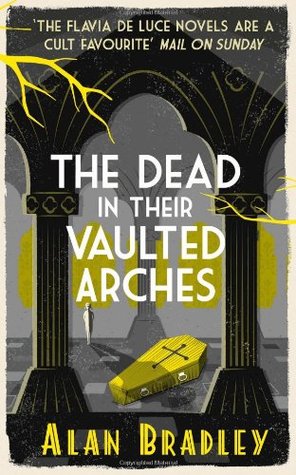
The Weed that Strings the Hangman’s Bag by Alan Bradley

The Weed that Strings the Hangman’s Bag is the second book in Alan Bradley’s Flavia de Luce mystery series. I read and loved the first one, The Sweetness at the Bottom of the Pie, last year but it’s taken me so long to find time to read this one that the third book has also now been released and is waiting patiently on my shelf.

For those of you who are new to the series, the novels are set in the small English village of Bishop’s Lacey during the 1950s and feature Flavia de Luce, an eleven-year-old detective and chemistry genius. The mysteries are not particularly complex but Flavia’s unique narrative voice makes the books a lot of fun to read.

The Weed that Strings the Hangman’s Bag begins shortly after the previous book ended, but if you haven’t already read The Sweetness at the Bottom of the Pie I don’t think it would matter too much. And if you have read The Sweetness… you’ll find that this book is really very much the same: Flavia is still conducting experiments in her laboratory, her sister Daffy is still obsessed with books, her other sister Feely is still obsessed with her appearance, Father is still collecting stamps. But the tone of this book is slightly darker than its predecessor and I enjoyed the mystery more as there were a lot of possible suspects and the villain wasn’t immediately obvious – at least not to me!

This time Flavia investigates a murder that takes place during a puppet show in the village hall and begins to connect this death with the hanging of a little boy in Gibbet Wood several years earlier. As a detective, the advantage Flavia has is that being an eleven-year-old girl she can ask questions that the police can’t ask and can convince the local people to tell her things they might not tell an adult. Being an expert in poisons helps too, of course!

Flavia hasn’t changed a lot between the first book and this, but she does feel that little bit older and her sense of humour seems sharper. I’m hoping her character is going to develop further as the series goes on. The thing I love about Flavia is that she is somehow both a believable and an unbelievable character at the same time. She has a vocabulary like no eleven-year-old I’ve ever met and both her chemical and general knowledge are exceptional even by adult standards, but despite this she still feels real to me. She also has fears and insecurities (usually covered up by her tough exterior) and this book continues to explore her difficult relationships with her sisters and father, as well as introducing another family member, Aunt Felicity.

I love the old-fashioned, innocent feel of this series, which reminds me so much of the Enid Blyton books I grew up reading. Hopefully it won’t be too long before I can let you know what I think of A Red Herring Without Mustard!

Review: The Sweetness at the Bottom of the Pie by Alan Bradley

After hearing so many good things about Alan Bradley’s Flavia de Luce mysteries, I had high hopes for this book – and I wasn’t disappointed. It was every bit as enjoyable and delightful as I had been told it was.

Eleven year old Flavia de Luce, who wears her hair in pigtails and rides a bike called Gladys, most be one of the most unusual detectives in fiction. Her biggest passion is for chemistry – and more specifically, for poisons. She loves nothing more than spending time conducting experiments in her own fully equipped laboratory and her heroes include famous chemists such as Marie Paulze Lavoisier, Robert Bunsen and Henry Cavendish.

When a dead bird with a rare stamp impaled on its beak is found on the de Luces’ doorstep, Flavia is puzzled by the effect the discovery has on her father. Later, Flavia finds something much more sinister in the cucumber patch and when her father is accused of murder, she becomes determined to clear his name.

Although this wasn’t a particularly complex mystery, it was an interesting one, involving magic tricks, a sheet of Penny Black stamps and a slice of custard pie. There were parts of it that I could figure out quite easily but others that took me by surprise. I don’t often read mysteries anymore, but this book reminded me of exactly why I used to love them! However, the mystery itself is only one element of this book. I think due to the characters and the setting (which includes all the little period details that place the story firmly in 1950 and perfectly capture a small village atmosphere), this series could appeal even to non-mystery lovers.

The main reason I enjoyed this book so much was Flavia herself. She really is a wonderful character, innocent and lovable one minute, ruthless and vengeful the next (at the beginning of the book she runs away in tears when her sisters Ophelia and Daphne taunt her by pretending she’s adopted – and then proceeds to inject poison ivy into Ophelia’s lipstick). The chemistry aspect of the book particularly interested me as I have a degree in chemistry myself – although I was never as passionate as Flavia about the subject! She seems to have a PhD level grasp of the subject already. And her sphere of knowledge also encompasses literature, history, film and music. She’s so incredibly clever and independent that it’s easy to forget she’s only supposed to be eleven. There’s no way you would expect a real child of that age to speak or behave the way Flavia does – and yet somehow, in a strange way, I was able to overlook the fact that she’s so unrealistic and could accept her as a plausible character.

I’ve seen comparisons with Nancy Drew and Harriet the Spy, but while I was reading this book I was also reminded of Enid Blyton’s Five Find-Outers series, which was also set in a small English village in the 1940s/50s and featured a group of children who always solved the mystery before the village policeman. I have no idea if Alan Bradley would have been inspired by those books at all, but there are definitely some similarities.

I loved this book and now I can’t wait to read The Weed that Strings the Hangman’s Bag!