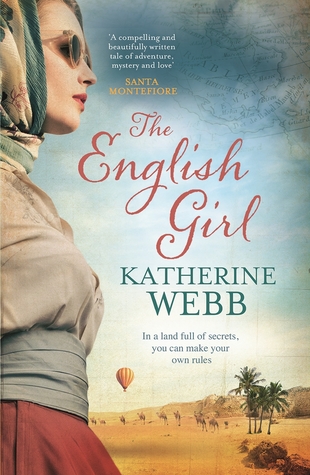
The English Girl by Katherine Webb

One of the things I love about reading is that it gives me the opportunity to learn about places I have never visited and am probably never likely to. Katherine Webb’s The English Girl is set in Oman, which is not a country I’ve ever read about before. Having previously read only The Misbegotten by Webb, I found this one a very different novel, not least because of the fascinating setting.

The ‘English girl’ of the title, Joan Seabrook, has grown up listening to her father’s stories of Arabia and longing to explore this magical, mysterious land for herself. Now, in 1958, her dreams have come true and she is on her way to Oman with her fiancé, Rory. Foreign tourists are not usually welcome in Oman, but Joan has obtained special permission – with the help of a family friend who happens to be the foreign minister – to visit her brother Daniel, who is stationed there with the British army. Having recently finished studying for her degree in archaeology, Joan is looking forward to investigating some of the sites she has heard so much about.

Arriving in the city of Muscat, Joan is disappointed to discover that the places she really wants to see – Fort Jabrin and Jebel Akhdar (the Green Mountain) – are off limits because of the war which is currently being waged in the mountains of Oman between the supporters of the Sultan and the Imam. She consoles herself with visits to Maude Vickery, the famous explorer who was the first woman to cross the desert known as the Empty Quarter and who has made Muscat her home. Maude was Joan’s childhood heroine and she is thrilled to have the chance to get to know her. Now an elderly woman, Maude is bitter, sharp-tongued and resentful, and not at all what Joan had expected, but when Maude asks her to carry out an important mission on her behalf, Joan is unable to refuse – even if it means putting her own life in danger.

As I’ve said, this is the first book I have read set in Oman, and I loved the beautiful descriptions of the deserts, the mountain ranges, the valleys and forts, and the streets of Muscat. It’s the perfect backdrop for Katherine Webb’s story of adventure, mystery and romance! This is also the first time I’ve read about the Jebel Akhdar War of the 1950s and the conflict between the interior of Oman (the Imamate) and the Sultanate of Muscat. The British army supported the Sultan in the war and as Joan’s brother Daniel is a soldier, this gives the characters in the novel a personal connection to events taking place around them.

Although I found a lot to enjoy, it took me a while to really get into this book and I think that was partly because Joan just didn’t appeal to me as a character. I wasn’t very interested in her relationships with Rory and Daniel and I felt that she kept putting herself into dangerous situations unnecessarily. I hoped I would warm to her eventually, but I didn’t. However, this is not just Joan’s story – it is also Maude’s, and while she is not the most likeable of characters either, she is a fascinating one.

As soon as I began to read about Maude, I thought of the real-life explorer Gertrude Bell, and after finishing the book I wasn’t surprised to see that the author’s note at the end confirmed that she had been the inspiration for the character. About half of the novel is written from Maude’s perspective, taking us back in time to her exciting journey through the Empty Quarter and her determination to get across the desert before her friend and rival Nathaniel Elliot. By the time I reached the end of Maude’s story, I admired her for what she had achieved but I also understood what had shaped her into the bitter, unhappy old woman Joan meets in Muscat.

The English Girl could be thought of as a novel of secrets as everyone seems to be hiding something. Maude, betrayed by someone she thought she could trust, has been trying to hide her pain and heartbreak for most of her life, while Nathaniel has also been concealing something that happened on his own expedition. Both Rory and Daniel are keeping secrets from Joan and there are hints of further mysteries as far back as Joan’s childhood too. Most of all, there are the secrets of Oman and of the desert and seeing these unfold as the setting is brought to life will be my lasting memory of this book.


The Winds of Heaven by Monica Dickens

When I saw that Jessie of Dwell in Possibility was hosting a Mini Persephone Readathon this weekend, I knew I wanted to take part and I knew exactly what I would be reading: The Winds of Heaven, a book published by Persephone which I had originally been planning to read for Jane’s Monica Dickens Day last month but didn’t have time. I wasn’t sure what to expect from Monica Dickens as I’ve never read any of her books before, but I loved this one and will now be looking for more.

The Winds of Heaven (1955) follows the story of Louise Bickford, whose husband, the controlling and oppressive Dudley, dies a year or two before the novel opens. Left alone with no money to support herself, Louise cannot afford anywhere to live, so is forced to rely on the hospitality of her daughters. Although Louise has shown her three daughters nothing but love and affection, they each make it very clear that they don’t really want her staying with them and see her as a burden to be moved on to the next sister as quickly as possible.

Louise is a lovely person – generous, selfless and sensitive to the feelings of others; I had a lot of sympathy for her and for the situation in which she finds herself. The logical solution would be to get a job, but a combination of factors – her age (approaching sixty), her class, her lack of experience at any type of work and the disapproval of her daughters – mean that this is never considered as a realistic option for Louise. All she can do is continue to move from one household to the next, trying to make herself useful but knowing that she is unwanted and unappreciated.

The three daughters seem to have inherited none of their mother’s good qualities. They are three very different people, but in their different ways they are all as unpleasant and selfish as each other. Miriam is a snob, obsessed with appearances and her place in the community. Her marriage is not a particularly happy one, but as Arthur is rich enough to pay for holidays abroad and ponies for the children, she’s not complaining too much! Eva, the middle sister, is an aspiring actress who lives in London and is too preoccupied with her career and her affair with a married man to give any thought to her mother’s problems. Anne, the youngest, is a farmer’s wife but does very little to help out on the farm – she is a lazy, sullen, resentful woman who thinks only of herself and her own comfort.

For a novel with so many unlikeable characters, I found this a surprisingly enjoyable and entertaining read. Louise’s story is obviously a very sad one at times, but Monica Dickens writes with enough humour and lightness that it never becomes completely depressing. And although her relationships with Miriam, Eva and Anne are difficult, Louise does have two special people in her life who make things much more bearable. One is her young granddaughter Ellen, with whom she forms a close bond. Ellen is Miriam’s eldest daughter and, like Louise, she often feels like an outsider in the family. The other is Gordon Disher, a man she meets while sheltering from the rain in a London tea shop.

Mr Disher is the most unlikely of romantic heroes – he is overweight, sells beds in a department store and writes cheap paperback thrillers with titles like The Girl in the Bloodstained Bikini. He is also a lovely, kind, gentle man who sees that Louise is unhappy and does all he can to make things better for her. Their meetings are few and far between – Louise is sure she’s too old for romance and she doesn’t spend a lot of time in London anyway – but I found their relationship quite moving and always looked forward to the moments when they were together.

Towards the end of the book, events take a more dramatic turn and if I have a criticism it would be that I’m not sure whether this was really necessary. The final sentence, though, was perfect! I wish Monica Dickens had written more books about these characters, but I enjoyed this one enough to know that I will be investigating the rest of her novels anyway!

The Winds of Heaven endpapers

Someone at a Distance by Dorothy Whipple

Today would have been Dorothy Whipple’s birthday – and she is the next author in Jane’s Birthday Book of Underappreciated Lady Authors. I have never read any of her books but have been curious about them for a while and I thought a good place to start might be Someone at a Distance, her 1953 novel which seems to be her most popular and which has been published both as a standard dove-grey Persephone and as a Persephone Classic.

On the surface, Someone at a Distance is the simple story of the breakdown of a marriage. At the beginning of the novel, publisher Avery North and his wife, Ellen, seem to be the perfect couple. Having been married for twenty years, they are no longer passionately in love but still have an affectionate relationship and appear to be quite content with their comfortable, middle-class lives. They are devoted to their two children – eighteen-year-old Hugh, who is away on National Service, and fifteen-year-old schoolgirl Anne – and have a lovely house in the countryside with a large paddock for Anne’s beloved pony, Roma. If only Avery’s mother, the elderly Mrs North, hadn’t begun to feel lonely living alone in her big house nearby, and if only she hadn’t decided to look for a companion for the summer…

Old Mrs North responds to an advertisement in The TimesYoung Frenchwoman desires to spend July, August in English home. French conversation. Light domestic duties – and soon Louise Lanier comes to stay. Louise is the daughter of a bookseller in a provincial town in France and sees coming to England as a way of escaping from the humiliation of being rejected by her lover who has recently married another woman. Bored and miserable, Louise sets her sights on Avery North and won’t be satisfied until she has caused as much trouble as possible.

As I’ve said, the plot is a simple one, but Whipple’s writing and the way in which she tells the story give it the additional layers that make it such a compelling read. You can see what is going to happen almost from the start, but you don’t know exactly when or how it will happen – and when the inevitable moment comes, you feel as shocked and upset as the characters themselves. My sympathies were with Ellen; she came across as such a genuinely nice person, who really didn’t deserve the treatment she receives from Avery and Louise. I was impressed by how well she coped with the huge changes in her life…at least until an incident near the end of the book, which disappointed me slightly as I discovered that Ellen didn’t feel quite the way I would have liked her to have felt (sorry for being vague, but I’m trying to avoid too many spoilers).

The reactions of the other characters – the North children, the servants, friends and neighbours, and Louise’s family in France – are also explored. In some ways their thoughts and emotions are timeless, but in others this does feel like a book of its time, for example when Anne is too ashamed to tell her teachers and friends at school about her parents’ separation because she thinks they will view her differently. As for Louise, she is a wonderful character. It would have been easy for Whipple to write her as a one-dimensional villain, who does what she does purely out of spite and nastiness, but instead she takes the time to show us Louise’s life in France and to try to explain what made her such a bitter person. There were times when I could almost, but not quite, feel sorry for Louise – although in the end it was her parents I pitied, as they were forced to come to terms with the sort of woman their daughter was.

Someone at a Distance is a great book, with much more emotional depth and complexity than I expected when I first started to read. Now that I’ve been introduced to Dorothy Whipple, I’m sure I’ll be reading more of her work.

As Chimney Sweepers Come to Dust by Alan Bradley

In this, the seventh book in Alan Bradley’s Flavia de Luce series, our twelve-year-old detective is sent away to boarding school in 1950s Canada, having been banished from her family home at the end of the previous novel. If you have never read a Flavia mystery before, this is probably not the best place to start; I would recommend reading at least a few of the earlier ones first, particularly the sixth, The Dead in Their Vaulted Arches, so that you will understand the reasons for her banishment and the choice of this particular Canadian school.

Anyway, back to As Chimney Sweepers Come to Dust. Almost as soon as Flavia arrives at Miss Bodycote’s Female Academy in Toronto, she stumbles upon yet another dead body – or rather, this one stumbles upon Flavia when it falls down the chimney in her room, having been dislodged by another girl who has climbed up to hide from a teacher. Why is there a dead body up the chimney? Who is it? Could it be one of the three missing girls who have all disappeared from the Academy over the last year or two? Flavia doesn’t know, but she’s determined to find out!

This is the first book in the series not to be set at Buckshaw, the de Luce ancestral home in the English village of Bishop’s Lacey. I have always found the setting to be part of the charm of these books, so although it was nice to have a change, I did find myself missing Father, Feely, Daffy, Dogger and everyone else from Buckshaw. There are plenty of new characters in this book to take their places – including an enigmatic and intimidating headmistress and a chemistry teacher who has been on trial for murder – but none of them felt as well drawn as the characters in the previous novels.

Still, I always enjoy a school setting because it brings back memories of the school stories I loved as a child, such as Enid Blyton’s Malory Towers and St Clare’s books. Maybe Alan Bradley liked that sort of story too and wanted an opportunity to write one of his own; otherwise I’m not sure I really see the point in moving Flavia out of her usual setting. I had expected the storyline involving the Nide, which was introduced in the last book, to be advanced in this one, but actually we learn very little more about it – and what we do learn just made me more confused!

I was pleased to find that this book had a much stronger mystery element than the previous one and although some parts of the mystery didn’t feel fully resolved at the end, it was nice to see Flavia back to making her lists of suspects and searching for clues. Finally, don’t Alan Bradley’s books have great titles? This one is taken from Shakespeare’s Cymbeline: “Golden lads and girls all must, As chimney-sweepers, come to dust”. The title of the next one, Thrice the Brinded Cat Hath Mew’d, is also Shakespeare-inspired. I’m looking forward to reading it – despite not liking the last two books as much as the earlier ones, I do still enjoy spending time with Flavia!

This is Book #2 for my R.I.P. XII challenge.

Leopard at the Door by Jennifer McVeigh

This is the first book I’ve read by Jennifer McVeigh, although I do remember hearing good things about her first novel, The Fever Tree. This latest one, Leopard at the Door, sounded appealing too – and I did like it, although it was a much darker novel than I’d been expecting!

The novel opens in 1952 with our narrator, Rachel Fullsmith, arriving in Kenya after an absence of six years. Rachel was born to British parents but spent her childhood in Kenya until, after losing her mother at the age of twelve, she was sent to England to live with her grandparents. Now, as an eighteen-year-old, she is returning to the place she still considers to be home, only to find that everything has changed…and not in a good way.

Trouble is brewing in Kenya, with unrest threatening to spill over into violence as the group known as Mau Mau begin to rebel against British rule. Rachel has fond memories of her friendships with the Kikuyu people and at first she isn’t too worried, but with increasing reports of oaths being sworn to the Mau Mau and attacks on both Europeans and on Kikuyu who try to resist the movement, she realises how serious the situation is. The Fullsmith farmhouse is not a safe haven either, though; Rachel’s father has a new partner, Sara, who makes no secret of her contempt for the ‘natives’ and who can barely hide her hostility towards Rachel. Turning to her childhood tutor, Michael, for support, Rachel is glad that she still has one true friend left – but, as a Kenyan, Michael is torn between helping the cause of his own people and loyalty to the white people he has lived and worked with for so many years.

The Mau Mau Uprising of 1952 played a significant part in Kenya’s history, but although I had heard of it, I really knew nothing about it – the events leading up to it or what the rebellion itself involved – until reading this book. As you can probably imagine, it’s not pleasant to read about; although the cover may look light and romantic, the story is anything but. This was a harsh and violent time, with people killed for refusing to swear an oath and men, women and children murdered in their own homes or hacked to death with pangas (and I should warn you that there are also some graphic descriptions of the slaughter of animals). The characters in the novel provide us with a range of views and attitudes, from Sara’s racism and prejudice to Rachel’s horror at the brutality but desire to understand. As someone with no prior knowledge of the rebellion, I thought the author did an excellent job of explaining what happened and why, and of trying to show both sides of the story.

Rachel’s personal story is interesting too and again it’s quite dark. When she first returns to Kenya she is full of excitement and nostalgia, but she quickly has to reconcile her happy memories with the reality of the present day – with the violence surrounding her, the distance between herself and her father, and her struggle to find any common ground with Sara. Some horrible things happen to Rachel over the course of the novel, particularly near the end, but she does still have some moments of happiness; she also has a love interest, although I didn’t find their romance very convincing and I felt that this was the one element that let the book down.

Jennifer McVeigh writes beautifully about Kenya, bringing to life the vast landscape, the heat of the sun, the animals and birds. There is a lot to enjoy in this novel even if, due to the subject, it’s not always the easiest of reads. It reminded me at times of Dinah Jefferies’ The Separation, which is about a similar uprising in Malaya, so if you have read that novel I would recommend trying this one too.

Thanks to the publisher for providing a copy of this book for review via NetGalley.

The Silk Merchant’s Daughter by Dinah Jefferies

After reading and loving Dinah Jefferies’ The Tea Planter’s Wife last month, I immediately added another of her books, The Silk Merchant’s Daughter, to my 20 Books of Summer list, hoping for another great read.

The Silk Merchant’s Daughter is set in French Indochina, the name formerly given to the group of French colonial territories which included Vietnam, Cambodia and Laos. The title character – and our heroine – is Nicole Duval, the eighteen-year-old daughter of a French silk merchant based in Hanoi, the capital city. The period during which the story takes place is a turbulent time in the history of the region and Jefferies provides a useful timeline at the front of the book for those of us who need some help in understanding the sequence of events.

As the novel opens in 1952, Nicole learns that her father is planning to hand over the running of the entire silk business to her older sister, Sylvie, leaving Nicole with only one small, neglected silk shop in the Vietnamese quarter of the city. Nicole is disappointed and resentful; her relationship with Sylvie has been difficult from childhood and yet again, Nicole has been made to feel inferior. To make matters worse, the man she loves – Mark, an American trader who is in Hanoi on mysterious government business – has previously been in a relationship with her sister, and Nicole is not at all sure that he and Sylvie no longer have feelings for each other.

Determined to make the best of things, Nicole opens up the little silk shop and it is here, living and working among the Vietnamese people, that she begins to understand their discontent with French rule. With the help of Tran, a militant with the revolutionary group the Viet Minh, Nicole’s mind is opened to new ideas and views. Being half Vietnamese herself – she has inherited her looks from her late Vietnamese mother, whereas Sylvie resembles their French father – Nicole has a certain amount of sympathy for Tran and his friends. But Mark and the Duvals will be on the opposite site of the coming conflict, so Nicole needs to decide where and with whom her loyalties lie.

The Silk Merchant’s Daughter is another enjoyable and engaging novel from Dinah Jefferies, bringing to life the history of a place about which I previously knew very little. Having learned about the Malayan Emergency in The Separation and 1920s Ceylon in The Tea Planter’s Wife, it was good to have the opportunity this time to add to my knowledge of Vietnam. I haven’t read much about the Vietnam War and nothing at all – until now – about the years immediately preceding it, encompassing the rise of the Viet Minh and the First Indochina War. It was also interesting to read about French colonialism, which made a change from reading about British colonialism!

Writing the novel from the perspective of Nicole was a good decision by Jefferies, as she is in the unusual position of being both French and Vietnamese. However, I never really felt that she was truly torn between the two and it seemed fairly obvious to me which side, and which man, she would eventually choose, and that took some of the tension and emotion out of the story. There are some wonderful descriptions of Vietnam, from the sights, sounds and smells of the streets of Hanoi to the colours and textures of Nicole’s silks, but on the whole I found this book slightly disappointing after the very high standards set by The Tea Planter’s Wife.

Although this is not my favourite Dinah Jefferies book, I am still looking forward to reading Before the Rains, her new novel set in India.

This is book 2/20 for my 20 Books of Summer challenge.

Margaret Kennedy Day: Lucy Carmichael

For this year’s Margaret Kennedy Day, hosted by Jane at Beyond Eden Rock, I decided to read Lucy Carmichael, Kennedy’s tenth novel, published in 1951. With so many of her books still unread to choose from – I’ve previously read only The Constant Nymph and Troy Chimneys – I had no real reason for picking this one over the others, but it’s one of Jane’s favourites so I hoped I had made a good choice!

Lucy Carmichael, as you would expect, follows the story of Lucy Carmichael who, as the novel opens, is preparing for her wedding to Patrick Reilly. It should be one of the happiest days of Lucy’s life, but instead it is one of the worst: Patrick doesn’t turn up, the wedding doesn’t take place and Lucy is left devastated. As she tries to come to terms with what has happened, she decides that if she is to move on with her life she needs to get away and start again in a place where nobody knows about her past. And so she jumps at the chance to take a new job at an arts institute in another town, which sounds like just the sort of change she needs.

Settling into her new home and new job in Ravonsbridge, Lucy makes new friends, forms new relationships and becomes a valued member of the community. Eventually she will even have the chance to love again, although it will take her a while to get to that point as she now has different priorities and more experience, and wants to get things right this time. Apart from the drama of the opening scenes this is not a very dramatic story, but there is still a lot going on in Lucy’s life and I won’t delve into the plot in any more detail as I wouldn’t want to spoil any little surprises for future readers.

Margaret Kennedy shows a lot of understanding and sympathy for Lucy’s situation; being jilted at the altar is, thankfully, not something I have experienced myself but if it did happen I hope that I would have the strength to react the way Lucy does, with dignity and resilience, rather than allowing her heartbreak and humiliation to destroy the rest of her life. Lucy is also lucky that she has a close and loyal friend – Melissa – who keeps in touch with her after she leaves home, and although the story of their friendship is told mainly in the form of letters, it was one of my favourite aspects of the book.

But although I did enjoy this book – very much so – I couldn’t quite love it. I thought the story lost its way a little bit during the second half of the book and while Lucy’s work in the community was still interesting to read about, I wasn’t as absorbed as I was at the beginning. Last year for Margaret Kennedy Day I read Troy Chimneys, which turned out to be one of my books of the year; of all Kennedy’s novels, I suspect that was the perfect one for me and that I can’t expect the others to satisfy all of my personal reading tastes in quite the same way. Still, it was lovely to meet and get to know Lucy!

Have you read Lucy Carmichael or anything else by Margaret Kennedy? Are you taking part in this year’s Margaret Kennedy Day?