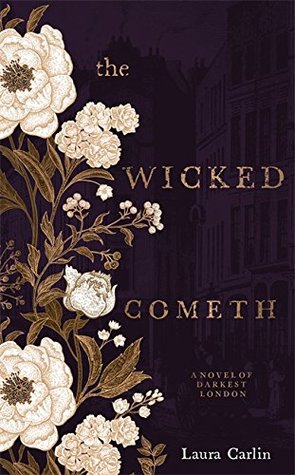
The Wicked Cometh by Laura Carlin

With such a beautiful cover and with the enticing subtitle “A novel of darkest London”, Laura Carlin’s The Wicked Cometh was impossible to resist. I was looking forward to reading it but, having seen a mixture of reviews over the last few weeks, some very positive and others less so, by the time I started it my expectations weren’t as high as they had been.

The novel is set in the early 1830s, during the reign of William IV, and opens with The Morning Herald reporting on the increasing number of men, women and children being declared missing in London. One young woman who has been following the news reports closely is Hester White; she is growing concerned about her cousin Edward who had arranged to meet her at Smithfield three weeks ago and has failed to arrive. Hester’s life has not been easy since the death of her parents a few years earlier; finding herself alone in the world she has been living with her father’s former gardener, Jacob, and his wife, Meg. Their home is a London slum, very different from the parsonage in rural Lincolnshire where Hester grew up, and she has been hoping that Edward can offer her an opportunity to start a new life away from the city.

When Hester is knocked down and injured by a carriage belonging to Calder Brock, suddenly another way of escape presents itself. Calder, who is a doctor, takes her to his family’s country estate, Waterford Hall, to recuperate, and explains to her that he would like her to stay and be educated by his sister Rebekah. With his interest in social reform, he hopes this experiment will show that even those from the poorest slums are capable of learning and improving themselves. Hester can already read and write, but is happy to pretend otherwise to avoid having to go back to Jacob and Meg. And so her lessons with Rebekah begin and a special friendship starts to form…

Everything I’ve described so far happens in the first half of the book and up to that point I found that I was really enjoying it. I liked Hester and although present tense first-person narration isn’t my favourite, her voice was strong and compelling. Her relationship with Rebekah felt natural and right, and I was pleased that it took time to develop. I was curious about the disappearances in London too and wanted to know more.

Then, in the middle of the book, there was a change of pace. As Hester and Rebekah began to investigate and uncover the truth, I felt that the author was trying too hard to incorporate every possible trope of the 19th century sensation novel, from family secrets to hidden documents to clandestine marriages. The story began to feel very melodramatic and contrived and lost its effectiveness. There were aspects of the plot that reminded me of Fingersmith by Sarah Waters, as well as one or two developments that made me think of The Woman in White, and I suspect that if I hadn’t read so many similar books I would probably have enjoyed this one a lot more. This was a particular problem at the very end of the novel where something which should have been a big surprise was too easy to predict.

I did like Laura Carlin’s writing and the atmosphere she creates; The Wicked Cometh is already receiving a lot of attention and as a debut novelist I’m sure she has a successful career ahead of her. For me, though, this is a novel of two very different halves. Some readers will prefer, as I did, the slow scene-setting of the first half and others the dramatic revelations of the second. If it sounds like your sort of book, give it a try – maybe you’ll love it more than I did!

Thanks to Hodder and Stoughton for providing a copy of this book for review via NetGalley.
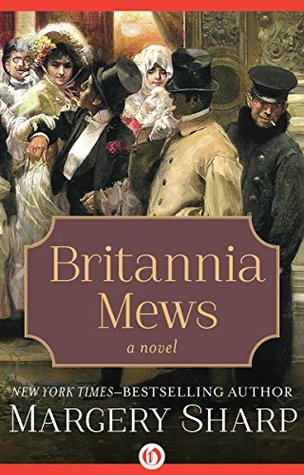
Britannia Mews by Margery Sharp

I discovered Margery Sharp through Jane of Beyond Eden Rock who, for the last few years, has been hosting an annual Margery Sharp Day on the author’s birthday. This year, Jane is doing something slightly different: she has put together a Birthday Book of Underappreciated Lady Authors to celebrate the work of some of her favourite writers throughout the year. Margery Sharp is first on the list and as I’ve enjoyed her books in the past, I wanted to join in.

Britannia Mews (1946) is my fourth Margery Sharp novel and probably my favourite so far. Beginning in the 1870s and taking us through to the 1940s, it follows the story of Adelaide Culver from childhood to old age. We first meet Adelaide as a curious ten-year-old exploring Britannia Mews, a London street inhabited by servants and coachmen – a street which is considered less than respectable and off limits to middle-class children like Adelaide. Returning to the Culver’s comfortable townhouse in nearby Albion Place, Adelaide has no idea that in just a few years’ time Britannia Mews will be her home.

It’s all cousin Alice’s fault; if she hadn’t been suffering from a cold and missed their drawing lesson, Adelaide would never have been left alone with their drawing master, Henry Lambert, and then he might never have told her that he loved her. But Alice does have a cold and Mr Lambert does declare his love for Adelaide – and Adelaide, despite knowing that her parents will disapprove, does agree to marry him.

Their marriage takes place on the day the rest of the Culver family move away to a lovely new house in the countryside. Adelaide, meanwhile, is moving into Mr Lambert’s rooms above a coach house in Britannia Mews. Estranged from her family, living in what is rapidly becoming a slum and finding that her new husband is not quite the person she thought he was, married life proves to be very challenging for Adelaide. When she finally has the opportunity to escape from Britannia Mews, however, she must decide whether she really wants to leave the street that has become her home.

Britannia Mews is very different from the other books I’ve read by Margery Sharp – The Nutmeg Tree, The Flowering Thorn and Cluny Brown. All three of those are lovely novels but they are much lighter in tone and, although Britannia Mews is not entirely without its moments of wit and humour, in general this is a darker and more serious story. I don’t want to give the impression that it’s a depressing one, though, because it isn’t. Yes, Adelaide’s life is difficult, at least at first, but it’s her own life – she has made her own choices and had to live with them, made her own mistakes and had to find her own solutions. Unlike her cousin Alice, who represents the ideal of what a Victorian woman should be, Adelaide is unconventional, independent and, by the time the twentieth century arrives, an inspiration to the younger generation.

One woman in particular who belongs to the younger generation is Dorothy – Dodo – Baker, daughter of Adelaide’s cousin Alice. Like Adelaide before her, Dodo feels stifled by the middle-class circles in which her parents move and she knows she wants something different out of life. Britannia Mews, which by the 1920s has become a lively and fashionable address, is, for Dodo as well as for Adelaide, a symbol of freedom and the opportunity to be who you want to be. The second half of the novel is very much Dodo’s story rather than Adelaide’s; it took me a while to adjust to the change of heroine but once I did I found Dodo just as interesting to read about. I enjoyed watching her get to know the Lamberts and waiting to see whether she would uncover the secret they had kept hidden for so many years.

Of course, the most important character of all is Britannia Mews itself, a street which seems to cast a spell over those who live there, pulling them back every time they might think about leaving. I loved reading about the changing nature of the street over the years and the people who inhabited it at various times in its history. I was also fascinated by the descriptions of the Puppet Theatre which Adelaide opens in one of the old coach-houses and the magnificent hand-made puppets created by Henry Lambert.

This was a wonderful choice of book to celebrate Margery Sharp’s birthday this year and I’m hoping to join in with some of Jane’s other Birthday Book authors in the months to come.

Death Comes for the Archbishop by Willa Cather

This is the first book I’ve read from my new Classics Club list and my third by Willa Cather. I’m grateful to the recent Classics Spin for choosing it for me because although I do like Cather’s writing I seem to need something to push me into picking up her books. This one could have lingered on my list for a long time otherwise, which would have been a shame as once I started reading it I loved it. It’s certainly my favourite of the three I’ve read so far (the others are The Professor’s House and My Ántonia).

Death Comes for the Archbishop is set in the nineteenth century and follows the stories of Bishop Jean Marie Latour and his friend Father Joseph Vaillant, two French missionaries who have been sent into the newly formed diocese of New Mexico – territory which has recently been acquired by America. As they begin their work of spreading their faith to the people of New Mexico, they face a number of challenges. The landscape, although beautiful, is harsh and often inhospitable; the railroad has not yet arrived so travel must be by mule over difficult terrain. When they do eventually reach other settlements, they are disappointed to find that the Catholic priests already established in these communities are, in most cases, not suitable for the job. They are either corrupt, greedy, too powerful, too weak or insufficiently devoted to their religion.

It is the task of Father Latour, with the help of Father Vaillant, to decide how to tackle these problems, while also learning to love his new home and getting to know the people who have lived there for generations. These include not only Americans and Mexicans, but also the Hopi, Navajo and other Native American people, whom Cather writes about with sensitivity and sympathy. Each group have their own customs, traditions, stories, histories and superstitions and as all of these things are new to the Bishop and his friend, the reader is able to learn along with them.

I have never been to New Mexico so as I read I found myself turning to Google for images of the deserts and hills, mesas and pueblos, plants and trees that are mentioned in the novel. After Latour visits the pueblo of Acoma and hears about the legend of the Enchanted Mesa, for example, I wanted to see what it would be like to live in such a harsh and isolated location. Cather writes beautifully about the New Mexico landscape; her use of colour is wonderful, helping to bring her descriptions to life. Here is the moment when Latour arrives at Santa Fé for the first time:

As the wagons went forward and the sun sank lower, a sweep of red carnelian-coloured hills lying at the foot of the mountains came into view; they curved like two arms about a depression in the plain; and in that depression was Santa Fé, at last! A thin, wavering adobe town…a green plaza…at one end a church with two earthen towers that rose high above the flatness. The long main street began at the church, the town seemed to flow from it like a stream from a spring. The church towers, and all the low adobe houses, were rose colour in that light,–a little darker in tone than the amphitheatre of red hills behind; and periodically the plumes of poplars flashed like gracious accent marks,–inclining and recovering themselves in the wind.

My favourite aspect of the novel is the relationship between Bishop Latour and Father Vaillant. The two men have known each other since they were students together at the seminary in France and I found the depiction of their friendship very moving, particularly later in the book when Father Vaillant has the chance to take up a new mission far away; the Bishop, who can’t bear to lose his companionship, must decide whether to keep his friend with him for selfish reasons or to let him go and give him the chance to develop his own career elsewhere and carry out the work which will make him happy. The characters are based on real historical figures – Jean-Baptiste Lamy and Joseph Projectus Machebeuf – but I like the names Cather has chosen for them. Vaillant, meaning ‘valiant’, is perfect for Joseph, who is brave and energetic, warm and friendly, while Latour (‘the tower’) is quieter and more reserved, finding it more difficult to open up and make friends. Their different qualities, different strengths and weaknesses are what make them such a successful partnership.

Death Comes for the Archbishop has no real plot, being more a series of little stories and vignettes spread across a number of years and describing the various experiences Latour and Vaillant have as they travel around the New Mexico diocese. I do prefer novels that strike a balance between the plot-driven and the character-driven, but I still thoroughly enjoyed this book – it got my new Classics Club journey off to a great start! I’m looking forward to reading more Willa Cather and I think the next one I pick up will be either Shadows on the Rock or A Lost Lady.

~

Book 1/50 from my second Classics Club List

Lincoln in the Bardo by George Saunders

It’s February 1862 and an eleven-year-old boy is dying, probably of typhoid fever. After his death, he is interred in a crypt at Oak Hill Cemetery in Georgetown. Unable to accept that he has lost his beloved son, the boy’s father enters the crypt on several occasions to hold the body and grieve. The boy’s name is Willie Lincoln and his father is Abraham, the sixteenth President of the United States.

According to author George Saunders this is a true story, reported in contemporary news accounts at the time, and is what inspired him to write Lincoln in the Bardo, a novel which won the 2017 Man Booker Prize. I don’t always get on well with Booker novels and I wasn’t at all sure whether it was a good idea for me to read this book, but it sounded so unusual and intriguing that when I saw it in the library I couldn’t resist.

The first thing to consider is the meaning of that word in the title – ‘bardo’. In Tibetan Buddhism, bardo is the transitional state between death and rebirth. It is portrayed in Saunders’ novel as a sort of limbo inhabited by the ghosts of people who either aren’t aware that they are dead or won’t admit to it, and for one reason or another have not yet moved on. This is where Willie Lincoln finds himself following his death and is unable to leave because his father is not ready to let go. The other spirits are worried about Willie – they know the bardo is no place for a child to linger – but they also have stories of their own, which slowly begin to unfold as the novel progresses.

The next thing – a very important thing – that I need to mention is the writing style, because Lincoln in the Bardo is not written in conventional prose. Instead, it takes the form of a cacophony of voices, all speaking up, giving their opinions, interrupting each other and completing each other’s sentences. It looks a bit daunting on the page, with short fragments of dialogue accompanied by the speaker’s name, but approaching it as if I were reading a play made it feel easier to follow. I don’t usually listen to audiobooks, but I think this particular novel would be a good one to listen to. Apparently the audio version has 166 narrators!

As well as the conversations taking place in the bardo, there are also some chapters made up of quotations from a selection of primary and secondary sources including letters, memoirs and academic accounts. These provide us with some background information on Abraham Lincoln and the period before and after Willie’s death. The sources looked authentic, but I later discovered that although some of them are real, others are fictional – and there is no easy way to tell which ones are which. This bothered me slightly, but probably won’t bother everyone! What I did like was the way Saunders uses these quotations to illustrate the unreliability of sources and the importance of looking at more than one account of the same event. For example, a chapter describing Lincoln’s appearance gives one source saying that his eyes are “gray-brown”, followed by another stating that they are “bluish-brown” and another simply “blue”.

I would say this was a love it or hate it type of book – except that for me it was a bit of both! There is no doubt that it’s wonderfully creative, imaginative and original, with a lot to admire and enjoy, but my initial feeling that this wasn’t really a book for me proved to be correct. I have never been much of a fan of experimental styles and structures; I find that I get distracted from the story and am unable to become fully absorbed in the way that I prefer. Maybe for that reason, I didn’t find the book as emotional as I would have expected given the subject – although other readers have described it as moving and heartbreaking, so it’s probably just me. I’m glad I read it though, as I would have been curious about it forever otherwise! If you’ve read it too, I would love to hear what you thought.

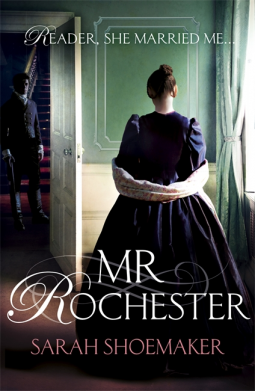
Mr Rochester by Sarah Shoemaker

As I’m not usually a fan of sequels, prequels or retellings of classic novels, I wondered if I was making a mistake in reading Mr Rochester, a book which, as you have probably guessed, is inspired by Charlotte Brontë’s Jane Eyre. However, I’ve always found Mr Rochester an interesting character and the premise of this novel was intriguing enough to tempt me. And I enjoyed it more than I thought I would; the first few sections of the book are excellent – but the last part doesn’t work as well, for reasons I’ll explain shortly.

In Jane Eyre, we meet Edward Fairfax Rochester at his home, Thornfield Hall, where Jane has come to take up a position as governess. We do learn a little bit about his family background and his life before Jane, but is it enough for us to fully understand what made him the man he is? I’ve never thought so and clearly Sarah Shoemaker didn’t either because in Mr Rochester she takes us back to Edward’s childhood to explore the people and events that may have shaped his character and formed the man who will eventually fall in love with Jane Eyre.

At the beginning of Shoemaker’s novel, Edward is a lonely little boy who is largely ignored and neglected by his father and older brother Rowland. At the age of eight he is sent away to be educated, along with two other boys, at the home of his tutor, and although at first he is heartbroken at having to leave his beloved Thornfield Hall the friendships he forms at school will have a big influence on his life. On the rare occasions when he is reunited with his family, he receives no love or affection at all, yet it is clear that his father has not forgotten him and has his future all mapped out. Edward ends up in Jamaica where he takes over the management of the Rochester plantation, Valley View – and is pushed into marriage with the beautiful Bertha Mason, the woman who will become Brontë’s famous ‘madwoman in the attic’.

I really enjoyed the first two thirds of the book, covering the period described in my previous paragraph. This is the part of Rochester’s life Charlotte Brontë didn’t tell us about – at least not in any detail – so Shoemaker is free to use her imagination. I loved reading about Edward’s early childhood, his schooldays and his apprenticeship in a mill; this could have been the basis of an interesting piece of Victorian historical fiction in itself, even without the Jane Eyre connection. The Jamaican chapters are compelling too. There are some similarities with Wide Sargasso Sea by Jean Rhys, but this time our sympathies are intended to be with Mr Rochester as well as with Bertha. Shoemaker’s Rochester does his best for Bertha under difficult circumstances and I found him a more likeable character than both Rhys’s Rochester and Brontë’s…until the point where he returns to Thornfield and meets Jane Eyre.

The rest of the novel – about a third of the book – is a fairly straightforward retelling of Jane Eyre, written from Rochester’s perspective instead of Jane’s. This is where things start to fall apart, in my opinion. Shoemaker puts Brontë’s words directly into the mouths of Rochester and Jane rather than her own – and although she has written in a suitably ‘Victorian’ style throughout the novel, her writing is obviously not the same as Brontë’s, which means the sudden change in the dialogue feels unnatural and uncomfortable. I think I would have preferred her to have simply followed the broad outline of the Jane Eyre plot instead of trying to stick to it rigidly.

The Mr Rochester for whom I’d gained so much sympathy earlier in the book, the quiet, lonely, obedient little boy whose life paralleled Jane’s in so many ways, the insecure man pushed into a career and a marriage not of his own choosing and who longed for nothing more than to go home to Thornfield Hall – that man is gone and I had trouble believing that Shoemaker’s Rochester would behave the way he does in the final section of the book; the whole Blanche Ingram storyline feels out of character, for example.

In other words, if this had just been an original novel inspired by Jane Eyre and set in the Victorian period I would probably have loved it; it was the retelling of the familiar Brontë plot that I didn’t find entirely successful. I didn’t feel that this book really added to or changed my feelings about Jane and Mr Rochester, but there were enough things that I liked about it to make it an enjoyable read anyway.

Thanks to Headline Review for providing a copy of this book for review via NetGalley.

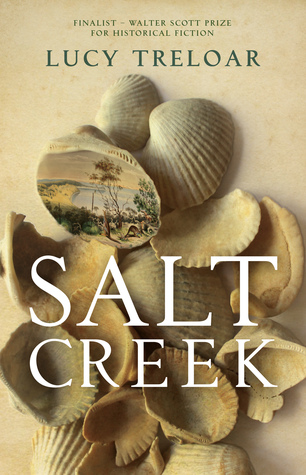
Salt Creek by Lucy Treloar

As well as taking part in German Literature Month this November, I also wanted to read something for Brona’s Australia Reading Month. I haven’t read many Australian books or authors and this is something I want to change, as discussed in a recent Historical Musings post. Lucy Treloar’s Salt Creek was one of the books I needed to read for my Walter Scott Prize project so seemed like the perfect choice.

Salt Creek is set in the 19th century and narrated by Hester Finch, who is fifteen years old as the novel opens in 1855. Having been leading a comfortable lifestyle in Adelaide, the family have fallen on hard times and Hester’s father has decided that they should move to the Coorong region of South Australia where they can try to build a new life for themselves farming the land. Arriving at Salt Creek in the Coorong, however, they find that things are not going to be easy. The landscape is beautiful but desolate, the land is difficult to tame and their Aboriginal neighbours view the newcomers with suspicion.

Hester’s mother, who has been depressed for some time, struggles to adapt and Hester, as the eldest daughter, finds herself taking on more responsibilities around the house. When the chance of freedom comes her way, will she take it or are the ties binding her to Salt Creek too strong? Meanwhile, the efforts of her father and brothers to work the land and make it suitable for farming bring them into conflict with the indigenous Ngarrindjeri people who have made the Coorong their home for generations.

Acting as a bridge between the two cultures is Tull, a boy from a local tribe who is welcomed into the Finch family and grows up with Hester and her brothers and sisters.

That winter I began to notice how differently he saw almost everything compared to us. Mama might say that the colours of winter reminded her of the highlands of Scotland, and I might say that the sky was sapphire or that the washing lines were like cobwebs on a cold morning. Hearing these things perplexed him, as did so much else – the encumbrances of our clothing, our impractical hair, our heavy boots, the fences that we built – which he made apparent by his stillness or his incredulity…

Tull’s relationship with the Finches is one of the most interesting aspects of the story. They come from such different worlds, yet find shared ground and common interests, giving hope that the wider groups they represent – the Aboriginal people and the white settlers – may be able to cooperate and work together. However, it is through Tull that Hester becomes aware of the harm the arrival of her family is doing to the Ngarrindjeri and to the environment.

The story itself has a bleakness to match the harshness of the landscape. Most of the characters experience little or no happiness, enduring poverty, the death and loss of loved ones, prejudice, betrayal and the breakdown of trust. It’s such a sad and tragic story – and yet I didn’t feel quite the emotional connection to Hester that I would have liked. I’m not sure why that should be, but I didn’t become fully invested in Hester’s personal story until I was well into the second half of the book. I don’t think it helped that the author chose to write part of the novel from the perspective of an older Hester living in England and looking back on her life. A more linear timeline might have worked better for me.

Still, Salt Creek is a beautifully written novel, with some lovely, vivid descriptions of the Coorong. Here is Hester having her first glimpse of her new home:

There was little enough to see – dry grasses and low shrubs in sweeps down to the lagoon, an arm of contorted trees hugging the slope from the low ridge and modest folds of land – a bed risen from like my own and its covers pushed back to hold the warmth of night. The colours were not intrinsic. A dry grass stem in shadow could be as drab as sightless eyes or gold in sunlight or silver in moonlight, but I did not know that then.

This was a good choice for the Reading Month; I loved the blend of fact and fiction (Lucy Treloar explains this in her author’s note) and the insights it gave me into life in South Australia, a place I knew very little about until now. I’m sure I’ll be picking up more Australian fiction soon!

The Crow Garden by Alison Littlewood

This is the first book I’ve read by Alison Littlewood, although I do remember hearing about The Hidden People a year or two ago and thinking it sounded interesting. I was attracted to The Crow Garden by its striking cover, but it sounded appealing too, with its Victorian setting and comparisons to Wilkie Collins and Susan Hill, so I thought I would give it a try.

Our narrator, Nathaniel Kerner, is a newly qualified ‘mad-doctor’ on his way to Yorkshire to take up his first position at Crakethorne Manor, an asylum for those ‘troubled in mind’. The tone of the novel is set immediately, with descriptions of dark skies, desolate heaths and remote villages on the journey north and Nathaniel’s first sight of his new place of work, a bleak grey stone building with iron bars on the windows. The asylum is run by Doctor Chettle, a man whose preferred methods of treatment – cold baths, electric shocks and phrenology – are very different from Nathaniel’s. Nathaniel will have the opportunity to try out some of his own ideas when he is assigned his first patient, the beautiful Victoria Adelina Harleston.

Mrs Harleston has been brought to Crakethorne by her husband following an incident on a London omnibus. Accusing her of hysteria, he demands that Nathaniel and Chettle stop at nothing to find a cure for his wife. Believing that the best way to get to the bottom of a patient’s problems is by talking and listening, Nathaniel gradually begins to uncover Mrs Harleston’s story. Far from making things clearer, however, the situation only becomes more confusing. Is Mrs Harleston really insane or is there more to her hysteria than meets the eye? Nathaniel knows he is becoming too deeply involved in the life of his patient but he has vowed to help her and now there’s no going back.

This is the sort of story and setting I usually enjoy, but I think there’s a limit to how many novels about Victorian asylums you can read and I am now close to reaching that limit! I was pleased when, in the middle of the book, the action moved away from Crakethorne for a while and into the streets of London. Here Nathaniel is swept up in the world of mesmerists, spiritualists and séances and although these are also common elements in Victorian historical fiction, I found that the book became much more interesting from this point onwards. Nathaniel’s narration also starts to become increasingly less reliable (although I won’t tell you why as I want to leave you to discover some of the novel’s surprises for yourself) and it is difficult to tell exactly what is real and what isn’t, which gives the rest of the novel a disturbingly hypnotic and unsettling feel.

I appreciated the effort Alison Littlewood makes to tell Nathaniel’s story in language appropriate to the 19th century. It’s something that is always important to me in historical fiction, but even more so in books of this type in which the atmosphere and the setting play such a big part. A few poorly chosen words and phrases can so easily pull you out of the time period, but thankfully Littlewood gets it just about right.

The Crow Garden was an interesting read but, as I’ve said, I think I’ve read too many books with similar settings and themes to really get anything new out of this one. The Asylum by John Harwood, Affinity by Sarah Waters, The Girl Who Couldn’t Read by John Harding and, of course, Wilkie Collins’ classic The Woman in White all came to mind while I was reading, and I would recommend all of those ahead of this book. It didn’t help that I disliked the character of Mrs Harleston so didn’t have the sympathy for her that I would usually have with a woman at her husband’s mercy and committed to an asylum against her will.

Despite not really loving this book, though, I did find it entertaining – and with its atmosphere, Gothic undertones and subtle touches of the supernatural, it’s an ideal autumn or winter read. If anyone else has read it, I would be interested to know what you thought.

Thanks to Quercus Books for providing a copy of this book for review via NetGalley.