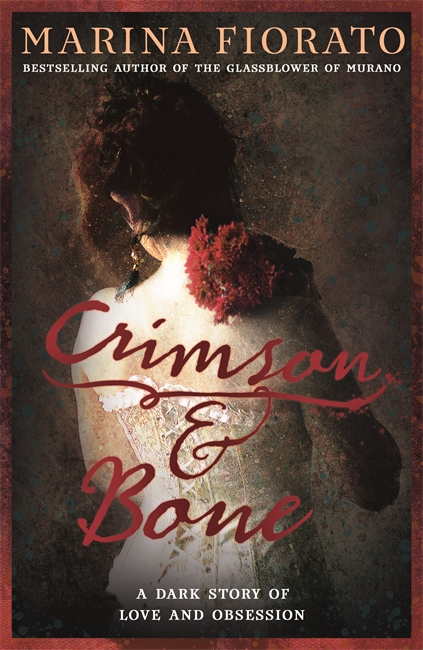
Crimson and Bone by Marina Fiorato

It’s January 1853 and seventeen-year-old Annie Stride is standing on Waterloo Bridge looking down at the River Thames, contemplating suicide. Having grown up in the East End of London as part of a large and impoverished family, Annie has drifted into a life of prostitution. Her only friend, Mary Jane, drowned in the Thames the previous year and now, pregnant and homeless, Annie has decided she has no choice but to do the same. Just as she gets ready to jump from the bridge, she is rescued at the last minute by a handsome young man who introduces himself as Francis Maybrick Gill.

Francis is a talented Pre-Raphaelite artist who is planning a new series of paintings on the subject of the ‘Fallen Woman’ – and he wants Annie to be his model. And so Annie, who had been only moments away from death, finds herself living with Francis in his large and luxurious Gower Street home, posing for portraits of Eve, Rahab and Jezebel. As well as using Annie as his muse, Francis also takes steps to improve her mind, to correct her East End speech and to help her with her reading and writing. She has no idea why he is taking so much interest in her, but she is so grateful she doesn’t care – until late one night two visitors come to call and Annie begins to wonder whether Francis Maybrick Gill is really the man she thought he was.

Crimson and Bone, Marina Fiorato’s latest novel, is divided into three parts and everything I have described above happens in the first part alone. The action also moves away from London for a while to Florence and Venice; Fiorato, who is half-Venetian herself, always writes beautifully about Italy and we are given some lovely, vivid descriptions of the country. The author’s love of art also shines through, with lots of information on the Pre-Raphaelite approach to art, exhibitions at the Royal Academy, the symbolism in the paintings for which Annie models, and, through the character of a mysterious ‘rainbow man’, the origins of the paints and pigments Francis uses.

From the beginning, the reader is kept in the dark as to Francis’s motives. What are his true plans for Annie? Does he really just want to paint her or does he have some other reason for his sudden interest in her? And what is the significance of his obsession with white camellias? A series of diary entries written by Annie’s friend Mary Jane appear at the start of each chapter which eventually shed some light on things, while also raising more questions along the way. It’s obvious that something is not quite right with the whole situation, but we don’t know what or why and the tension builds slowly throughout the novel.

However, there are a few inaccuracies and anachronisms which do spoil the book somewhat – for example, Annie tries to improve her speech by listening to gramophone records (several decades before they would have been available) and is taken to the theatre to see performances of Pygmalion (not staged until 1913) and Adelaide Neilson in Measure for Measure (more than twenty years too early). Admittedly, not knowing anything about Adelaide Neilson, I wasn’t aware of the third one until someone else pointed it out in their review, but it makes me wonder what else I might have been too caught up in the story to notice.

And the fact that I became so caught up in the story and the atmosphere – and that I cared about what happened to Annie – meant that I did enjoy this novel overall, despite its flaws.

This is book 15/20 of my 20 Books of Summer challenge.

By Gaslight by Steven Price

Well, this was a long book! Not only does it have over 700 pages, it’s also the sort of book that requires a lot of concentration, which makes it a very slow read. I’ve been reading it for the whole of August, which is one of the reasons why I’m not going to complete my 20 Books of Summer challenge by the deadline now. Was it worth so much time and effort? I’m actually not sure; it wasn’t a complete success with me – there were times when I found myself really enjoying it and others when I couldn’t wait to be finished – but on the whole I think I’m glad I read it.

This is the second novel by Canadian author and poet Steven Price. Set in the 19th century, it follows the stories of two men – William Pinkerton and Adam Foole – who are bound together by tales of a shadowy figure known, appropriately, as Edward Shade. Pinkerton is a famous American detective who is in London assisting Scotland Yard with an investigation into the death of a woman, possibly Charlotte Reckitt, whose severed head has been found in the Thames. He believes Charlotte has links with Edward Shade, an elusive criminal whom his father had devoted twenty years of his life to hunting down, without success. But who is Shade? A real person…a ghost…or just an obsession?

Adam Foole, a thief and swindler, has also recently returned to England with his two accomplices – the giant Japheth Fludd, and Molly, a young pickpocket. Foole has received a letter from a woman he once knew asking for help, but on his arrival in London he is unable to find her. Soon his path will cross with William Pinkerton’s; it seems that both of their fates are linked with Charlotte Reckitt and the mysterious Edward Shade.

By Gaslight takes us on a tour of the darker side of London as Foole and Pinkerton (separately or together) visit Millbank Prison, an opium den, a séance and the underground sewer system. However, there are long interludes set in South Africa and in America during the Civil War and these are essential to understanding the backgrounds to our characters and therefore to understanding the mysteries at the heart of the novel. These sections have quite a different tone from the London parts and, to me, they didn’t really feel as though they belonged in the same book; had the whole novel been devoted to the Civil War or had it been purely a Victorian murder mystery I think I would probably have been happier. This is just my opinion, though, and I’m sure other readers will love the variety of settings and changes in atmosphere.

By Gaslight is the perfect title for this book – not only are gaslights mentioned frequently, the whole novel (or the London chapters, at least) feels misty and murky and everything seems to happen either at night or in the fog and rain. Although most of the action takes place in 1885 and any long flashbacks are usually given their own chapters, eventually the borders between past, present and future start to blur, all adding to the sense of mystery and of facts being hidden or obscured.

The author has also made the decision not to use correct punctuation – commas are used sporadically and quotation marks not at all. Again, whether or not you will feel comfortable with this is a matter of personal taste; you could see it as a clever way of trying to immerse the reader more fully in the fogs and mists of the story or, like me, you could just find it annoying and distracting. I should add, though, that at no point did I actually struggle with it; I could always tell how a sentence was intended to be read and who was speaking to whom.

On the whole, though, this is an atmospheric and unusual novel and, despite the length and my reservations about the writing style, I never thought about abandoning it. It’s unlike any other Victorian novel I’ve read and if anyone else has read it, I would be interested to hear what you thought of it.

Thanks to the publisher, Oneworld Publications, for providing a copy of this book for review via NetGalley.

This is book 14/20 of my 20 Books of Summer challenge.

Shadow of the Moon by M.M. Kaye

I really have no idea why I haven’t read this book before now. The Far Pavilions has been one of my favourite books since I was a teenager, but for some reason it just never occurred to me to look into what else M.M. Kaye wrote until recently, when I read two of her Death In… mystery novels. When I saw that Cirtnecce was hosting a readalong of Shadow of the Moon this summer, it seemed the perfect opportunity to try another of Kaye’s historical novels in the hope that I would love it as much as The Far Pavilions!

Shadow of the Moon was originally published in 1957 and revised in 1979. Like The Far Pavilions, it is set in India, but at a slightly earlier time – before and during the Sepoy Mutiny of 1857. Our heroine, Winter de Ballesteros, is born in Lucknow to an English mother and Spanish father. Orphaned by the age of six, Winter is sent to England to be raised by her great-grandfather, the Earl of Ware, but the country of her birth still holds a special place in her heart and she dreams of returning one day to the Gulab Mahal, the place she considers home.

Winter is eleven when she meets Conway Barton, who is visiting from India, and she is captivated by his good looks and his connection with the country she misses so much. Conway, with his eye on Winter’s fortune, suggests a betrothal, but it is not until six years later that Winter is old enough to go and join him in India for the wedding. Now Commissioner of Lunjore, Conway says that he is far too busy to escort his fiancée across the sea himself, so he sends his assistant, Captain Alex Randall, in his place. Unknown to Winter, however, her betrothed is no longer the man she thinks he is and has another reason for wanting to delay their meeting. Will the marriage take place or will Alex be able to change her mind during the long voyage to Lunjore?

There’s a romantic aspect to Shadow of the Moon, then, but the historical element is just as important. Cirtnecce has put together two excellent posts (here and here) describing the political landscape in India in 1857, how the country came to be ruled by the British East India Company and the factors leading to the rebellion. All of this is explored in a lot of depth throughout the novel, showing the same impressive level of research and the same understanding and sympathy for India and its people that I remember from The Far Pavilions.

The descriptions of India itself are wonderful and vivid. Whether she’s writing about the streets and bazaars of Lunjore or the relentless heat of summer and the relief of the monsoon, Kaye always chooses just the right words to bring the scene to life. The horrors and atrocities of the Mutiny are also described in vivid detail, although a relatively short portion of the novel is devoted to the actual rebellion and much more to the gradual building of tension, ending in the controversy over the new Enfield rifles which sparked the revolt (the British required the sepoys to use cartridges which were smeared with pork and beef fat, offensive to both Muslims and Hindus).

Lunjore, where much of the action is set, is a fictional district on the borders of Oudh (although it is portrayed so convincingly I had to check to see whether it was a real place or not) but the situation which unfolds there is similar to that being played out elsewhere in India. The British commanding officers are seemingly blind to what is going on around them, refusing to listen to stories of unrest amongst the Indian people and unwilling to doubt the loyalty of their armies. Alex Randall is one of the few exceptions – a man who thinks for himself and who tries to see things from the point of view of others. It’s so frustrating to watch his advice and warnings repeatedly falling on deaf ears as his superiors tell themselves he is worrying about nothing and stubbornly refuse to heed his words.

I found Alex an interesting, complex character, torn between his feelings for Winter and what he sees as his duties and responsibilities towards both the Company and the people of Lunjore. I was particularly intrigued by his relationship with Kishan Prasad – two men who are on ‘opposite sides’ but who each understand what the other is trying to do and under different circumstances might have been friends. With the bridging role he plays between the British and Indian perspectives, Alex often reminded me of Ashton Pelham-Martyn from The Far Pavilions. It took me a bit longer to warm to Winter – I was irritated by her infatuation with Conway and had to keep reminding myself that she was only seventeen!

Whether or not the romance captures your imagination, though, I think there should be something in this novel to interest most readers…the fascinating historical background, the colourful portrait of another time and place or maybe the adventure (plenty of daring escapes, disguises, ambushes and secret meetings by moonlight). I loved it and now I can’t wait to read M.M. Kaye’s other historical novel, Trade Wind, and the rest of the Death In series.

This is book 11/20 for my 20 Books of Summer challenge.

To the Bright Edge of the World by Eowyn Ivey

The Snow Child was always going to be a hard act to follow and I think my fear that Eowyn Ivey’s second novel would be a disappointment could explain why I’ve been putting off reading it since it was published last year. Including it on my list for the 20 Books of Summer challenge gave me the push that I needed to pick it up and start reading – and I’m pleased to say that, although The Snow Child is still my favourite, there was very little disappointment here!

To the Bright Edge of the World, like Ivey’s first novel, is set in Alaska – but other than that, it’s a very different type of book. It tells the story of Colonel Allen Forrester who, in 1885, is commissioned to lead an expedition with the aim of navigating Alaska’s Wolverine River and charting previously unmapped territory. Through a series of journal entries we are able to join Allen and his small group of companions on their journey and are with them every step of the way as they struggle over difficult terrain, face harsh weather and encounter native tribes. It all feels so authentic that you could easily believe Allen Forrester was a real person and these were his real diaries – actually, he is a fictional character but it seems that Eowyn Ivey based him on a real-life explorer, Lieutenant Henry T. Allen, who led an expedition in that same year up the Copper River (reimagined as the ‘Wolverine River’ in the novel).

Although this book does not have the fairy tale feel of The Snow Child and is much more grounded in reality, myth and folklore still play an important part in the story. As they make their way up the Wolverine River, Allen and his men are followed by an Old Man who is said to be able to fly and are joined by a woman called Nat’aaggi who believes that her husband was an otter.

– They believe it is a thin line separates animal and man, Samuelson said. – They hold that some can walk back & forth over that line, here a man, there a beast.

This is not just Allen’s story, however. It is also the story of Sophie, his wife, who had hoped to join her husband on his adventures but had to settle for being left behind at Vancouver Barracks. Desperately awaiting news, with no way of knowing if Allen is even alive or dead, it’s going to be difficult for Sophie to get through the months ahead. Looking for something to fill her days, she decides to take up photography and develops a passion for her new hobby, going to ever greater lengths to capture photographs of the wildlife and birds she sees around the barracks.

Sophie also keeps a journal, recording her thoughts and feelings so that she can share them with her husband when he returns, and these two journals – Sophie’s and Allen’s – form the bulk of the novel, one set of entries alternating with the other. I was interested in both and although Allen’s may sound much more exciting, I had no preference for one over the other. There were some passages from each journal that I found slightly tedious or where I felt that things were being dragged out for too long, but a few pages later I would be pulled back into the story again. I liked both characters, so that helped!

The 19th century stories of Allen and Sophie are interspersed with contemporary letters exchanged between Walter Forrester, their great-nephew, and Josh Sloan, the curator of a museum in Alaska. Walter has decided to make a gift of the Forrester journals and the other artefacts from the expedition to the museum – and we are given the opportunity to see some of these artefacts, which include photographs, illustrations, newspaper reports and fragments of documents. These are not always presented in chronological order, which is sometimes confusing, but it gives the overall effect of looking through a scrapbook or somebody’s private collection of memorabilia. It was also nice to watch a friendship developing between Walt and Josh, two men of different generations and backgrounds, living many miles apart.

Not knowing very much about Alaska and its history, I feel that I’ve learned a lot from this novel, as well as being entertained by a fascinating story.

This is book 9/20 for my 20 Books of Summer challenge.

Beneath a Burning Sky by Jenny Ashcroft

I was drawn to Beneath a Burning Sky by the setting – Egypt in the late 19th century – and comparisons to other authors I’ve enjoyed, such as Victoria Hislop and Dinah Jefferies, made it sound even more appealing. Including it on my 20 Books of Summer list ensured that I got to it quickly but, although I did find a lot to like, I was left with feelings that were much more mixed than I’d hoped.

The plot is an exciting one. It begins shortly after twenty-two-year-old Olivia marries businessman Alistair Sheldon and leaves England to live with him in Egypt, the country where she spent her own early childhood. It’s not long before she becomes aware of the true nature of her cruel, abusive husband, but she is unwilling to admit to anyone just how unhappy her marriage is and devotes herself instead to settling into her new home in Alexandria and to getting to know her sister Clara, with whom she has just been reacquainted after many years.

When Clara disappears on a trip into the city – seemingly abducted from a busy street – Olivia is devastated. This is the second time she has lost her sister and she is determined to do everything she can to rescue her. As she searches for clues to explain Clara’s disappearance, however, she becomes convinced that her own husband, Alistair, may have had something to do with it. It’s a terrible situation to be in and even the one bright spot in Olivia’s life – her relationship with Edward Bertram, Alistair’s lodger – is just another additional complication. As the story unfolds, there is plenty of the “love and betrayal and mystery” promised by the blurb; all the ingredients for a great novel, so I was disappointed that, for me, they didn’t quite come together to form a successful whole.

My biggest problem with the book was the beginning. I found the opening chapters confusing and muddled. A lot of characters seemed to be introduced all at once – and had such involved and eventful backstories that I wondered if this was actually a sequel and if the early lives of Olivia and Clara had already been covered in a previous book (it isn’t and they hadn’t). Things did settle down after a while, but I still felt that some aspects of the plot were never fully explained or resolved.

Although I came to like and care about the two main characters, Olivia and Edward, and wanted them to find some happiness together, I thought the novel’s villains were just too evil to be true. Alistair had no nuances to his character and no redeeming qualities at all, while Olivia and Clara’s grandmother Mildred, a bitter, spiteful woman, had a hatred for her granddaughters which seemed out of proportion to the explanation that was given. There were some interesting characters amongst the Egyptians, though, particularly Nailah, a young woman whose story is linked with Olivia’s in ways which don’t become clear until the end of the book. The decision to write the novel from the perspectives of both Egyptian and British characters provided an opportunity to compare lifestyles and attitudes and to see things from more than one angle.

I didn’t feel that I learned much about the history of the period but, to be fair, it wasn’t really that sort of book. I think it will have more appeal to readers who enjoy romantic suspense rather than those who are looking for a more detailed work of historical fiction – personally I enjoy both, so despite my problems with Beneath a Burning Sky I still liked it enough to keep reading to the end, curious to see what had happened to Clara and whether Olivia and Edward could find a way to be together.

Thanks to the publisher for providing a copy of this book for review via NetGalley.

This is Book 7/20 for my 20 Books of Summer challenge.

The Essex Serpent by Sarah Perry

What is the Essex Serpent? A magical beast? A wonder of science? A judgement from God? William Ransome, vicar of the parish of Aldwinter, where the legendary serpent is said to have been sighted, is reluctant to give any credence at all to the rumours, viewing them as a distraction from the religious faith he is trying to instil in his parishioners. Cora Seaborne, however, is fascinated by tales of the fearsome sea monster lurking in the marshes of Essex, stealing away livestock and claiming human lives. Unusually for a woman in 1893, Cora is an amateur naturalist, with a particular interest in the work of the fossil collector Mary Anning. When she hears of the Essex Serpent, she wonders whether it could be an undiscovered species – or some sort of dinosaur?

Cora will have plenty of opportunities to test her theories and investigate further; having been recently widowed, she and her son Francis have moved from London to Colchester in Essex. It is on a visit to nearby Aldwinter that she meets William Ransome. Although their views are very different – not just on the serpent, but also on science, religion, and just about everything else – the two find themselves drawn together and a friendship begins to develop; a friendship which could become something more, if it wasn’t for the fact that Will is already married and that his wife, Stella, is dying of tuberculosis.

Although it is the relationship between Cora and William which drives the novel forward, there are many other subplots involving a large number of other characters. There’s Cora’s companion Martha, for example, a socialist who is campaigning to improve the living conditions of London’s poorest people, and Luke Garrett, a surgeon who closely follows all the latest advances in medicine and is itching for an opportunity to try them out for himself. A lot of time is also devoted to Francis, a serious, solitary boy who would probably be diagnosed today with a form of autism, and to Stella who, as her health declines, develops an obsession with collecting anything blue. I couldn’t help feeling, at times, that Sarah Perry was trying to do too much – trying to include every possible social issue of the 19th century – but on the whole I thought this was a fascinating, intelligent novel, with ideas spilling out of every page.

The Essex Serpent is one of those novels which is not only set in the Victorian era, but also attempts to capture the tone and style of a Victorian novel – while at the same time, being written in the modern day, bringing a new perspective to topics and themes which Victorian authors had less freedom to explore. The French Lieutenant’s Woman by John Fowles is a good comparison – although I have to say I enjoyed this book a lot more than Fowles’. I thought Sarah Perry’s writing was excellent, especially her descriptions of the landscape and the natural world, but occasionally her choice of language (particularly the use of contractions such as I’d’ve and shouldn’t’ve) pulled me out of the 19th century world she had otherwise so carefully created.

The criticisms I have of this book, though, are just minor ones; overall I was very impressed and can certainly understand why it has been so popular and so successful. It’s also nice to find a book that lives up to the promise of its beautiful cover!

The Leopard by Giuseppe Tomasi di Lampedusa

This novel by Italian author Giuseppe Tomasi di Lampedusa, published posthumously in 1958, is one I had been interested in reading for a few years, having seen lots of very positive reviews, but it was including it on my 20 Books of Summer list that pushed me into picking it up towards the end of June. I have to confess, when I first started reading it I wasn’t at all sure whether I was going to like it, but I think that was mainly because I had no understanding of the historical context. Google came to the rescue and after I’d familiarised myself with the background to the novel I found it much easier to follow what was happening.

The Leopard is set in 19th century Sicily during the Risorgimento (the movement for the unification of Italy). We explore this period of Italian history through the eyes of a Sicilian nobleman, Don Fabrizio Corbera, Prince of Salina, who is forced to watch as the world around him changes beyond his control. Beginning in 1860, the year Garibaldi lands on the coast of Sicily, we see the gradual decline of the Prince’s family and the nobility as a whole.

While Don Fabrizio regrets the loss of values he once held dear and hopes that somehow, once Italy has been united, the class system will be able to survive, his nephew Tancredi has a very different outlook, explaining that “everything needs to change, so that everything can stay the same”. The relationship which develops between Tancredi and the beautiful Angelica, daughter of a wealthy businessman, is only possible because of the breakdown in the class structure; characters like Angelica represent the future, whereas those like Don Fabrizio are becoming part of history.

Although the novel is set in the past – and does immerse the reader in another time and place, with some elegant and vivid descriptive writing – the author occasionally reminds us that he is viewing events from a point many years in the future. For example, he lets us know that the palace he is describing with painted gods on the ceiling will be destroyed by a bomb in 1943. It all adds to the poignancy and to the atmosphere of decay and decline.

If you’re wondering about the title, it refers to the symbol of the Salina dynasty and, I think, the power and grace of the aristocracy. As the Prince himself muses, “We were the Leopards, the Lions; those who’ll take our place will be little jackals, hyenas…” The whole novel is rich in symbolism: a stone leopard above the door has the legs broken off in a sign of things to come, while the initals engraved on Don Fabrizio’s wine glass are fading away and even the fate of his dog Bendico is another reminder that everything must come to an end.

The Leopard is a beautifully written book and although it’s surprisingly short, there’s so much packed into its pages I think a re-read would be necessary to be able to fully appreciate it. After an uncertain start, I was very impressed with this book and can see why it is considered a classic Italian novel.

This is Book 4/20 for my 20 Books of Summer challenge.