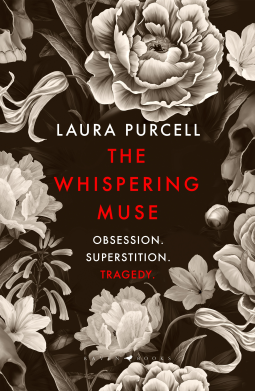
The Whispering Muse by Laura Purcell

This is the second book I’ve read by Laura Purcell; I liked, but didn’t love, the first one I read, Bone China, so was hoping for better things from this one. It certainly sounded good – a Gothic novel set in the theatres of Victorian London – and I wasn’t disappointed at all. I was gripped from start to finish!

Our narrator is Jenny Wilcox, a young woman who has been left to support herself and her younger siblings after her brother Gregory ran off to America with an actress, taking the family savings with him. Jenny is deeply grateful when Gregory’s former employer, Mrs Dyer of the Mercury Theatre, offers her a job as dresser to the new leading lady, Lilith Erikson. Before she even begins work, however, Jenny discovers that Mrs Dyer has not just offered her the position out of kindness – she believes that her husband is having an affair with Lilith and she wants Jenny to spy on them.

At first, Jenny shares Mrs Dyer’s dislike of Lilith, but gradually she becomes concerned about the behaviour of the beautiful young actress. Why is she so obsessed with a watch engraved with the face of Melpomene, Muse of Tragedy – a watch that once belonged to the actor Eugene Grieves, who died on stage while performing Dr Faustus? Could Lilith have formed some sort of pact with Melpomene, to help her achieve her dream of becoming London’s greatest tragic actress? And if so, what will Melpomene demand in return?

The Whispering Muse is divided into five acts, mirroring the five tragedies performed by the Mercury Theatre Company over the course of the novel, beginning with Macbeth. Theatrical settings are usually atmospheric and this one is no exception! I loved the insights we are given into what goes on behind the scenes and the descriptions of Lilith’s powerful stage performances are so vivid I could almost imagine I was watching them from a seat in the front row. The book is wonderfully creepy in places – and a bit gory in others, although not excessively so. What makes it so compelling is that we’re never quite sure whether Lilith really has made a pact with her muse and supernatural forces are at work within the Mercury Theatre or whether the strange events that begin to take place have a more human explanation.

As well as enjoying the fascinating plot, I also found it interesting to see how Jenny’s relationships with the other characters change over the course of the novel. Although I didn’t always agree with Jenny’s decisions, I had some sympathy for her situation – she needs to keep Mrs Dyer happy in order to stay in her job and earn money to support her younger brothers and sister, but the closer she becomes to Lilith the more she starts to feel that Mrs Dyer’s hatred of the actress is unreasonable and the more her conscience begins to bother her. The dynamics between these three characters add extra depth to the story and make it something special. I loved it and look forward to reading Laura Purcell’s other books!

Thanks to Raven Books for providing a copy of this book for review via NetGalley.
This is book 5/50 read for the 2023 Historical Fiction Reading Challenge.
The Darlings of the Asylum by Noel O’Reilly

I have read several novels that tackle the subject of Victorian women locked away in asylums, sometimes due to depression, anxiety or ‘hysteria’, but often simply because they were an inconvenience to their husbands or families. The Asylum by John Harwood, The Crow Garden by Alison Littlewood and The Girl Who Couldn’t Read by John Harding are a few examples and I was keen to see how Noel O’Reilly would approach the same topic in his new novel, The Darlings of the Asylum.

The story begins in Brighton in 1886 with a marriage being arranged between our narrator Violet Pring and the wealthy Felix Skipp-Borlase. Violet is fond of Felix but she knows she doesn’t love him and doesn’t want to marry him – what she really wants is to be free to pursue a career as an artist and she’s not ready to give up on her dream. The more her mother tries to push her into the marriage, the more Violet tries to resist until things finally reach a climax and a tragedy occurs. The next day, with no memory of what happened, Violet wakes up to find herself incarcerated in Hillwood Grange Lunatic Asylum.

Getting to know the other inhabitants of Hillwood Grange, Violet finds that many of them do have genuine mental health issues – although nothing to warrant the kind of treatment they are receiving in the asylum – but she has no idea why she has been sent here herself. She knows she must have done something terrible, but nobody will tell her what it was and she can barely remember her last night of freedom at all. Allowed only limited contact with family and friends and banned from drawing and painting, Violet is miserable and frightened – particularly when she discovers that the sinister Dr Rastrick may have his own reasons for wanting her in the asylum. Violet must find a way to prove that she is sane and escape from Hillwood Grange, but how can she do that when everyone around her seems to be part of a conspiracy to keep her imprisoned forever?

The Darlings of the Asylum is a fascinating novel, although quite similar to the books I’ve mentioned and others with a Victorian asylum/mental hospital element. Still, whether or not you’ve read much on this topic before, the portrayal of Violet’s plight is disturbing and at times horrifying, as she desperately tries to make herself heard and free herself from the clever and manipulative Dr Rastrick. Violet also makes an effort to befriend some of the other women in Hillwood Grange who are even less fortunate than herself and have been dismissed as insane or used as subjects for experiments rather than receiving the sort of care we would expect them to be given today.

Noel O’Reilly has written the book from Violet’s perspective and although sometimes I find that male authors don’t write in a convincing female ‘voice’ and vice versa, I thought he did a good job here. I could believe in Violet as a Victorian woman, albeit a slightly unconventional one. I was also happy with the way her story ended. It wasn’t quite what I’d expected, but better than some of the alternatives would have been! Now I’ll have to read Noel O’Reilly’s first novel, Wrecker, about shipwrecks on the Cornish coast.

Thanks to HQ for providing a copy of this book for review via NetGalley.

Book #63 read for the Historical Fiction Reading Challenge 2022.

The Secret of Matterdale Hall by Marianne Ratcliffe

The Secret of Matterdale Hall is Marianne Ratcliffe’s new novel and the first book to be published by Bellows Press, a small independent publisher who describe themselves as ‘championing unagented writers of speculative & historical fiction, particularly queer, POC & marginalised authors’. In many ways Matterdale Hall seems like a traditional Victorian Gothic novel, but it also has some fresh new elements that make it feel original and different.

Our heroine, Susan Mottram, is a young woman whose family has fallen into poverty following her father’s death. Looking for a way to support her mother and younger sister, Susan finds work as a teacher at Matterdale Hall, a girls’ boarding school run by Dr and Mrs Claybourn in a remote part of Yorkshire. Susan immediately likes the eccentrically dressed doctor, who treats psychiatric patients in his infirmary within the hall, but she has a more difficult relationship with his wife and their daughter Marion, whose views on teaching and discipline conflict with Susan’s own. Some of the children also prove challenging, particularly the badly-behaved Isabella and the silent, withdrawn Mary.

One day, Susan crosses paths with Cassandra, a young woman from a neighbouring estate. At first Cassandra seems strangely hostile, but when Susan discovers that Cassandra is both mixed-raced and deaf, able to communicate only through sign language, she understands that what she had mistaken for hostility is actually shyness and a lack of trust. Gradually, a friendship begins to form between the two of them – and Susan finds that she desperately needs a friend to help her unravel the mysteries that are beginning to emerge at Matterdale Hall. What happened to Susan’s predecessor, who disappeared without trace? Why does little Mary never speak? And what is really going on in Dr Claybourn’s ‘infirmary’?

Although I found some of the secrets of Matterdale Hall quite easy to guess, there was still plenty of suspense as I waited to see whether I was right and how and when Susan would also discover the truth. The lonely Yorkshire setting, with much of the story taking place in the winter, added to the atmosphere and it was difficult not to think of Jane Eyre and Wuthering Heights, while I was also reminded of Stacey Halls’ Mrs England. But as well as the secrets and mysteries, I was fascinated by the portrayal of a small school in the 19th century and the attitudes to education and methods of teaching.

Despite the darkness and the sense of foreboding, there are still some moments of happiness for Susan. The patience and kindness she offers to the girls in her care is rewarded when they begin to open up to her and allow her to help them and her relationship with Cassandra also starts to flourish, first as a simple friendship and then as something more. I liked the way the two women’s feelings for each other develop slowly and realistically rather than being a love at first sight romance, giving the reader time to get to know them both and become invested in their stories. Deaf people don’t get a lot of attention in historical fiction (Shadow on the Highway by Deborah Swift is the only other book I can think of with a deaf heroine) so I found that aspect of the book interesting too.

The Secret of Matterdale Hall is written in a formal style that mimics the Victorian novels that have obviously influenced it and the long chapter titles, giving us an idea of what the following pages will contain, also add to the 19th century feel. It’s an entertaining read and I’ll be interested to see what Marianne Ratcliffe writes about in her next book.

Thanks to the author for providing a copy of this book for review.

Book #60 read for the Historical Fiction Reading Challenge 2022.

The Legend of Sleepy Hollow by Washington Irving

I’ve never read anything by Washington Irving but The Legend of Sleepy Hollow appears in an anthology of classic ghost stories I bought for my Kindle a few years ago and Halloween seemed like the perfect time of year to read it. I thought I already knew the story from the 1999 Tim Burton film but of course it turns out that it’s only very loosely based on Irving’s original work, which is often the case with adaptations. It’s also not very scary, so if horror stories make you nervous, don’t worry – this one isn’t likely to give you nightmares!

Irving begins by describing the valley of Sleepy Hollow, an old Dutch settlement in New York State steeped in legend and superstition.

A drowsy, dreamy influence seems to hang over the land, and to pervade the very atmosphere…Certain it is, the place still continues under the sway of some witching power, that holds a spell over the minds of the good people, causing them to walk in a continual reverie. They are given to all kinds of marvellous beliefs, are subject to trances and visions, and frequently see strange sights, and hear music and voices in the air.

The most famous of Sleepy Hollow’s legends involves a ghost known as the Headless Horseman, said to be a Hessian soldier who lost his head in battle and goes on a nightly ride through the Hollow in search of his missing head. When Ichabod Crane, an outsider from Connecticut arrives in the valley to take up the position of schoolmaster, he is fascinated by this story. A believer in witchcraft, Ichabod is naturally superstitious and enjoys listening to the tales of local ghosts and goblins.

Soon Ichabod sets his sights on the beautiful Katrina Van Tassel, daughter and only heir of a wealthy farmer. However, he faces stiff competition for Katrina’s hand in marriage in the form of Brom Bones, a ‘burly, roaring, roystering blade…the hero of the country round’. After being rejected by Katrina during a party at the Van Tassels’ home one night, the disappointed Ichabod rides off alone into the night – only to find that he is being pursued by a mysterious figure on horseback…

There’s not much more I can say about this story without spoiling it. It’s a short one, so if you want to read it for yourself it shouldn’t take up too much of your time. Published in 1820, it’s easy to read and to follow and although Irving’s descriptive writing provides a lot of Gothic atmosphere, it’s a fun and entertaining ghost story rather than a terrifying one. It also has a wonderfully ambiguous ending!

I’ll have to read more of Washington Irving’s stories at some point. The only other one I’m familiar with is Rip Van Winkle, but obviously he has written a lot more than that!

This is my seventh and final read for R.I.P. XVII

The Fortune of the Rougons by Émile Zola

La Fortune des Rougon, originally published in French in 1871, is the first novel in Émile Zola’s twenty-volume Les Rougon-Macquart cycle. It’s also the book selected for me in the recent Classics Club Spin and the edition I read is an English translation by Brian Nelson.

I’ve already read one of the later books from the cycle – The Ladies’ Paradise – but rather than continue picking them out at random, I thought it might be more sensible to go back to the beginning of the series and try to read them in order. I was a bit hesitant about reading this first book, however, because it sounded as though it was mainly concerned with setting things up for the rest of the series – and that was the case, up to a point, but I found that there was still enough plot to make this an interesting novel in its own right.

The Fortune of the Rougons is set in the fictional French town of Plassans and opens on a Sunday night in December 1851 with two young lovers, Silvère and Miette, joining up with an army of insurgents. It’s the eve of Louis Napoleon’s coup d’état which will result in the formation of the Second Empire under Napoleon III. Silvère wants to give his support to the Republicans who are opposing the coup and thirteen-year-old Miette finds herself coming along to carry the flag.

We then leave Silvère and Miette behind for a while so that Zola can take us back several generations and introduce us to Adelaide Fouque who, through her marriage to the peasant Rougon and a later relationship with the alcoholic smuggler Macquart, is the ancestor of most of the other major characters in the novel. He then follows the lives of Adelaide’s three children – her eldest son, Pierre Rougon, and his illegitimate half-brother and sister, Antoine and Ursule Macquart – as they grow into adults and embark on a family feud. Finally we meet Adelaide’s grandchildren (of whom Silvère is one) and see how they all fit into the events of the formation of the Second Empire.

Once Pierre, Antoine and Ursule have married and had children of their own, the number of characters in the novel quickly multiplies and I’m glad my copy of the book included a family tree as I found myself constantly needing to refer to it. The Rougon-Macquart family are largely an unpleasant group of people – Pierre Rougon tricks his mother into signing over her house to him, depriving his brother of his inheritance, while Antoine Macquart is a violent, aggressive drunk – but there are still some characters with traits I could admire and some I could pity. It seems that Zola’s aim in writing the series was to explore the effects of heredity, so in this book the legitimate Rougon branch of the family are shown to be scheming, avaricious social-climbers while the Macquarts, descended from a rogue, are leading miserable, sordid lives.

The history of the coup d’état and the Second Empire is quite complicated, particularly if, like me, you come to the book with no prior knowledge of these events. With Plassans (based on Aix-en-Provence, where Zola himself grew up) being so far from the action, information comes to the Rougons via the eldest son, Eugène, who lives in Paris, and the people of the town gather in the Rougons’ yellow drawing room to discuss the latest developments. This keeps the reader at a bit of a distance and it took me a while to get everything straight in my head, but later in the book when we rejoin Silvère and Miette marching with the army we get a little bit closer to some of the action.

I didn’t really love The Fortune of the Rougons, but there were parts that I enjoyed very much and I’ll look forward to meeting some of the characters again in the other books in the cycle. I wish I had read this one before jumping straight into The Ladies’ Paradise as I would then have had more understanding of Octave Mouret’s background (he is another descendant of Adelaide Fouque).

Have you read any of the Rougon-Macquart novels? Did you read them in order or at random and do you think it makes any difference?

This is book 33/50 from my second Classics Club list.

The Romantic by William Boyd

Wandering through Africa wasn’t that much different, in a sense, from wandering through London, or Paris, or Boston. You thought the road ahead was obvious and well marked but more often than not the destination you had so clearly in mind would never be reached. Never. Things got in the way. There were diversions, problems, changes of mind, changes of heart…

Cashel Greville Ross, the hero of William Boyd’s new novel The Romantic, is a man who does plenty of wandering and whose path through life changes direction many times. Born in Ireland in 1799, he lives through some of the major events of the 19th century and becomes a soldier, a writer, a farmer and an explorer – though not all at the same time. He is present on the battlefield of Waterloo, befriends Byron and Shelley in Pisa and travels through Africa in search of the source of the Nile.

Cashel is not a real person, of course, although Boyd does his best to convince us that he is. The book is presented as a biography, complete with footnotes, pieced together from a bundle of letters, notes, maps and photographs which apparently fell into Boyd’s hands several years ago. It’s not a new idea, but it’s very cleverly done here and I can almost guarantee that you’ll be googling things to see if they’re true, even while knowing that they can’t possibly be!

The Romantic is a long novel, but I read most of it in one weekend because it was so gripping I couldn’t bear to put it down. Although the story never becomes bogged down with historical or geographical detail, it’s still completely immersive and I loved every minute I spent in Cashel’s world. His life story unfolds in a series of distinct episodes and I found each one equally compelling: his childhood in County Cork and the uncovering of family secrets; a journey across Italy in order to write a book about his travels; a moral dilemma faced in a Sri Lankan village while fighting with the Indian Army…these are just a few of Cashel’s adventures and there are many more which I’ll leave you to discover for yourself.

Cashel himself is a likeable character, but also a flawed one. As the title suggests, he’s hopelessly romantic; as a young man, his own proud and impulsive nature ruins his chance of happiness with the woman he loves and this sets the tone for the rest of the novel and the rest of his life, as he continually moves from country to country, continent to continent, unable to put this missed opportunity behind him and settle down. His naivety makes him vulnerable and he is repeatedly taken advantage of, suffering a series of injustices and at one point ending up in the Marshalsea Prison for debt, but he never seems to learn from his mistakes, falling into the same traps over and over again. It’s frustrating, but it’s also what kept me turning the pages, desperate to see how Cashel would get out of the latest predicament he had found himself in!

This is one of my books of the year without a doubt and I’m sorry that I’ve never read any William Boyd before.

Thanks to Viking for providing a copy of this book for review via NetGalley.

This is book 53 read for the Historical Fiction Reading Challenge 2022.

The Rose of Sebastopol by Katharine McMahon

When I put my list together for this year’s 20 Books of Summer, I tried to include a mixture of new releases I was excited about reading and older books that had been on my TBR for a long time. The Rose of Sebastopol is one that I bought back in 2010 from my favourite bookshop, Barter Books, and has been waiting on my shelf for twelve years! If I’d known I was going to enjoy it so much I would certainly have made time for it before now.

The novel opens in 1855 with our narrator, Mariella Lingwood, arriving in Italy to visit her fiancé, Henry Thewell, a surgeon who has recently been stationed in Crimea where war is continuing to rage between Russia and the allied forces of France, Britain, Turkey and Sardinia. Having become seriously ill, Henry has left the battlefields and is recuperating in the Italian town of Narni. Their reunion doesn’t go as planned, however, when the feverish Henry mistakes Mariella for her cousin, Rosa – and she discovers that throughout his illness he has been calling Rosa’s name.

Rosa had left England for the Crimean peninsula several months earlier hoping to join Florence Nightingale’s team of nurses. At first she had kept her family informed as to her whereabouts, but then her letters stopped coming. Unable to learn any more from Henry other than that he and Rosa had met in the Crimea and that Rosa is now missing, Mariella sets off for the war zone herself, determined to find her lost cousin and to hear the truth about her relationship with Henry.

Mariella is an unlikely heroine to be undertaking such an epic journey. Coming from a comfortable middle class background, she has led a very sheltered life and so far her only involvement in the war has been sticking maps and newspaper cuttings into a scrapbook. She represents the Victorian ideal – quiet, obedient, devoted to her parents and conforming to society’s expectations in every way – but for most of the book, I found her very unlikeable. Not only does she lack personality, she’s also quite selfish – probably a product of her upbringing as she has never been encouraged to show any real empathy for people less fortunate than herself.

In contrast, Rosa is a much more engaging character – strong, courageous, determined to achieve her ambition of becoming a nurse and making a difference to people’s lives. I think most authors would have chosen to tell Rosa’s story rather than Mariella’s, so I was intrigued by Katharine McMahon’s decision to write from the perspective of the boring, uninteresting Mariella who, until Rosa disappears, seems content to sit at home with her needlework. Of course, there’s some character development eventually and the journey across Europe does begin to gradually change Mariella’s outlook on life, but it’s always Rosa who drives the plot forward despite being physically absent for most of the novel. Similarly, it seemed at first that Henry would be the main male love interest in the book, but the real hero turns out to be someone unexpected. I was impressed by the way McMahon has us thinking we know which characters we’re supposed to like or dislike, then turns everything around and makes us think again.

This is possibly the first novel I’ve read with the Crimean War as the setting. I’ve read other books set in that time period where the war has been referred to, but I can’t think of any that have actually taken us to the heart of the action – Florence Nightingale’s base at the hospital in Scutari, the sites of the Battle of Balaclava and the Battle of Inkerman, and the besieged city of Sebastopol (or Sevastopol as we would normally call it now). McMahon doesn’t try to portray the war in any kind of romantic way, concentrating instead on the mistakes made by the British and French commanders and the terrible human cost, with large numbers of deaths and casualties. The idea of allowing women to nurse wounded soldiers was very new at that time and we see how some of the women volunteering to join Florence Nightingale were turned down because they were too young or too attractive; they had to meet a strict set of criteria because everything they did would be reported in the British media and Nightingale wanted nothing to damage the reputation of the nursing team she had put together.

I really enjoyed this book and if any of you have read any others set during the Crimean War I would love to hear about them.

This is book 18/20 from my 20 Books of Summer list.

This is book 46/50 read for the Historical Fiction Reading Challenge 2022.