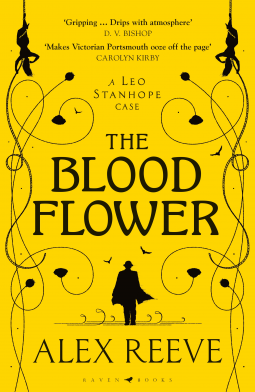
The Blood Flower by Alex Reeve

The Blood Flower is the fourth book – and sadly, the last – in Alex Reeve’s Leo Stanhope mystery series. I’ve been following this series since the first book was published and am sorry there won’t be any more to look forward to, but the author has stated that he has achieved what he set out to achieve with these novels and is ready to move on to other things.

The four novels in this series all work as standalone mysteries, but if you want to get to know Leo properly and understand his history and relationships with the other characters, I would recommend starting with The House on Half-Moon Street and reading the books in order if you can.

In The Blood Flower, set in the late Victorian period, Leo and his wife, Rosie, are heading for the south coast of England, where Leo, in his position of journalist with a London newspaper, has been asked to cover a murder case in Portsmouth. Rosie’s sister, Viola, happens to live in Portsmouth with her husband and Leo is looking forward to seeing them for the first time – but Rosie seems strangely reluctant for him to meet his in-laws. He doesn’t have too much time to wonder about this, however, because work must come first and soon Leo is being updated by the local police on the deaths of two young people, both found by the Portsmouth docks with their throats slit.

When Sergeant Dorling dismisses the two victims as misfits and outcasts and seems more concerned with how Leo is planning to portray the police in his newspaper article, Leo knows that if the murderer is going to be brought to justice he will have to solve the mystery himself. His investigations lead him to the notorious Papaver nightclub and a circus at the New Hippodrome theatre in search of the mysterious Blood Flower which seems to have played a part in both murders. But Leo has a secret of his own: he was born and raised as Charlotte Pritchard, before leaving his old life behind to live as the man he knows he really is. Only his closest friends know he is transgender, but if this information falls into the wrong hands he could find himself in serious danger.

I think this is the best book in the series; I enjoyed it even more than the last one, The Butcher of Berner Street. The Portsmouth setting makes a nice change from the Victorian London of the previous three books and Alex Reeve brings it vividly to life, with a contrast between the tourist areas with their colourful beach huts, bathing machines and shops selling postcards, and the darker side of the city which is where most of the story is played out. It was good to meet some of Leo’s old friends again – the actor Peregrine Black; Alfie the pharmacist and his young daughter, Constance; the elderly Jacob and his wife, Lilya – but moving the action away from London also allows Leo to meet lots of new people. Of the new characters, one I found particularly interesting was Olga Brown, or Miss La La, a black acrobat from Prussia and a real historical figure (her portrait was painted by Edgar Degas).

Leo himself continues to be a very likeable and engaging narrator, liable to make mistakes or say and do the wrong thing, but that only makes him feel more human. His transgender status is just one part of who he is and never really dominates the story; this, like the other books in the series, is a mystery novel first and foremost and the mystery is always at the centre of the plot. It’s quite a complex one and there are some interesting twists and turns towards the end as we discover what the Blood Flower is and who was responsible for the murders. Once the mystery was solved, I was sorry to have to say goodbye to Leo and his friends but I respect the author’s decision to move on and will be interested to see what he writes next!

Thanks to Raven Books for providing a copy of this book for review via NetGalley.

This is book 43/50 read for the Historical Fiction Reading Challenge 2022.

The Magician by Colm Tóibín

The Magician is probably a book I would never have chosen to read if it hadn’t appeared on first the longlist then the shortlist for this year’s Walter Scott Prize for Historical Fiction. I’ve read and enjoyed other books by Colm Tóibín: Brooklyn, about a young Irish immigrant in 1950s New York and House of Names, a retelling of the Oresteia. This one, though, a fictional biography of the author Thomas Mann, sounded less appealing to me, particularly as I’ve read very little of Mann’s work (only Death in Venice and Other Stories) and wasn’t sure if I was really interested in reading about his life. There was only one way to find out…

The Magician begins with Thomas Mann’s childhood in the German city of Lübeck towards the end of the 19th century, then takes us through his entire adult life as he marries, has children, becomes a successful author and leaves Germany for first Switzerland and then the US, where the family will live for several years. The childhood chapters help us to see what shapes Thomas into the man he will later become. His father dies in 1891, leaving Thomas and his siblings with their mother, a Brazilian woman who doesn’t quite conform to the expectations of their quiet, staid community in Lübeck, so they move to Munich where Thomas meets and marries Katia Pringsheim, the daughter of a Jewish mathematician.

A lot of time is devoted to Mann’s relationship with Katia and the six children they have together, but also to his sexual desires for young men, something Katia must have been aware of but seems to have ignored. Some of Mann’s repressed feelings for these men find their way into his writing, such as in Death in Venice where the middle-aged von Aschenbach becomes infatuated with the beautiful young Tadzio. Katia herself also inspires her husband’s work; her stay in a Swiss sanatorium after becoming ill in 1911 forms the basis of The Magic Mountain, a book I haven’t read. No knowledge of Mann’s work is required, but when I came across references like that, I did feel that if I’d been more familiar with his books it would have added something extra to the experience of reading The Magician.

The novel also explores Mann’s relationship with his older brother, Heinrich, another writer, and later in the book, the focus switches more and more to Thomas and Katia’s children, giving us a glimpse of what Thomas was like as a father – but only a glimpse, because Thomas remains a remote and distant figure throughout the novel. I felt that he never fully came to life and although I did learn a lot about him, there was no warmth and I wasn’t able to connect with him on an emotional level. I think a non-fiction book on Mann would probably have worked better for me.

However, as well as telling the story of Thomas Mann’s life, Tóibín also tells the story of the first half of the 20th century; not much time is spent on World War I, but I did find it interesting to see World War II unfold from the perspective of the Manns, a family who leave Germany for their own safety and become part of the German émigré community in Los Angeles. Although it takes Thomas a while to come to terms with what is happening in his home country, once he does he becomes a public critic of the Nazi regime. He also worries about the future of his own books and the loss of the freedom to write material that everybody is able to read:

He contemplated the idea that someday in the near future his books would be withdrawn in Germany, and it frightened him. He thought back to Buddenbrooks and The Magic Mountain, the books for which he was most famous, and realized that they would have been paler books, less confident, less intense, had he known when he was writing them that no German would be permitted to read them.

The Magician is a book that I admired, but not one that I loved. I’ll continue to read other books by Tóibín, but I think I prefer the way he writes about fictional characters rather than real ones.

This is book 40/50 read for the Historical Fiction Reading Challenge 2022.
Godmersham Park by Gill Hornby

I enjoyed Gill Hornby’s previous novel, Miss Austen, about the life of Jane Austen’s sister Cassandra. Her new one, Godmersham Park, is also inspired by the Austens, telling the story of Anne Sharp, who became one of Jane’s closest friends after taking up the position of governess to her niece, Fanny.

We first meet Anne in 1804 on the day of her arrival at Godmersham Park, the estate in Kent that is home to Edward Austen Knight, his wife Elizabeth and their many children. (If you’re in the UK and have a current £10 note to hand, Godmersham Park is the house depicted on the back beside the portrait of Jane Austen). At thirty-one years old, Anne has no experience of teaching or caring for children, but following the death of her mother she has found herself in need of employment and somewhere to live. This change of circumstances comes as a shock to Anne and it takes her a while to settle into her new job and way of life.

When Anne’s eleven-year-old charge, Fanny, shows her the letters she has been receiving from her Aunt Jane (yes, that Jane), Anne finds them charming and immediately decides that Jane is her ‘favourite Austen’. Anne will have to wait a long time for her chance to meet this mysterious letter-writer, but first she makes the acquaintance of another Austen – Jane and Edward’s brother Henry, who comes to stay at Godmersham Park and quickly befriends the new governess.

This is a lovely novel and, like Miss Austen, although it doesn’t self-consciously try to recreate the style of Jane Austen’s work, the language still transports you back to the early years of the 19th century. There are no glaring anachronisms that I noticed and it even feels like the sort of story Austen herself could have written. The pace is slow and apart from a subplot involving a mystery surrounding the whereabouts of Anne’s father, nothing very dramatic happens, yet I was drawn in by the characters and the setting and found it quite absorbing. It was particularly interesting to read about Anne’s experience of working as a governess and how she struggled to find her place within the household, not being fully accepted either as one of the family or one of the servants.

The novel is inspired by the diaries kept by Fanny Austen Knight, letters exchanged between Anne Sharp and Jane and Cassandra Austen, and a first edition of Emma that Jane signed for Anne. All of these things add to our knowledge of Anne’s life and personality and provide evidence of her close friendship with Jane Austen. However, almost nothing is known of Anne’s background before she arrived at Godmersham Park and Gill Hornby explains in her author’s note that she had to use her imagination to create a backstory for Anne. The overall result is a convincing blend of fact and fiction, which I really enjoyed.

Thanks to Century for providing a copy of this book for review via NetGalley.

This is book 6/20 from my 20 Books of Summer list.

This is book 31/50 read for the Historical Fiction Reading Challenge 2022.

Theatre of Marvels by Lianne Dillsworth

When the audience take their seats at Crillick’s Variety Theatre looking forward to an evening of entertainment featuring the Great Amazonia, a ‘savage queen’ captured in Africa, little do they know the act is a fraud. The ‘Great Amazonia’ is actually Zillah, a young mixed-race Londoner who has never been to Africa in her life. Zillah can see nothing wrong with what she is doing; she enjoys being the headline act, she’s being paid for her work and she’s making some powerful new friends, among them Vincent, Viscount Woodward, who is setting her up as his mistress. It’s not until she meets Lucien Winters, an African merchant and former slave, that she begins to question her actions and wonder whether there is a better life she could be leading.

Then, her manager Marcus Crillick unveils a new act – the ‘Leopard Lady’ – and Zillah’s eyes are opened to the full extent of Crillick’s cruelty and the way she and others are being exploited for financial gain. When the Leopard Lady goes missing, Zillah becomes convinced that she is being held captive somewhere and sets out to search for her – a search that will take her across Victorian London, from the bustling dockyards to the slums of St Giles and the elegant parlours of the upper classes. Meanwhile Zillah must choose between Vincent and Lucien and decide how she wants her future to unfold.

I enjoyed Theatre of Marvels, although it did seem very similiar at first to Elizabeth Macneal’s Circus of Wonders, another novel about the exploitation of ‘circus attractions’. However, this one is written from a very different perspective, allowing Lianne Dillsworth to explore different themes such as racial and class inequality and slavery. The thousands of black and mixed race people who lived in Victorian London are often ignored in fiction set in that period, but Dillsworth gives them a voice here through the characters of Zillah, Lucien and others. Zillah is a particularly interesting heroine as she is clearly struggling with her identity throughout the novel, feeling that she doesn’t truly fit in with one community or the other and trying to decide who she is and what she wants.

Although I felt that some of the characters, particularly the villain Marcus Crillick and Zillah’s friend and rival Ellen, were too thinly drawn, there were others I found much more interesting. I was intrigued by Vincent Woodward, as there were times when I thought he must genuinely care about Zillah, but I doubted from the beginning that he would have the courage to defy convention and commit to a future with her. I could only see their relationship ending unhappily. On the other hand, Lucien seemed to have a deeper understanding of Zillah and much more personal integrity, yet I never really managed to warm to him. However, I thought I had predicted how the story would end and was taken by surprise because it wasn’t quite what I’d expected!

While I would have liked to have seen more of the Leopard Lady and to have heard some of her story from her own point of view, I did enjoy getting to know Zillah. This was an absorbing and surprisingly quick read and I’ll be looking out for more books from Lianne Dillsworth.

Theatre of Marvels is published in the UK on Thursday 28th April 2022. Thanks to Hutchinson Heinemann for providing a copy of this book for review via NetGalley.

This is book 19/50 read for the Historical Fiction Reading Challenge 2022.
This is also my contribution to Reading the Theatre 2022 hosted by Lory of Entering the Enchanted Castle.

Booth by Karen Joy Fowler

This fascinating new novel by Karen Joy Fowler tells the story, in fictional form, of the Booths, the 19th century theatrical family who produced two of America’s most acclaimed actors, as well as one infamous killer – John Wilkes Booth, the man who assassinated Abraham Lincoln.

Although John Wilkes is, unfortunately, the best known Booth and probably the reason many readers will be drawn to this novel – to find out more about his background and what drove him to commit such a terrible crime – this is not just his story. In fact, he plays no bigger a part in it than several of the other Booths. For much of the first half of the book, the focus is on his father, the Shakespearean actor Junius Brutus Booth, who will have an important influence on the lives of each of his children – despite the fact that they rarely see him, as he spends so much time away on tour while the family stay at home on their farm near Baltimore.

Junius Brutus is a talented and successful stage actor, but as the years go by his alcoholism and eccentric behaviour make him increasingly unreliable, damaging his reputation and his financial situation. Still, he remains the centre of his children’s lives, and when three of his sons – Junius Jr (or June), Edwin and John Wilkes – follow in his footsteps and become actors themselves, they face a lifelong battle to avoid comparisons with him and with each other. It is Edwin who emerges from his father’s shadow to become one of the leading actors of his time and it is from Edwin’s perspective that we see part of the story unfold.

There are also two Booth daughters who survive to adulthood, Rosalie and Asia – and these are the other characters whose perspectives we see throughout the novel. Rosalie is the eldest and her viewpoint is particularly important early in the novel as she has experiences and memories that her younger siblings do not. As Rosalie grows into a sensitive woman who remains unmarried and close to her mother, she becomes known to the family as ‘poor Rosalie’, a sad and slightly tragic figure. Her younger sister Asia, a stronger personality who will become an author later in life, also offers some interesting insights into the dynamics of the Booth family; she has good relationships with both Edwin and John and feels caught in the middle as tensions begin to grow between the two brothers.

The murder of Abraham Lincoln doesn’t take place until near the end of the novel and there’s not much time left after that to explore the impact this terrible event has on the rest of the Booth family. Neither are we given any real answers as to what went wrong with John Wilkes Booth and what led him to carry out the assassination. It’s hard to say why, coming from a family who were loyal to the Union and largely anti-slavery, it is only John who ends up supporting the Confederacy and opposing abolition. All we can do is make our own assessment based on the information we are given, through the eyes of his siblings, about his childhood, his relationships, his education and his political views.

The novel has clearly been thoroughly researched (although in her author’s note, Karen Joy Fowler explains that as there’s very little information available on Rosalie Booth, it was necessary to use her imagination to fill in the gaps where Rosalie’s character is concerned). However, the book is incredibly detailed and this does slow the plot down a lot, particularly in the middle. We are also given some biographical information on Abraham Lincoln himself and on the events that lead to the Civil War and his presidency. These sections are interspersed with the Rosalie, Edwin and Asia chapters and are presented as non-fiction, which I didn’t really like as I felt it disrupted the flow of the story.

Despite the negative points I’ve just mentioned, I loved this novel. Even the use of present tense and heavy foreshadowing didn’t put me off. I enjoyed learning about a group of historical figures I’d previously known almost nothing about – I particularly liked the parts about the colourful theatrical careers of Edwin and Junius Brutus – and every time I picked the book up I looked forward to finding out what would happen to the family next. I haven’t read anything else by Karen Joy Fowler, not even We Are All Completely Beside Ourselves, but having enjoyed this book so much I’ll consider reading some of her others now.

Thanks to Serpent’s Tail for providing a copy of this book for review via NetGalley.

This is book 13/50 read for the Historical Fiction Reading Challenge 2022.
The Lady of the Camellias by Alexandre Dumas, fils

Translated by Liesl Schillinger

As a fan of the elder Alexandre Dumas, author of The Count of Monte Cristo, The Three Musketeers and many more, I thought it was time I tried the work of his son, Alexandre Dumas fils. His 1848 novel La Dame aux Camélias – often published in English as The Lady of the Camellias or Camille – was on my Classics Club list and when the Club announced another of their ‘dares’ this February (“Simply read a classic book from your #CClist that you classify as romantic, glamorous, sexy or alluring. It could even be a book or author that you are predisposed to love”) I thought this would be a good opportunity to read it!

The lady of the title is Marguerite Gautier, a Parisian courtesan or ‘kept woman’, who is the mistress of several men including a wealthy duke. Her nickname comes from the fact that she is rarely seen without a bouquet of camellias, red on the days of the month when she is unavailable to her lovers, white when she is free again. One evening at the opera, she catches the attention of a young man called Armand Duval. Armand becomes obsessed with Marguerite and although she informs him that he isn’t rich enough to maintain her extravagant lifestyle, he is determined to become her only lover and put an end to her involvement with other men.

We know from the beginning of the novel that Marguerite will die of consumption (tuberculosis), that she will be in debt at the time of her death and that her possessions will be sold at auction. It’s at this auction that our unnamed narrator buys a book belonging to Marguerite with an inscription by Armand Duval. The purchase of the book leads to a meeting between Armand and the narrator during which Armand tells him the tragic story of his relationship with Marguerite.

Despite knowing that the story was not going to end happily and despite not particularly liking either Armand or Marguerite, I still found The Lady of the Camellias quite gripping and difficult to put down. It’s also beautifully written (and beautifully translated from the original French by Liesl Schillinger in the Penguin Classics edition I read). Although I prefer the style of Dumas père, it’s worth remembering that Dumas fils was only twenty-three years old when he wrote this book, basing it on his own relationship with the courtesan Marie Duplessis, which probably explains the immaturity of the young Armand Duval in the novel.

After falling in love at first sight, in the way only characters in 19th century novels do, and before even getting to know Marguerite, Armand decides that he must ‘possess’ her – and then, once he has her, doesn’t trust her and fails to understand or appreciate the sacrifices she is making for him. My sympathies lay much more with Marguerite, although it took me a long time to warm to her. I think it would have helped if we had been given more information on her background, to explain why she was so obsessed with money and jewels and how she had come to live the frivolous life she was leading. Still, her story is very sad and a good example of double standards between men and women.

If you think this story sounds familiar, it has been adapted many times for stage and screen and was the inspiration for Verdi’s opera La traviata and the 2001 film Moulin Rouge.

This is book 27/50 read from my second Classics Club list.

The Key in the Lock by Beth Underdown

The Key in the Lock is Beth Underdown’s second novel. Her first, The Witchfinder’s Sister, was a fascinating historical novel set during the Manningtree witch trials of 1645; this new book sounded very different, but I still wanted to give it a try.

The novel opens in 1918, with Ivy Boscawen trying to come to terms with the death of her son, Tim, shot dead in the trenches of the Western Front. Ivy is desperate to know exactly what happened to Tim, but after speaking to some of his fellow soldiers what she discovers about her son’s death makes her feel even more distressed. Worse still, the loss of Tim triggers memories of another boy, William Tremain, who died thirty years earlier in a fire at the Great House in Polneath, Cornwall. Ivy, whose father was the Polneath doctor at the time, has been haunted by William’s tragic death ever since and has never been able to shake off her feelings of guilt about her actions in the aftermath of the fire.

With Ivy as the narrator, the novel moves back and forth in time between 1918 and 1888, gradually shedding light on the mysteries surrounding both deaths. Family secrets are uncovered, wills are read, inquests are held, clandestine meetings take place and identities are revealed – yet this is not really the exciting, suspenseful Gothic novel I had been hoping for. It moves along at a very slow pace and although I was enjoying it enough to want to read on to the end, I never felt fully engaged with either the plot or the characters.

There is an advantage to the slow pace, however, which is that it gives the reader a chance to try to solve some of the mysteries and guess some of the secrets before Ivy does. It’s a complex story, with lots of pieces that only begin to fall into place towards the end and there were points where I felt confused, particularly as the two timelines often seem to merge together. A chapter heading may indicate that we are in 1918, but after a few paragraphs Ivy starts to remember the events of 1888 again and it’s not always clear which period we are reading about. Also, the ‘key in the lock’ of the title turns out to be several keys to several locks in several doors and I struggled to keep track of the significance of them all.

I did like the atmosphere Beth Underdown creates and the attention to period detail; I never felt that the language or attitudes were too modern. She also writes very convincingly about Ivy’s grief for her lost son, her sense of guilt over what happened at the Great House, and the terrible misunderstandings and assumptions that have persisted for thirty years. It’s a very sad story, where lives are taken too early, acts of kindness go unappreciated until it’s almost too late and wicked deeds go unpunished for too long. An interesting read, but with a tighter focus I think it could have been a much better book.

Thanks to Pigeonhole for the opportunity to read this book.

This is book 1/50 read for the Historical Fiction Reading Challenge 2022.