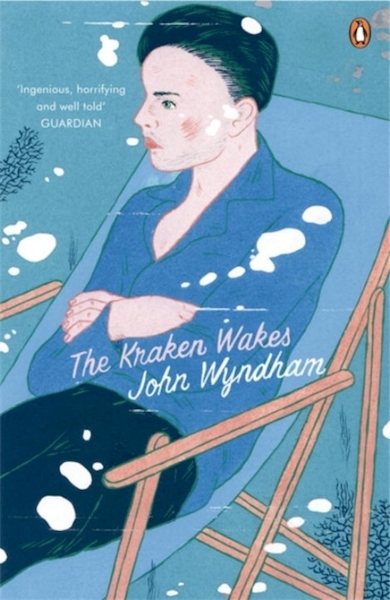
 This was the book selected for me in the recent Classics Club Spin. For once, I’ve managed to finish my book before the deadline (4th October).
The Kraken Wakes was published in 1953 and, like most of John Wyndham’s other books, is a classic science fiction novel. It’s narrated by Mike Watson, who works as a reporter for the EBC (a fictional rival to the BBC). At the start of the novel, Mike and his new wife Phyllis, also a reporter, are on their honeymoon on a cruise ship in the Atlantic when they spot something odd in the sky: five bright red lights descending towards the sea and disappearing beneath the water. As more and more sightings like this are reported, it becomes clear that these fireballs are not just falling at random – they are heading for the deepest waters in the world, which suggests that some kind of plan is under way.
When ships mysteriously begin sinking while trying to cross these deep sea areas, panic spreads across the world. Many people blame the Soviet Union, who in turn blame Western capitalist governments – the Cold War is ongoing, after all – but Mike and Phyllis support the theories of Professor Alastair Bocker, who is warning the public that an alien presence, one which can exist only at very high pressures, has settled beneath the sea and is targeting shipping and human life. The Watsons see evidence of this for themselves when they accompany Bocker to the Caribbean island of Escondida and witness strange mechanical ‘sea tanks’ emerging from the sea. Still, Bocker and his theories get very little support, being ridiculed by the media and ignored by governments…until the situation escalates to a point where it can no longer be ignored by anyone.
I enjoyed this book, although not as much as The Midwich Cuckoos or Chocky, which are my favourites by Wyndham. This is a more traditional alien invasion novel in many ways, although there are some unusual elements – for example, we don’t actually see the aliens and they don’t try to interact with humans or make their motivations clear. I don’t want to go into too much detail and spoil the whole plot, but there’s also an ecological thread to the story, mirroring modern climate change warnings, which makes it feel very relevant, probably more so today than in 1953.
I liked Mike and Phyllis and the way their marriage was portrayed as a true partnership based on mutual love and respect. Phyllis is a strong character and it’s good that, rather than being pushed into a minor role, she plays an important part throughout the novel and Mike may not have survived without her intelligence and resourcefulness. The most interesting thing for me, though, was seeing how governments, scientists and the public react to a threat affecting the whole world. I think we got a taste of this during the Covid pandemic – governments being slow to take action, advice and warnings being ignored, public denial and confusion. But this is where I think the decision to have the whole book narrated by Mike was a bit limiting. I would have liked to have seen the situation from other perspectives, to have heard conversations between various government ministers, to have seen what was happening in communities around the world, to have watched Professor Bocker and his fellow scientists trying to come up with answers.
Overall, this was a fascinating read. I’ve now read all of Wyndham’s major novels, but still have his short stories and his early work published as John Beynon to try.
This is book 7/50 from my third Classics Club list.


I do agree that having one narrator can be a bit problematic, but I’m keen to read a John Wyndham may be I’ll go with the Midwich Cuckoos first?
Yes, I think in this case it would have been better to use multiple narrators to fill in the gaps in the plot. The Midwich Cuckoos was the first Wyndham I read and my favourite, but The Day of the Triffids would probably be a good starting point as well.
This and his other book Day of the Tryffids are two classics I really want to read.
They’re both fascinating books. I hope you enjoy them!
I read this a million years ago, so can’t remember a *thing* about it. You might prompt me to re-read a few of Wyndham’s books though [muses]. I’d certainly like to read ‘Triffids’ again.
I would like to re-read some of his books as well, but not just yet as I still have a few more to read for the first time.
I enjoyed this one too, although it’s not quite at the same level as his best books. I do think he’s quite interesting for his time in the way he portrays women – they tend to be a bit less pathetic than a lot of the women in SF at that time!
This is one of my least favourites so far, but only because his others are so good!
Oh nice! I only read The Day of The Triffids, but want to read more