Good Evening, Mrs Craven: The Wartime Stories of Mollie Panter-Downes

Mollie Panter-Downes was the London correspondent for the New Yorker and this collection from Persephone Books brings together a number of her contributions to the magazine which were written during World War II. The book opens with her Letter from London dated 3 September 1939 and ends with another dated 11 June 1944. Between the two letters are twenty-one short stories, each of which offers an insight into the hopes and fears of British people trying to deal with the changes the war has brought to their lives.

These stories are not particularly dramatic or sensational in any way. They are realistic stories that focus not so much on the war itself, but on the effects of the war on the women (and a few of the men) who were left behind at home. We read about women attending sewing parties, worrying about loved ones who are away fighting, preparing for their husbands to go to war, coping with being pregnant during the war and experiencing almost any other wartime situation you can think of.

After finishing the book, there are a few stories that stand out in my memory more than the others. In Clover, for example, is a story about a rich woman called Mrs Fletcher who takes in a family of evacuees from a poor part of London. This was an interesting study into how the war pushed together people of different social backgrounds who wouldn’t usually have mixed with each other. This Flower, Safety follows Miss Mildred Ewing as she moves from one hotel to another in an attempt to escape from danger, beginning to despair of ever finding somewhere safe to live. Then there’s the story of Miss Burton, who is so hungry she can think about nothing else. The title story is also one of the best; it’s about a woman who has been having an affair with a married man. On the evening before he leaves to go to Libya, she wonders how she’ll be able to find out whether he’s dead or alive:

“Don’t think I’m being stupid and morbid,” she said, “but supposing anything happens. I’ve been worrying about that. You might be wounded or ill and I wouldn’t know.” She tried to laugh. “The War Office doesn’t have a service for sending telegrams to mistresses, does it?”

The stories are published in chronological order, as they appeared in New Yorker between 1939 and 1944, showing how life in Britain changed as the war progressed. Despite the subject matter, these stories are not all bleak and depressing – there’s also a lot of humour in Panter-Downes’ writing, in the form of gentle wit and irony.

As with most of the short story collections that I’ve read, there were some that didn’t interest me very much, but others that I loved and wished were longer. However, I think reading them all at once was a mistake as it was a bit too much for me. I think I would have enjoyed this collection even more if I had dipped in and out and taken the time to appreciate each story individually.

Recommended.

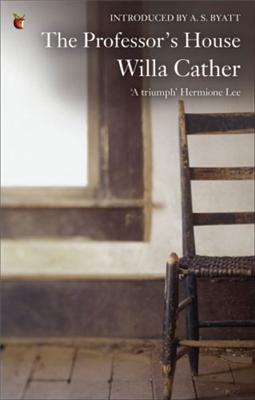
Review: The Professor’s House by Willa Cather

Willa Cather is an author I’ve heard a lot about but whose work I’ve never read until now.  I should probably have started with her most famous book, My Antonia, but something drew me to this one, The Professor’s House.

The Professor of the title is Godfrey St Peter, a man in his fifties, around the same age as Willa Cather was when she wrote this novel. At the beginning of the book, St Peter and his wife are preparing to move into their new home.  At the last minute the Professor decides that he doesn’t want to give up his old house just yet, so that he can continue to work in his old study and spend some time alone with his memories.

Most of the book revolves around St Peter reminiscing about his family and friends and coming to terms with the idea of leaving the past behind and embracing modern life.  At the forefront of the Professor’s thoughts is his former student Tom Outland, who had once been engaged to his daughter Rosamond. On his death in the First World War, Outland left everything he had to Rosamond – and this inheritance is causing trouble for the St Peter family.

If you prefer books with a gripping plot and lots of action you’ll want to avoid this one, as it was one of the slowest moving books I’ve ever read. I have to admit there were a few times during the first few chapters that I came close to abandoning it, but I kept reading because it was so well written. I would describe this as a calm, quiet, reflective book; one with such powerful, eloquent writing and beautiful imagery that it doesn’t really matter that not much actually happens.

The book is divided into three sections; the first and third are essentially character studies of the Professor and his family, particular his two daughters Rosamond and Kathleen and their husbands. The middle section is very different in both style and subject, as it tells in a flashback the story of Tom Outland’s life in New Mexico before he met the St Peter family. This story-within-a-story was fascinating but did feel slightly out of place, almost as if it had just been dropped at random into the middle of an entirely different book.

One of the things that stood out about Cather’s writing for me was the use of colour in her descriptions.

The grey sage-brush and the blue-grey rock around me were already in shadow, but high above me the canyon walls were dyed flame-coloured with the sunset, and the Cliff City lay in a gold haze against its dark cavern. In a few minutes, it too was grey and only the rim-rock at the top held the red light. When that was gone, I could still see the copper glow in the piñons along the edge of the top ledges. The arc of sky over the canyon was silvery blue, with its pale yellow moon, and presently stars shivered into it, like crystals dropped into perfectly clear water.

The Professor’s House is possibly a book I would appreciate more if I read it again when I’m older, as I found it difficult to identify with a fifty-two year old man looking back on his life. This was my first experience of Willa Cather and although I don’t think she’s going to be a favourite author, I will probably read more of her work at some point in the future.

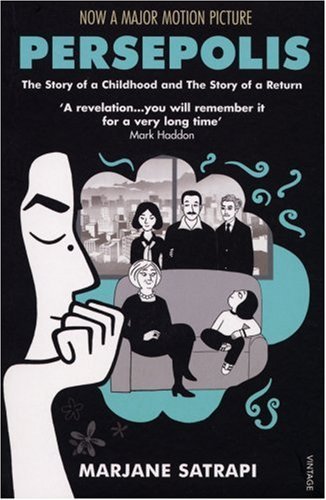
Review: Persepolis by Marjane Satrapi

This is the first graphic novel I’ve read. There, I’ve admitted it. I can’t explain why it has taken me so long to read one. It’s not that I think they’re childish or ‘not real literature’ or anything like that; it had just never occurred to me to read them and until I started blogging I didn’t even realise how popular they were. When I did decide I’d like to try one I thought a graphic memoir might be the best to start with and as I’d seen Persepolis reviewed on so many blogs it seemed a good choice. And it was, because I loved it.

This edition is actually two books in one: The Story of a Childhood and The Story of a Return. They can be bought separately but you really need to read the first book before the second.

These two books are the memoirs of Marjane Satrapi. In The Story of a Childhood she tells us what it’s like to be a child growing up in Iran during the 1970s and 80s. Due to the Islamic Revolution and the Iran-Iraq War, Iran becomes an oppressive and often dangerous place to live, particularly as Marjane develops into a rebellious teenager. Her concerned parents eventually decide that the safest option is to send their daughter away to start a new life in Europe.

Before beginning this book, I didn’t know very much at all about Iranian history and politics. I found that seeing things through a child’s eyes was fascinating and informative. Marji is an intelligent, imaginative girl and like all children she’s always curious and full of questions, so for someone who knows very little about Iran, this book offers an opportunity to learn along with Marji.

In the second volume, Marji is living in Austria, struggling to adapt to life in a country with an entirely different culture. This second book is more about the personal problems she faces with relationships, drugs and money and although I had a lot of sympathy for the situation she was in, I didn’t enjoy reading this book as much as the first one. I did find it more interesting towards the end when she finally returns to Iran several years later and finds she has as much trouble fitting back into her old life as she’d had fitting into life in Austria.

Although this was definitely a new experience for me, I was quickly able to forget that I was reading a ‘graphic novel’ and become absorbed in Marjane Satrapi’s story. The simple, stark black and white drawings were perfect and made it easy to understand what was happening. Rather than just illustrating the text, the pictures played an equally important part in telling the story.

I enjoyed this book much more than I expected to. It was a powerful and moving story, with some moments of humour too. So, if you are also new to graphic novels and unsure where to start, I have no hesitation in recommending this one to you!

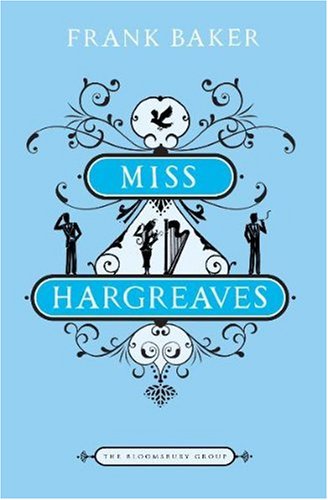
Review: Miss Hargreaves by Frank Baker

When I started to notice these Bloomsbury Group books appearing on other blogs, I knew I wouldn’t be able to resist reading them too. Not just because the covers are so pretty, but also because the stories all sound so intriguing! Miss Hargreaves (pronounced Hargrayves as we are told in the author’s note) was the one that appealed to me the most and the one I’d heard the most about – and it was the right choice because I loved it. It’s a charming tale about the power of imagination and how it can lead to an unusual and unlikely friendship.

“Henry,” I moaned, “she is exactly as I imagined.”
Limping slowly along the platform and chatting amiably to the porter, came – well, Miss Hargreaves. Quite obviously it couldn’t possibly be anyone else.

Norman Huntley has always allowed his imagination to run away with him. On a trip to Ireland with his friend Henry, they amuse themselves by inventing an imaginary eighty-three-year-old woman called Constance Hargreaves. They make Miss Hargreaves a poet and a musician; they give her a dog called Sarah and a cockatoo named Dr Pepusch – and Norman writes her a letter inviting her to stay at his home in Cornford, Buckinghamshire.

Never expecting her to accept his invitation (how could she – she doesn’t exist!) Norman is stunned when a little old lady arrives at the train station accompanied by a dog, a cockatoo, a harp – and even her own bath. It seems that Norman’s creation has come to life – and with even Henry convinced it’s all a practical joke, how will he explain Miss Hargreaves to his parents, his sister and his girlfriend Marjorie?

As the story continues, it gets more and more bizarre. I can safely say this is one of the most original and unusual books I’ve read for a long time! Miss Hargreaves is an unforgettable character – endearing and eccentric, yet ever so slightly sinister – and Norman is torn between a fatherly pride in his creation and frustration at the way she’s taking over his life. Somewhere in the middle of the novel, a gradual shift of power from Norman to Miss Hargreaves takes place, resulting in an almost Frankenstein-like situation where the creator begins to lose control of his creation. And yet Miss Hargreaves seems to be aware that there’s something different about her and that some kind of invisible bond exists between herself and Norman.

I was expecting the story to be funny and entertaining – and it is. However, there are also some very moving and poignant scenes, making the book a perfect mixture of dark and light.

There was only one aspect of this book that I could maybe have done without and that was the music. With Norman Huntley’s church organ, Cornelius Huntley’s violin and Miss Hargreaves’ harp, the musical elements of the book became a bit too much for me. However, I’m sure other readers will enjoy the organ playing scenes and they certainly add to the quirkiness and originality of the book.

Recommended

Pages: 317/The Bloomsbury Group/Year: 2009 (originally published 1940)/Source: My own copy

Review: Miss Ranskill Comes Home by Barbara Euphan Todd

Barbara Euphan Todd was best known as the children’s author who wrote the Worzel Gummidge series about a scarecrow who comes to life. Miss Ranskill Comes Home, first published in 1946, was her only adult novel.

Shortly before the start of World War II, Nona Ranskill was swept overboard whilst on a cruise and was washed up on a desert island. The only other inhabitant of the island is a man known as ‘the Carpenter’, who had also fallen overboard on an earlier occasion. At the beginning of the book, the Carpenter has died and we first meet Miss Ranskill as she’s digging his grave. Before his death however, he had managed to finish building a boat with which he had intended to sail himself and Miss Ranskill to safety. After burying the Carpenter, Miss Ranskill makes an attempt to escape from the island on her own. Luckily, before she becomes hopelessly lost at sea, she is rescued by the British Navy. Returning to England after almost four years, Miss Ranskill discovers that it’s not the England she left behind: in her absence, World War II has begun…

This may all sound very far-fetched, but Todd actually makes it seem believable. I thought the whole idea of someone being cut off from the world and returning home only to find themselves suddenly thrown into the middle of a war was absolutely fascinating. I particularly enjoyed the first half of the book which deals with the first few days of Miss Ranskill’s arrival in England, when everything feels strange and surreal. Even the English language seems different and full of unfamiliar words. When she tries to buy food she can’t understand why she’s asked for her ‘ration book’, or why she needs ‘coupons’ to purchase clothes. This leads to some very amusing situations but at the same time you can’t help but feel sorry for poor Miss Ranskill.

Although he’s dead before the story even begins, the strongest character in the book is the Carpenter. He is constantly in Miss Ranskill’s thoughts and his presence is there on almost every page in the form of flashbacks and memories. Although Miss Ranskill’s friends found it scandalous that she had spent four years in the company of a strange man – particularly a man they consider to be of a lower social standing – I think anyone who has read this book will agree that if we were stranded on a desert island, the Carpenter is exactly the type of person we would like to be stuck there with.

Makes it more homely-like, Miss Ranskill, see.
That had been one of his favourite expressions. He used it as he arranged stones round the smoky fire, and when he handed her a shell.
Saucer, see, Miss Ranskill. We mayn’t have cups, but we’ve plenty of saucers. Makes it more homely.

His optimism and words of wisdom had helped to sustain Miss Ranskill during her time on the island and continue to give her comfort on her return to wartime Britain. However, the years on the island and the company of the Carpenter have given her a new outlook on life and she finds it difficult to adjust. Unlike her friends and family who are all absorbed in their war work, Miss Ranskill feels detached from what’s going on and spends most of the book remembering the island and even feeling nostalgic about the fact that she had to eat fish for every meal and wear the same clothes for nearly four years! England may have changed, but Miss Ranskill has changed even more.

This book has the perfect blend of humour and poignancy and gives us an opportunity to explore World War II from a unique perspective. Recommended.

Pages: 328/Publisher: Persephone Books/Year: 2003 (originally published 1946)/Source: Library book

Review: The Scapegoat by Daphne du Maurier

What would you do if you came face to face with yourself? That’s what happens to John, an Englishman on holiday in France, when he meets his exact double – a Frenchman called Jean de Gue.  John agrees to go for a drink with Jean but falls into a drunken stupor and wakes up in a hotel room to find that Jean has disappeared, taking John’s clothes and identity documents with him!

When Jean’s chauffeur arrives at the hotel, John is unable to convince him of what has happened – and ends up accompanying the chauffeur to Jean de Gue’s chateau, where the Frenchman’s unsuspecting family assume that he really is Jean de Gue.  Naturally, they expect him to continue running the family glass-making business and arranging shooting parties – things that John has absolutely no experience in.  Before long, it starts to become obvious that Jean is using John as a scapegoat; Jean’s family and business are both in a mess and he wants someone else to have to deal with them.

Throughout the book, I was forced to revise my opinions once or twice about what was really going on. If everything in the book is supposed to be taken literally, then we need to suspend belief at times: could two men really be so identical that even their mother, wife and daughter can’t tell the difference? There is also another way to interpret the story, one which goes deeper into the psychology of identity – I won’t say any more about that here, but if you have read the book this theory may have occurred to you too.

As usual, du Maurier’s writing is wonderfully atmospheric. She has a way of making you feel as though you’re actually there in the hotel room in Le Mans, the grounds of Jean de Gue’s estate in the French countryside and Bela’s antique shop in the town of Villars.

When John first arrives at the de Gue chateau, every member of the household is a stranger to him but we (and John) are given enough clues to gradually figure out who each person is and what their relationship is to Jean de Gue.  From the neglected pregnant wife and the hostile elder sister to the resentful younger brother and the religious ten-year-old daughter, every character is well-drawn and memorable.

Another thing I love about Daphne du Maurier’s writing is her ability to always keep the reader guessing right to the final page (and sometimes afterwards too).  This was a fascinating and unusual story, one of my favourite du Maurier books so far.

Highly recommended

Pages: 320/Publisher: Virago Press (Virago Modern Classics)/Year: 2004 (originally published 1957)/Source: Library book

Review: Under a Blood Red Sky by Kate Furnivall

Unfortunately I was unable to finish this book – which is not something that happens to me very often. I hadn’t heard of Under a Blood Red Sky (also published under the title The Red Scarf) until I saw it in the library and I thought I’d give it a try as I love historical fiction set in Russia.   It sounded interesting:

Anna and Sofia are two women who meet whilst imprisoned in a Soviet labour camp in the 1930s and become best friends. When Anna becomes ill, Sofia comes up with a daring plan to run away from the camp and find help. Anna has told her about a childhood friend, Vasily, who is now living under an assumed name in the town of Tivil. After successfully escaping, Sofia heads for Tivil to look for Vasily and ask him to return to the camp with her to save Anna.

However, right from the beginning of the book I felt we were being asked to accept things that weren’t plausible.  The whole plot was just too far-fetched for me.  The other (bigger) problem I had with this book was that I couldn’t connect with any of the characters. Although they were constantly putting their lives at risk and facing unimaginable horrors under Stalin’s communist regime, I found I didn’t really care what happened to them. Sofia was one of those model heroines – beautiful, brave, intelligent and perfect. Everybody seemed to be captivated by her and I couldn’t really understand why. She just didn’t feel like a real person to me. Of course, there were some situations that even Sofia couldn’t deal with – that’s where the gypsy Rafik came in, using mesmerism and mind-control to overcome obstacles.  I thought the whole magical aspect of the book seemed a bit out of place.

I tried to keep reading, thinking the book might get better but when I found I was almost halfway through and still wasn’t enjoying it, I decided not to waste any more time on it and put it down with a sigh of relief. I’m glad I had borrowed this book from the library instead of spending money on it – at least I didn’t lose anything apart from a couple of days when I could have been reading something else.

Genre: Historical Fiction/Pages: 512/Publisher: Sphere/Year: 2008/Source: Library book