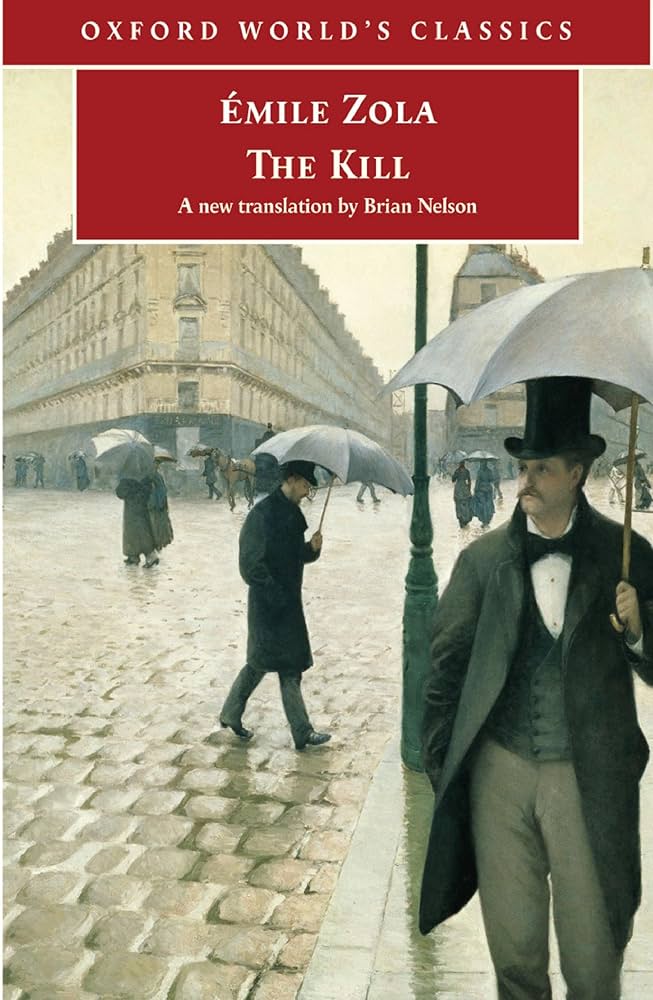
 Translated by Brian Nelson
This is the second book in Émile Zola’s Les Rougon-Macquart cycle, if reading in order of publication. A few years ago I read the first book, The Fortune of the Rougons, which lays the foundations for the rest of the series, but each novel is also designed to stand alone. The connection between them is that each book features characters who belong to rival branches of the same family, the Rougons and the Macquarts, all descended from Adelaïde Fouque, whom we met in the first novel. The Kill, or La Curée to give it its French title, was published in 1872 and is set during the Second French Empire (1852-1870).
The Kill follows Aristide Rougon, son of Pierre Rougon from the first book, as he leaves his home in Provence and settles in Paris, where he changes his name to Aristide Saccard. It’s a good time to arrive in Paris as the city is currently undergoing huge renovations with new boulevards, parks and landmarks being created under the supervision of Baron Haussmann. Ambitious and ruthless, Aristide starts buying up properties he has discovered are targeted for demolition then claiming compensation from the city at vastly inflated levels. He’s beginning to make a fortune through this corrupt scheme when his wife becomes terminally ill. Before she has even died, Aristide is already arranging his next marriage – to Renée, a girl from a rich family who will come with a large dowry.
The marriage is not a very happy one, with both husband and wife aware that it’s not much more than a business deal. Bored, Renée begins an affair with Maxime, Aristide’s son by his first wife. Maxime is several years younger and expected to marry the wealthy but consumptive Louise de Mareuil, but he is excited by the idea of a forbidden, incestuous relationship with his stepmother. In an interesting reversal of normal gender stereotypes, Zola portrays Maxime as delicate, feminine and beautiful while describing Renée as having masculine traits and being the stronger, more assertive of the two. Their affair forms one major thread of the novel; the other is concerned with Aristide’s business schemes and his attempts to get Renée to sign over the deeds to her family home.
The Kill, then, is a book that focuses on the lives of the rich and privileged. It’s a very descriptive book, as Zola brings to life the huge, opulent mansions, exquisite clothing, lavish banquets and luxurious carriages of the very wealthy. The title is a hunting term referring to the scraps of prey that are thrown to the hounds at the end of the hunt and Zola uses this as a metaphor for the greed of the businessmen who are fighting for money, power and influence and taking whatever they can from the rebuilding of the city. There wasn’t a single character I liked or had much sympathy for (although Aristide’s sister Sidonie was a great villain!) and I found all the descriptions of extravagance and waste overwhelming and distasteful, but I know that was the point of the novel so it certainly achieves its purpose. Apparently Zola himself was a poor journalist at the time of writing this book and had no personal experience of the sort of world he was describing, so everything had to be written purely from research, which makes it even more impressive.
I’m aware that there are several English translations of this book available, including an old one you can download free from Project Gutenberg, but I read a modern (2004) translation by Brian Nelson and do recommend it. I also found the introduction to my Oxford World’s Classics edition interesting as it discusses not just the story but also Baron Haussmann’s transformation of Paris. One of the projects that took place under Haussmann was the creation of the glass and iron structure that housed the Les Halles food market, which is the setting of the third book in the series, The Belly of Paris, and the next one I’m planning to read!

Book 8/20 of 20 Books of Summer

I’m also counting this towards Paris in July hosted by Emma of Words and Peace.
This is also book 5/50 from my third Classics Club list.


Great review!
Yes, Zola has fabulous descriptions of the society of his time, with each book looking at a different aspect.
So glad you found a good translation
Thanks! Yes, I love the insights he gives into different aspects of French society. I’m looking forward to the next book.
I’ve just started The Ladies Paradise, because it’s about department stores and they seem to be figuring in my reading a lot this year but I like the idea of reading a series from the beginning. The opulence reminds me of Balzac and Old Goriot in particular, you’re right it is distasteful!
The Ladies’ Paradise was actually the first one I read in this series and I thought it was a good starting point, but then I decided to go back to the beginning and try to read the rest in order. I hope you’re enjoying it.
Zola is so great, isn’t he – I love all the details and descriptions! The Oxford World’s Classics editions are really good ones; I’ve used them for both of the Zola novels I’ve read so far and would definitely recommend them to anyone else.
Yes, I was impressed with this edition and will try to stick with Oxford World’s Classics for the rest of the books if I can.
I’ve only read one book by Zola, but I think I prefer Balzac so far.
I’ve only read Cousin Bette by Balzac, which I enjoyed. I’m not sure if I prefer him to Zola, though – I think I need to read more of his books first.
I’ve read a few more. At first, I wasn’t sure I liked him (and I think my first was Cousin Bette), but I have liked him more as I’ve gone on.
I haven’t read this Zola novel, and even though I like Zola…at least the two novels by him that I’ve read…this plot doesn’t really appeal to me.
It’s not a particularly strong plot, but I did love the descriptions of Paris.
I just read Germinal and am keen to read more Zola! It sounds like there are some similar themes here about the unethical lifestyles of the rich.
I started to read Germinal a few years ago but abandoned it as I just wasn’t in the right mood for it. I’m looking forward to trying it again, although it could be a while now that I’ve decided to read through the series in order. And yes, Zola makes it clear in this book how much disdain he has for the very rich, even though he’s writing from their perspective here.
Oh fascinating, Helen, an enlightening review! I’m ⅔ of the way through my first Zola novel, Thérèse Raquin, which though it predates this series, also depicts a Paris as Hausmann begins his grand plan.
I’ll be interested to hear your thoughts on Thérèse Raquin – it was the first Zola novel I read before starting this series and I remember finding it fascinating, although obviously very dark.
I’ve just put the finishing touches to my review, which I’ve scheduled to appear before the end of the month. In the meantime I’ll look back at your review presently!
So glad you are enjoying Zola. My first experience of him was via Germinal and then I read a few others and loved them all. Like you I decided to go back to the beginning. I’m now reading book 5 – The Conquest of Plassans – very good.
Germinal seems to be a popular starting point with Zola, although my first was Thérèse Raquin and then The Ladies’ Paradise, before deciding to read through the series in order. I’m glad you’re enjoying book 5 – I’ll look forward to that one when I come to it.
The only one I’ve not really enjoyed so far is The Dream. It has some good elements but it’s not like any of his other books
I’ve only read Germinal, which was so bleak, but incredibly good. I’m looking forward to reading more. Are you planning to read them in order?
Yes, I’m intending to read them in order, although I don’t know whether I’ll ever actually get through all twenty! I’m glad you liked Germinal – I did start to read it once but was in completely the wrong mood for it, so I’m looking forward to trying it again when I come to it.
I’m collecting titles for next year’s Paris in July. In the past I’ve read and loved five Zola novels: Thérèse Raquin, Germinal, L’Assommoir, The Belly of Paris, and Nana. I’m reading The Earth now.
I’m glad you loved all of those! I’ve read Thérèse Raquin but not the others, so I’ll look forward to them.
Glad you enjoyed reading this – it does sound scandalous and intriguing, and set in an interesting time period. 😊
Yes, the time period is fascinating – I loved his descriptions of Paris and how it was changing so much at that time.