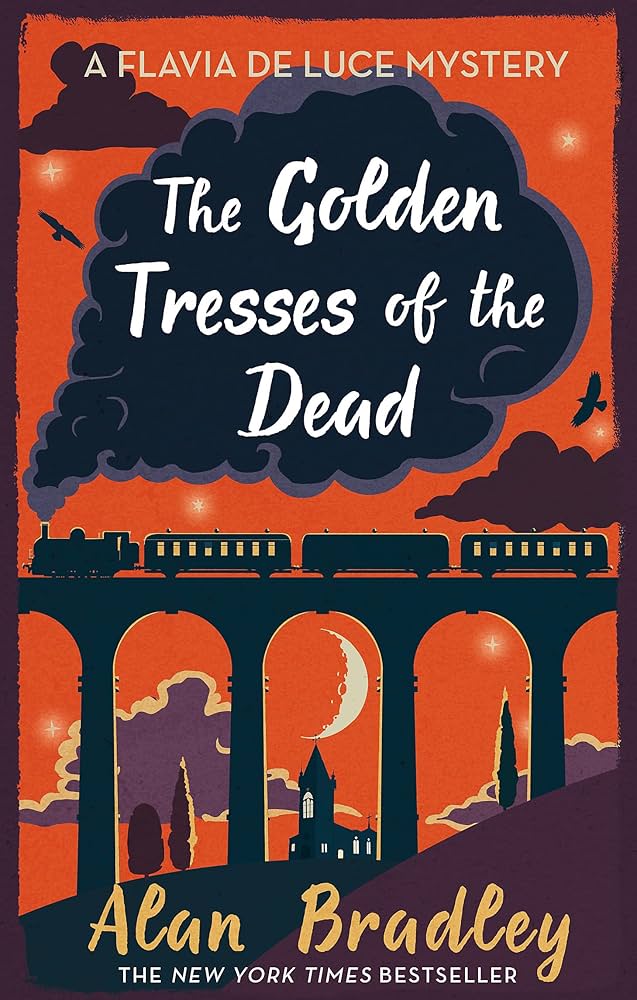
 After a five year gap, Flavia de Luce is back! It seemed that 2019’s The Golden Tresses of the Dead was going to be the last in the series, so I was pleased to see book eleven, What Time the Sexton’s Spade Doth Rust, appear towards the end of 2024. If you’re wondering about the title, it comes from the poem At the End by Andrew Dodds.
In this book, our young heroine Flavia de Luce and her fellow amateur detective, the gardener Dogger, are investigating yet another suspicious death in the village of Bishop’s Lacey. Major Greyleigh, a retired hangman, has been found dead after eating a breakfast of apparently poisonous mushrooms – and the police suspect Mrs Mullet, the de Luce family cook, who had picked and served the mushrooms to the victim. Flavia and Dogger are sure there’s been a mistake – Mrs Mullet can’t possibly be a murderer! Before they can prove her innocence, however, they must try to find the real killer.
I enjoyed the mystery in this book more than in the last one – it was less complicated and easier to follow. Mrs Mullet being implicated makes Flavia and Dogger’s investigation feel more personal and relevant than usual, while the profession of the victim – a hangman – provides motives for other people to want him dead. Also, with the cause of death believed to involve poison, there are plenty of opportunities for Flavia to put her knowledge of chemistry to good use!
I do miss Flavia’s interactions with her sisters, especially as after fighting and arguing with them for most of the series it had seemed a few books ago that her relationships with them were starting to turn a corner. Feely (Ophelia), who got married at the beginning of the previous book, is still away on her honeymoon and doesn’t appear at all, and although Daffy (Daphne) is still living at home, we barely see her either. In fact, it’s mentioned that she’s busy completing her application for Oxford University, so presumably she’ll be gone soon as well. I was struggling to work out the ages of the characters in this book; we were told in the last one that Flavia is twelve, but I can’t remember how much older her sisters are – and I can’t believe only a year has passed since the beginning of the series, where she was eleven!
One character we do see a lot of is Undine, Flavia’s annoying younger cousin (I’m not sure exactly how old she is either). Again, Flavia’s relationship with Undine is improving as she starts to acknowledge that in some ways her cousin actually reminds her of herself. Unfortunately, I don’t find Undine at all fun or endearing and she’s really no substitute for Daffy and Feely.
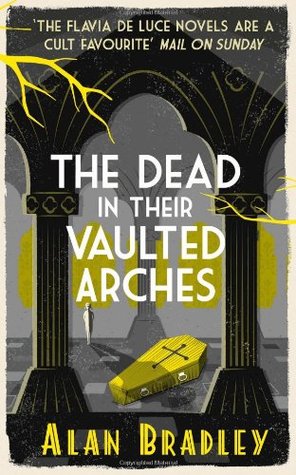
I was surprised to see that the storyline introduced earlier in the series involving the secret society known as the Nide was picked up again in this book. Having formed a big part of the plot of book six, The Dead in Their Vaulted Arches, and to a lesser extent book seven, it has never really been referred to again until now – and, to be honest, I think it should have just remained forgotten. An espionage/world power storyline doesn’t really fit with the otherwise charming, cosy mystery feel of the series. Still, it meant several big plot twists and the return of a character I hadn’t expected to see again!
Alan Bradley has said that he’s now busy working on the twelfth Flavia book, so it will be interesting to see where things go next.
Thanks to Orion for providing a copy of this book for review via NetGalley.



 She Reads Novels