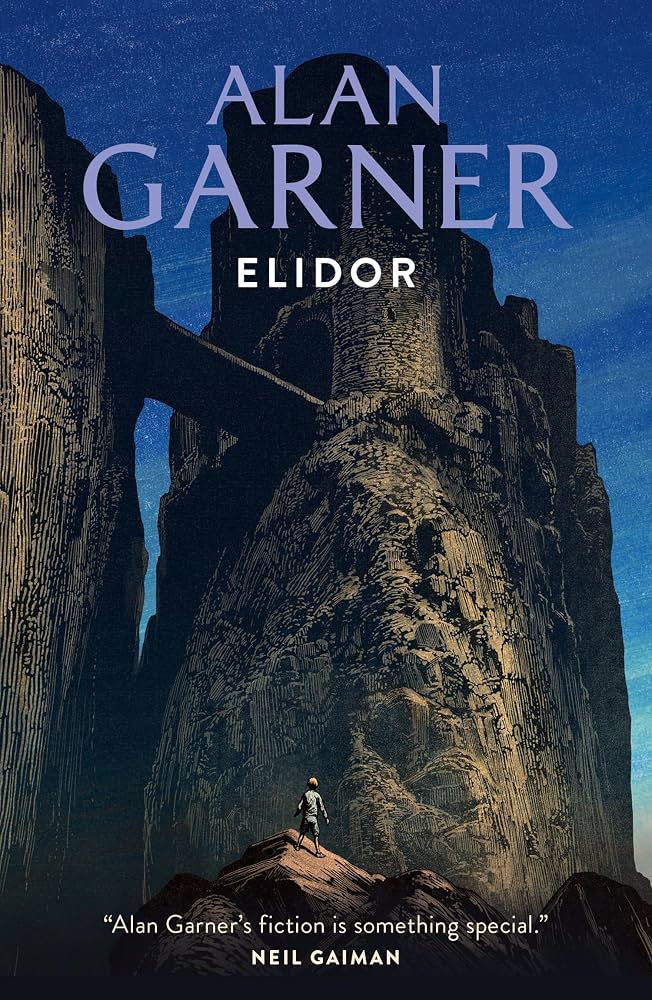
 I’ve been meaning to re-read this classic children’s fantasy novel for a long time and was motivated to move it further up the TBR pile after reading a wonderful review by Chris of Calmgrove Books earlier this year. I first read it at the age of about nine or ten – or rather, it was read by a lovely teacher who used to read aloud to us at the end of the day. I enjoyed it so much I got my own copy to read for myself a few years later.
Elidor was published in 1965 and has a strong 1960s feel which contrasts with the eerie, otherworldly nature of the fantasy land of Elidor. It begins with Roland Watson and his older siblings Nicholas, Helen and David wandering the streets of Manchester one cold afternoon, looking for something to do to pass the time. The post-war urban slum clearances are under way and the children stumble upon a church being prepared for demolition. When one of them accidentally kicks a ball through the church window, they go in one by one to look for it and don’t return, until only Roland is left.
Following his brothers and sister into the church, he discovers a portal to another land: Elidor, a world that was once beautiful but is now dying and decaying, under attack from the forces of darkness. Here, Roland meets the mysterious Malebron – a blind fiddle player, or is he a king? – who tells him that three of Elidor’s four golden castles have now become dark, but all hope isn’t yet lost. The Watson siblings must find the four Treasures – a stone, a spear, a cup and a sword – and keep them safe in their own world until light can be restored to Elidor.
For a fantasy novel, we spend a surprisingly small amount of time in Elidor itself. Most of the story takes place in Manchester, once the children have returned with the Treasures (which, away from Elidor, are transformed into everyday objects to make them easier to hide). However, the boundary between the two worlds is thin and the dark forces of Elidor begin to find their way through. There was a scene I found quite terrifying as a child, where the hidden objects begin to create static electricity, causing interference with all the electrical items in the Watson household. I still found it very unsettling as an adult! It’s this encroachment on the characters’ ordinary lives that makes Elidor darker than, say, the Narnia books. It reminded me a lot of Susan Cooper’s The Dark is Rising, which also features a battle between light and dark and the intrusion of evil forces on the real world.
Another thing this book and the Susan Cooper series have in common is a strong mythological background, with various allusions to myths and legends woven into the plot. Roland’s name, for example, is significant because the first part of the story has parallels with the folktale Childe Rowland, in which Rowland also has two brothers and a sister, Burd Ellen, who also disappear after kicking a ball over a church. Then there’s the title Elidor, inspired by a medieval Welsh folktale (Elidyr and the Golden Ball); the four castles and four treasures, which correspond to the Irish legends of the Tuatha Dé Danann; and the untamed unicorn, Findhorn, whose song is the key to saving Elidor. Don’t worry, though, if you’re not familiar with any of these myths – they’re not necessary to understanding the story.
Although I enjoyed reading Elidor again after so many years, I didn’t find it an entirely satisfying book. There’s not much worldbuilding regarding Elidor itself; we only get a brief glimpse of it early in the novel and we never really learn exactly why it is being destroyed, who the evil forces are or what their aims are. Everything is kept intentionally vague and although this does add to the general eeriness of the book, I would have liked to have known more. We aren’t told the ages of the children either – we just know that Nicholas is the oldest and Roland the youngest. I found it surprisingly frustrating not knowing how old they were! Of course, none of this bothered me the first time I read it and it is a children’s book, after all.
I’m not sure if I ever read any of Alan Garner’s other books and can’t remember them if I did. Maybe I should try some of them now that I’ve reminded myself of this one.

