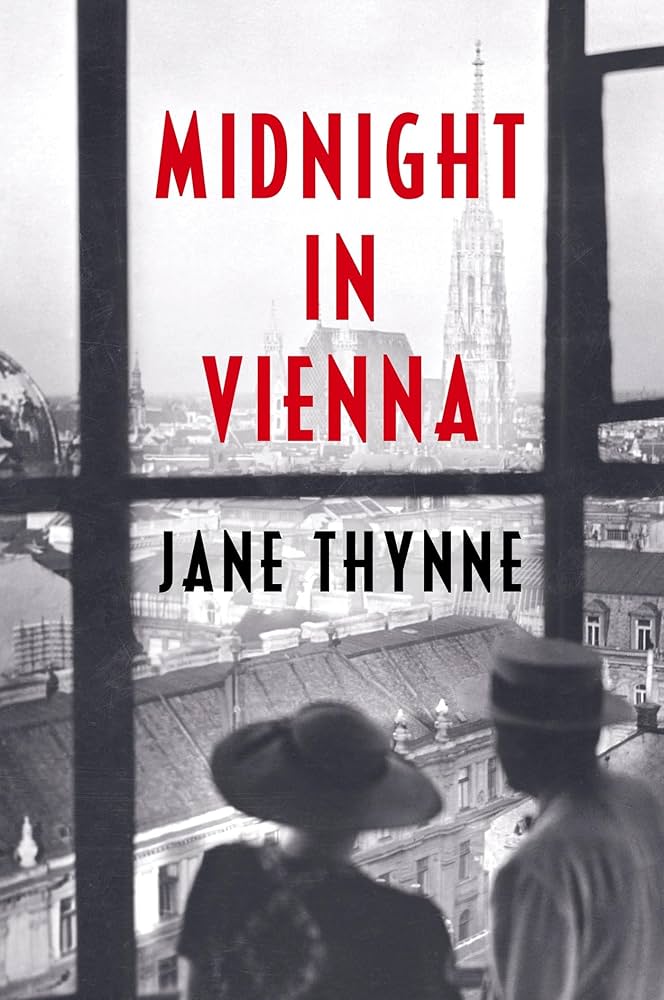
Midnight in Vienna by Jane Thynne

It’s 1938 and Stella Fry has just returned to London from Austria, where she has been working as a private tutor for a Jewish family in Vienna. With the worsening political situation in Europe, the family decided to leave for the safety of New York, and Stella has found herself back home with no job. Famous mystery writer Hubert Newman is advertising for someone to type up his new manuscript and Stella applies for the position. After meeting with Newman and being offered the job, she is shocked when she learns the next day that he has been found dead. Another shock follows twenty-four hours later when she receives the manuscript of his new book, Masquerade, and finds that he has dedicated it To Stella, spotter of mistakes.

Harry Fox is a former Special Branch detective who left the police force under a shadow, but is still carrying out unofficial intelligence work, spying on suspected communists. He has reason to believe that Hubert Newman’s death was not a natural one and when his path crosses with Stella’s and he discovers that she had lunch with the author the day before he died, the two team up to investigate.

I really enjoyed Midnight in Vienna; the only negative thing I can say about it is that Stella was a bit too trusting of strangers and too quick to put herself in dangerous situations without thinking of the consequences. The biggest example comes very early in the novel when, having only just met Harry Fox, she agrees to travel back to Vienna alone on the trail of someone possibly implicated in Hubert’s murder – at a time when everyone else is trying to get out of Austria. However, I can forgive this because the Vienna sections of the book are so well done, perfectly illustrating the mood in Austria during that period which followed the annexation by Nazi Germany.

With Hubert Newman being an author, there’s also a literary element to the novel. Newman (a fictional character, by the way) is a member of the Detection Club, a real-life society of prominent British mystery writers, and Harry Fox’s investigations lead to a meeting with one of the founding members, Dorothy L. Sayers. She only makes a brief cameo appearance but I thought the way Thynne portrayed her character was very convincing. As well as the literary world, we also get a glimpse of the theatrical world of the 1930s through Stella’s actress friend, Evelyn, so there’s a lot going on outside of the central mystery.

This is the first of Jane Thynne’s novels I’ve read. It seems that most of her previous books are similar wartime/espionage thrillers and having enjoyed this one so much I’m sure I’ll be reading more of them. I’m also wondering whether there will be a sequel to this book as I think there’s plenty of scope for some of these characters to return for a second adventure.

Thanks to Quercus for providing a copy of this book for review via NetGalley.

Book 44/50 for the Historical Fiction Reading Challenge 2024
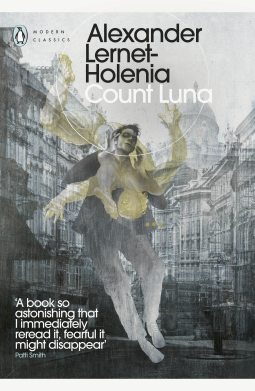
Count Luna by Alexander Lernet-Holenia

Translated by Jane B. Greene

What a strange book this is! I enjoyed it, but I’m not sure I fully understood everything the author was trying to say. It’s the first book I’ve read by Alexander Lernet-Holenia and I’m definitely now interested in reading more.

Count Luna was first published in German in 1955 (Lernet-Holenia was an Austrian author) and appeared in an English translation by Jane B. Greene a year later. It has recently been published in a new edition by Penguin Classics.

The novel begins with Alexander Jessiersky, an Austrian aristocrat, entering the Catacombs of Praetextatus in Rome, apparently in search of two French priests believed to have vanished somewhere in the underground passageways. When Jessiersky himself also fails to emerge from the catacombs, his disappearance is reported to the police, who link him with a series of incidents which occurred in Austria and are still under investigation. The rest of the book is presented as an account of Jessiersky’s life leading up to the disappearance, based on reports by the Italian and Austrian authorities.

We learn that at the start of World War II, Jessiersky is the head of a large Viennese transport company. When the company tries to purchase some land belonging to Count Luna, who refuses to sell, the board of directors come up with a plan to confiscate the land and have Luna sent to a Nazi concentration camp. Jessiersky himself is not involved in this, but does nothing to prevent it from happening – and so, when the war is over, he begins to worry that Luna has survived the camp and is coming back to take his revenge.

On one level, Count Luna could be described as a psychological thriller; told mainly from Jessiersky’s perspective, there’s a growing sense of paranoia and fear as he becomes convinced that Count Luna is following him around Vienna, watching from the shadows, breaking into his house and even trying to poison his children. Whether any of these things are true or only exist in Jessiersky’s imagination I’ll leave you to discover for yourself. The atmosphere becomes very dark and the feeling of tension increases as the novel heads towards its conclusion and Jessiersky enters the catacombs – and from this point the story becomes quite bizarre and even more nightmarish.

At 160 pages, Count Luna is a short novel, but took longer than I expected to read as there are some long, detailed digressions into subjects such as the lineage of the Jessiersky family, which need some concentration from the reader (and don’t really add a lot to the story as a whole). Apart from the references to the war, it felt more like a book written in the 19th century than one written in the 1950s. The war is a crucial part of the story, however, and I’ve seen reviews suggesting that Lernet-Holenia was drawing parallels between Jessiersky’s guilt over Luna’s fate and Austria’s own post-war guilt, which does make a lot of sense. I also think the name Luna (the moon) is no coincidence, as Jessiersky discovers that trying to escape from Luna – and therefore from his guilt – is as useless as trying to escape from the moon.

Although I didn’t love this book as much as I thought I was going to at the beginning, I did find it completely fascinating and it left me with a lot to think about.

Thanks to Penguin Classics for providing a copy of this book for review via NetGalley.

A Song for Summer by Eva Ibbotson

Before summer draws to an end (not that it’s been much of a summer here anyway – I started writing this during a thunderstorm), I decided to read the appropriately titled A Song for Summer, Eva Ibbotson’s last adult novel, first published in 1997. It has more recently been reissued and remarketed for a YA audience but, like Ibbotson’s The Secret Countess and The Morning Gift, I think it’s a book that could be equally enjoyed by both adults and young adults.

Ellen Carr is the daughter of a suffragette and a solicitor who was killed during World War I. Raised by her mother and two aunts, also former suffragettes, Ellen is expected to go to university and then pursue a suitably impressive career – a politician, perhaps, or the first female President of the Royal Academy. However, it quickly becomes obvious that Ellen’s talents and ambitions lie in another direction. What she really wants to do is cook and clean, so she heads for Austria to take up a position as housekeeper at the experimental Schloss Hallendorf School.

As Ellen tries to settle into her new job and home in the beautiful Austrian countryside, she discovers that the school is not the idyllic place she had hoped it would be. There are lots of eccentric misfits among the staff, as well as several troubled children with difficult family lives whose parents have either sent them to boarding school because they don’t have time for them or because they’re not able to care for them. With her warm, maternal nature, Ellen sets out to solve everyone’s problems and bring some happiness to Schloss Hallendorf.

Although this book was published in 1997, Ellen is not really what you could describe as a ‘modern’ heroine. She rejects a university education and the chance to be a pioneer for women’s rights like her mother and aunts because she prefers to bake and sew and clean. There’s nothing wrong with that, of course, as long as it’s a woman’s own choice rather than something she feels is her duty, but not many of today’s historical fiction authors would choose to write about a woman like Ellen and this book does at times feel more like one written in the 1930s, when it is set, than in the 1990s.

There’s a love interest for Ellen, in the form of the Czech gardener and fencing teacher, Marek Tarnowsky. As we discover early in the novel, there’s a lot more to Marek than meets the eye; not only is he a talented composer and conductor, he is also working undercover to help Jews flee the Nazi regime. The story of Ellen’s domestic life at Hallendorf is interspersed with accounts of some of Marek’s missions, including a daring attempt to rescue his best friend, a Jewish violinist, and eventually Ellen also becomes involved in helping him. However, although I’m sure we are all supposed to love Marek as much as Ellen does, I never really warmed to him and this took away some of the emotional impact of the story.

Although I liked this book, mainly for its portrayal of Austria on the brink of war, I found it the weakest of the four Ibbotson novels I’ve read so far (my favourite is probably Madensky Square). I’ll continue to read her books and hope that I’ll enjoy the next one I read more than this one.

This is book 15/20 of my 20 Books of Summer 2023

This is book 36/50 for the 2023 Historical Fiction Reading Challenge.

Airs Above the Ground by Mary Stewart

airs-above-the-ground This month, one of my favourite authors, Mary Stewart, would have been 100 years old and to mark the occasion I decided it was time to pick up one of the few remaining books of hers that I still hadn’t read. I chose Airs Above the Ground, a suspense novel set in Austria which was first published in 1965 – and it was a great choice because I loved it!

At the beginning of the novel, our heroine, Vanessa March, is angry and disappointed because her husband, Lewis, has insisted on going to Stockholm on a business trip just when they had been due to leave for a summer holiday in Italy. Left behind in London, Vanessa meets a friend, Carmel Lacy, for tea and is shocked when Carmel mentions that she has just seen Lewis in a newsreel about a circus fire in Austria. Convinced that there must have been some mistake, Vanessa goes to watch the news footage herself and discovers that it’s true – not only is Lewis in Austria when he’s supposed to be in Sweden, he has also been caught on film with his arm around a pretty young girl.

Conveniently, Carmel’s teenage son, Timothy, is hoping to go to Vienna to visit his father and Carmel is looking for someone to act as a chaperone. Determined to catch up with Lewis and find out what’s going on, Vanessa agrees to accompany him. On arriving in Austria, however, Tim admits that he hasn’t been completely honest about his relationship with his father and instead he ends up staying with Vanessa as she searches for Lewis. They are an unlikely pair – at seventeen, Tim doesn’t really need a chaperone, especially not one who is only twenty-four herself – but a friendship quickly forms and together the two become caught up in a mystery involving a travelling circus, a mysterious Englishman and an old piebald horse.

Airs Above the Ground is a book I’ve been looking forward to reading for a long time and I wasn’t disappointed at all. I found so many things to enjoy, first and foremost the beautifully written descriptions of the Austrian countryside, the mountains, the villages and the fictional castle of Schloss Zechstein which becomes the focus of the action for the second half of the story:

And, perched on the outermost edge of the crag, like something straight out of the fairy books of one’s childhood, was the Schloss Zechstein, a miniature castle, but a real romantic castle for all that, a place of pinnacles and turrets and curtain walls, of narrow windows and battlements and coloured shields painted on the stone. There was even a bridge; not a drawbridge, but a narrow stone bridge arching out of the forest to the castle gate, where some small torrent broke the rock-ridge and sent a thin rope of white water smoking down below the walls.

Many of Mary Stewart’s novels involve the heroine forming a bond with a lonely or neglected young boy, and while Timothy is too old to be considered a child, it was still good to watch the relationship between them develop. It’s a relationship based entirely on trust, friendship and mutual liking, with no hints of any romantic attraction at all. Of course, unlike most Stewart heroines, Vanessa is already married before the novel even begins and this does give her character a slightly different feel. Like the others, she’s a strong, intelligent and resourceful woman but she’s clearly in awe of Lewis, and although I did enjoy her interactions with her husband, it seemed that whenever he was around she tended to place too much reliance in him and lost some of that strength and resourcefulness.

I also loved Old Piebald, the horse whose master died in the circus fire and whose injured leg Vanessa treats using her veterinary skills. The scene at the end of Chapter 9 where he is grazing in a meadow with circus music playing in the distance has to be one of my favourite moments in all of Mary Stewart’s novels! Horses play an important role in the story – Tim’s real reason for coming to Austria is to get a job with Vienna’s famous Spanish Riding School and it was nice to have an opportunity to learn more about the school and its beautiful Lipizzaner stallions. The novel takes its title from the movements performed by these horses, known as the ‘airs above the ground’.

As well as all of the other things I’ve mentioned, there’s also plenty of drama, including a desperate race around the castle battlements, a car chase and a scene involving a mountain railway train. Airs Above the Ground hasn’t become one of my absolute favourite Stewart novels, but it’s definitely in my top five or six (I’ve read eleven of her suspense novels so far, plus three of her Arthurian novels). Have you read this one? And have you done anything to celebrate Mary Stewart’s centenary?

The Morning Gift by Eva Ibbotson

The Morning Gift This is not the first Eva Ibbotson novel I’ve read – I have previously read Madensky Square and The Secret Countess, both of which I enjoyed – but I’ve been particularly looking forward to this one as so many Ibbotson readers speak so highly of it.

The novel opens in Vienna and introduces us to Ruth Berger, the twenty-year-old daughter of a professor of Zoology, whose life revolves around music, nature and her cousin Heini, the concert pianist she has always expected to marry. When the Nazis invade Austria in 1938, Ruth and her family are forced to flee but while her parents make it to safety in London, Ruth is left behind due to a problem with her student visa. A friend of her father’s, the British scientist Professor Quinton Somerville, comes to the rescue with the suggestion that Ruth marries him as a way of getting to London. Once Ruth is safely in England, the marriage can be annulled.

Of course, things don’t go exactly as planned and dissolving their marriage of convenience proves to be harder than they expected. Ruth becomes a student at Thameside University and finds herself in Quin’s class where it will be impossible for them to avoid each other as the lawyers have advised. While she and Quin struggle with the growing attraction they feel for each other, another complication arrives in the form of Heini who has made his way to England and expects Ruth to marry him as soon as possible. Will Ruth and Quin’s secret marriage be discovered?

The Morning Gift is a lovely, romantic story; it took me a while to get into it as the beginning was quite slow, but I became completely absorbed in the story somewhere in the middle and although it was really quite predictable, I still didn’t want to stop reading until I’d found out how things would end for Ruth and Quin. But there is more to this book than just the romance; among other things, it also offers insights into what life was like for a family who escaped persecution in Austria just in time and took refuge in London. This aspect of the novel is based on the author’s personal experiences – her own mother had to flee Vienna and Eva joined her at Belsize Park in London, where the Berger family live in the novel.

I also liked the academic setting and all the little scientific references that are dropped into the story as Ruth studies for her Zoology degree. I particularly enjoyed the descriptions of the field course at Bowmont, Quin’s estate in Northumberland. Ruth takes genuine pleasure in the natural beauty of her surroundings – the waves tumbling against the cliffs, the smell of vanilla drifting from a gorse bush, the sound of a curlew calling – and I loved seeing the Northumberland coast through her eyes.

I liked both Ruth and Quin, but there’s also a good selection of strong secondary characters: the other refugees who meet for tea and cakes in the Willow Tea Rooms; Ruth’s Uncle Mishak who copes with his wife’s death by planting radishes; Quin’s formidable Aunt Frances who will do anything to prevent Bowmont being given to the National Trust; and Ruth’s fellow students at the university, especially Verena Plackett, the closest thing to a villain in this novel. There are many more – too many to mention here – but all of them have something to add to the story.

I did enjoy The Morning Gift but it’s probably my least favourite of the three Ibbotson novels I’ve read so far. There was nothing in particular that I disliked about this book (apart from the slow start); it’s just that I preferred The Secret Countess and Madensky Square. I’m looking forward to continuing to work through the rest of Ibbotson’s novels!

Thanks to the publisher for providing a review copy via NetGalley.

Gretel and the Dark by Eliza Granville

Gretel and the Dark One night in 1899, Benjamin discovers a young woman lying on the ground near Vienna’s mental hospital, naked and bruised, and takes her to the home of his employer, the famous psychoanalyst, Dr Josef Breuer. The girl, whom Dr Breuer names Lilie, insists that she is not human, that she’s just a machine. Her mission, she says, is to destroy a monster. The doctor enlists Benjamin’s help in trying to uncover the truth about his young patient, but both men find themselves increasingly drawn to the mysterious Lilie.

Many years later, in Germany, we meet a spoilt and badly behaved little girl called Krysta. She has recently moved house with her father, another doctor, to be nearer his job working with ‘animal people’ at what Krysta believes is a zoo. Krysta’s father is busy with his work, leaving his daughter to entertain herself by remembering the fairy tales she was told by her old nurse, Greet, and making friends with Daniel, a lonely little boy she discovers eating worms in the grounds of the ‘zoo’. When an unexpected tragedy throws Krysta’s life into turmoil, she learns that Greet’s stories can provide an escape from the horrors that are going on around her.

Well, this is proving to be a very difficult book to write about without giving too much away! Gretel and the Dark is one of those books where it is not immediately obvious what is happening. For a long time I was confused. What was the link between the two storylines? Was Lilie a real person or was she a machine, as she claimed? How did she seem to have so much knowledge of the future? And who was Gretel supposed to be?

I think I spent about 300 of the book’s 350 pages trying to figure out the connection between Krysta and Lilie and coming up with theories, most of which were completely wrong. I only started to guess the truth shortly before it was revealed and when everything began to come together in the final chapters of the book, I discovered that the story I had actually been reading was not quite the one I’d thought I was reading!

Despite the allusions to fairy tales and the fact that some of the main characters are children, this is actually a very, very dark novel. Again, I can’t really discuss any of the issues the book raises because it would be best to know as little as possible before starting to read – though I don’t think it would be too much of a spoiler to say that the place where Krysta’s father works is not really a zoo at all, but something much more sinister. And the fairy tales Krysta recalls throughout the book are not the light, whimsical kind, but the dark and gruesome ones. Hansel and Gretel is one of her favourites and she enjoys using her imagination to push various enemies into the witch’s oven! Later in the book, when something particularly horrible happens to Krysta, another of the tales Greet told her takes on new meaning.

I liked Eliza Granville’s writing but I didn’t find this an easy book to read because some parts of the story were so disturbing and unpleasant. Although it was not a book I could describe as ‘enjoyable’ it was certainly very clever and unusual…and I can almost guarantee you’ll still be thinking about it long after reaching the final page.

Thanks to Penguin Ireland for the review copy.

Madensky Square by Eva Ibbotson

I felt a sudden longing to record…to retain…my everyday life here in Madensky Square. I shall remember my tragedies, my follies and my joys – everyone remembers those. But what of the ordinary things, the little happenings? What of the ‘dailiness’ – who has a care for that?

I think this is the first Eva Ibbotson book I’ve read. I say ‘think’ because it’s possible that I’ve read one or two of her children’s books (Which Witch? sounds very familiar), but this is definitely the first time I’ve read one of her adult or young adult books. Ibbotson is an author I’ve been wanting to try for a long time as so many of the bloggers I follow keep mentioning how much they love her. Madensky Square isn’t one that I’ve heard much about so probably wouldn’t have been the one I would have chosen to start with, but Amazon were offering it as their Kindle Daily Deal a few weeks ago and I couldn’t resist!

The book is set in Austria just a few years before the start of the First World War. Our narrator, Susanna Weber, is a dressmaker with a small but busy shop on Vienna’s Madensky Square. At the beginning of the novel, Susanna tells us that for the next twelve months she is going to keep a journal recording the lives of her friends, her customers and the other inhabitants of Madensky Square. She starts her story in the spring of 1911 and in the pages that follow we meet and get to know the people who populate Susanna’s world.

Being a dressmaker gives Susanna the opportunity to meet a wide range of people from different walks of life. She hears all of their gossip and becomes involved in the various dramas taking place in each of their lives. There’s Frau Schumacher, for example, who already has six daughters and whose husband is hoping for a son to inherit his timber business; how will he react if their next child is another girl? Then there’s Nini, Susanna’s Hungarian assistant, who is an anarchist and needs to decide whether her political beliefs are more important than her chance of love. Others include the Countess von Metz, a proud, sharp-tongued old lady who still loves buying dresses despite living alone and in poverty, the beautiful and very religious Magdalena Winter, and the eccentric Professor Starsky, an expert in Reptile Diseases. There are a large number of characters, but they are all so different and described in so much depth I never had any difficulty remembering who they all were. Some did feel a bit stereotypical (particularly the plain and awkward ‘bluestocking’, Edith Sultzer, and the fat butcher, Herr Huber) but I could overlook that as they were still so well-written and memorable. Even Rip the dog, whose owner sends him out every day with a little purse tied around his neck to buy the newspaper, has a distinct personality of his own!

Susanna herself is a lovely, warm person who others frequently look to for help and advice. However, her own life is no less interesting and complicated than that of any of the other characters I’ve mentioned. She has experienced a lot of sadness and loss in her past, but I don’t want to give too much of her personal story away as it’s only revealed to the reader slowly as the book progresses. Of all the other storylines in Madensky Square, my favourite was the one involving Susanna’s relationship with Sigismund Kraszinsky, a young Polish orphan. Sigi is a talented pianist and his uncle has brought him to Vienna in the hope of furthering his career as a musician, which unfortunately comes at the expense of allowing him to have a normal childhood. The story of how Susanna befriends this lonely, nervous little boy and tries to bring some happiness into his life is one of the most moving of the novel’s many subplots.

I loved reading the descriptions of Madensky Square itself, with its fountain, café and statue of Colonel Madensky, as well as the countryside, the opera houses and all the other places Susanna visits; I especially enjoyed reading about Susanna and Sigi’s trip to the magical Grottenbahn in Linz! I was satisfied with the way the book ended too – it wrapped things up nicely for all the characters we had been following in so much detail and had grown to love and care about over the course of the novel. There are happy endings for some of them, but not for others, which is realistic and more effective than if there had been a fairytale ending for everyone.

I loved this book and I’m hoping that maybe those of you who are Eva Ibbotson fans can tell me which of her books I should try next?