The Second Sight of Zachary Cloudesley by Sean Lusk

I was drawn to The Second Sight of Zachary Cloudesley by the setting – 18th century Constantinople – but I wasn’t sure that it would really be my sort of book. From the blurb, I was expecting a strong magical realism element, something I don’t always get on with. However, I was pleased to find that this aspect of the novel was actually much more subtle than I’d expected.

The story begins in London in 1754 with the birth of Zachary Cloudesley. Sadly, his mother dies giving birth to him, leaving little Zachary to be raised by his father Abel, a clockmaker and inventor of automata. Fortunately, Abel doesn’t have to do this alone – help soon arrives in the form of wet nurse Mrs Morley and the eccentric Aunt Frances, two very different women who go on to play important roles in Zachary’s life.

From an early age, it becomes apparent that Zachary possesses the gift of ‘second sight’ which allows him to see into the future and this gift only becomes stronger following a serious accident for which Abel blames himself. In order to keep his son safe, Abel is persuaded to accept a commission which takes him far away from his London workshop, to Constantinople (Istanbul). But when Abel fails to return from his journey, Zachary is determined to follow him and do whatever it takes to rescue his missing father.

The first half of this novel has a very Dickensian feel. I was particularly reminded of Dombey and Son, which also begins with a baby being born, the death of the mother in childbirth and the arrival of a wet nurse. I enjoyed getting to know the characters who make up the Cloudesley household: the forthright, opinionated but warm-hearted Grace Morley and her little daughter Leonora; the larger-than-life Aunt Frances who takes her crow and two parrots everywhere she goes; and Abel’s apprentice Tom, an intelligent, talented young man with a not-so-well hidden secret. All of these people have interesting histories of their own, which are revealed during the early stages of the novel.

When the action moves away from London, to the heart of the Ottoman Empire, we are treated to some colourful descriptions of Constantinople, the sultan’s palace, and the seraglio, presided over by the kizlar agha (the head of the eunuchs). However, this is where I felt the story lost its way a little bit and for a while I struggled to stay interested. I think this could have been partly due to the focus switching to Zachary who, despite being the title character, was not as engaging as Frances or Mrs Morley. I’m also not quite sure what the point was in the ‘second sight’ aspect of the book as it didn’t really seem essential to the plot. Still, this was an entertaining debut novel by Sean Lusk – if you read and enjoy it, I can recommend Cynthia Jefferies’ The Outrageous Fortune of Abel Morgan for another adventure in Constantinople or The Clockwork Girl by Anna Mazzola if you’re interested in the world of 18th century automata.

Thanks to Doubleday for providing a copy of this book for review via NetGalley.

This is book 27/50 read for the Historical Fiction Reading Challenge 2022.
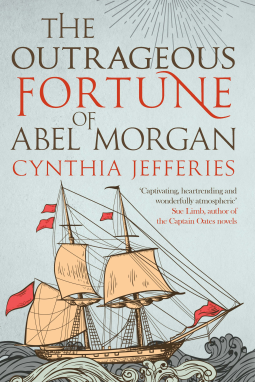
The Outrageous Fortune of Abel Morgan by Cynthia Jefferies

Cynthia Jefferies is probably better known as an established children’s author writing under the name of Cindy Jefferies, but she has recently turned her hand to writing novels for adults, of which The Outrageous Fortune of Abel Morgan was her first. It was the title and cover that caught my attention at first, then when I read what the book was about I thought it sounded like something I was almost certain to enjoy.

The story begins in 1660, with Christopher Morgan returning to England following the restoration of Charles II, having spent several years in exile with the others who fought on the side of the Royalists in England’s recent civil war. Christopher no longer has any interest in taking his place at court and intends to start a new life for himself and his family as owners of the wonderfully named Rumfustian Inn in the village of Dario, but his dreams are destroyed when his beloved wife dies in childbirth. Sinking into depression, he is sustained only by his relationship with his baby son, Abel, whom he raises alone with the help of the servants.

As the years go by, the two become closer than ever, but when Christopher makes an enemy of a local smuggler, he and Abel both pay a terrible price. Abel disappears while out riding his pony and Christopher’s only clue to his whereabouts is a mysterious map of Constantinople. Does this show where Abel has been taken? Christopher isn’t sure, but he’s determined to do whatever it takes to find his son. While he continues to search, however, Abel himself is having adventures of his own…

The Outrageous Fortune of Abel Morgan is best described as a good old-fashioned adventure story – a sort of cross between Robert Louis Stevenson’s Treasure Island and Daphne du Maurier’s Jamaica Inn. With smugglers, secret tunnels, sinister villains, pirate ships and action on the high seas, it’s a fun and entertaining read – yet I didn’t love it as much as I felt I should have done. While I had a lot of sympathy for Christopher, I never warmed to Abel at all; I found him quite selfish and some of his actions towards the end of the book made me actively dislike him. As half of the novel was narrated from his perspective, this was definitely a problem for me. I was also confused by the storyline which plays out in Constantinople as it seems to have very little bearing on the rest of the story and a villain introduced in this section didn’t have the impact I expected him to have.

Still, I was kept in suspense throughout the novel, wondering whether Christopher and Abel would ever meet again. The main theme of the love between father and son is handled with sensitivity and emotion and I had tears in my eyes several times towards the end of the book – which I always think is a sign that an author is doing something right! I would be happy to read more of Cynthia Jefferies’ adult novels; her new one, The Honourable Life of Thomas Chayne, is out now.

Thanks to Allison & Busby for providing a copy of this book for review via NetGalley.

Children of Earth and Sky by Guy Gavriel Kay

children-of-earth-and-sky I love Guy Gavriel Kay’s books, so I really don’t know why it is that I’ve read so few of them! I’ve had Under Heaven waiting on my Kindle since finishing The Last Light of the Sun more than a year ago, but for some reason there always seems to be something else that needs to be read first. When I noticed his latest novel, Children of Earth and Sky, in the library I decided to forget Under Heaven for now and read this one first, while I was in the mood for it.

Guy Gavriel Kay’s books are a wonderful and unique blend of fantasy and historical fiction. Children of Earth and Sky is set in the same world as several of his other novels, including The Lions of Al-Rassan – a world with two moons, one blue and one white, in which the three main religious groups are the sun-worshipping Jaddites, the Asharites who pray to the stars and the Kindath who worship the moons (corresponding to Christians, Muslims and Jews respectively). The action in this book takes place mainly in thinly disguised versions of Venice, Dubrovnik and Constantinople – which Kay renames Seressa, Dubrava and Asharias – in what is clearly supposed to be the Renaissance period.

The plot is quite a complex one, with multiple storylines which meet and intersect from time to time, so rather than attempting to describe it in any detail, I’m just going to mention a few of the characters we meet.

First, there’s Pero Villani, a young artist from Seressa, who has been sent on a mission to the Osmanli (Ottoman) court at Asharias with a commission to paint a portrait of the Grand Khalif, Gurçu the Destroyer. However, Seressa’s Council of Twelve have another task in mind for Pero to carry out at Asharias, one which could put his life in danger. The Council are also keen to place a spy in the rival republic of Dubrava and enlist the services of Leonora Valeri, a woman with a troubled past who welcomes the chance to escape from Seressa.

The ship on which Pero and Leonora embark on the first stage of their journey is owned by the family of Marin Djivo. As the younger son of a Dubrava merchant, Marin has a lot of experience of the world of trade and shipping, but this particular voyage is about to change his life. Sailing from Seressa to Dubrava, his ship is boarded by pirates from the walled town of Senjan, and among them is the archer Danica Gradek, a young woman who is desperate to prove herself as a warrior and avenge her family against the Osmanli. Finally, there’s Damaz, who was captured as a child and trained to fight in the Osmanli army.

The lives of these five characters become closely entwined as their paths cross, then part, then cross again, and the actions of one may have consequences – sometimes unintentional – which affect the lives of one or all of the others. Now that I’ve read several of Kay’s novels, I can see that this seems to be a recurring theme in his work.

I have been to both Venice and Dubrovnik – and would highly recommend visiting them if you haven’t already – and even though Kay’s versions have different names, the descriptions of both locations are still clearly recognisable. If you have a good knowledge of the history of Renaissance Europe, you should be able to draw historical parallels, as well as geographical, between this fantasy world and the real one – but remember that it is a fantasy world (even though the magical elements are small and understated), which gives Kay the freedom to take the story in any way he wishes without sticking rigidly to historical fact.

I found a lot to love about this book; my only disappointments were the ending and the lack of emotional engagement I felt with the characters. When I think of the thought-provoking epilogue that ended Tigana, or the dramatic conclusion of The Lions of Al-Rassan, that’s what was missing from Children of Earth and Sky. The novel’s various storylines were wrapped up too neatly and too completely at the end of the book and didn’t make much of an emotional impact on me, which was a shame after spending so long getting to know this set of characters.

This is not one of my favourite Kay novels so far, but I did enjoy it and am looking forward to reading the rest of his work, probably beginning with Under Heaven!

Master of Shadows by Neil Oliver

Master of Shadows There were several things that drew me to Master of Shadows: the setting (the fall of Constantinople in 1453) was one, and the protagonist (the Scottish engineer, John Grant) was another. Most of all, I was curious to see what Neil Oliver’s fiction would be like. Oliver is best known as a television presenter and historian – he recently presented the BBC series Celts: Blood, Iron and Sacrifice – and although he has previously published some non-fiction, Master of Shadows is his first novel.

I have mentioned Constantinople, but much of the first half of the novel is actually set in Scotland, where the soldier Badr Khassan has come to fulfil a deathbed promise, having sworn to protect the wife and child of his friend, the late Patrick Grant. He finds Jessie Grant and young John just in time to interrupt an attempt on their lives by the men of Patrick’s enemy, Sir Robert Jardine of Hawkshaw. Pursued by the vengeful archer, Angus Armstrong, Badr and John leave Scotland and travel across Europe, making a living by fighting as mercenaries. Along the way they meet a mysterious female warrior called Lena who is also a target of the same group of Scots and who is hiding some important secrets regarding her own identity and John’s.

Eventually John arrives in Constantinople, one of the final strongholds of the Byzantine Empire, now under threat from the mighty Ottoman army. As the Emperor Constantine XI prepares to defend his city and Sultan Mehmet II gathers his forces outside the walls, two more characters come to the forefront of our story: Prince Constantine, the Emperor’s crippled son, and Yaminah, the girl he loves. The lives of John, Yaminah and the Prince come together during the dramatic Siege of Constantinople and the final days of the Byzantine Empire.

Master of Shadows is a combination of history, adventure and romance set against a backdrop of what is surely one of the most fascinating and significant periods in Europe’s history – the collapse of one empire and the expansion of another. I thought the book was generally well written and, knowing that the author is an archaeologist and historian, I also felt confident that it would have been well researched. However, he does take some liberties with certain historical characters; I really disliked Lena’s story, although I can’t explain why without telling you who she really is and that would be a spoiler! There’s also a supernatural aspect to the novel – John Grant is able to feel the Earth moving through space and can sense the people around him without using sight or touch – but this didn’t become such a big part of the story as I’d feared at first.

I had previously encountered John Grant as a character in Dorothy Dunnett’s House of Niccolò series (under the slightly different name of John le Grant) and was quite fond of him, so I was looking forward to seeing how he would be portrayed by another author. Very little is known about the real John Grant; records show that a Johannes Grant was employed as an engineer by the Byzantine Empire and his expertise in counter-tunnelling prevented the Turks from invading Constantinople from under the walls. He was originally thought to have been German but more recent research suggested that he was actually Scottish. This lack of historical information has allowed Neil Oliver to create a whole backstory for John to explain how he came to be in Constantinople. The character is quite different from the one in Dunnett’s novels, but I did still like him (although I found it irritating that he is always given his full name of John Grant, sometimes multiple times in the same paragraph, and is never just referred to as John).

Master of Shadows is an interesting first novel – I particularly liked the Scottish chapters near the beginning and the romance between Prince Constantine and Yaminah – but there were too many little things that didn’t work for me. As well as the Lena storyline and the supernatural element I’ve mentioned above, there’s a lot of jumping around in time which makes it slightly difficult to follow what is happening. I’m not sure whether I’ll read any more of Neil Oliver’s fiction, but I might try one of his non-fiction books instead.

Review copy provided by the publisher via NetGalley.