A Ghost Hunter’s Guide to Solving a Murder by F. H. Petford

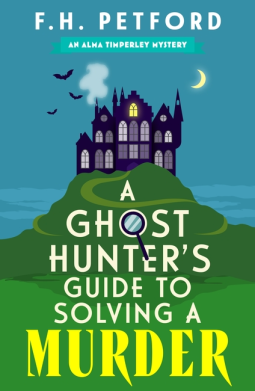
Twenty-two-year-old Alma Timperley is stunned when she learns that her Aunt Gladys has died, leaving her hotel in Cornwall to Alma in her will. The news comes as a particular surprise as Alma didn’t even know that Gladys existed in the first place! Still, she accompanies her lawyer, James Nascent, to Falmouth on the Cornish coast to inspect her inheritance and likes what she sees. The Timperley Spiritualist Hotel overlooks the town below and has a very special clientele. The people who come to stay are hoping to make contact with loved ones beyond the grave and their reservation fee includes three sessions with one of the hotel’s two mediums, George Weaver and Valentine Wragge.

Alma has always believed she has psychic abilities herself, so she’s intrigued and decides to immediately take ownership of the hotel. She soon finds that she has more than ghosts to worry about, however, because it’s 1914 and war has recently broken out with Germany. Why has a book written in German been hidden inside a cooking pot in the hotel kitchen? And who turned on a light in the tower, guiding an enemy Zeppelin in from the shore? Is someone in the hotel spying for the Germans?

This is the first book in a planned series of novels starring Alma Timperley and based on this one I’ll definitely be looking out for more. It wasn’t really what I’d expected, though; the title and cover gave me the impression this would be a humorous cosy mystery set in a haunted house, but it’s actually something very different. There’s no ghost hunting (unless you count mediums trying to contact spirits) and there’s not really a mystery either. The identity of the German spy – referred to as Excalibur – is revealed to the reader very early in the book and although Alma and the police don’t know who it is, I would have preferred to be kept in suspense as well, wondering who it was.

Despite the book not really being as advertised – which is a shame, as it seems to have resulted in the book receiving worse reviews than it deserves – I still enjoyed it. I particularly loved the Cornish setting: Petford does a great job of bringing Falmouth to life, with its bay and harbour and local landmarks such as Pendennis Castle, which played a part in the town’s defences during the war, and the King’s Pipe, a chimney used to burn tobacco illegally smuggled into the country. We also learn a lot about PK Porthcurno, once the world’s largest telegraph station where many cables from overseas came ashore and now a museum open to the public.

I think this book has a lot to offer, as long as you approach it as historical fiction about German spies in the First World War and not a ghost story or a detective novel. It covered some aspects of the war I hadn’t read much about before and it held my interest from beginning to end. I liked Alma and her friends and hope to meet them again soon.

Thanks to Hodder & Stoughton for providing a copy of this book for review via NetGalley.
Book 4 for RIP XX

The Living Stones: Cornwall by Ithell Colquhoun

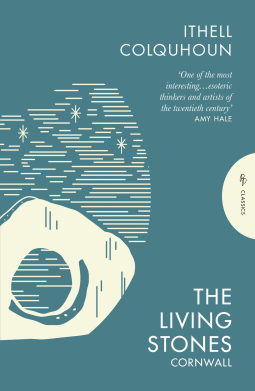
Earlier this year I enjoyed reading Ithell Colquhoun’s The Crying of the Wind, an account of the author’s travels around Ireland, so I decided to read her other travel book, The Living Stones, published two years later in 1957. This one is inspired by her visits to Cornwall in the late 1940s, where she came in search of escape from post-war London. As an artist, she wanted a suitable property to use as an occasional refuge where she could paint in peace and in 1949 she purchased Vow Cave, a small wooden studio with very basic living facilities.

Vow Cave (Colquhoun tells us that Vow is derived from vugha, the Cornish word for cave) is in the village of Lamorna on the Penwith peninsula a few miles from Penzance. Although she writes about the landscape, the surrounding countryside and some local places of interest, this book isn’t really a travelogue in the same sense as The Crying of the Wind, where the author described trips and excursions to different areas of Ireland. Instead, she explores the culture and history of Cornwall in general, with chapters devoted to separate topics, giving it almost the feel of a collection of short essays.

Lots of Cornish customs and rituals are discussed, ranging from the Gorsedh of Cornwall, or gathering of the bards, and the ‘Obby ‘Oss (hobby horse) festival in Padstow to the Furry Day celebrations which mark the arrival of spring (the name likely has nothing to do with fur and comes from the Cornish word for ‘fair’ or ‘feast’). There’s a chapter on traditional Cornish foods such as potato cakes, Cornish cream and the Cornish pasty, and another on folk medicine and witchcraft – Colquhoun has a particular interest in the occult. Some sections are fascinating, although there were others where I found my attention wandering.

Both books I’ve read by this author feel random and meandering, lacking in focus. I found that the best way to read them was in small doses, a few short chapters at a time alternating with other books, rather than straight through from beginning to end. As a pair, they’re definitely worth reading if you have any interest in Ireland or Cornwall, and I did learn a lot from them. Colquhoun has also written a novel, Goose of Hermogenes, which sounds intriguing!

Thanks to Pushkin Press Classics for providing a copy of this book for review via NetGalley.

Secrets of the Bees by Jane Johnson

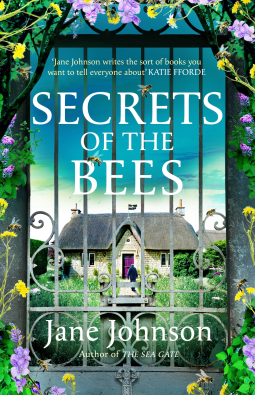
Ezra Curnow is almost eighty years old and has spent his whole life living in a little cottage on the Trengrose estate in Cornwall. It was home to his father and grandfather before him and Ezra can’t imagine living anywhere else. His cottage has no modern appliances or conveniences, not even a television, but Ezra doesn’t see the need; he spends most of his time outdoors with his cat and tame jackdaw, growing his own fruit and vegetables and tending to his bees in their hive.

Ezra’s peaceful life is shattered when Eliza Rosevear, mistress of Trengrose House, dies without leaving a will. The estate goes up for sale and is bought by Toby Hardman, a London businessman, who arrives with his wife Minty, an interior designer, and their teenage son, Dom. As soon as they move in, they begin converting part of the estate into a glamping site and looking for other ways to bring in tourists. Ezra is horrified, particularly when they remove the ancient Celtic cross that gives Trengrose its name. Worse still, it seems that the Hardmans also have their eye on Ezra’s cottage and with no official paperwork to prove that it’s his, he could be at risk of losing his home.

Secrets of the Bees is Jane Johnson’s latest novel and one of several, including The White Hare, that are set in her native Cornwall. Her love for the Cornish landscape, history, customs and people comes through strongly in her descriptive writing and in her creation of Ezra Curnow. Ezra represents tradition and a way of life that has almost disappeared; he has very little in terms of material possessions, but is happy and content. The Hardmans are the complete opposite – they represent change and progress, they have money, cars, technology, yet what they don’t have is happiness. Toby and Minty’s marriage is strained and lacking in trust, while Dom has been expelled from his expensive school for dealing drugs. Although Toby is the villain of the book and seems to be a lost cause, there’s still hope for Minty and Dom and we see them begin to improve and grow as people through their association with Ezra and the Cornish countryside. Dom even became one of my favourite characters, which I certainly hadn’t expected at first.

It’s very common, of course, for residents to object to new developments in their area, particularly ones that could damage the environment or cause noise and disruption, but Ezra takes his protests a step further. He comes up with some very inventive and amusing ways to throw the Hardmans’ plans into disarray, which adds some humour to a serious subject. Proving ownership of his cottage is much more difficult for him – there’s always been an understanding between the Rosevears and the Curnows but apparently nothing has been put in writing. It’s only when we are given some glimpses into the lives of Eliza Rosevear and her family – and into Ezra’s own past, including his National Service in Cyprus in the 1950s – that the truth about the Trengrose estate begins to emerge.

Although the book seemed slow at first and it took a while for things to really start moving, I gradually became completely immersed in the story. I could picture the setting so vividly and I loved everything Jane Johnson had to say about human beings and our relationship with the natural environment. I’ve enjoyed everything I’ve read by Johnson so far, whether set in Cornwall or in other parts of the world, historical or contemporary. I must find time to go back and read the remaining books of hers that I haven’t tried yet.

Thanks to Head of Zeus/Apollo for providing a copy of this book for review via NetGalley.
Scarlet Town by Leonora Nattrass

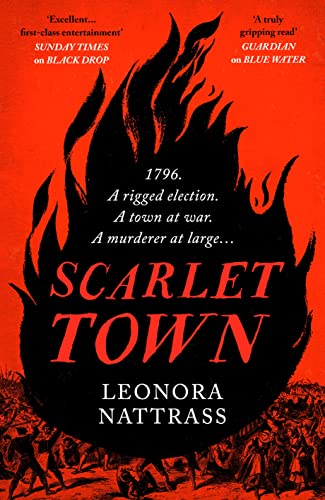
Scarlet Town is the third book in Leonora Nattrass’s Laurence Jago series set in the final decade of the 18th century. I enjoyed the first two books – Black Drop and Blue Water – and this one is another strong entry in the series.

It’s 1796 and Laurence Jago, accompanied by his friend, the journalist William Philpott, has just returned from his voyage to America (described in Blue Water). Jago, once a clerk in the Foreign Office, is now apprenticed to Philpott and is grateful to his friend for the opportunity, while at the same time angry with him for causing his beloved dog, Mr Gibbs, to be left behind in Philadelphia! Back in England again, they head for Jago’s home town of Helston in Cornwall, intending to visit his cousin Pythagoras (affectionately known as Piggy). On arrival in Helston, however, they are shocked by what they find. Not only does wig-wearing appear to have fallen out of fashion during their absence, but the entire town seems to be caught up in the fever of the upcoming election.

Helston is known as a ‘rotten borough’, where only two men in the town are allowed to vote – and one of these two electors has died under suspicious circumstances. It seems that someone is also attempting to kill the remaining elector, so the town’s patron, the Duke of Leeds, asks Laurence to investigate – but to Laurence’s dismay, his own beloved cousin Piggy begins to emerge as the number one suspect. Will he be able to prove Piggy’s innocence and find the real culprit? And who will win the election if both of the Duke’s electors are unable to vote?

According to the author’s note, the situation described in the book (without the deaths/murder attempts) is based on an election that actually did take place in Helston in the 1790s. Several of the characters are people who really existed, including Sir James Burges, the Duke’s candidate for Parliament, and Stephen Lushington (chairman of the East India Company), the alternative candidate put forward by the town’s mayor – and the novel’s title refers to the red ribbons and silks worn by supporters of the mayor’s candidate as opposed to the blue worn by supporters of the Duke’s. I remember learning about the rotten boroughs at school and the events portrayed in this book perfectly illustrate why electoral reform was so desperately needed. Many people complain about today’s electoral system, but the people of Helston were dealing with a system so corrupt that only a tiny minority were making decisions that affected everyone else, where there was no secret ballot and votes could be bought and sold, leaving the electors open to bribery and blackmail.

As well as the fascinating historical setting, I also found the murder mystery quite compelling; it was maybe not as enjoyable as the mystery in Blue Water, and there were times when I felt it became a bit too complicated, but it was intriguing and kept me guessing until the end. Nattrass also lightens the mood with some humour in the form of Toby the Sapient Hog (based on a real performing pig). I love the 18th century world she has created in this series – everything feels so authentic and thoroughly researched. I’m not sure if there’s going to be a fourth book, but if there is then I can’t wait to read it.

Thanks to Viper for providing a copy of this book for review via NetGalley.
This is book 44/50 for the 2023 Historical Fiction Reading Challenge.

The White Hare by Jane Johnson

‘Once you’ve lived in this valley, you’ll never be free of it. Its uncanny beauty gets inside you, right into the marrow. It has its own climate, its own peculiar character. In the same way as people can draw you in and repel you at the same time; both beguile and frighten you.’

I love Jane Johnson’s books; they always have such fascinating settings – 17th century Morocco in The Sultan’s Wife, 15th century Spain in The Court of Lions, and the author’s native Cornwall in The Tenth Gift. She returns to Cornwall again for her new novel, The White Hare, a book steeped in the myths and legends of that region of England.

The novel begins in 1954, with Mila Prusik, her mother Magda and five-year-old daughter Janey arriving at White Cove near Eglosberyan on the Cornish coast. Having left Poland for England during World War II, the family had been settled in London until a disastrous relationship with a married man left Mila desperate to make a fresh start. She and Magda have bought a neglected old house in the Cornish countryside and are planning to restore it to its former glory and turn it into a guest house. However, not everyone is happy to see the house under new ownership and the Prusiks receive a hostile welcome.

As Mila and her mother begin their restoration work, they hear hints from their neighbours that the house has a sinister past and should be left alone. The two women think this is nonsense and continue with their plans, but Mila becomes increasingly concerned about the changes in Janey’s behaviour – particularly her obsession with Rabbit, a stuffed toy that seems to have a mind of its own. How is all of this related to sightings of the legendary White Hare and to the strange symbols and carvings Mila finds all over the house and its grounds?

The White Hare is one of the most atmospheric books I’ve read for a while, not just because of the supernatural aspects – which are subtle, ambiguous and unsettling – but also because of the way the setting is so beautifully described. As Jane Johnson explains in her author’s note, the town of Eglosberyan and its valley are not real but are inspired by several real places. I could picture the white house surrounded by dark woodland, the stream tumbling between mossy rocks, the lonely beach framed by granite cliffs – they are all brought so vividly to life.

I also found it interesting to follow the relationship between Mila and Magda. When they first arrive in Cornwall, Mila is timid and submissive, allowing herself and Janey to be bullied by the hard and domineering Magda, but both characters do grow and change throughout the novel as the valley works its magic on them. There’s also a love interest for Mila, but although I did like him I felt that this part of the story took too much of a dramatic turn towards the end. Still, this is a very enjoyable novel and, while it’s quite different from the other Jane Johnson books I’ve read, being set entirely in one period and not as far into the past, I liked it just as much.

I still have three novels by Jane Johnson left to read: The Sea Gate, The Salt Road and Pillars of Light. If you’ve read any of them, please help me decide which I should read next!

Thanks to Head of Zeus for providing a copy of this book for review via NetGalley.
The Tenth Gift by Jane Johnson

When we think about slavery it’s not usually the capture and sale of white Europeans that comes to mind, but that is the topic at the heart of Jane Johnson’s The Tenth Gift. In August 1625, a church in Mount’s Bay, Cornwall was raided by Barbary pirates who took sixty men, women and children into captivity to be sold at the slave markets of Morocco. In The Tenth Gift, Johnson imagines the story of one of these captives – a young woman called Catherine Anne Tregenna.

When we first meet Catherine, or Cat as she is known, she is working as a lady’s maid at a large manor house in Cornwall. A marriage has been arranged for her with her cousin, Robert Bolitho, but Cat wants more out of life. Her skills with a needle have won her a commission from the Countess of Salisbury and she dreams of joining a guild and becoming a master embroiderer, even if she has to leave Cornwall to do it. However, she is soon to travel further from Cornwall than she could ever have imagined. Abducted from church by Barbary corsairs along with her friends, family and neighbours, Cat finds herself on a ship heading towards North Africa, her fate to be decided by the corsair captain.

But Cat’s is not the only story to be told in this novel. In the present day, we meet Julia Lovat, a woman who has been having an affair with Michael, her best friend’s husband, a seven-year relationship which has just come to an end. As a parting gift, Michael gives her an old book of embroidery patterns, but when Julia opens the book she is confronted by something unusual – a series of diary entries written in the margins by someone called Cat who lived in the seventeenth century. Julia is soon engrossed in reading about Cat’s ordeal, but it is only when she visits Morocco herself that she is able to put together all the pieces of Cat’s story.

I found a lot to enjoy in The Tenth Gift, which isn’t surprising as I’ve previously enjoyed two of Jane Johnson’s other Moroccan novels, The Sultan’s Wife and Court of Lions. She writes so vividly about Morocco, describing all of the sounds, sights and smells with a vibrancy that really brings the setting to life. Her depiction of seventeenth century Cornwall is equally well done and it’s obvious that she knows both places very well. The two storylines – past and present – fit together perfectly and the links between them don’t feel too contrived, although there are some supernatural undertones, particularly towards the end, that I thought seemed unnecessary.

I liked Cat and found her story fascinating but, as happens so often with these dual timeframe novels, I thought the present day one was much weaker. I never really managed to warm to Julia and didn’t have much sympathy for her relationship problems; I did become more invested in her story once she arrived in Morocco, but I think the book would have worked better as a straight historical novel without the modern day sections. Cat’s adventures are so interesting and I appreciated the way Jane Johnson tries to give an explanation for why the corsairs behaved the way they did and explores both the similarities and differences between Christian and Islamic cultures.

If you do read this book and enjoy it, you might also enjoy The Sealwoman’s Gift by Sally Magnusson, which deals with a different pirate raid, this time on Iceland’s Westman Islands in 1627, or The Sea-Hawk by Rafael Sabatini, a wonderfully entertaining novel which also takes us from Cornwall to the Barbary Coast.

Thanks to Head of Zeus for providing a copy of this book for review via NetGalley.
Greenwitch by Susan Cooper

Greenwitch is the third novel in Susan Cooper’s The Dark is Rising sequence. I loved the first two books, so I was pleased to find that I enjoyed this one just as much. It brings together characters from both the first book and the second, so I would recommend reading both of those before starting this one, if possible.

The novel opens with the Drew children – Simon, Jane and Barney – whom we met in Over Sea, Under Stone, returning to Trewissick in Cornwall with their Great Uncle Merriman. The Grail, which played such a big part in Over Sea, has been stolen from the British Museum and the children know who is responsible: the forces of the Dark. However, the inscription on the Grail can be of no use to the Dark without the manuscript that will help to decipher it – and the manuscript is lost at the bottom of the sea.

To help the Drews in their quest to recover the Grail and locate the missing manuscript, Merriman has brought along Will Stanton, the boy we first met in The Dark is Rising. But Will doesn’t reveal to the others that he, like Merriman, is one of the Old Ones and working for the forces of Light, so they are left feeling uneasy and resentful about his presence and his relationship with their Great Uncle.

Like the previous books in the series, this is an atmospheric and eerie story, steeped in magic and ancient folklore. The ‘Greenwitch’ of the title is a giant effigy in the form of a woman made of sticks, constructed by the women of Trewissick and sacrificed to the sea in a yearly ritual – not just an inanimate object, but a living being, with a mind of her own. This is referred to as a type of ‘Wild Magic’, or the magic of nature, another element in the ongoing battle between Light and Dark. The Greenwitch holds the key to understanding the Grail, but the children will have to persuade her to give up her secrets before the agents of the Dark get there first.

I found this book as compelling as the first two and read most of it in one day; as a book aimed at younger readers, it’s quite short and the plot moves along at a fast pace, but as an adult there’s still enough depth and complexity to the story and characters to hold my attention. It was good to see the three Drew children again, after they were absent from the last book, and this time I particularly liked the large and important part Jane played in trying to befriend the Greenwitch and defeat the Dark. At first I was disappointed by the children’s hostility towards Will and the way he seemed to have a much quieter, more passive role in this novel after being the central protagonist of the last one, but later I decided that the decision to tell most of the story from the Drews’ perspective was actually quite effective. It made Will appear aloof and otherworldly, in keeping with his position as one of the Old Ones working on behalf of the Light. Still, I found the reluctance of Will and Merriman to confide in the other children quite frustrating, as it would have made things so much easier for them.

There are some wonderful moments and set pieces in this book: the ritual sacrifice of the Greenwitch; the evil that emanates from the paintings produced by the artist of the Dark; Jane watching from her window as magic and madness take hold of the village of Trewissick. Although this is the middle book in the series and so there are still things that haven’t been resolved and things that I don’t quite understand yet, I really enjoyed it and am looking forward to continuing with The Grey King.

This is book 13/20 from my 20 Books of Summer list. Obviously I am not going to complete the list this summer, but I’ve enjoyed most of the books I’ve read, which is the most important thing!