South Riding by Winifred Holtby

I read South Riding in February and managed to finish it just in time to watch the recent BBC adaptation. I’m glad I was able to read the book before watching the series as I like to be able to form my own images of the characters before seeing someone else’s interpretation of them. I also think if I hadn’t read the book first I would have found some parts of the adaptation quite confusing.

I first came across Winifred Holtby in Vera Brittain’s Testament of Youth (she and Brittain were close friends) but this is the first time I’ve read any of her work. South Riding, as well as being a wonderful story, is also a realistic and insightful portrait of a community, which reminded me of Middlemarch by George Eliot. It also shares some plot elements with Jane Eyre – one of the main characters even remarks on this herself!

So what is the book actually about? Well, it’s about Sarah Burton who is appointed headmistress of Kiplington High School for Girls and who begins to fall in love with troubled gentleman farmer Robert Carne. It’s also about Lydia Holly, the brightest girl in the school, who is forced to abandon her education and stay at home to look after her younger siblings after their mother dies in childbirth. And it’s about…no, I won’t tell you any more – South Riding is about so many different things I would rather leave you to discover them for yourself. But at the centre of all these storylines is the South Riding council, which makes the important decisions that affect the lives of every character in the book. And there are a lot of characters! When I first opened the book and saw the huge character list at the front, I was slightly overwhelmed: would I be able to keep track of who was who?

The answer is yes, because every one of them is well drawn and memorable. I really admired Sarah Burton. She was a woman who thought she could make a difference and she was prepared to take action to make things happen. But even some of the minor characters (such as Miss Sigglesthwaite, the nervous science teacher and Lily Sawdon, the innkeeper’s invalid wife) get their turn in the spotlight and I was very impressed that Holtby was able to give such a large number of very different characters so much depth. They all feel like real, believable people, people you might live or work with in real life.

Another aspect of the book I enjoyed was the portrayal of Yorkshire in the 1930s. Holtby paints vivid pictures and images, from the crowded streets and alleys of Kingsport to ‘The Shacks’, a cluster of huts and converted railway carriages where the poorest families live. The ‘South Riding’ doesn’t actually exist – the North, East and West Ridings are the three historic subdivisions of Yorkshire – but the setting feels completely realistic (Holtby apparently used the East Riding, where she grew up, as her inspiration).

I admit that South Riding hadn’t previously sounded very interesting to me and I hadn’t expected to love it as much as I did. It was a book I looked forward to returning to every day and I was sorry when I reached the final page.
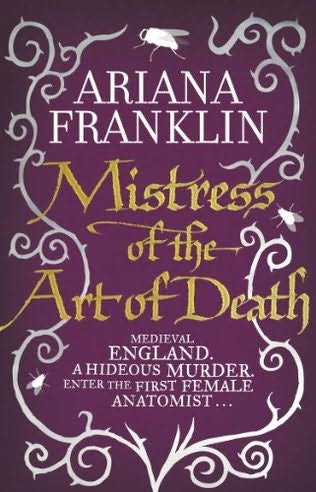
Mistress of the Art of Death by Ariana Franklin

This is my second book for the Great Transworld Crime Caper and is the first in a series of historical mysteries by the late Ariana Franklin. I knew nothing about this series but Mistress of the Art of Death appealed to me because of the medieval setting (I love books set in medieval England).

This book has an unusual heroine. Her name is Adelia Aguilar and she is a trained doctor, very rare in the year 1171. Adelia is from Salerno, where women are allowed to attend medical school. Her speciality, however, is as a ‘doctor of the dead’ – in other words, she is skilled in performing autopsies and finding out the causes of death. When several young children go missing in Cambridge and the city’s Jews are blamed for the disappearances, Adelia is sent to England to investigate.

As I said, I love reading about medieval history and Franklin touches on many different aspects of the period – from the big things, such as the relationship between the church and the monarchy, to the small, such as the clothes people wore and the food they ate. Adelia, being Italian, is unfamiliar with the politics and customs of 12th century England, which allows the reader to learn along with her – so no need to worry if you don’t have much knowledge of the period. Despite some very modern dialogue and Adelia’s distinctly 21st century thought processes, everything else felt suitably ‘medieval’. Setting and atmosphere are so important in fiction and this is an area in which I thought Franklin excelled. It wouldn’t really be fair for me to comment on the historical accuracy as I haven’t studied the 12th century in any detail but I would say that if you’re looking for a serious piece of historical fiction which is correct in every detail then you need to look elsewhere. Accept this book for what it is though, and it’s an enjoyable read.

The writing in the prologue and opening chapters feels quite light and humorous and I expected the whole book to have the same tone, but when Adelia begins to investigate the mystery things start to feel a lot darker. I should point out that the story does revolve around the abduction and murder of children which isn’t nice to read about; it’s quite graphic in places and a bit disturbing. As for the mystery itself, I didn’t guess who the murderer was, but then I wasn’t really trying to guess. Sometimes I prefer not to attempt to work things out and just enjoy the story – and this was one of those occasions.

I found Adelia a fascinating and engaging character although, as I mentioned earlier, she thought, spoke and behaved more like a woman from the 21st century than the 12th. She’s a strong, independent person who is constantly questioning the role of women in society and has a very modern outlook on medicine, the law and life in general; I liked her but she wasn’t a believable medieval woman. Most of the secondary characters are well-rounded and interesting, particularly Adelia’s housekeeper, Gyltha, and her surly but endearing grandson, Ulf – and I loved the depiction of Henry II.

I enjoyed Mistress of the Art of Death and I look forward to being reacquainted with Adelia Aguilar in the other three books in the series. Sadly, Ariana Franklin (Diana Norman) died in January this year aged 77.

I received a copy of this book from Transworld for review.

Major Pettigrew’s Last Stand by Helen Simonson

For some reason I have found this review very difficult to write and have started and re-started it several times. I think the problem is that Major Pettigrew’s Last Stand is a very simple novel, but also a very complex one. On one level it’s a gentle, romantic story about sixty-eight year old Major Ernest Pettigrew and his love for Mrs Jasmina Ali, the Pakistani woman who runs the village shop. But there’s so much more to the book than that. In Major Pettigrew’s Last Stand, Helen Simonson explores a number of issues including racism, religion, loneliness, family relationships and tradition vs progress.

The book is set in the small English village of Edgecombe St Mary where Major Pettigrew, a retired British army officer, lives on his own at Rose Cottage. Both he and Mrs Ali have suffered recent bereavements and are starting to feel very alone in the world. The Major welcomes Mrs Ali’s friendship as she’s refreshingly different from the other women in Edgecombe St Mary; she’s quiet, dignified and shares his love of literature. Unfortunately, the Major’s middle-class friends and neighbours disapprove – they can’t think of Mrs Ali as anything other than the woman from the village shop. Meanwhile, Mrs Ali’s nephew, Abdul Wahid, is also unhappy about his aunt’s new relationship – he’s hoping she’ll move away to live with family so that he can take over the management of the shop. Can the Major and Mrs Ali overcome these obstacles and find happiness?

Major Pettigrew is a wonderful character, both endearing and annoying at the same time. It seemed to me that while he was accusing others of being judgmental, he was constantly making his own judgments about people: northerners, teenagers, Americans and even his own family and friends. However, he is never rude to other people and he does come to discover that some of his own prejudices are unfair. He has a certain amount of old-fashioned charm and I could sympathise with him as he tried to adapt to a rapidly-changing world. I loved him from the beginning because he was a polite, honourable person who genuinely wanted to do the right thing.

I also loved Mrs Ali. She wanted so much to be accepted by her neighbours but struggled to fit in with such a narrow-minded community where most of the other ladies were wrapped up in a world of parties, dances and committees, and didn’t even seem to realise how hurtful and insensitive some of their comments were. Almost all of the other characters, as seen through Major Pettigrew’s eyes, were loud, selfish and bad-mannered, which reflected the way the Major viewed the modern world. The Major’s son Roger was particularly obnoxious!

I really liked the setting of Edgecombe St Mary. Although the story was presumably supposed to be taking place in the 21st century, the descriptions of the village could have been from decades ago and showed a stark contrast with the commercialism and development that the Major hated so much.

If there was one thing that spoiled this book for me, it was a plot development near the end that I thought was unnecessarily dramatic and which felt completely out of place. Up to this point the story had been fairly slow-paced and subtle, concentrating on the small dramas of day to day life, and I would have preferred it to have continued this way to the end. Apart from this small criticism, I really enjoyed this book. Major Pettigrew’s Last Stand is a lovely, inspiring story and for such a gentle, leisurely read it was very difficult to put down!

The Thirteenth Tale by Diane Setterfield

The last book I read in 2010 was The Thirteenth Tale by Diane Setterfield. This is a book that has been hugely popular with book bloggers over the last few years and as usual, I appear to be one of the last to read it. I don’t have any excuse for this other than that certain books just seem to pass me by!

The Thirteenth Tale is the story of the reclusive and secretive Vida Winter, the world’s most popular author. Despite Winter’s fame, her past is shrouded in mystery; every time a new book is published she agrees to be interviewed – and every time she gives the journalist a different version of her life story. Now that she’s approaching the end of her life, she decides it’s time to tell the truth and summons Margaret Lea to write her biography.

Margaret is surprised by the request – after all, she’s just an amateur biographer who works in her father’s bookshop – but she agrees to visit Miss Winter and listen to what she has to say. As the story of Winter’s childhood unfolds, Margaret discovers what it is they have in common and why she was chosen to write the biography.

The Thirteenth Tale borrows elements of classic novels such as Wuthering Heights, The Woman in White, Jane Eyre, and The Turn of the Screw and it felt instantly familiar to me: the Yorkshire moors, twins, mistaken identities, ghosts and governesses all play a part in the story. I’m not saying this book was unoriginal or an exact copy of any other novel – it wasn’t – but Diane Setterfield was obviously trying to capture the overall mood of those gothic classics. Not only are the books I just mentioned referred to over and over again in the story, but they are cleverly incorporated into the plot.

Yet despite the familiarity, I didn’t guess everything that was going to happen. When the solution to the mystery (or one of the mysteries, as there are a few) was revealed, it surprised me – although the clues had been there all along and I’m sure if I read the book again it would be obvious.

One thing that struck me while I was reading this book was that we are never told when the story was supposed to be set. There are no historical references to suggest when the events of the book are taking place. Even Margaret’s timeframe, although obviously fairly recent, is still vague. I’m sure this was deliberate and it does help to give the story a timeless feel, but I’m one of those readers who likes to know when a story is set!

I can see why The Thirteenth Tale has been so popular because it really is a book for book lovers, with lots of great quotes like this:

Do you know the feeling when you start reading a new book before the membrane of the last one has had time to close behind you? You leave the previous book with ideas and themes – characters even – caught in the fibers of your clothes, and when you open the new book, they are still with you.

And this:

Do they sense it, these dead writers, when their books are read? Does a pinprick of light appear in their darkness? Is their soul stirred by the feather touch of another mind reading theirs? I do hope so.

While I didn’t love this book as much as I hoped I would (which I suspect might just be because I’ve read too many books of this type recently), it was fun, entertaining and very quick to read for a book with over 450 pages. It was also a perfect read for late December – a book to curl up with indoors while it’s cold and dark outside.

The Wilding by Maria McCann

The Wilding is set in England in 1672, just after the end of the Civil War. Our narrator is Jonathan Dymond, a young man who works as a cider-maker. Jonathan lives with his loving parents and leads a quiet, happy life, travelling around the neighbouring villages with his mobile cider-press. But when Jonathan’s father receives a mysterious letter from his dying brother, Jonathan grows suspicious and decides to visit his uncle’s widow to investigate. At his Aunt Harriet’s house he meets Tamar, one of his aunt’s servants, and begins to unravel the circumstances surrounding his uncle’s death.

Due to the fast pace and the plot twists, I would recommend reading this book in as few sittings as possible. I had started off reading it in small portions alongside another book and found it difficult to get into the story; when I decided to put my other book to one side for a while and concentrate solely on this one, I found that I flew through the rest of the novel. The story was entertaining, very compelling and kept me turning the pages.

McCann evokes the period very well. I liked the way she portrayed a small rural community in 17th century England. I also learned more than I could ever wish to know about cider-making and apples…

What does Solomon say? ‘Comfort me with apples.’ Everything about them is kind and comforting: the mild eating apple, the sharp or bitter fruit that crushes to a miraculous sweetness, the homely apples, like tried and trusted friends, that serve all purposes.

But to me, the difference between a good book and a great book is having strong characters that I can connect with – and unfortunately I felt that most of the characters in The Wilding had very little depth. As the narrator, Jonathan was boring and not very engaging. Tamar and her mother were both interesting, well-drawn characters, but as we only saw them through Jonathan’s eyes, I didn’t get to know them as well as I would have liked to. It would have been nice to have had part of the story told from Tamar’s perspective, because Jonathan was just too weak and I felt no emotional involvement with him at all.

So, I thought The Wilding was a good book but not a great one. I would recommend it to people who like well-written, fast moving historical fiction with plenty of twists and revelations.

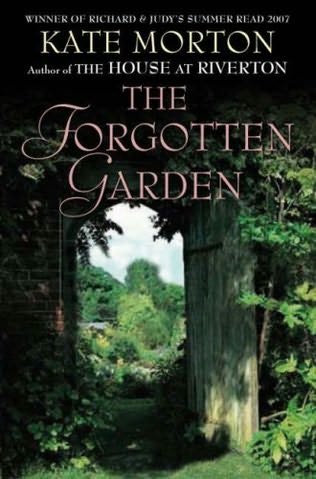
The Forgotten Garden by Kate Morton

Kate Morton’s latest book, The Distant Hours, is getting a lot of attention at the moment but I thought that before I decided whether to buy it I should really read the previous two books of hers that have been sitting on my shelf unread for a long time. I’m so glad I finally decided to pick up The Forgotten Garden because, although it wasn’t perfect, I loved it overall.

In 1913, just before the beginning of World War I, a port master finds a little girl with a suitcase sitting alone on the docks at Maryborough, Australia. With no sign of the child’s parents and no clue to her identity, he takes the girl home with him, where he and his wife name her Nell and raise her as their own daughter. But what was Nell doing in Australia? Who were her real parents? And what is her connection with the mysterious Eliza Makepeace, writer of fairy tales?

When Nell dies in 2005, she leaves everything to her granddaughter, Cassandra – including a cottage in Cornwall, England. When Cassandra travels to Cornwall to investigate, she begins to uncover some secrets about her grandmother’s identity and attempts to solve the mystery of Cliff Cottage.

At first I thought I was going to have a problem with Kate Morton’s writing style. She has quite a flowery, descriptive style which you’ll either love or hate. For example:

Was it always this way? Did those with passage booked on death’s silent ship always scan the dock for faces of the long-departed?

As the book went on though, the writing bothered me less, because I was becoming so absorbed in the story. It had a wonderful atmosphere and was very reminiscent of The Secret Garden in places (the manor house, the invalid cousin, the walled garden – and Frances Hodgson Burnett even makes a brief appearance!) It also felt a bit like a Daphne du Maurier book in places (particularly the Cornwall scenes) and the Swindell family whom Eliza lives with in turn-of-the-century London could have come straight from a Dickens novel. Some of Eliza’s fairy tales are even included in the book which I thought was a nice touch although I wasn’t too impressed with the stories themselves.

The biggest problem I had with this book was the constant jumping around in time and place. One chapter would be set in London in 1900, the next in Brisbane in 2005 and the next in Cornwall in 1975, which disrupted the flow of the story and made it difficult to follow. We also switch narrator with every chapter, which made me even more confused, particularly as there was almost nothing to differentiate between the voices of Cassandra, Nell and Eliza. It was too easy to forget who I was reading about. Eliza’s storyline was by far the most interesting of the three though and I think it would probably have worked on its own as a straight historical fiction novel.

The solution to the mystery was made very obvious to the reader from early on in the book, so when it was finally revealed it came as an anti-climax. This didn’t really spoil the story for me but it was slightly frustrating to watch Cassandra trying to solve the mystery and knowing that she was getting it completely wrong. I would have appreciated it if some of the clues could have been kept from the reader until nearer the end.

Other than those few points, I loved this book, which was great because I really hadn’t expected to. For such a long and complex book it was surprisingly quick to read.

Those of you who have read all of Kate Morton’s books, how does this one compare to The House at Riverton or The Distant Hours?

Review: A Moment of Silence by Anna Dean

A Moment of Silence is an entertaining murder mystery set in the early 19th century. It’s the first in a series of novels featuring the wonderful Miss Dido Kent.

The story begins when Dido is summoned to Belsfield Hall, the country estate of the Montague family. Her niece Catherine is engaged to Sir Montague’s son Richard – who has mysteriously disappeared during their engagement party. Dido agrees to help Catherine solve the mystery behind Richard’s disappearance, but events soon take a more sinister turn when a dead body is found in the shrubbery…

This was a light, easy read which should appeal to fans of Jane Austen due to the setting and the elegant, witty writing style – although I’m not a huge Austen fan and I still loved it! A Moment of Silence has all the elements of a classic English country house mystery: clues, red herrings and lots of possible suspects, with almost every one of the guests and family members concealing a secret of some kind. Although some of the clues were quite obvious, there were others that I didn’t figure out and the mystery was interesting enough to hold my attention right to the end.

But rather than the mystery itself, the main reason I loved this book was because of Miss Dido Kent, who is a wonderfully engaging character. She’s intelligent, observant and always speaks her mind, though usually in a good-natured way. Although we’re not told exactly how old she is (unless I missed it) she’s unmarried and her ‘spinster’ status gives her the freedom to investigate and to wander around the estate asking questions and interfering – always with the best intentions of course! I loved reading Dido’s letters updating her sister Eliza on the progress of her investigations (we never actually meet Eliza, but the letters are intended to allow us some insights into Dido’s private thoughts and musings).

I can’t wait to read more Dido Kent mysteries. This was a great start to the series and I’m looking forward to reading the second, A Gentleman of Fortune.

Recommended

Note: This book is published under the title Bellfield Hall in the US.