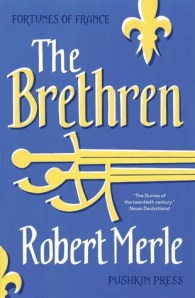
The Brethren by Robert Merle

The Brethren How could I resist a book that has been compared to both Alexandre Dumas and Dorothy Dunnett’s Lymond Chronicles? The Brethren is the first in Robert Merle’s thirteen-volume series, Fortunes of France, and sounded exactly like the sort of book I usually love! I was surprised to find that, despite being hugely successful in France when it was originally published between 1977 and 2003, the series is only now being made available in an English translation for the first time by Pushkin Press.

This first instalment introduces us to the de Siorac family and is set in the 16th century during the French Wars of Religion, a period of conflict between the Catholics and the Huguenots (Protestants). Our narrator is Pierre, the young son of Jean de Siorac, a former soldier who retires to the castle of Mespech in the Périgord region of France and establishes a small Huguenot community there with the help of his friend, Jean de Sauveterre. The two Jeans are such close friends that they formally adopt each other as brothers, becoming the ‘brethren’ of the title, but while they are united in their religious beliefs, they have very different personalities!

The adventures that follow are remembered by an older Pierre, looking back on his life. He tells us of the time the château of Mespech was attacked by a band of gypsies and of an attempt to rescue the family’s former maid from a plague-stricken town, as well as the more mundane tasks of haymaking and harvesting. We also get to know the other members of the household, from Pierre’s Catholic mother (whose refusal to convert is a source of discord within the family) and his wet-nurse’s mischievous daughter, Little Helix, to the superstitious cook, La Maligou, and the three veteran soldiers who have been with the two Jeans since their earliest military campaigns. Most of all, though, we follow the religious struggles taking place between Catholic and Huguenot, both within the walls of Mespech and throughout the whole of France.

I found The Brethren an enjoyable book, although it was not exactly what I had expected. It lacked the humour and flair of Dumas’ novels and the characters didn’t come to life the way Dunnett’s do, but I did still find plenty of things to love. The portrait of 16th century France is vivid and fascinating and I learned a lot about the religious wars, which I’ve never read about in so much detail before.

After finishing the book I was interested to discover that Robert Merle had written the originals using a form of 16th century French. The English edition, you may be relieved to hear, is not written in anything resembling 16th century English, but it does not really seem like an entirely modern translation either. This wasn’t a problem for me, as I do like books to have an old-fashioned feel, especially when I’m reading historical fiction. However, the writing does become quite dry in places and there’s not as much action as I would have hoped for, with a lot of time spent on discussions of religious treaties and detailed descriptions of battle strategies.

As Pierre is a young child throughout most of this novel and still only fifteen, I think, at the end, many of the things he tells us about are things he has not actually witnessed or taken part in personally. Instead, he gives us second-hand accounts of his father’s adventures, often drawing on Jean de Siorac’s journal, the Book of Reason. This has the effect of creating a distance between Pierre and the reader so that I found his narration slightly detached at times. But although Pierre didn’t pull me into the story as quickly as I would have liked, I did eventually become completely absorbed in the lives of the de Siorac family. I’m already looking forward to the second book and I hope Pushkin Press will continue to publish the rest of the series.

I received a copy of this book from the publisher for review.

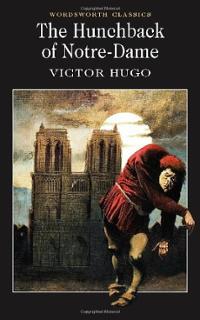
The Hunchback of Notre-Dame by Victor Hugo

The Hunchback of Notre-Dame Or Notre-Dame de Paris, to give it its original French title and one which is much more appropriate. Quasimodo, the hunchback, has a surprisingly small role in the book while the cathedral of Notre-Dame itself is at the heart of the story, with most of the action taking place within its walls, on top of its towers or in the streets and squares below.

Set in 15th century Paris, the novel follows the stories of three tragic and lonely people. First there’s the beautiful gypsy dancer, La Esmeralda, who captivates everyone she meets with her looks, her dancing and her magic tricks. Alone in the world with only her goat, Djali, for company, she dreams of one day being reunited with her parents. Then there’s Claude Frollo, the Archdeacon, once a good and compassionate man who rescued Quasimodo as a child and raised him as his son. He becomes obsessed with Esmeralda after seeing her dancing in the Place de Grève and descends into a life dominated by lust and envy, turning away from the church and towards black magic. Finally, of course, there’s Quasimodo himself, the bell-ringer of Notre-Dame. Outwardly deformed and ugly, his kind heart and his love for Esmeralda lead him into conflict with his adoptive father, Frollo.

I read Hugo’s Les Miserables almost exactly five years ago and I really don’t know why it has taken me so long to read another of his books. I loved Les Miserables and I loved this one too, though not quite as much; this is a shorter and slightly easier read, but I didn’t find the story as powerful or emotional. It was a good choice for the R.I.P. challenge, though – the atmosphere is very dark and there are plenty of Gothic elements.

At least having had some previous experience of Hugo meant that I knew what to expect from his writing! You need to be prepared for some long diversions and chapter after chapter that has almost nothing to do with the plot or the main characters. Hugo devotes a lot of this novel to discussing Gothic architecture, the structure of the cathedral, the geographical layout of Paris and other topics which may or may not be of interest to the reader. I’m happy to admit that I didn’t read every single word of these sections (in fact, I skipped most of the chapter entitled A Bird’s-Eye View of Paris) and I don’t feel that I missed anything as a result.

The version of the book that I read is not actually the one pictured above (I just wanted a book cover to illustrate my post). I downloaded the free version from Project Gutenberg for my Kindle, which is Isabel F. Hapgood’s 1888 translation. I was very happy with it, but I’m used to reading older books and older translations; depending on your taste you might prefer a more modern translation. And just as a side note, does anyone else love books with imaginative chapter titles? There are some great ones here, including The Inconveniences of Following a Pretty Woman through the Streets in an Evening, The Effect which Seven Oaths in the Open Air Can Produce and The Danger of Confiding One’s Secret to a Goat. Much more intriguing than just numbering them 1, 2, 3!

As I’ve now read Hugo’s two most popular books, can anyone tell me if there are any others that I should read? I like the sound of Ninety-Three and The Man Who Laughs, but are they worth reading?

Bitter Greens by Kate Forsyth

Bitter Greens Since reading Kate Forsyth’s Brothers Grimm-inspired The Wild Girl last year, I have been looking forward to Bitter Greens, another novel with a Grimm connection. I’m sure most of us know, or have at least heard of, the fairy tale Rapunzel. Although this fairy tale was included in the Grimm Brothers’ 1812 collection, Children’s and Household Tales, it was actually based on a much earlier story, Persinette, which was published in 1698 and written by a woman called Charlotte-Rose de Caumont de La Force. In Bitter Greens, Kate Forsyth combines a re-telling of the Rapunzel story with a fascinating account of the life of Charlotte-Rose.

The novel begins in 1697, on the day that Charlotte-Rose is banished from the court of Louis XIV and sent to a convent. With her sharp tongue, sense of humour and spirited personality, it seems that Charlotte-Rose has been the cause of too much scandal for the Sun King’s liking and is now receiving her punishment. After the lively and opulent court of Versailles, Charlotte-Rose finds it very difficult to adapt to life in a strict and austere nunnery. The only thing that makes her days bearable is her friendship with one of the nuns, Soeur Seraphina, who entertains her with a story about a little Italian girl called Margherita…

Accused of stealing a handful of bitter greens from a witch’s garden, Margherita’s parents are forced to make a bargain with the witch: she will not report them for the theft if they agree to hand over their daughter as soon as she reaches the age of seven. And so Margherita finds herself taken from her parents and locked in a high tower by Lake Garda – a tower which can only be accessed when Margherita throws her long red hair from the window to form a ladder.

Margherita’s story unfolds slowly, a few chapters at a time, and alternates with the story of Charlotte-Rose who is looking back on her life, her love affairs and her time at court. There is also a third strand to the novel and in this we learn the history of Selena Leonelli, the witch of the fairy tale, who was once a Venetian courtesan known as ‘La Strega Bella’ and a model for the artist Titian. These three women lead lives which are in some ways very different but in others quite similar. Each has been touched by sadness and tragedy, but each woman proves herself to be strong and resilient in the end.

There’s just so much packed into this novel: the scandals and intrigues of the 17th century French court, a version of Rapunzel much darker and more compelling than the one I remember from my childhood, a vivid depiction of Renaissance Italy, magic and witchcraft, religious persecution, stories within stories, and much more. I was never bored, no matter which of the three women I was reading about. Charlotte-Rose is a wonderful character and I’m surprised that more authors of historical fiction haven’t used her as a subject for their novels. This is the first time I’ve had the pleasure of reading about her and I think it’s sad that she seems to have been largely forgotten by history.

Much as I loved Charlotte-Rose, though, I always found myself looking forward to returning to Margherita in her tower. She and Selena never felt quite as real to me as Charlotte-Rose did (which is maybe not surprising as they are supposed to be fairy tale characters, after all!) but I really enjoyed revisiting the Rapunzel story, which I hadn’t read or even thought about for such a long time. There were elements of fantasy and magical realism within Margherita’s tale that worked well alongside the more realistic narrative of Charlotte-Rose and I thought the balance was perfect. I loved Bitter Greens and would highly recommend both this book and The Wild Girl.

Bitter Greens_Blog Tour Banner_FINALv2 I read Bitter Greens as part of the Historical Fiction Virtual Book Tour. For more reviews, interviews and guest posts please see the tour schedule.

An Officer and a Spy by Robert Harris

An Officer and a Spy “Is it possible that innocence is not recognised in an age of enlightenment and truth? Let them search. I ask no favour, but I ask the justice that is the right of every human being. Let them continue to search; let those who possess powerful means of investigation use them towards this object; it is for them a sacred duty of humanity and justice.”

In 1894, Alfred Dreyfus, a Jewish officer in the French army, is found guilty of spying and passing on France’s military secrets to the Germans. After being publicly degraded and stripped of his rank at a ceremony in Paris, he is exiled to Devil’s Island to live in solitary confinement in a tiny stone hut. One of the men involved in the conviction of Dreyfus is Georges Picquart, the narrator of An Officer and a Spy.

At first, Georges is sure that Dreyfus is guilty, but after being promoted to Colonel and made head of the Statistical Section (French military intelligence) he starts to have doubts. And when evidence of a second spy comes to light, Georges begins to wonder…what if Dreyfus was innocent all along?

An Officer and a Spy may be a work of fiction, but the events I’ve described above really happened. Known as the Dreyfus Affair, it was a serious miscarriage of justice that caused a huge scandal and divided public opinion in France. The author Emile Zola was even inspired to write an article in support of Dreyfus which was published under the title J’accuse…! and led to him being brought to trial for libel. The most shocking aspect of the case was the extent to which military officials had attempted to cover up the truth and fabricate evidence to hide the fact that mistakes had been made and that an innocent man had been used as a scapegoat.

This fictional account of the Dreyfus Affair is closely based on historical fact. The first half of the novel follows Georges Picquart as he discovers that there’s more to the case than meets the eye; in the second half we see what he decides to do with the information he has uncovered. Every step of the way he is thwarted by the very people he should have been able to depend upon for help and it becomes obvious that some members of his department are more interested in protecting their reputations than in seeing justice prevail.

This is the first book I’ve read by Robert Harris; for a long time he’s been an author I’ve been aware of without ever thinking I might enjoy, but when I saw that this novel had won this year’s Walter Scott Prize for Historical Fiction it convinced me to give it a try. And guess what? I loved it! Not having much previous knowledge of the Dreyfus story (it was touched on in Paris by Edward Rutherfurd but this is the first time I’ve read about it in any depth), I was completely gripped by Georges Picquart’s investigations.

From the historical fiction perspective, this book is excellent. It’s packed with information but never becomes boring or overly detailed and it’s firmly set in its time period – Georges travels by steam train, he communicates via telegram, and during a posting in Tunisia he can only rely on out-of-date newspapers as a way of following the progress of the case at home in France. But I would also recommend this book to readers of spy novels and thrillers and to anyone who enjoys well-written, well-researched fiction in general. Although the pace is slow at the beginning, it soon becomes quite a page turner, especially if you’re not very familiar with the facts of the Dreyfus Affair.

An Officer and a Spy really is a fascinating novel and took me through a range of emotions from shock to frustration to absolute outrage! Now I would like to try another book by Robert Harris. Any suggestions?

The Strangled Queen by Maurice Druon

The Strangled Queen This is the second book in Maurice Druon’s Accursed Kings series (Les Rois Maudits in French). There are seven novels in the series, all published between 1955 and 1977, telling the story of the monarchs of medieval France. The front covers of these new HarperCollins editions tell us that The Accursed Kings inspired George R.R. Martin’s A Game of Thrones, but be aware that this is not a fantasy series!

In the first book, The Iron King, we saw how Philip IV the Fair of France brought about the destruction of the Knights Templar. Before being sent to burn at the stake, the Grand Master, Jacques de Molay, cursed Philip and his descendants to ‘the thirteenth generation’. Philip was the first victim of the curse, but now he is dead and in The Strangled Queen we see how his son, Louis, becomes the next to suffer. Unlike his father, the newly crowned Louis X proves to be a very weak king and allows himself to be manipulated by his uncle, the Count of Valois, who is engaged in a power struggle with Enguerrand de Marigny, the former king’s chief minister.

Louis’ personal life is also a disaster – his wife, Marguerite of Burgundy, has been imprisoned for adultery following the Tour de Nesle Affair (described in the previous book) and as there is currently no Pope, he is unable to obtain a divorce so that he can find a new queen. Valois is hoping to arrange a marriage between his niece, Clemence of Hungary, and Louis, but first a new Pope will have to be chosen. However, Enguerrand de Marigny has other ideas and will do whatever it takes to thwart Valois’ plans.

I enjoyed The Strangled Queen, though not as much as The Iron King which I read more than a year ago and loved. I wished I hadn’t let so much time go by between reading the first book and the second as this really does seem to be a series that needs to be read in order with each book following on directly from the one before. Storylines that were begun in The Iron King were picked up again and continued in this book and I found myself struggling to remember exactly what had happened previously. I had forgotten all about Tolomei, the Lombard banker and his nephew Guccio, for example, but I was very pleased to see Guccio again as he is one of the few likeable characters in the series.

My only real complaint with this book is that, as someone who doesn’t know much about this period of French history, the title is a very big spoiler in itself. Knowing that the queen was going to be strangled took away some of the suspense! Luckily, though, the queen’s fate only forms a part of the story. Most of the novel is actually devoted to the rivalry between Charles of Valois and Enguerrand de Marigny…so you can expect lots of plotting, scheming and intrigue! And these are not the only plotting, scheming characters – there’s also Robert of Artois, still hoping to find a way of reclaiming his lands from his detested Aunt Mahaut.

I think the element of the book I found most interesting, though, is the portrayal of a young man (Louis X) who is unexpectedly forced to accept responsibilities that he is not ready for and not able to deal with. While I certainly didn’t like Louis (I find it difficult to have sympathy for someone whose idea of fun is shooting doves in an enclosed barn), I could understand his fears and insecurities and could see why it was so easy for the people around him to take control.

The third book in the series is called The Poisoned Crown so it sounds as if there’s still more trouble ahead for the sons of Philip the Fair!

Madam, Will You Talk? by Mary Stewart

Madam Will You Talk When I heard the sad news of Mary Stewart’s death recently I wanted to read one of her books as a tribute. There are still quite a few that I haven’t read and I decided on this one, her debut novel from 1955. It was a great choice because I loved it.

The novel is narrated by Charity Selborne, a young widow on holiday in the south of France with her best friend, Louise, an art teacher. Settling into their hotel, they get to know the other guests, including David, a thirteen-year-old boy from England, and his beautiful French stepmother. When Charity hears that David’s father, Richard Byron, has recently been acquitted of murder and could be in France at this moment searching for his son, she grows worried for the boy’s safety…but her efforts to protect David mean that she herself becomes Richard’s next target.

There’s a lot more to the story than that, but I really don’t want to say much more about it because this is one of Mary Stewart’s most exciting and suspenseful novels and I would like everyone to be as enthralled by the twists and turns of the plot as I was. All I will say is that this book contains one of my favourite sequences in all of the Stewart novels I’ve read – a thrilling car chase in which Charity is pursued across the French countryside (in a chapter appropriately titled Exit, pursued by a Bear – another thing I love about Mary Stewart is the way she works so many literary and mythological references into her writing).

This book is very dated now and definitely feels like one that was written in the 1950s, but I think that just adds to its charm. There are also lots of stunning descriptions of Avignon, Nîmes, Marseilles and all the other places Charity’s adventures take her to (I was pleased to see that her visit to Marseilles included a trip to the Chateau d’If, made famous by Alexandre Dumas in The Count of Monte Cristo). I particularly loved this description of Charity watching the sun rise above the remote village of Les Baux:

“How long I sat out there, in a coign of carved stone and rough rock, I do not know. Long enough, I suppose, for my vigil did at length bring in the dawn. I saw the first light, forerunning the sun, gather in a cup of the eastern cloud, gather and grow and brim, till at last it spilled like milk over the golden lip, to smear the dark face of heaven from end to end. From east to north, and back to south again, the clouds slackened, the stars, trembling on the verge of extinction, guttered in the dawn wind and the gates of day were ready to open at the trumpet…”

Since discovering Mary Stewart’s romantic suspense novels three years ago I have been hoping to find another one to match the brilliance of the first one I read, Nine Coaches Waiting. Now that I’ve read eight more of her books, I think Nine Coaches will always be my favourite, but Madam, Will You Talk? has come very close!

I think Anbolyn is hosting another Mary Stewart Reading Week in September, so whether you’re already a Stewart fan or whether you have yet to try any of her books, I hope you’ll consider joining in. I have Wildfire at Midnight, Thunder on the Right, My Brother Michael and Airs Above the Ground still to read, but maybe it’s time I tried her Merlin series which I’ve heard so much about. What do you think?

Madame Bovary by Gustave Flaubert

Madame Bovary I read Madame Bovary during April as part of a readalong hosted by Juliana of Cedar Station and CJ of ebookclassics. It was a book I’d been thinking about reading for a while anyway so the announcement of the readalong couldn’t have come at a better time for me.

Madame Bovary is a French realist novel published in 1856. The title character, Emma Bovary, longs to experience the drama and excitement she has read about in romantic novels but she is unlikely to find it in her marriage to Charles Bovary, an unambitious country doctor. Charles loves his wife and is not unkind to her, but Emma finds him boring and her life dull and meaningless. After she and Charles attend a ball hosted by the Marquis d’Andervilliers, Emma becomes depressed and miserable; she has had a glimpse of a more glamorous world and it has left her even more disillusioned and dissatisfied with her own situation.

Charles wonders whether a move to a larger town will make her happy but Emma is no more content in their new home in Yonville-l’Abbaye than she was in the small village they’ve left behind. Seeking an escape from her unhappy existence, Emma has affairs and spends money she can’t afford, but as she becomes more reckless in both her romantic and financial entanglements, her life begins to spiral out of control.

It has been interesting to read the opinions of other readalong participants, because while I think we all agree that Emma’s behaviour is silly and self-destructive, the amount of sympathy we have for her seems to vary widely. Some readers can relate to Emma and admire her for doing something to try to change her life and find some happiness; other readers find her very selfish and annoying.

I’m one of those readers who didn’t like Emma at all, though I did have some pity for her, because I know there weren’t many options open to women in the 19th century, particularly those living in provincial areas, who wanted more from life than just to be a wife and mother. I can see why she may have felt that adultery was a way of escape and a way to find the passion she’d read about in books. I thought it was sad that Emma couldn’t even take any pleasure in her daughter (when Berthe is born, her first emotion is disappointment that the baby isn’t a boy). Later, when Berthe comes up to her hoping for affection Emma pushes the little girl away so that she falls and hurts herself. Poor Berthe – and life doesn’t get any better for her later in the book either.

I don’t think Charles was entirely blameless as he could have made more effort to understand his wife’s feelings and he was so naïve that he seemed completely oblivious to what was going on, but my sympathy was definitely with him and with Berthe more than with Emma. I noticed, though, that Flaubert himself seems to stay neutral throughout the novel, reporting on his characters’ thoughts and actions without actually passing judgment on them and telling us what we should think.

There were parts of this book that I really enjoyed, but I’ll have to be honest and say that much as I wanted to love this book I just didn’t. I think my dislike of Emma was part of the problem, but not the whole problem, as I didn’t find the writing style very engaging either. The version of Madame Bovary that I read was an older Penguin edition (pictured above) translated by Alan Russell – I had no reason for choosing this translation other than that it happened to be the one I already had on my shelf, which seemed as good a reason as any. I didn’t really have any problems with it and found it easy enough to read, but having since read that Flaubert prided himself on always searching for the perfect word, in this case it’s possible that the translation did affect my enjoyment. I didn’t like the book enough to want to read it again in a different translation to find out, though!

While this has not become a favourite classic, I’m still glad I’ve read it. If nothing else, I can now see where Mary Elizabeth Braddon’s inspiration for her novel The Doctor’s Wife came from!