An Officer and a Spy by Robert Harris

An Officer and a Spy “Is it possible that innocence is not recognised in an age of enlightenment and truth? Let them search. I ask no favour, but I ask the justice that is the right of every human being. Let them continue to search; let those who possess powerful means of investigation use them towards this object; it is for them a sacred duty of humanity and justice.”

In 1894, Alfred Dreyfus, a Jewish officer in the French army, is found guilty of spying and passing on France’s military secrets to the Germans. After being publicly degraded and stripped of his rank at a ceremony in Paris, he is exiled to Devil’s Island to live in solitary confinement in a tiny stone hut. One of the men involved in the conviction of Dreyfus is Georges Picquart, the narrator of An Officer and a Spy.

At first, Georges is sure that Dreyfus is guilty, but after being promoted to Colonel and made head of the Statistical Section (French military intelligence) he starts to have doubts. And when evidence of a second spy comes to light, Georges begins to wonder…what if Dreyfus was innocent all along?

An Officer and a Spy may be a work of fiction, but the events I’ve described above really happened. Known as the Dreyfus Affair, it was a serious miscarriage of justice that caused a huge scandal and divided public opinion in France. The author Emile Zola was even inspired to write an article in support of Dreyfus which was published under the title J’accuse…! and led to him being brought to trial for libel. The most shocking aspect of the case was the extent to which military officials had attempted to cover up the truth and fabricate evidence to hide the fact that mistakes had been made and that an innocent man had been used as a scapegoat.

This fictional account of the Dreyfus Affair is closely based on historical fact. The first half of the novel follows Georges Picquart as he discovers that there’s more to the case than meets the eye; in the second half we see what he decides to do with the information he has uncovered. Every step of the way he is thwarted by the very people he should have been able to depend upon for help and it becomes obvious that some members of his department are more interested in protecting their reputations than in seeing justice prevail.

This is the first book I’ve read by Robert Harris; for a long time he’s been an author I’ve been aware of without ever thinking I might enjoy, but when I saw that this novel had won this year’s Walter Scott Prize for Historical Fiction it convinced me to give it a try. And guess what? I loved it! Not having much previous knowledge of the Dreyfus story (it was touched on in Paris by Edward Rutherfurd but this is the first time I’ve read about it in any depth), I was completely gripped by Georges Picquart’s investigations.

From the historical fiction perspective, this book is excellent. It’s packed with information but never becomes boring or overly detailed and it’s firmly set in its time period – Georges travels by steam train, he communicates via telegram, and during a posting in Tunisia he can only rely on out-of-date newspapers as a way of following the progress of the case at home in France. But I would also recommend this book to readers of spy novels and thrillers and to anyone who enjoys well-written, well-researched fiction in general. Although the pace is slow at the beginning, it soon becomes quite a page turner, especially if you’re not very familiar with the facts of the Dreyfus Affair.

An Officer and a Spy really is a fascinating novel and took me through a range of emotions from shock to frustration to absolute outrage! Now I would like to try another book by Robert Harris. Any suggestions?

The Strangled Queen by Maurice Druon

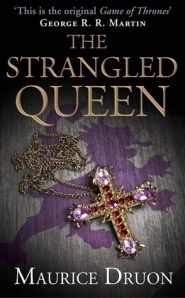
The Strangled Queen This is the second book in Maurice Druon’s Accursed Kings series (Les Rois Maudits in French). There are seven novels in the series, all published between 1955 and 1977, telling the story of the monarchs of medieval France. The front covers of these new HarperCollins editions tell us that The Accursed Kings inspired George R.R. Martin’s A Game of Thrones, but be aware that this is not a fantasy series!

In the first book, The Iron King, we saw how Philip IV the Fair of France brought about the destruction of the Knights Templar. Before being sent to burn at the stake, the Grand Master, Jacques de Molay, cursed Philip and his descendants to ‘the thirteenth generation’. Philip was the first victim of the curse, but now he is dead and in The Strangled Queen we see how his son, Louis, becomes the next to suffer. Unlike his father, the newly crowned Louis X proves to be a very weak king and allows himself to be manipulated by his uncle, the Count of Valois, who is engaged in a power struggle with Enguerrand de Marigny, the former king’s chief minister.

Louis’ personal life is also a disaster – his wife, Marguerite of Burgundy, has been imprisoned for adultery following the Tour de Nesle Affair (described in the previous book) and as there is currently no Pope, he is unable to obtain a divorce so that he can find a new queen. Valois is hoping to arrange a marriage between his niece, Clemence of Hungary, and Louis, but first a new Pope will have to be chosen. However, Enguerrand de Marigny has other ideas and will do whatever it takes to thwart Valois’ plans.

I enjoyed The Strangled Queen, though not as much as The Iron King which I read more than a year ago and loved. I wished I hadn’t let so much time go by between reading the first book and the second as this really does seem to be a series that needs to be read in order with each book following on directly from the one before. Storylines that were begun in The Iron King were picked up again and continued in this book and I found myself struggling to remember exactly what had happened previously. I had forgotten all about Tolomei, the Lombard banker and his nephew Guccio, for example, but I was very pleased to see Guccio again as he is one of the few likeable characters in the series.

My only real complaint with this book is that, as someone who doesn’t know much about this period of French history, the title is a very big spoiler in itself. Knowing that the queen was going to be strangled took away some of the suspense! Luckily, though, the queen’s fate only forms a part of the story. Most of the novel is actually devoted to the rivalry between Charles of Valois and Enguerrand de Marigny…so you can expect lots of plotting, scheming and intrigue! And these are not the only plotting, scheming characters – there’s also Robert of Artois, still hoping to find a way of reclaiming his lands from his detested Aunt Mahaut.

I think the element of the book I found most interesting, though, is the portrayal of a young man (Louis X) who is unexpectedly forced to accept responsibilities that he is not ready for and not able to deal with. While I certainly didn’t like Louis (I find it difficult to have sympathy for someone whose idea of fun is shooting doves in an enclosed barn), I could understand his fears and insecurities and could see why it was so easy for the people around him to take control.

The third book in the series is called The Poisoned Crown so it sounds as if there’s still more trouble ahead for the sons of Philip the Fair!

Madam, Will You Talk? by Mary Stewart

Madam Will You Talk When I heard the sad news of Mary Stewart’s death recently I wanted to read one of her books as a tribute. There are still quite a few that I haven’t read and I decided on this one, her debut novel from 1955. It was a great choice because I loved it.

The novel is narrated by Charity Selborne, a young widow on holiday in the south of France with her best friend, Louise, an art teacher. Settling into their hotel, they get to know the other guests, including David, a thirteen-year-old boy from England, and his beautiful French stepmother. When Charity hears that David’s father, Richard Byron, has recently been acquitted of murder and could be in France at this moment searching for his son, she grows worried for the boy’s safety…but her efforts to protect David mean that she herself becomes Richard’s next target.

There’s a lot more to the story than that, but I really don’t want to say much more about it because this is one of Mary Stewart’s most exciting and suspenseful novels and I would like everyone to be as enthralled by the twists and turns of the plot as I was. All I will say is that this book contains one of my favourite sequences in all of the Stewart novels I’ve read – a thrilling car chase in which Charity is pursued across the French countryside (in a chapter appropriately titled Exit, pursued by a Bear – another thing I love about Mary Stewart is the way she works so many literary and mythological references into her writing).

This book is very dated now and definitely feels like one that was written in the 1950s, but I think that just adds to its charm. There are also lots of stunning descriptions of Avignon, Nîmes, Marseilles and all the other places Charity’s adventures take her to (I was pleased to see that her visit to Marseilles included a trip to the Chateau d’If, made famous by Alexandre Dumas in The Count of Monte Cristo). I particularly loved this description of Charity watching the sun rise above the remote village of Les Baux:

“How long I sat out there, in a coign of carved stone and rough rock, I do not know. Long enough, I suppose, for my vigil did at length bring in the dawn. I saw the first light, forerunning the sun, gather in a cup of the eastern cloud, gather and grow and brim, till at last it spilled like milk over the golden lip, to smear the dark face of heaven from end to end. From east to north, and back to south again, the clouds slackened, the stars, trembling on the verge of extinction, guttered in the dawn wind and the gates of day were ready to open at the trumpet…”

Since discovering Mary Stewart’s romantic suspense novels three years ago I have been hoping to find another one to match the brilliance of the first one I read, Nine Coaches Waiting. Now that I’ve read eight more of her books, I think Nine Coaches will always be my favourite, but Madam, Will You Talk? has come very close!

I think Anbolyn is hosting another Mary Stewart Reading Week in September, so whether you’re already a Stewart fan or whether you have yet to try any of her books, I hope you’ll consider joining in. I have Wildfire at Midnight, Thunder on the Right, My Brother Michael and Airs Above the Ground still to read, but maybe it’s time I tried her Merlin series which I’ve heard so much about. What do you think?

Madame Bovary by Gustave Flaubert

Madame Bovary I read Madame Bovary during April as part of a readalong hosted by Juliana of Cedar Station and CJ of ebookclassics. It was a book I’d been thinking about reading for a while anyway so the announcement of the readalong couldn’t have come at a better time for me.

Madame Bovary is a French realist novel published in 1856. The title character, Emma Bovary, longs to experience the drama and excitement she has read about in romantic novels but she is unlikely to find it in her marriage to Charles Bovary, an unambitious country doctor. Charles loves his wife and is not unkind to her, but Emma finds him boring and her life dull and meaningless. After she and Charles attend a ball hosted by the Marquis d’Andervilliers, Emma becomes depressed and miserable; she has had a glimpse of a more glamorous world and it has left her even more disillusioned and dissatisfied with her own situation.

Charles wonders whether a move to a larger town will make her happy but Emma is no more content in their new home in Yonville-l’Abbaye than she was in the small village they’ve left behind. Seeking an escape from her unhappy existence, Emma has affairs and spends money she can’t afford, but as she becomes more reckless in both her romantic and financial entanglements, her life begins to spiral out of control.

It has been interesting to read the opinions of other readalong participants, because while I think we all agree that Emma’s behaviour is silly and self-destructive, the amount of sympathy we have for her seems to vary widely. Some readers can relate to Emma and admire her for doing something to try to change her life and find some happiness; other readers find her very selfish and annoying.

I’m one of those readers who didn’t like Emma at all, though I did have some pity for her, because I know there weren’t many options open to women in the 19th century, particularly those living in provincial areas, who wanted more from life than just to be a wife and mother. I can see why she may have felt that adultery was a way of escape and a way to find the passion she’d read about in books. I thought it was sad that Emma couldn’t even take any pleasure in her daughter (when Berthe is born, her first emotion is disappointment that the baby isn’t a boy). Later, when Berthe comes up to her hoping for affection Emma pushes the little girl away so that she falls and hurts herself. Poor Berthe – and life doesn’t get any better for her later in the book either.

I don’t think Charles was entirely blameless as he could have made more effort to understand his wife’s feelings and he was so naïve that he seemed completely oblivious to what was going on, but my sympathy was definitely with him and with Berthe more than with Emma. I noticed, though, that Flaubert himself seems to stay neutral throughout the novel, reporting on his characters’ thoughts and actions without actually passing judgment on them and telling us what we should think.

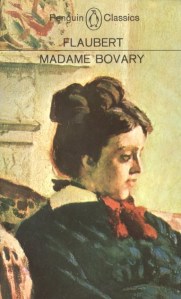
There were parts of this book that I really enjoyed, but I’ll have to be honest and say that much as I wanted to love this book I just didn’t. I think my dislike of Emma was part of the problem, but not the whole problem, as I didn’t find the writing style very engaging either. The version of Madame Bovary that I read was an older Penguin edition (pictured above) translated by Alan Russell – I had no reason for choosing this translation other than that it happened to be the one I already had on my shelf, which seemed as good a reason as any. I didn’t really have any problems with it and found it easy enough to read, but having since read that Flaubert prided himself on always searching for the perfect word, in this case it’s possible that the translation did affect my enjoyment. I didn’t like the book enough to want to read it again in a different translation to find out, though!

While this has not become a favourite classic, I’m still glad I’ve read it. If nothing else, I can now see where Mary Elizabeth Braddon’s inspiration for her novel The Doctor’s Wife came from!

The Collector of Dying Breaths by M.J. Rose

The Collector of Dying Breaths This is the sixth book in M.J. Rose’s Reincarnationist series and although I haven’t read any of the others I think this is the third to feature the character of Jac L’Etoile (the previous two are The Book of Lost Fragrances and Seduction).

The Collector of Dying Breaths is set in two different time periods, one contemporary and one historical. The historical storyline is set in the 1500s and begins with Rene le Florentin, a young apprentice in an Italian monastery, being wrongly accused of murdering his master, the monk and apothecary Dom Serapino. Rescued from prison by Catherine de Medici, who is about to marry into the French royal family, Rene starts a new life in Paris as perfumer to the French court. But while his knowledge of fragrances, potions and poisons makes him indispensable to Catherine, Rene continues to work on a secret project he and Serapino had begun in Italy based on the theory that a person’s dying breath can be captured in a bottle. Rene believes that if he can discover the correct combination of ingredients to mix with the dying breath, he will be able to use the resulting mixture to reanimate the soul.

In present day France, we meet mythologist Jac L’Etoile. Jac comes from a family of perfumers but tries to avoid becoming too closely involved in the perfume industry because certain scents seem to cause her to experience vivid memories of the past – not just her own past, but other people’s too. However, when the rich, eccentric Melinoe Cypros asks her to come to her chateau and continue the work of Rene le Florentin, Jac reluctantly agrees. But as Jac begins to search for the formula needed to reanimate a dying breath, she finds herself haunted by visions of the 16th century perfumer and the woman he loves.

While this is a complete novel in itself and it’s not completely necessary to have read the previous ones, there are frequent references to events from Jac’s past which I’m assuming must have been covered in earlier books and I did feel that I was missing something by coming to the series so late. The author does attempt to give new readers all the backstory we need, but there was too much of this and I found it a bit overwhelming. I did think the historical sections of the novel were well done and I found them more compelling than the contemporary sections. The way Catherine de Medici was portrayed was interesting, if more negative than I’d expected, and I enjoyed the dynamics between Catherine, Rene and Catherine’s astrologer, Ruggieri.

Although it took me a while to get into the present day storyline, once Jac and the others began to work on deciphering lists of ingredients and trying to prepare potions, I became much more interested. I was fascinated by the idea that simply using the same ingredients that Rene used in the 16th century may not work because their properties have altered so much over the centuries. For example, we are told that ambergris (a secretion produced by whales that was commonly used in fragrances) could be slightly different in its modern form because the diet of the whales and the quality of the water in which they live is not the same as five hundred years ago.

This is a very imaginative book, perfect for those readers who like a touch of the paranormal in their historical fiction. I think it was just my unfamiliarity with the series and the characters that prevented me from enjoying it as much as I would have liked to.

TCODB_Tour Banner_FINAL

I read The Collector of Dying Breaths as part of the Historical Fiction Virtual Book Tour. For more reviews, interviews and guest posts please see the tour schedule.

The Splendour Falls by Susanna Kearsley

The Splendour Falls This is the fifth Susanna Kearsley book I’ve read and while I’ve enjoyed them all (I think The Firebird is my favourite) I found this one a bit different from most of the others. Usually Kearsley’s novels include a supernatural element and some form of time-travel, whether it’s via telepathy, reincarnation or being physically transported through time, but this book doesn’t have anything like that, being set almost entirely in the present.

The Splendour Falls is narrated by Emily Braden, who has agreed to join her historian cousin, Harry, on a trip to Chinon in France where he is planning to do some research on the Plantagenets. Knowing Harry’s absent-mindedness and lack of consideration for other people, she is not surprised when she reaches Chinon and discovers that her cousin is nowhere to be seen. As she waits for him to arrive, Emily forms some new friendships among the other guests staying in her hotel and also becomes intrigued by the stories of two Isabelles who lived in Chinon several centuries apart.

The first is the 13th century queen, Isabelle of Angouleme, wife of King John of England, who may have hidden some treasure in the tunnels beneath Chinon while the castle was under siege from John’s enemies. The second Isabelle lived during World War II and is also believed to have hidden a treasure of her own to keep it safe from the Nazis. As Emily begins to grow concerned for her missing cousin she learns more about both Isabelles and their lost treasures. Could they be linked to Harry’s disappearance?

I enjoyed The Splendour Falls but it’s not one of my favourite Kearsley novels as I do prefer the ones with stronger historical elements (I really wanted more information on the two historical Isabelles). This is more of a mystery novel than a historical novel and in this respect it reminds me of Every Secret Thing more than any of her other books. I think one of the things I liked best about this book was the setting. Kearsley’s descriptions of Chinon – the narrow streets and steps, the vineyards, the medieval castle (the Château de Chinon) and the Chapelle Sainte-Radegonde – are all so beautiful. I’ve never been to that part of France but this book had me instantly searching Google for pictures and it does look as lovely as it sounds.

My only problem with The Splendour Falls was trying to keep track of all the characters. A huge number of them were introduced in the first few chapters, including two Canadian brothers, a French vineyard owner, a British musician, a German artist, an American couple and a gypsy. It was completely overwhelming and I felt I didn’t have time to get to know one character before another one appeared! I also found it hard to believe that Emily would instantly become such good friends with a group of random strangers staying in the same hotel.

This book has been reissued by Sourcebooks for the first time this week, but it’s not a new Susanna Kearsley novel. While I was reading I kept thinking that the ‘present day’ setting felt slightly dated – there was a noticeable lack of modern technology which would surely have made Emily’s attempts to contact Harry a lot easier – and the explanation for this is that the book was originally published in 1995. I wouldn’t recommend this as a first introduction to Kearsley’s work, but I think existing fans will probably find a lot to enjoy in The Splendour Falls, as I did.

I received a copy of this book from NetGalley for review

Twenty Years After by Alexandre Dumas

Twenty Years After At last! I’ve been meaning to read the sequel to The Three Musketeers for about five years now and I regret not having read it earlier as I loved it every bit as much as I expected to. I’ve done my best to avoid any big spoilers here but if you haven’t read The Three Musketeers yet you might prefer not to read the rest of this post until you have.

Twenty Years After, as you might have guessed, is set twenty years after The Three Musketeers. The political situation in France has changed during this time period: Cardinal Richelieu is dead and has been succeeded by the Italian Cardinal Mazarin, who is in league with the widowed Anne of Austria, mother of the young King Louis XIV of France. The French people are divided between Mazarin’s supporters and his opponents, the Frondeurs, who are unhappy with the way the country is being run. As Twenty Years After begins, France is close to civil war and when Mazarin meets our old friend d’Artagnan and hears of the brave exploits he has performed in the past, he asks him for help, along with his companions, the three musketeers – Athos, Porthos and Aramis.

D’Artagnan and his three friends have drifted apart over the years but he sets out to find them and invite them to join him in the Cardinal’s service. But while Porthos (hoping that Mazarin will reward him with a barony) is happy to go along with d’Artagnan, the other two have already taken the opposite side in the conflict. The story that follows is the story of how the friendship between d’Artagnan, Athos, Porthos and Aramis is tested by their differing political views and loyalties. Their work takes them to England, where King Charles I is facing capture and execution, and again they find themselves in opposition – but ultimately their loyalty is still to each other, especially when faced with a new enemy in the form of Mordaunt, the son of Milady, the previous book’s villain.

I found Twenty Years After a much more complex book than The Three Musketeers; I’m completely unfamiliar with this period of French history and even after finishing the book I’m not sure I really understood all of the historical background or exactly which of the various princes and dukes was on which side of the conflict. It’s a more mature book too – the characters are twenty years older and have different motivations and priorities, which allows Dumas to explore some different ideas and themes. But there’s still plenty of swashbuckling adventure and I definitely thought this book was just as much fun to read as the first one. As in The Three Musketeers there are some great and memorable scenes and set pieces – the scene on the scaffold during the execution of Charles I is one of the best – and I also loved the sequence of chapters describing the imprisonment of the Duc de Beaufort and his attempts to escape (which involved a trained dog, lobsters, some tennis balls and a giant pie).

The novel begins with an introduction to Cardinal Mazarin, but we don’t have to wait too long until we meet d’Artagnan again, still a lieutenant in the musketeers and dreaming of a captaincy. The other three musketeers and their servants are then reintroduced gradually one by one: first d’Artagnan’s old valet, Planchet, then Aramis with Bazin, Porthos and Mousqueton, Athos and finally Grimaud. I was a bit disappointed, though, that I had read more than 200 pages before all four of our heroes were reunited and together again in the same scene. And that was really the only problem I had with this book – the fact that throughout most of the story the four are divided into two pairs working towards different goals, with Porthos and d’Artagnan on one side and Athos and Aramis on the other.

The basic personality traits of the musketeers are the same, but they have also changed in many ways since the previous book, which is what you would expect after a gap of twenty years. D’Artagnan has matured from the naïve, passionate, brave young man we met in The Three Musketeers into a clever, cunning, quick-thinking man of forty who is now the natural leader of the group. Aramis has fulfilled his ambition of entering the church but isn’t fully committed, still being too interested in women and fighting. As d’Artagnan tells him, “when you were a musketeer you were forever becoming the abbé, and now you are an abbé you appear to me to have a strong leaning to the musketeers.”

Athos was my favourite character in The Three Musketeers but in this book he has become so honourable and saintly that I found him very frustrating at times. I still liked him but I much preferred the younger Athos of the wine cellar and the Bastion Saint-Gervais! In contrast, Porthos, who was never the brightest of the four, seems to have become even less intelligent. I’m sure he wasn’t quite as stupid in the first book! It does result in some great comedy moments though, and I do admire Dumas for making changes rather than leaving his characters static and undeveloped. It was also good to see that the musketeers’ four servants are given more personality in this book, particularly Grimaud and Mousqueton who even have some separate adventures of their own.

As I expected, Twenty Years After has definitely been one of my most enjoyable reads of the year! The Vicomte de Bragelonne awaits…