Mauprat by George Sand

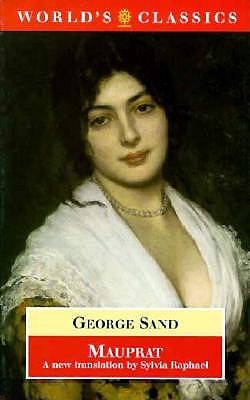
Mauprat When I was looking for suggestions for books to read for the Women’s Classic Literature Event, Camille de Fleurville suggested the French author George Sand (a pseudonym of Amantine Lucile Aurore Dupin) and pointed me in the direction of her 1837 novel, Mauprat. Having never read George Sand before, I had no idea what her books would be like, but whatever I was expecting, it wasn’t this!

The novel begins with a description of Roche-Mauprat, an abandoned château in the French countryside, once home to Bernard Mauprat, an orphan raised by his wicked grandfather and violent, brutal uncles:

On the borders of La Marche and Berry, in the district known as Varenne, which is naught but a vast moor studded with forests of oak and chestnut, and in the most thickly wooded and wildest part of the country, may be found, crouching within a ravine, a little ruined château. The dilapidated turrets would not catch your eye until you were about a hundred yards from the principal portcullis. The venerable trees around and the scattered rocks above bury it in everlasting obscurity; and you would experience the greatest difficulty, even in broad daylight, in crossing the deserted path leading to it, without stumbling against the gnarled trunks and rubbish that bar every step. The name given to this dark ravine and gloomy castle is Roche-Mauprat.

Mauprat is set in the eighteenth century, in the years leading up to the French Revolution, and in Varenne an ancient feudal system is still in place with the peasants living in fear of the powerful Mauprat family, who rule over them with tyranny and corruption. One night Bernard’s uncles take a young girl captive in the woods and bring her back to Roche-Mauprat. Her name is Edmée and she is a cousin of Bernard’s belonging to another, more civilised branch of the family. Instantly attracted to his beautiful cousin, Bernard helps her to escape, but not before making her promise to marry him in return.

Unfortunately for Bernard, he didn’t specify exactly when Edmée will have to marry him. Once she is free of Roche-Mauprat, she insists that she cannot possibly become Bernard’s wife until he proves himself worthy. And so Bernard begins a seven-year struggle to gain an education and transform himself into the sort of respectable, well-mannered man Edmée is happy to love. How much of a man’s character is due to heredity and how much to the way he has been brought up? In Mauprat, we see that even a man who has had the roughest of upbringings has the opportunity to change through love, guidance and his own desire to improve.

The novel is narrated by a much older Bernard, who is entertaining some visitors with the story of his life, but apart from the first chapter, the book is structured as a straightforward first person narrative. We are with Bernard through every step of his journey, from his flawed younger self – rough, impulsive, passionate and uneducated – to the more refined, cultured man he becomes after being shaped by Edmée’s influence. Along the way Bernard encounters several other men – from the reclusive philosopher Patience and the mole-catcher Marcasse to the Abbé Aubert and the American soldier, Arthur – all of whom provide help and advice and teach him some important lessons.

We see Edmée only through Bernard’s eyes and this makes it difficult to understand her motives. I had a lot of questions about Edmée as I read. Why was she determined to keep Bernard waiting for so many years? Did she truly love him – and if so, at what point did she begin to love him? And if you love someone, shouldn’t you be prepared to accept them for what they are? Some of these questions are answered, to some extent, by the end of the book but Edmée still intrigued and frustrated me.

Mauprat is also interesting from an historical perspective. Bernard spends some time in America fighting in the Revolution (this is where he meets Arthur, the soldier and natural scientist who becomes his friend and helps to continue his education), while France is also on the brink of revolution and society is already beginning to change:

The poor have suffered enough; they will turn upon the rich, and their castles will fail and their lands be carved up. I shall not see it; but you will. There will be ten cottages in the place of this park, and ten families will live on its revenue. There will no longer be servants or masters, or villein or lord.

As I’ve mentioned, Mauprat wasn’t quite what I’d expected (the Gothic atmosphere and the amount of melodrama surprised me) and I don’t know whether it’s typical of George Sand’s novels, but I did enjoy it. Sand herself sounds like a fascinating woman too. I would like to read more of her books, so any recommendations are welcome.

Finally, I should point out that I didn’t read the edition pictured above, but it was the only decent cover image I could find. I read the free version available through Project Gutenberg, translated by Stanley Young.

The Poisoned Crown by Maurice Druon

The Accursed Kings has it all. Iron kings and strangled queens, battles and betrayals, lies and lust, deception, family rivalries, the curse of the Templars, babies switched at birth, she-wolves, sin and swords, the doom of a great dynasty…and all of it (well, most of it) straight from the pages of history.

This is how the author George R.R. Martin has described Maurice Druon’s series of French historical novels, the inspiration behind his own Game of Thrones. The Accursed Kings (Les Rois Maudits) consists of seven books, all published between 1955 and 1977 and all available in English translations. The Poisoned Crown (Les Poisons de la Couronne) is the third in the series, continuing the story from The Iron King and The Strangled Queen.

The Poisoned Crown It’s 1315 and Louis X (known as le Hutin, the Quarreller) is on the throne of France. As the son of the late Philip the Fair, whose line was cursed ‘to the thirteenth generation’, Louis’ reign will be short and troubled. In the previous novel we saw the demise of his first wife, Marguerite of Burgundy. Now a second marriage has been arranged – with the beautiful Clémence of Hungary, who arrives in France after a terrible sea voyage and quickly wins the hearts of those around her with her kindness, generosity and religious devotion. All that remains is for Clémence to provide the king with heirs and secure the succession to the throne.

In some ways it seems that the presence of Clémence is making Louis a better person, but in others he is still proving to be cruel, weak and incompetent. A war against Flanders ends disastrously, he is unable to deal with the impact of famine and he fails to listen to good advice, being too easily influenced by his unscrupulous uncle, Charles of Valois. Meanwhile, trouble is brewing again between the king’s cousin, Robert of Artois, and Robert’s great-aunt Mahaut, who are still fighting over the lands they each regard as their own. Eventually the barons of Artois begin to rise against Mahaut, bringing the king into the dispute and setting a chain of events into motion which could bring about the end of Louis’ reign.

Three books into this series, I’m still enjoying it, but The Poisoned Crown is probably my least favourite so far. It feels like a bridging novel, leading us from the previous two volumes into the remainder of the series, rather than a satisfying story in itself. There’s less action in this one and too much focus, at least in my opinion, on the conflict between Robert of Artois and the Countess Mahaut. Still, there were plenty of things that I did like and the history is as fascinating as ever; I previously had almost no knowledge of what was happening in France during this period, so I’m really learning a lot from these novels.

Not everything in The Accursed Kings is based strictly on historical fact, though. One of the subplots which is largely fictional involves the Lombard banker, Spinello Tolomei, and his young nephew, Guccio Baglioni. Guccio’s romance with the impoverished noblewoman Marie de Cressay moves on a step in this book, although Druon goes on to spoil things for us by informing us of what the next ten years will have in store for them. One thing I find quite annoying about Druon’s writing is his habit of constantly telling us what is going to happen next. Of course, when you don’t know the history, even the titles of some of these books are spoilers in themselves!

The Poisoned Crown ends abruptly, but the scene is set for the fourth book in the series, The Royal Succession.

The Glass-Blowers by Daphne du Maurier

A glass blower, remember, breathes life into a vessel, giving it shape and form and sometimes beauty; but he can, with that same breath, shatter and destroy it.

The Glass-Blowers The Glass-Blowers was the book selected for me in the last Classics Spin at the end of August. The deadline for reading our Spin book is this Friday, so I’ve finished just in time! Although it has taken me a while to actually pick this novel up and read it, that’s not because I wasn’t looking forward to it. Daphne du Maurier is one of my favourite authors and I fully expected to love this book as I’ve loved most of her others. That didn’t really happen, unfortunately, but I did still find things to enjoy.

Published in 1963, The Glass-Blowers is historical fiction based on the lives of du Maurier’s own ancestors who lived in France during the Revolution. The story is narrated by Sophie Duval, an elderly woman writing her family history in the form of a letter to send to her nephew. Sophie begins by looking back on her childhood growing up in the Loir-et-Cher region of France as the daughter of master glass-blower Mathurin Busson. Most of her early memories revolve around her eldest brother, Robert, who is constantly getting into debt and finding himself in trouble. It is Robert who will eventually move to England and provide the link to Daphne du Maurier herself.

In France, meanwhile, Sophie and her other siblings – Pierre, Michel and Edmé – become swept up in the drama of the French Revolution. So much of what I’ve read about the Revolution is focused on Paris, so it was fascinating to read about the ways in which it affected the lives of those living in the countryside and in other cities such as Le Mans. The section set during the War in the Vendée is particularly gripping and vivid – probably because Sophie herself is caught up in the uprising and experiences it directly. Other major events happen in the background and Sophie only hears thirdhand accounts, which takes away some of the emotional impact of the story (I kept thinking of The Brethren by Robert Merle, another novel set in France which is written in a similarly passive style).

The distance between narrator and reader meant that I never became fully engaged in the lives of the Bussons and never felt that I had really got to know Sophie. Her brother and sisters were stronger characters, particularly Michel, who becomes a political activist and joins the National Guard, and Robert, who repeatedly reinvents himself as one business venture after another ends in failure. Robert infuriated me at first but he eventually became my favourite character and I found myself looking forward to his scenes as they added a spark of life to what I was beginning to find quite a tedious story.

One of the things I usually love about du Maurier is her descriptive writing and the way she creates a strong sense of time and place – and this is something that I thought was missing from The Glass-Blowers (apart from in the Vendée scenes, as I mentioned above). This hasn’t become a favourite du Maurier book, then, but in my opinion even her weaker novels are still worth reading. Now that I’ve read this one I’m planning to read Mary Anne, another fictional account of one of du Maurier’s ancestors, this time on the English side of the family. After that I’ll only have Frenchman’s Creek and Castle Dor left to read.

The Vicomte de Bragelonne by Alexandre Dumas

The Vicomte de Bragelonne This is the third Dumas novel to feature d’Artagnan and his three friends, Athos, Porthos and Aramis. Originally published in serial form as part of a much longer book, it is now usually split into three volumes of which The Vicomte de Bragelonne is the first and Louise de la Vallière and The Man in the Iron Mask are the others. As Dumas is one of my favourite authors I was fully expecting to love this book – and I did, although it was not quite as satisfying as the first two d’Artagnan novels – The Three Musketeers and Twenty Years After.

The first thing to say about The Vicomte de Bragelonne is that it is not really about the Vicomte de Bragelonne! He does appear near the beginning and again near the end, but his role in the story is not really any more significant than any number of other characters. The next thing I should say is that any reader hoping to find the four friends working together again in the spirit of “all for one and one for all” will be disappointed; we do see quite a lot of Athos, but Porthos and Aramis only come into the story very briefly towards the end.

So, what is this book about, then? Well, possibly because this is only one section of a longer work, it’s difficult to give a summary of the plot. The first half of the novel concentrates mainly on d’Artagnan and Athos who are working on two separate schemes both designed to restore Charles II to the throne of England. History tells us that the restoration would be accomplished – though not quite in the way described in this book, which is much more fun than what actually happened!

Later in the book we learn that Aramis and Porthos seem to be helping the Superintendent of Finances, Monsieur Fouquet, to build fortifications on the island of Belle-Île. We don’t find out exactly what they are up to, however, and this part of the story is left shrouded in mystery, presumably to be developed in the next two novels. Finally, there’s the storyline involving the title character, Raoul (the Vicomte), and his love for Louise de la Vallière.

The gaps between these three subplots are filled with lots of chapters detailing the political situation in France in the 1660s (particularly the death of Cardinal Mazarin and the rivalry between Fouquet and Louis XIV’s new Minister of Finance, Colbert) and the romantic intrigues of the French court (revolving around the King’s marriage and also his brother’s marriage to Charles II’s sister, Henrietta). All of this makes The Vicomte de Bragelonne a heavier, slower read than the previous two novels, but I didn’t find it boring at all – I love the way Dumas writes and I love French history, so I didn’t really mind the fact that there was less swashbuckling action and that we don’t see as much of d’Artagnan’s friends.

Of course, where history (or even geography) is concerned it can’t always be assumed that everything in a Dumas novel is completely accurate. I was amazed to find that in Dumas’ world the city of Newcastle had suddenly been transported from the River Tyne to the banks of the River Tweed sixty miles to the north! Dumas also tends to change dates or rearrange the sequence of events whenever the story calls for it as well, though I’m sure I wouldn’t have even noticed most of these alterations if I hadn’t been referring to the notes at the back of the book. I’m pleased to say, by the way, that the notes in the Oxford World’s Classics edition didn’t spoil any of the story – although I avoided the introduction just in case.

As The Vicomte de Bragelonne doesn’t stand alone as a complete novel and wasn’t originally intended to, there are a lot of things left unresolved at the end of the book, as you would expect. I’m looking forward to continuing the story soon with Louise de la Vallière!

Cousin Bette by Honoré de Balzac

Cousin Bette Balzac is an author I have wanted to try for years but have kept putting off, partly because I thought he sounded intimidating and difficult to read and partly because he wrote so many books it was hard to know where to start! Then, last month I chose ten books at random from my Goodreads “to-read” shelf – and one of them was Cousin Bette, a novel I couldn’t even remember adding to my shelf in the first place, but which sounded very appealing. I obviously couldn’t put off reading Balzac any longer!

Cousin Bette (originally La Cousine Bette and sometimes translated as Cousin Betty) was published in 1846 and is set in 19th century Paris. The title character is Lisbeth – Bette – Fischer, a relation of the Hulot family who has always been jealous of her beautiful cousin Adeline. Plain, poor, and having turned down several marriage proposals, Bette is still unmarried at the age of forty-two. When she rescues a young Polish sculptor, Wenceslas Steinbock, from a suicide attempt and takes him under her wing, she is pleased to be able to tell everyone that she has a lover at last. Her happiness is shattered, however, when Adeline’s daughter, Hortense, falls in love with Wenceslas and marries him herself.

Bette vows to take revenge on the Hulot family and joins forces with Valerie Marneffe, her pretty young neighbour. Knowing that Adeline’s husband, the Baron Hulot, is a notorious womaniser and that Valerie is looking for a rich lover, Bette sees a way to ruin the Baron and destroy the rest of the family in the process.

I enjoyed Cousin Bette and I think it was a good choice for my first Balzac novel. I found it surprisingly easy to read and very entertaining, although I did need to concentrate to follow all the intricacies of the plot. The summary I have given above is only the beginning of the story; Bette is by no means the only character who plots and schemes and tries to cause trouble – and in fact, many of the misfortunes that befall members of the Hulot family are caused by their own personal weaknesses and flaws rather than the influence of others. Baron Hulot, for example, despite being one of the targets of Bette and Valerie’s cruelty, really only has himself to blame as he is unable to resist the temptation placed in his way.

I saw the three main female characters – Cousin Bette, Valerie Marneffe and Adeline Hulot – as representing three stereotypical views of 19th century women of different classes and social groups. Bette is the bitter, jealous middle-aged spinster, Valerie the selfish, manipulative beauty, and Adeline the faithful, loving wife who turns a blind eye to her husband’s many affairs. Any reader who is interested in gender roles and the portrayal of women in literature will find a lot to think about in Cousin Bette.

Before reading this novel I had no idea what the outcome of the story would be and I was kept in suspense until the end. Of course, I’m not going to tell you how it ends, but it’s not quite as simple as the ‘good’ characters being rewarded and the ‘bad’ ones being punished. It’s all very melodramatic – and all very bleak as well – but I enjoyed it and am looking forward to reading more Balzac. As he wrote more than one hundred books, I would love to know if you’ve read any of them and which ones you would recommend.

Pure by Andrew Miller

Pure This is another book that I’ve read for my Reading the Walter Scott Prize project and another interesting read – though a very dark one.

The story is set in France in 1785, just a few years before the French Revolution. Jean-Baptiste Baratte, a young engineer from Normandy, has arrived in Paris commissioned with an important but gruesome task – the destruction of the cemetery of Les Innocents. As the oldest and largest cemetery in the city, Les Innocents has now become overcrowded, smelly and unsanitary. To prevent it becoming even more of a health hazard than it already is, Jean-Baptiste has been given the job of destroying the cemetery and its church, emptying the graves and arranging for reburial elsewhere.

The novel is based on historical fact – Les Innocents really did need to be removed in the 18th century in order to purify the surrounding area and a market place was later built on the site of the old cemetery. However, Jean-Baptiste Baratte is fictional and in Pure Andrew Miller imagines what it may have felt like to be the person responsible for carrying out such an unpleasant and controversial task. Everyone has an opinion on the destruction of the cemetery and as Jean-Baptiste continues his work, he learns just how deeply people feel about it.

During his time in Paris, Jean-Baptiste lodges with the Monnards, whose daughter Ziguette is not at all pleased with the removal of the cemetery she has been able to see from her window all her life. On his first inspection of the church, he meets the organist Armand de Saint-Méard, who will lose his job when the building is demolished. In another building on the site live the sexton and his young granddaughter, Jeanne, both of whom have devoted their lives to Les Innocents. And then there are the men – ex-miners from the mines of Valenciennes – summoned to Paris by Jean-Baptiste to help with the excavations of the graves. All of these people are affected in some way by what is happening and Jean-Baptiste receives both support and opposition.

I enjoyed the first half of this book which deals with Jean-Baptiste’s first days in Paris, getting to know the people in and around the cemetery, and deciding how to proceed with the job he has been given. I loved the portrayal of a young man experiencing life in a big city, so desperate to fit in that he lets his new friends persuade him to exchange his smart brown suit for a pistachio green silk one. France is heading towards Revolution and although this never becomes a big part of the plot, the hints are there in the references towards progress, a group of rebellious young men who call themselves the ‘party of the future’, grafitti daubed on walls, the contrast between the working class and the aristocracy – and a doctor called Guillotin who arrives at the cemetery to study the skeletons.

I’m not sure what went wrong with the second half of the book, but I started to lose interest at the point when the miners arrived in Paris and work on the cemetery began. I had found it interesting to read about the preparations, the inspections that had to be made and what the work would involve, but the descriptions of the actual excavations started to feel repetitive. I was also hoping for more character development, but apart from Jean-Baptiste himself the other characters have very little depth. Two of them commit acts of violence towards the end of the book, yet I didn’t feel that their motivations were fully explored and the consequences of both actions seemed to be resolved too quickly.

Pure is a fascinating novel, especially if you’re interested in historical fiction set in pre-Revolutionary France. I really liked Andrew Miller’s style of writing, but my lack of emotional engagement with the characters and the other problems I’ve mentioned above left me feeling slightly disappointed at the end.

The Sea Garden by Deborah Lawrenson

The Sea Garden I remember hearing a lot about Deborah Lawrenson’s The Lantern a few years ago but never found time to read it, so I was pleased to have the opportunity to read her latest book, The Sea Garden. This book consists of not just one story, but three, each taking up approximately one third of the book and introducing us to three very different women. The stories are loosely connected but each has a different setting and a different feel.

The first of the three stories (you could probably call them novellas) is also titled The Sea Garden. It’s 2013 and Ellie Brooke, a landscape garden designer, is visiting Porquerolles, a small island off the coast of France where she has agreed to restore a memorial garden for a client, Laurent de Fayols. However, she is unprepared for both the hostile welcome she receives from Laurent’s elderly mother and for the supernatural experiences that happen to her while on the island. Ellie’s story then comes to an abrupt end and another begins…

The Lavender Field takes us back to Nazi-occupied France in 1944 and a small community of people working for the French Resistance. Marthe Lincel, a young blind woman, is an apprentice at the Distillerie Musset in Provence. Her work involves creating fragrances and perfumed soaps, but as the war progresses she turns her skills to helping Allied soldiers. There are the beginnings of a dramatic and romantic wartime story here, but again we come to the end too soon…

The third and final story is A Shadow Life, the story of Iris Nightingale, who is working for British Intelligence in 1943, gathering information and recruiting spies to be sent into occupied France. Iris grows close to one of the agents, Xavier Descours, but his work is secretive and dangerous and this is not a good time to be falling in love. As the book draws near to its conclusion, we finally begin to see some connections between Ellie, Marthe and Iris and the men in their lives.

This is a beautifully written book, set in a time period I love to read about (World War II). There are some lovely descriptions of Provence with its lavender fields and also of the island of Porquerolles, a place I previously knew nothing about. The Porquerolles story has some ghostly/supernatural elements and I was impressed with the way the author creates such an eerie atmosphere in what should be a peaceful, idyllic setting. I also enjoyed learning about the work Iris carries out for the SOE (Special Operations Executive); it was fascinating to see the level of secrecy that was required when going undercover in France!

My problem with this book was the structure. Keeping the three stories separate just didn’t work for me as well as a more traditional multiple time period novel would have done. While there were definitely some links between the three, most of these didn’t become obvious until very near the end of the book. When things did start to come together the result was fascinating, but it happened too late and I’m sure I would have been happier if the three stories had been woven together from the beginning to form one cohesive novel.

Marthe’s section in particular felt very disconnected from the other two – yes, there was some character overlap, but I’m not convinced that such a large chunk of the book needed to be devoted to Marthe’s story. The third story – the one with Iris and the secret agents – was the one I found most compelling, possibly because it’s the only one that felt like a complete story and brought in elements from the other two. At the end, though, there were still some questions left unanswered and if I had enjoyed the book more, I would have taken the time to go back and search the earlier sections to see if there were any clues I had missed.

I received a copy of The Sea Garden for review via NetGalley