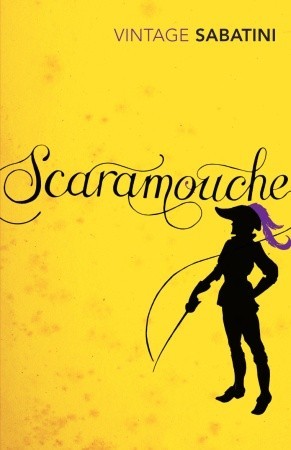
Scaramouche by Rafael Sabatini

Scaramouche is set at the beginning of the French Revolution and tells the story of Andre-Louis Moreau, a young lawyer from Britanny who has been brought up by his godfather, a man who many people believe is really his father. Andre-Louis has little interest in politics until his friend Philippe, who is passionate about the revolutionary cause, is provoked into fighting a duel with the Marquis de La Tour d’Azyr. It’s a duel Philippe has no chance of winning and when he is killed by the Marquis, Andre-Louis considers it to be murder.

Deciding that his friend’s voice must not be silenced, Andre-Louis speaks out against the privileged classes but when his speeches turn out to be much more successful than he expected, he finds himself in trouble with the law and is forced to run for his life. Joining a group of travelling actors, he takes the role of Scaramouche and discovers he has a natural talent for both acting and writing plays. First as Scaramouche, then as a fencing master and a politician, Andre-Louis sets in motion a plan for taking revenge on the man who killed Philippe.

From the wonderful opening line of this 1921 novel by Rafael Sabatini (“He was born with a gift of laughter and a sense that the world was mad”) I could tell I was going to love Scaramouche! And I did – it’s one of the best books I’ve read so far this year. The story involves a bit of everything: action, romance, history, political intrigue, humour and adventure.

Some readers might find Andre-Louis too unbelievable as a character, in the way he seems to succeed at almost everything he does, whether it’s acting, writing, orating or fencing, as well as being clever, courageous, quick-witted and charismatic. I can definitely understand this point of view, but it wasn’t really a problem for me. I thought he was a great character and I was able to suspend disbelief enough to just accept that he was good at everything! And he’s not perfect; he can be difficult to like at times and is often described by other characters as heartless (though we, as the reader, know that sometimes he’s putting on an act and not showing his true feelings). He does have flaws, he makes mistakes and his motives are not always easy to understand. His enemy, the Marquis, is another interesting character with more depth than he appears to have at first and some good qualities as well as bad ones – he’s more than just a stereotypical villain.

My favourite part of the book was the section in the middle where Andre-Louis joins the troupe of Commedia dell’Arte actors. Before I read this book I admit that I would have been unable to explain exactly what Commedia dell’Arte involved; now I know that it’s a form of improvisational theatre where the actors perform ‘scenarios’ or sketches, with each member of the group taking on one specific role. The best known of the stock characters found in Commedia dell’Arte, all of which have their own costumes and characteristics, include Harlequin, Pierrot, Pantaloon, Columbine and Scaramouche, who Wikipedia describes as a ‘roguish clown character’. Andre-Louis seems to identify with the character so much that even when he’s not acting he still sometimes thinks of himself as ‘Scaramouche’.

The events leading up to the French Revolution are central to the plot but this aspect of the book never became too overwhelming so if you don’t have much knowledge of the historical background it shouldn’t be a problem. There’s a good balance of historical detail and swashbuckling action, and there’s always something happening: a swordfight, a last-minute escape or a dramatic revelation. The fencing and duelling scenes are well written though I wished I understood all the terminology so I could fully appreciate Andre-Louis’ skill!

I’m not sure why it never occurred to me before to read Sabatini, considering he’s often compared to Alexandre Dumas, who I love. Having now read this book, I can understand the comparisons. Scaramouche has a lot in common with The Count of Monte Cristo, one of my favourite novels of all time (they are both historical adventure novels with a French setting, both have vengeance and justice as major themes and the character of Andre-Louis reminded me in some ways of Edmond Dantes). If you like Dumas or other books of this type, then I would highly recommend giving Scaramouche a try. I’ll definitely be reading more of Sabatini’s books – Captain Blood next, I think.

Thoughts on finishing the Lymond Chronicles

I apologise for abandoning my blog this week – I’ve been very busy both at work and at home, and any spare time I did have was devoted to finishing Dorothy Dunnett’s Lymond Chronicles. Because I read the final two books, The Ringed Castle and Checkmate so close together, rather than posting separate ‘reviews’ I decided to combine both books into the same post, along with some comments on the series as a whole.

Let’s start with the fifth book in the series, The Ringed Castle. After all the praise I’ve bestowed on the first four books it’s difficult to find new words to describe how I felt about this one, so suffice to say that it was as wonderful as the others. Russia is one of my favourite settings for historical fiction so I liked that aspect of the book, though I was equally interested in the chapters set at the Tudor court.

As with the previous novels, there’s a lot of history in this book – in the Russian sections we learn about Ivan IV, the Cossacks and the Crimean Tartars, and in the English sections we find ourselves at the centre of the conspiracies and political intrigue surrounding Queen Mary I and the future Elizabeth I. We also meet John Dee, the famous astrologer and mathematician, who is always interesting to read about, as well as another historical figure I knew nothing about: the explorer Richard Chancellor. Chancellor’s work with the Muscovy Company and as a navigator form quite a big part of the plot and I’m glad I’ve been able to learn something about his life and career. The final voyage of the Edward Bonaventure was so sad and one of the most memorable parts of the book for me.

Oh, and I loved the scene in the Hall of Revels, which finally led to the ‘Anvil Moment’ Aarti has been telling me about. And yes, it was worth waiting for!

When I started Checkmate, it was with a mixture of excitement at finding out how Lymond’s story would end and also sadness at the thought of reaching the end of the series. I was hoping to make the final book last as long as possible, but of course I couldn’t and it actually took less time to read than any of the others. In a series of unputdownable books, I found this one the most unputdownable of them all! I admit to having to cheat once or twice and flip forward a few pages, which is something I usually try not to do, but knowing from the previous books that Dorothy Dunnett had no qualms about killing off major characters, sometimes the suspense was just too much to bear.

Having said that, this wasn’t my favourite of the six books. There were parts that I loved – the chase through the streets of Lyon, the hilarious Hotel de Ville banquet, as well as finally learning the truth about Lymond’s birth – but overall I enjoyed some of the earlier books more. Still, I thought Checkmate was a great conclusion to the series and it was good to see so many of the characters from the previous books brought together in this one, including the return of Jerott, Marthe and one of my favourites, Archie Abernethy. And after The Ringed Castle, in which Lymond becomes more isolated than ever from his family, I was glad that Sybilla and Richard played such a big role in this book (it’s been fascinating to follow all the ups and downs of the relationship between Richard and Francis).

I’d like to finish by saying that I agree with all the Dorothy Dunnett readers who have been commenting on my previous Lymond posts – this is the best series of historical fiction novels I’ve ever read and I can see why so many of you have been re-reading them for decades because I’m sure I’ll be doing the same. And for anyone who has yet to read these books, I can promise you that although they’re not the easiest of reads, it’s definitely worth making the effort and getting to know Francis Crawford of Lymond, one of the most complex, charismatic, fascinating characters you’re ever likely to meet in literature. Working through the six books of the Lymond Chronicles has been one of the greatest experiences in my lifetime of reading.

Queens’ Play by Dorothy Dunnett

Queens’ Play is the second of Dorothy Dunnett’s Lymond Chronicles. A few weeks ago I talked about how much I loved the first in the series, The Game of Kings, and I’m pleased to report that I enjoyed this one too, though maybe not quite as much. I never know how to write about the second book in a series as it’s very difficult to discuss it without giving away some of the things that happened in the previous book. So, while I’ll do my best to avoid spoiling too much, if you haven’t already read The Game of Kings then you might prefer to do so before reading any more of my posts on the series.

Queens’ Play starts two years after the end of The Game of Kings. Mary of Guise, the mother of seven-year-old Mary Queen of Scots, has asked Francis Crawford of Lymond to join them in France and help to protect the little Queen from a plot against her life. However, Lymond’s face and name are too well known in France and so he goes undercover, disguised as one of a party of Irishmen who are visiting the French court.

As with The Game of Kings, I was very impressed by the complexity of the characters and the intricate twists and turns of the plot, but Queens’ Play also gives us a vivid depiction of the court of Henri II with its splendour, extravagance and corruption. There are plenty of exciting, dramatic scenes and set pieces too – Lymond’s adventures in France include a hunt involving a cheetah and a wolfhound, a moonlit race across the rooftops of Blois, a wrestling match (I would never have thought I could find wrestling so thrilling to read about!), stampeding elephants and more than one attempted poisoning.

In the time between finishing Queens’ Play and posting this review I have been reading the third book, The Disorderly Knights (halfway through at the moment and loving it), and I’m already starting to see the importance of Queens’ Play in the context of the series. We are introduced to some new recurring characters and Lymond also learns a lot of important lessons in France – as well as battling some personal demons, he starts to understand what it means to be a leader, to care for the men under your control and to take responsibility for what happens to them.

As I mentioned at the start of this post, I thought Queens’ Play was a great book but I didn’t love it as much as I loved The Game of Kings. I think part of the problem was that at the end of The Game of Kings I had felt we were finally starting to see the real Francis Crawford, yet almost from the very beginning of Queens’ Play he was pretending to be somebody else – and although I was still enjoying the story, I wanted Lymond, not his alter ego. Still, as far as I can tell, a lot of people consider this to be the weakest book in the series, so if that’s true I’m really looking forward to the others!

Nine Coaches Waiting by Mary Stewart

I can’t believe this is the first Mary Stewart book I’ve read! Looking at other reviews of Nine Coaches Waiting it seems almost everyone else discovered her when they were a teenager and it’s so annoying to think that I’ve missed out on all these years when I could have been reading her books. Anyway, better late than never!

Nine Coaches Waiting is the story of Linda Martin, a half French/half English orphan who arrives in France to take a job as governess to young Philippe de Valmy. Philippe is also an orphan and heir to his father’s title and estates, but as he is only nine years old he is living under the guardianship of his Uncle Leon and Aunt Heloise at the family chateau in the Haute-Savoie region of France.

As soon as Linda arrives at the chateau it becomes obvious that something isn’t right and we are immediately thrown into an atmosphere of mystery and suspense. The de Valmys had insisted that their nephew’s new governess should be an English girl, so Linda decides not to admit that she speaks fluent French. But why is this important? Do Leon and Heloise have something to hide? When Leon’s dark, handsome son Raoul comes to visit, Linda finds herself falling in love with him – but does Raoul know what his father is planning and could he be part of the de Valmys’ wicked schemes?

To discuss any more of the plot details would be unfair to any future readers, so that’s all I’m going to say as I would like everybody to be as gripped by the story as I was. Throughout the entire book I found myself worrying about Linda, worrying about little Philippe, and wondering who they could and could not trust. And we are kept guessing right until the end. The tension rises and rises during the final chapters and although there were a couple of different ways the book could have concluded, I got an ending that I was happy with.

It’s not surprising that I enjoyed this book so much, because it has everything I love in a novel: mystery, suspense, romance, memorable characters and even some gothic undertones. It also had the beautiful setting and haunting atmosphere of a Daphne du Maurier novel and would be a perfect book for readers who like stories that are dark and thrilling without actually being scary. The book was written in the 1950s and is set in the 50s too, I think, but the story has a timeless feel and if not for the references to cars and planes it could have been set in a much earlier period.

Nine Coaches Waiting is one of the best books I’ve read this year. It’s maybe not the most life-changing or the most original, but certainly one of the most enjoyable and exciting. My only regret is that I didn’t curl up with it on a quiet weekend with no distractions, rather than starting it during a busy working week when I didn’t have much time to sit down and read. It’s great to have found a potential new favourite author and now I’m looking forward to exploring the rest of her work.

The Champion by Elizabeth Chadwick

Considering how much I enjoy historical fiction, Elizabeth Chadwick is one of those authors I feel I should probably love. Until recently though, I had only tried to read one of her books – which I think was Lords of the White Castle – and couldn’t get into it at all. On a visit to the library a couple of weeks ago I decided it was time to give her another chance and as I don’t know much about any of her books, I chose this one almost at random.

The Champion is set in France, Wales and England towards the end of the 12th century. Our hero is Alexander de Montroi, a seventeen-year-old novice monk who runs away from the monastery after being abused by the sub-prior. Deciding to swap the religious life for the battlefield, Alexander asks his older brother, Hervi, to help him become a knight. He proves to be a skilled fighter and is soon an important member of Hervi’s camp, jousting and taking part in tourneys (tournaments).

It’s here that Alexander meets and falls in love with Monday de Cerizay, the daughter of Hervi’s friend and fellow knight. Despite having wealthy relatives in England, Monday has spent her whole life travelling around the tourney circuit. Having seen what this lifestyle has done to her parents, Monday longs to better herself. So when Alexander asks her to marry him, she panics and leaves the camp without letting him know where she is going. Years later, Monday and Alexander meet again and have to begin rebuilding their relationship all over again, despite the attempts of Monday’s rich and powerful grandfather to split them up – and the reappearance of Alexander’s sworn enemy, Eudo Le Boucher.

The medieval world Elizabeth Chadwick has created in The Champion is amazingly vivid and believable. The amount of detail she goes into when describing clothes, fabrics, food and drink etc is very impressive. In particular I thought the descriptions of the knights’ camps at the tourneys were very well written and felt realistic. Chadwick shows us the less glamorous side of a knight’s life: worrying about money, searching for a rich man to sponsor them in the tourneys, looking for work in the winter, as well as the constant travelling around from camp to camp, running the risk of being defeated in battle and losing their horse, their possessions or even their life.

There are a few real historical figures who appear in the book, including Richard Coeur de Lion (Richard the Lionheart), his brother John, Count of Mortain (the future King John of England) and the knight, William Marshal. But it’s not really necessary to be familiar with the history of this period, as the focus is very much on the fictional lives of Alexander and Monday. I liked Alexander from the beginning, though I wasn’t so fond of his brother Hervi (maybe because his first appearance in Chapter One doesn’t really endear him to the reader) but as the story progressed I loved watching his relationship with Alexander develop, playing the role of the protective older brother. In fact, I thought the male characters in this book were stronger overall than the female ones. I didn’t find Monday a very memorable character and I didn’t always agree with or understand her actions either.

Once I got into this book, I really enjoyed it. I didn’t think the romantic storyline was very original or imaginative, but the wonderful medieval setting more than made up for it. I feel more like giving Elizabeth Chadwick’s other books a chance now that I know I do enjoy her work and my failure with Lords of the White Castle was probably just a case of the wrong book at the wrong time. Any suggestions as to which one I should try next?

The Mystery of the Blue Train by Agatha Christie

Ruth Kettering is an American heiress who receives a set of valuable rubies as a gift from her father. Despite his warnings to keep them somewhere safe, Ruth takes the jewels with her on a trip to Nice. During her journey through France on the famous Blue Train, Ruth is found strangled to death in her compartment – and the case containing the rubies has disappeared. Hercule Poirot, who also happens to be travelling on the same train, promises to help Ruth’s father solve the crime and identify the killer. Suspicion falls first on Ruth’s husband, Derek Kettering, whom she had been about to divorce, and then on the mysterious Comte de la Roche. Is one of them the murderer?

I grabbed The Mystery of the Blue Train from the library shelf without really knowing anything about it. A bit of research now tells me it’s one of Agatha Christie’s less popular Poirot novels and now that I’ve read it I think I can see why. It was written quite early in her career and at a troubled time in her personal life, and apparently the author herself was unhappy with it. The book does have all the elements that should have added up to a classic Christie novel (a rich heiress, a journey on a luxury train, jewel thieves, the South of France – and Hercule Poirot himself, of course) but while I did enjoy it, I still felt there was something missing.

Compared to the other Agatha Christie books I’ve read, which admittedly isn’t all that many, this one was much longer and seemed to take a while to really get started (the actual crime doesn’t take place until about 100 pages into the book). There was a very long wait before Poirot made his first appearance and instead we spend a lot of time being introduced to other characters, which would have been okay had I liked these characters, but I found them a bit stereotypical, from the American millionaire to the French count to the old antiques dealer.

There were also a few sub-plots that I felt didn’t really add much to the story, although I did enjoy the dialogue between Poirot and Katherine Grey, a young woman he meets on the train who becomes involved in the murder investigation. The mystery itself kept me guessing, though I think there were probably enough clues to be able to work out at least part of the solution, if you were paying more attention than I was! The Mystery of the Blue Train was entertaining in places but is probably my least favourite Christie novel so far.

The Invisible Bridge by Julie Orringer

The Invisible Bridge begins in 1937 and follows the fortunes of three Hungarian Jewish brothers – Andras, Tibor and Matyas Levi – as they try to survive in a Europe torn apart by World War II. At the beginning of the book, Andras is preparing to leave Budapest and go to Paris to study architecture. Soon after his arrival in France, Andras meets Klara Morgenstern, a woman nine years older than himself, a ballet teacher with a teenage daughter. Andras and Klara fall in love, but Klara has secrets in her past – secrets that she would prefer not to share with Andras.

Andras and Klara’s story is played out against a backdrop of wartime Paris, Budapest, Ukraine and parts of the Hungarian countryside. The complex relationship between Andras and Klara is always at the heart of the novel but to dismiss this book as just another romance is unfair because it’s so much more than that.

Despite reading a lot of novels set during World War II, this is the first one I’ve read that is told from a Hungarian perspective. Hungary was allied with Germany which meant this story approached things from a slightly different angle than most other books I’ve read about the war and as I knew almost nothing about the role Hungary played, I was able to learn a lot from this book. And of course, because Andras and his family are Jews the novel is very much from a Jewish viewpoint. We see how it grew increasingly dangerous to be a Jew living in wartime Europe and how the Levi family became desperate to escape to safety. And when eventually Hungary finds itself under German occupation, we see that the Hungarian Jews fared no better than Jews elsewhere in Europe.

I enjoyed this book but it wasn’t perfect. There were times when I thought the balance between the romance storyline and the war aspect wasn’t quite right. And some of the characters needed more depth. I really liked Andras at first as he was a character who was easy to like and sympathise with, but as the story went on I started to find him a little bit too perfect and after spending more than 600 pages with him I wished he’d had a few flaws just to make him more interesting. I also think it would have been a nice touch if part of the book had been written from another character’s point of view. Not really a criticism of the book – I just think it would have added another dimension to the story and with the book being so epic in scope, the opportunity was there to do this.

The biggest problem I had with the book was the length! I’m usually quite happy to immerse myself in a long book but unlike some stories which do take a long time to tell, I thought this one could easily have been a lot shorter. My attention started to wander somewhere in the middle of the book when a lot of time was spent describing Andras’s life in the forced labour service (Jews were no longer allowed to serve in the actual Hungarian army but instead were expected to do jobs such as felling trees and clearing minefields) but things did pick up again over the last hundred pages.

In fact, the final section of the book, with its descriptions of life in Budapest towards the end of the war is so compelling and filled with so much tension, it made it worth sticking with the book through the less interesting chapters in the middle. And of course, I was genuinely worried for some of the characters so I had to keep reading to make sure they survived to the end of the book! I thought Orringer did a good job of keeping us in suspense wondering who would live or die and despite the few minor negative points I’ve mentioned above, I loved The Invisible Bridge.