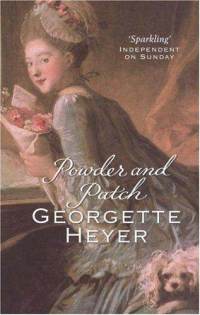
Powder and Patch by Georgette Heyer

Philip Jettan has grown up in the country on his family estate and has never shown any interest in fashionable society. As he grows older he falls in love with his childhood friend and neighbour, Cleone Charteris, but Cleone is unimpressed by Philip’s simple country ways and makes it clear she’s looking for a man with better manners and nicer clothes. And so, with the help of his Uncle Tom, Philip goes to Paris to learn how to be a gentleman…but when ‘le petite Philippe’ returns wearing powder and patches, writing French poetry and fighting duels, Cleone starts to wish she could have the old Philip back.

Powder and Patch is a very early Georgette Heyer novel and in my opinion not an example of her best work. If this had been my first experience of Heyer I think I would have been disappointed, but because I’ve read and enjoyed some of her other novels I’m prepared to accept that I’ll come across the occasional book that’s not as good. And having read some of her later books, it was interesting to see an early indication of her storytelling ability and talent for witty dialogue. There’s a lot of humour in the story but I didn’t find it as amusing as it was obviously intended to be – although I have to say, the final few chapters were quite funny and redeemed the book for me.

None of the characters in this book seemed to have much depth, with Cleone being particularly silly, especially in comparison to some of the stronger, more complex heroines in the other Heyer books I’ve read. I found it difficult to warm to her from the start because I thought Philip was fine the way he was: sincere, honest and reliable, and Cleone’s inability to accept him made me feel annoyed with her. The moral of the story is obvious: that outward appearances can be deceiving and it’s what’s inside that counts.

This book is set in the Georgian era, rather than the Regency period which Heyer is more famous for, and this gives the story a slightly different feel, although I don’t personally have any preference for one period over the other. I should point out that if you’re like me and have only a very basic knowledge of the French language (or none at all) be warned that there are a lot of French phrases scattered throughout the book, including an entire poem written in French. I don’t think it actually affected my understanding of the plot at all but I did keep wondering if I might be missing something.

Powder and Patch is a short novel but just the right length really because I don’t think the plot would have been strong enough to sustain a longer book. I found it a very quick and easy read which kept me entertained for a while, but definitely the weakest of the Heyer novels I’ve read so far.

13, rue Thérèse by Elena Mauli Shapiro

One day, American academic Trevor Stratton finds a mysterious box in his new office in Paris. On opening the box, he discovers a treasure trove of letters, postcards, photographs and other items that once belonged to a woman called Louise Brunet. As Trevor lifts each object out of the box, he begins to imagine what Louise’s life might have been like…

13, rue Thérèse is like nothing else I’ve ever read. The book is uniquely presented, making it a joy to read. Each item found in the box is reproduced on the page for the reader to look at. Whether a letter, a photograph, a pair of gloves or a coin, every one of these objects provides us with a wealth of information about Louise and her family. With each illustration we are encouraged to look beyond the obvious and search for hidden clues; it’s surprising how much we can learn about a person just by the way they address an envelope, for example. I really liked this aspect of the book; the pictures really enhance the story and give a feeling of intimacy and involvement.

Louise was an intriguing character, although her behaviour was often uncomfortable to read about. I loved the way her history gradually unfolded as Trevor pieced together information based on the contents of the box.

I did feel slightly confused at times while reading this book. I wasn’t always sure who the narrative voice belonged to and I wondered what the significance was of Josianne, the woman who left the box for Trevor to find. But when I reached the end of the book and spent some time thinking about what I had just read, everything became a lot clearer.

13, rue Thérèse is an interesting mixture of history, romance and mystery – with a touch of magic. It’s not an easy read, but I would have no hesitation recommending it to anyone who’s prepared to try something very imaginative and unusual.

I received a copy of this book from Headline for review.

The Virgin Blue by Tracy Chevalier

The Virgin Blue was Tracy Chevalier’s debut novel, first published in 1997. The only other book I’ve read by Chevalier is her most recent one, Remarkable Creatures, but I found both the writing style and atmosphere of this one entirely different.

The Virgin Blue follows two separate storylines, one from the present and one from the past, which eventually become woven together. In the modern day story, we meet Ella Turner who leaves her home in California and moves to the small French village of Lisle-sur-Tarn when her husband is offered a new job in France. Ella has trouble fitting into her new community – the local people are hostile and unwelcoming, and only the librarian Jean-Paul makes any attempt at friendship. As she begins to dig deeper into her family history, Ella’s hair begins to turn gradually red and, haunted by dreams of a brilliant blue, she starts to become aware of the parallels between her own life and that of her 16th century ancestor, a girl called Isabelle.

Isabelle de Moulin was a young peasant girl, known as La Rousse in reference to her red hair, who married Etienne Tournier, a man from a Huguenot family. With her red hair, her skills as a midwife and her love of the Virgin Mary and the colour blue, Isabelle is an object of suspicion. When the Tourniers find themselves under threat from their neighbouring Catholics, they are forced to flee France for Geneva in Switzerland, where they can follow their religion in freedom. It’s Isabelle’s tragic story that forms the second thread in The Virgin Blue.

I thought the alternating time periods in this book were handled well and they were each written in a distinctive style so that there could be no confusion. The Isabelle chapters had a dreamlike feel, almost like reading a fairytale. These chapters were also very sad and dark. Poor Isabelle was surrounded by cruel, vindictive people and seemed to have very little happiness in her life. Her story unfolded very slowly, being interspersed with Ella’s, and from the beginning there was always a sense of foreboding, a feeling that something bad was going to happen to Isabelle or her children.

I loved the setting of rural France, with its beautiful countryside and picturesque villages. Chevalier gives just enough detail to bring the landscape to life, without weighing the story down with too much description. The one thing that let this novel down for me was the characters. With the possible exception of Jean-Paul none of them felt quite real to me. I thought Rick, Ella’s husband, was especially bland and wooden, to the point where I didn’t even care what happened to him. The characters in the 16th century storyline never really came to life for me either.

So The Virgin Blue, for me, was an enjoyable but forgettable book. Despite the weak characters, I was able to become absorbed in the story while I was reading it but by the next day it was already fading from my mind. Having read Chevalier’s oldest book and her newest I’m now looking forward to reading the ones in between!

Persephone Reading Weekend: Little Boy Lost by Marghanita Laski

Persephone Reading Weekend is hosted by Claire and Verity. For those of you who are new to Persephone and wondering what this is all about, they’re a publisher dedicated to printing “mainly neglected fiction and non-fiction by women, for women and about women” and Claire and Verity have organised a weekend of reviews, giveaways and other Persephone-related fun. I’m glad I’m able to participate for the first time, as I hadn’t discovered Persephone Books in time for last year’s event. Since then I’ve read four Persephones – this one, Little Boy Lost, is my fifth. And I’m pleased to say that it has just become my favourite so far.

I was originally planning to read Alas, Poor Lady by Rachel Ferguson which I received from my Persephone Secret Santa at Christmas, but due to the length of the book I realised I wasn’t going to be able to read it in time to post about it this weekend. Although I’m still hoping to get to Alas, Poor Lady within the next few weeks (and looking forward to it as I’ve heard some good things about it), I decided that my book for the Reading Weekend would have to be the only other unread Persephone I own, Marghanita Laski’s Little Boy Lost.

And now I feel bad that Little Boy Lost was only my second choice. I can’t believe I’ve let this book sit on my shelf unopened for more than six months; if I’d realised I was going to love it this much I would have read it immediately.

Little Boy Lost is the second book I’ve read by Marghanita Laski – the first was The Victorian Chaise-Longue. However, I found the two books entirely different. Although I did enjoy The Victorian Chaise-Longue, this one was far more emotional and a more gripping, compelling read.

It’s Christmas Day, 1943, when Hilary Wainwright first learns that his son has been lost. He had seen baby John only once – a brief glimpse of a little red face with dark hair poking out of a bundle of blankets. Then, while Hilary was away, his wife, Lisa, was killed by the Gestapo in Paris and their little boy disappeared almost without trace. When the war is over, Hilary goes back to France and with the help of his friend, Pierre, he begins to follow a trail which he hopes will lead him to his lost son.

Laski does an excellent job of portraying the conflicting emotions Hilary experiences, torn between longing to be reunited with his son and worrying that if he does find him he might not want him. All through the book I was guessing what might happen – it wasn’t really obvious what the outcome would be and I could think of several different possibilities, some good and some bad.

The descriptions of post-war France are so vivid: the bomb-damaged buildings, the poverty, the food shortages – unless you were rich enough to take advantage of the black market, of course. And I was shocked by the descriptions of the conditions in the orphanages. As well as there not being enough to eat and drink, and a complete lack of any toys or games, it was chilling to think of children with tuberculosis living alongside the healthy ones.

Although I was trying to avoid hearing too much about this book before I read it, I knew it was supposed to become very nerve-wracking and suspenseful towards the end. Well, I can tell you that this is definitely true! There are so many great books that are let down by a weak ending, but this is certainly not one of them. The tension throughout the final few chapters was nearly unbearable, so much so that I was almost afraid to reach the end. And I imagine most readers, like I did, will have tears in their eyes when they reach the very last sentence.

Nicholas Lezard of The Guardian, who is quoted on the back cover, says it best: “If you like a novel that expertly puts you through the wringer, this is the one.”

Review: The Tapestry of Love by Rosy Thornton

When Rosy Thornton offered me a review copy of her new novel, The Tapestry of Love, I thought it looked and sounded wonderful – but I wasn’t sure what I would think of it as it’s a bit different from the type of book I usually read. I needn’t have worried though, because I thoroughly enjoyed it! I admit that I had previously been unfamiliar with Rosy Thornton and her books, but now that I’ve been enlightened I would definitely like to read more of her work.

The Tapestry of Love is the story of Catherine Parkstone, a forty-eight year old divorced woman who decides to sell her home in England and buy a cottage in the mountainous Cévennes region of France. Catherine intends to start her own business providing home furnishings for her neighbours, but unfortunately things don’t go quite according to plan. And her life becomes even more complicated when her sister Bryony arrives on a three month sabbatical!

Although the book has a quiet, gentle tone, the plot was interesting enough to hold my attention from beginning to end. There were enough moments of drama to keep the story moving along and some humourous scenes too – for example, Catherine’s telephone conversations with her daughter Lexie, an aspiring journalist who is feeling increasingly disillusioned with her job at a cake-decorating magazine.

I particularly enjoyed reading about all the little details of Catherine’s new life: gardening, cooking, beekeeping, shopping at the market. The real highlight of this book though, is the sense of community: when Catherine first arrives in La Grelaudiere she is a stranger, an outsider, but over time she begins to gain the trust and respect of her neighbours and starts to forge some real friendships. We get to know Monsieur Bouschet and his wife; the reclusive Guillaume; the elderly widow Madame Volpiliere and the enigmatic Patrick Castagnol. The author skilfully brings the characters to life and makes them feel completely realistic.

I’ve never been to the Cévennes, but the mountains, remote hamlets and picturesque villages are described so vividly I could easily build a picture of the area in my mind. While I don’t think I’d be brave enough to do what Catherine did and leave my home and family to move there all on my own, it does seem like a beautiful and peaceful place to live, the kind of place you could easily fall in love with.

I very much enjoyed spending time in the mountains with Catherine and her neighbours. If you’re interested in France, needlework, nature or good food, or if you’re simply looking for an absorbing and well-written story with likeable, believable characters, you should find plenty here to keep you happy.

Recommended

I received a copy of this book from the author for review

Picture from Wikipedia

Review: The Scapegoat by Daphne du Maurier

What would you do if you came face to face with yourself? That’s what happens to John, an Englishman on holiday in France, when he meets his exact double – a Frenchman called Jean de Gue.  John agrees to go for a drink with Jean but falls into a drunken stupor and wakes up in a hotel room to find that Jean has disappeared, taking John’s clothes and identity documents with him!

When Jean’s chauffeur arrives at the hotel, John is unable to convince him of what has happened – and ends up accompanying the chauffeur to Jean de Gue’s chateau, where the Frenchman’s unsuspecting family assume that he really is Jean de Gue.  Naturally, they expect him to continue running the family glass-making business and arranging shooting parties – things that John has absolutely no experience in.  Before long, it starts to become obvious that Jean is using John as a scapegoat; Jean’s family and business are both in a mess and he wants someone else to have to deal with them.

Throughout the book, I was forced to revise my opinions once or twice about what was really going on. If everything in the book is supposed to be taken literally, then we need to suspend belief at times: could two men really be so identical that even their mother, wife and daughter can’t tell the difference? There is also another way to interpret the story, one which goes deeper into the psychology of identity – I won’t say any more about that here, but if you have read the book this theory may have occurred to you too.

As usual, du Maurier’s writing is wonderfully atmospheric. She has a way of making you feel as though you’re actually there in the hotel room in Le Mans, the grounds of Jean de Gue’s estate in the French countryside and Bela’s antique shop in the town of Villars.

When John first arrives at the de Gue chateau, every member of the household is a stranger to him but we (and John) are given enough clues to gradually figure out who each person is and what their relationship is to Jean de Gue.  From the neglected pregnant wife and the hostile elder sister to the resentful younger brother and the religious ten-year-old daughter, every character is well-drawn and memorable.

Another thing I love about Daphne du Maurier’s writing is her ability to always keep the reader guessing right to the final page (and sometimes afterwards too).  This was a fascinating and unusual story, one of my favourite du Maurier books so far.

Highly recommended

Pages: 320/Publisher: Virago Press (Virago Modern Classics)/Year: 2004 (originally published 1957)/Source: Library book

Review: The Time of Terror by Seth Hunter

In The Time of Terror, Seth Hunter introduces us to a new naval hero in the style of C.S. Forester’s Horatio Hornblower.  Nathan Peake is a commander in the British Navy who spends his days chasing smugglers along the English coastline.  This is not really Nathan’s idea of fun and he longs to have some real adventures.  He gets his chance in the year 1793 when, with England and France at war, he is asked to run the blockade in the English Channel and deliver some important documents to the American minister in Paris.  Unknown to Nathan, however, his ship is carrying a cargo of counterfeit banknotes – putting his life in serious danger!

Although it’s not necessary to be an expert on French history to understand this story, you will get more out of it if you have some prior knowledge of the French Revolution and the Reign of Terror.  So if names such as Georges Danton and Robespierre mean nothing to you, it might be a good idea to do some research before beginning the book.

Readers who enjoy historical fiction novels that focus on real historical figures will be pleased to know that throughout the pages of The Time of Terror you’ll meet the author and feminist Mary Wollstonecraft, the American agent (and Mary’s lover) Gilbert Imlay, the revolutionary writer Thomas Paine and many more – so many, in fact, that I began to feel Hunter was just trying to drop as many famous names as possible into the story, regardless of whether they were necessary.  The sheer amount of historical detail in this novel was slightly overwhelming, though usually interesting.  There were dinner parties with Camille Desmoulins and Lucile Duplessis, visits to the waxworks (including a brief appearance by the young Madame Tussaud) and vivid descriptions of the guillotine.  However, other parts of the story that interested me were barely touched on.  The romantic storyline, for example, is very weak, and I would also have liked to have seen more of Nathan’s American feminist mother who had the potential to be a fascinating character.

If you’re concerned that there’ll be a lot of unfamiliar nautical terms and difficult-to-understand naval battles you’ll be right to some extent, but the story can still be followed even if you find yourself confused or bored by the seafaring aspects.  The sea battle scenes, although very well written, actually contribute very little to the plot and the book would have worked better as a more conventional historical fiction novel in my opinion.  However, there was probably too much land-based action to satisfy fans of nautical fiction so I think the book suffered from not really knowing what it wanted to be or what kind of reader it was aimed at.

This book is the first in a trilogy.  In the second Nathan Peake book, The Tide of War, the action moves to the Caribbean and in the third, The Price of Glory, Nathan will meet Napoleon Bonaparte.  Although I did find this book entertaining and interesting, I’m undecided as to whether I want to invest the time in following Nathan’s story to its conclusion.

Genre: Historical Fiction/Year: 2010/Publisher: McBooks Press/Pages: 391/Source: Won copy from LibraryThing