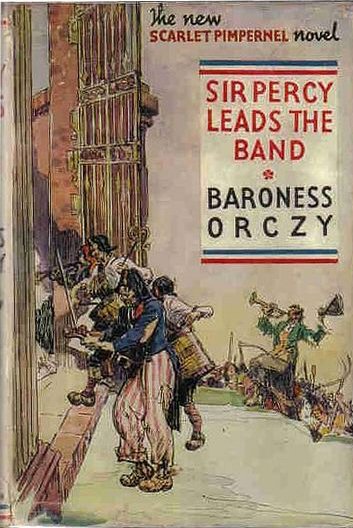
Sir Percy Leads the Band by Baroness Emmuska Orczy

Sir Percy Leads the Band This is one of the many sequels to Baroness Orczy’s classic historical adventure novel, The Scarlet Pimpernel. The story is again set during the French Revolution and at the beginning of the novel, in January 1793, King Louis XVI of France – now known simply as Louis Capet – has been found guilty of ‘conspiring against liberty’.

With their former king sentenced to death it’s a dangerous time for the French aristocracy, and Sir Percy Blakeney and his men are in France to help the La Rodière family avoid the guillotine. Knowing that his old enemy Chauvelin will be determined to track him down, a disguise is necessary – so Sir Percy becomes the fiddle-playing leader of a disreputable band of musicians entertaining crowds of revolutionaries in a tavern near the Château de la Rodière. This means Percy and the League of the Scarlet Pimpernel are ideally placed to be able to protect the family when the mob decides to attack the Château…but could someone within the League be about to betray their plans?

After reading (and loving) The Scarlet Pimpernel last year, I wanted to try another book in the series. I wasn’t sure which one to choose as I’ve seen a few different recommended reading orders, but I decided on this one as it is set immediately after the events of The Scarlet Pimpernel. I enjoyed it but it wasn’t as good as the original book. With all the action taking place in France, this means we don’t see anything of Sir Percy’s wife, Marguerite, which I thought was a bit disappointing as their relationship had formed such a big part of the story in The Scarlet Pimpernel. Marguerite was not a particularly strong character but I connected with her more than I did with either of the two female characters in this book, Blanche Levet or Cécile de la Rodière.

We do spend a lot of time with the other men of the League of the Scarlet Pimpernel. I remembered some of them from the previous book – Lord Anthony Dewhurst, Sir Andrew Ffoulkes and Lord Hastings – but there was also one who was new to me, St John Devinne. From the start it seems that Devinne is distrusted by everyone except Sir Percy and as Percy has previously proved to be so good at judging people and situations, the reader is made to wonder who is right and who is wrong. A lot of the novel’s tension and suspense comes from waiting to see whether he is going to betray Percy and the rest of the League.

Sir Percy Leads the Band was entertaining enough but I didn’t think it was anything very special and there’s really not a lot more I can say about it! Although I didn’t like it as much as The Scarlet Pimpernel it won’t deter me from trying some of the other books in the series at some point. Maybe those of you who are Scarlet Pimpernel fans can tell me whether it’s best to continue reading the series chronologically or if there’s another order you would recommend.

The Three Musketeers by Alexandre Dumas (re-read)

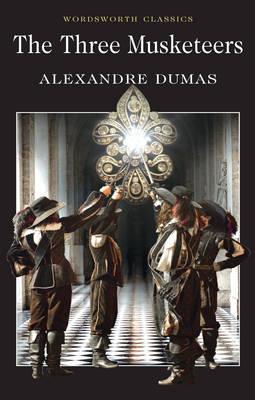
The Three Musketeers One of my goals for 2013 was to re-read more of my favourite books, something I’ve been neglecting in recent years. Well, here we are in the middle of April and so far I’ve only re-read one!

The Three Musketeers may be the title, but our hero is not a musketeer when we first meet him at the beginning of the novel, in the year 1625; his name is d’Artagnan and he’s a young man from Gascony in France, on his way to Paris where he hopes to join the King’s Musketeers under the command of Monsieur de Tréville. On his arrival in Paris, d’Artagnan encounters three of the musketeers – Athos, Porthos and Aramis – in one of those wonderful openings to a book that once you’ve read you’re unlikely ever to forget.

Soon d’Artagnan and the three musketeers become the best of friends, and when d’Artagnan meets and falls in love with Constance Bonancieux, one of the Queen of France’s ladies, all four of them are drawn into the intrigue surrounding the Queen’s affair with the powerful English nobleman, the Duke of Buckingham. With the King’s advisor, Cardinal Richelieu, hoping to expose the affair, Constance, d’Artagnan and his three friends become targets of the Cardinal and his spy, the beautiful Lady de Winter. But Milady, as she is known, is hiding a secret of her own and if d’Artagnan discovers the truth, he and Constance could find themselves in even greater danger.

I first read The Three Musketeers five years ago and when I finished it I had intended to read the other books in the trilogy (the second is Twenty Years After and third is the three-volume The Vicomte de Bragelonne/Louise de la Valliere/The Man in the Iron Mask) but as so often happens other books got in the way and I never did get around to continuing with the d’Artagnan series. And so when I made my list for the Classics Club I put all of them on there – along with a re-read of The Three Musketeers as I thought it would be a good idea to remind myself of the characters and story before embarking on Twenty Years After – and anyway, I never need an excuse to re-read a book that I enjoyed so much the first time!

I love Alexandre Dumas and although The Three Musketeers is not my favourite of the three novels of his that I’ve read (that would be The Count of Monte Cristo) I still think it’s a wonderful book with some great characters. The musketeers all have such different personalities: the aristocratic, melancholy Athos, the loud, brash Porthos, the fastidious would-be priest, Aramis, and of course, the brave, passionate d’Artagnan. Everyone will be able to pick a favourite musketeer, and mine is Athos. In her recent post on The Count of Monte Cristo, Lisa compared the character of Edmond Dantes with Francis Crawford of Lymond from the Lymond Chronicles by Dorothy Dunnett (two other great fictional characters, by the way); I agree, but I can also see some of Athos’ character traits in Lymond too, especially during one of the most memorable set pieces in the book, where the four friends eat breakfast in a fortress surrounded by enemy soldiers because it’s the only place they can find to talk in private.

It seems five years is a good length of time to wait between re-reads of a book. I had forgotten enough so that I could be surprised by the twists and turns of the plot, but remembered just enough to be able to look forward to some of my favourite parts: the breakfast scene I mentioned above, the episode with the Queen’s diamond studs, and especially the sequence of chapters in the middle (entitled Porthos, The Thesis of Aramis and The Wife of Athos) which is just a joy to read. The friendship between d’Artagnan, Athos, Porthos and Aramis is so inspiring and heartwarming (all for one, one for all!) and this is why, for me, there’s a change in the tone of the book when towards the end, the focus switches from the musketeers to Milady and I don’t enjoy the final third quite as much as the first two thirds.

Now, a note on the translation. I read the Wordsworth Classics edition of The Three Musketeers which uses the first English translation by William Barrow in 1846 (I think this is also the one used by Oxford World’s Classics). I would be interested to try a newer translation, such as Richard Pevear’s, to see how it compares – and also because I’m aware that the older translations altered certain parts of Dumas’ original text because they considered it too sexually explicit for Victorian readers. I can see that some readers today would probably find the Barrow translation too literal and antiquated but I didn’t have a problem with it at all; I actually quite like the way the sentences are constructed and I think it has a certain romantic, old-fashioned quaintness about it.

I’ll be moving on to Twenty Years After very soon!

The Iron King by Maurice Druon

The Iron King “This is the original Game of Thrones” it says on the front cover, but anyone picking this book up hoping for an epic fantasy novel is going to be disappointed. The French novelist Maurice Druon may have been George R.R. Martin’s inspiration (I haven’t read Martin’s books so wouldn’t know how strong the influence actually is), but this is definitely not fantasy – it’s an historical fiction novel and an excellent one too. While I think it’s good that Martin’s recommendation is encouraging people to read The Iron King, I do think it was maybe a mistake for the publisher to market the book in this way, as looking through the various reviews on Amazon it seems a lot of people have not got the novel they were expecting and as a consequence The Iron King has ended up with a lower rating than it deserves.

Anyway, now that we’ve established what type of book this is, let me tell you what it’s about! Originally published in the 1950s, this is the first in the seven-volume “Accursed Kings” series and tells the story of a fascinating period of French history. The Iron King of the title is Philip IV of France, who was also known as Philip the Fair. For seven years Philip has been persecuting the Knights Templar who he wishes to destroy because of their power and riches, and he finally succeeds in having their Grand Master, Jacques de Molay, burned at the stake. But before the Grand Master goes to his death, he puts a curse on the King and his descendants – “accursed to the thirteenth generation!”

Things soon start to go badly for Philip and his family when it emerges that his sons’ wives are cheating on them with two young courtiers. Philip’s daughter Isabella, who is in a loveless marriage to King Edward II of England, sees an opportunity to bring their adultery to light, with the assistance of her ambitious and vengeful cousin, Robert of Artois, who is forming a plot of his own to reclaim his lands from his hated Aunt Mahaut. It seems that the Grand Master’s curse has been successful…

As this is a novel first published in 1955 and translated from French, it does have a very different feel in comparison to most of the historical fiction novels that are being written today and this was something I really liked about the book. Unfortunately I don’t have the language skills to be able to read it in its original French, but as far as I could tell, the translator (Humphrey Hare) has done a good job and The Iron King was one of the most entertaining historical fiction novels I’ve read for a while. There were so many interesting things to learn about – the origins of the famous ‘Tour de Nesle affair’; the demise of the Knights Templar; the community of Lombard bankers in Paris – and with a plot involving murder, torture, poisonings, court intrigue, and family feuds, there was always something happening.

Don’t worry if you know nothing about this period of French history – I had absolutely no previous knowledge of Philip the Fair and his family before reading this book but that was not a problem at all because this edition of the book makes the story easy to understand and follow. Everything you need to know regarding the historical background, the politics or the causes of feuds and disputes is clearly explained in the notes at the back of the book and the character list at the front helped me remember who everyone was and how they were related to each other. I am now looking forward to the second Accursed Kings book, The Strangled Queen. I hope the publisher will continue to reissue the rest of the series!

The Light Behind the Window by Lucinda Riley

The Light Behind the Window With 2012 coming rapidly to a close I’ve now had to accept that I’m not going to have time before the end of December to write about all of the books I’ve read this year. I still have three outstanding reviews to post from October, five from November, plus any more books that I finish in the final two weeks of this month. The good news is that I do have drafts nearly complete for most of those books, so it’s just a case of finding time to finish them. I’m going to try to post as many as possible this week and next, beginning with this one, The Light Behind the Window.

This is the third novel by Lucinda Riley. I haven’t read her first, Hothouse Flower (published as The Orchid House in America), but I enjoyed her second, The Girl on the Cliff and was looking forward to reading this one. I would describe Lucinda Riley’s books as similar to Kate Morton’s: a mixture of history, romance and suspense within a dual time-frame structure. The action in The Light Behind the Window is divided between England in the 1990s and France in the 1940s.

We begin in 1998, when we meet Emilie de la Martinieres whose mother has just died, leaving Emilie to inherit the family estate which includes a beautiful château and vineyard in the south of France. Alone in the world and not sure what to do with her inheritance, Emilie is grateful for the help of her new friend, Sebastian Carruthers, who she meets at a restaurant in the village. Sebastian is an Englishman with connections to the de la Martinieres’ château – he tells Emilie that his grandmother, Constance, had stayed there during the Second World War. After a very short time, Sebastian and Emilie marry and return to England where the Carruthers have a home in Yorkshire. Here at Blackmoor Hall, Emilie meets her new brother-in-law, Alex, who is not on good terms with Sebastian and lives in a separate wing of the house. Sebastian has nothing good to say about Alex, but as Emilie gets to know them both better she begins to wonder whether there’s more to the feud between the brothers than meets the eye.

The link between the two families – the Carruthers and the de la Martinieres – is explored further in the novel’s other storyline, which takes place in the 1940s and follows the adventures of Constance Carruthers who has been recruited by the SOE (the British Special Operations Executive) to carry out espionage in occupied France and assist the French Resistance. After she finishes her training, Constance travels to Paris on her first secret mission but things don’t go according to plan and instead of being met by her contact she ends up in the home of Edouard de la Martinieres – Emilie’s father. The past and present stories – Constance’s in the 1940s and Emilie’s in the 1990s are connected in many ways and during the course of the novel the two threads meet and become woven together. As it says on the front cover of the book, “Unlocking the past is the key to the future…”

I didn’t enjoy this one as much as The Girl on the Cliff, though it was still an entertaining read. I do like Lucinda Riley’s writing overall, but I couldn’t help thinking that the dialogue in this book felt very stilted and unnatural. I have to mention it because it was something that really grated on me, especially in the first half of the book, though by the time I was halfway through I had been swept away by the story and after that any problems with the writing were less noticeable.

Whenever I read a novel set in more than one time period I usually (though not always) find that I become more involved in one than the other. Being the lover of historical fiction that I am, it’s not surprising that it tends to be the historical storyline that I prefer and that was the case again with this book. The contemporary story felt too predictable at times and there were too many plot developments that I found hard to believe, but the wartime story was fascinating and exciting. I’ve never read anything about the SOE before and it was so interesting to learn about their work in France and what it involved.

Another aspect of the book I want to mention is that two of the main characters are Nazi officers; one of them is not much more than a stereotype and is one of the novel’s villains, but the other is portrayed more sympathetically, as someone who is not completely committed and having doubts about the Nazi regime. I thought this was an interesting perspective, but it would have been nice to have seen him actually do more to act on his concerns and I’m not sure I was really very comfortable with the way his story ended.

Despite having a few problems with The Light Behind the Window I’m looking forward to Lucinda Riley’s next book and will hopefully get around to reading Hothouse Flower at some point too!

The Oracle Glass by Judith Merkle Riley

Set in Paris during the reign of Louis XIV, The Oracle Glass combines historical fiction with the supernatural to tell the story of Genevieve Pasquier and her involvement in one of the darkest episodes in French history, the Affair of the Poisons.

When her father and grandmother die under suspicious circumstances, fifteen-year-old Genevieve runs away from home and is rescued by the notorious witch, La Voisin. From an early age Genevieve has had the ability to read people’s fortunes by looking into water, and with La Voisin’s help she transforms herself into the mysterious Marquise de Morville, a fortune-teller who claims to be one hundred and fifty years old. Genevieve plans to use her powers to achieve two goals – to make the handsome Andre Lamotte fall in love with her, and to take revenge on the people who have wronged her in the past. But as she becomes more involved in the intrigues of the Sun King’s court, she begins to learn that she has stumbled into a dangerous world of magic and murder and that La Voisin, the Shadow Queen, is at the centre of a circle of witches, poisoners and abortionists.

The Oracle Glass was a wonderful, magical read. After a slow start, I soon began to look forward to picking up the book and escaping for a while into Judith Merkle Riley’s recreation of 17th century Paris. Not knowing anything about this period of history, I was surprised to discover that many of the characters I’d assumed were fictional were actually real people: Madame de Montespan, for example, the King’s mistress who frequently visits the Marquise de Morville to have her fortune told, La Reynie, chief of the Paris police, and the sorceress La Voisin herself. A lot of the events described in the story, including the eventual fates of some of the characters, were also true and in a way, I’m glad I didn’t know anything about these people as it meant I never had any idea what was going to happen next.

Genevieve, or the Marquise de Morville, is a wonderful character with a warm and engaging narrative voice and through her eyes we are shown how difficult life could be for a young single woman trying to make an independent living for herself in the 17th century. What makes her such an interesting character is that she is so flawed; she makes mistakes, does things that are wrong or stupid, and although she is intelligent she can also be very naïve.

There’s no real attempt to make the dialogue sound authentic – and Genevieve’s narrative voice sometimes feels very modern – but although this often irritates me in other books, I think there’s a certain type of historical fiction where it doesn’t matter too much and this is an example of that type: a book designed to be fun and entertaining, with plenty of humour to offset the darker themes. And yet the depiction of Paris in the 1600s does still feel vivid and real; I loved the descriptions of carriage rides through the snow-covered streets and the court of Louis XIV, the Sun King, is also very well portrayed. My only criticism is that at over five hundred pages I really don’t think the book needed to be quite so long and there were a few sections, especially in the middle, that seemed to drag.

Judith Merkle Riley is an author I’ve heard about but have never had the opportunity to read until now – I believe some of her books have been out of print for a long time but I’m glad to have finally had the chance to read The Oracle Glass and would certainly be interested in reading her other novels after enjoying this one so much!

I received a copy of The Oracle Glass through Netgalley courtesy of Sourcebooks

The Princess of Cleves by Madame de Lafayette

First published in French in 1678, The Princess of Cleves (or La Princesse de Clèves to give it its French title) is considered to be one of the first psychological novels. The story is set in the previous century (between 1558 and 1559), which also makes it an early example of the historical fiction novel.

Newly arrived at the court of Henri II, the beautiful Mademoiselle de Chartres catches the eye of the Prince of Cleves and they are soon married. The new Princess of Cleves does not love her husband, but she likes and respects him and for a while it seems that might be enough…until she meets and falls in love with the Duc de Nemours. The rest of the book explores the Princess’s conflicting emotions, as she becomes torn between her passionate love for the Duc and her desire to stick to her morals and do what she believes is right. Eventually the Princess faces an important decision, but the choice she makes is maybe not what you would expect and it’s left to the reader to make up their own mind whether they agree with her actions or not.

This book was of particular interest to me because earlier this year I read Queens’ Play by Dorothy Dunnett, which is set at the French court in the middle of the 16th century. The Princess of Cleves is set at the same court during the same period and so it was filled with names I recognised. The title character and her mother are fictional but the others are real historical figures: Henri II and his wife Catherine de’ Medici, Diane de Poitiers (the Duchess de Valentinois), the Constable de Montmorency, the Mareschal de St. Andre, the Prince of Conde, the Vidame of Chartres, the Duke de Guise and his brothers, as well as the Dauphin and his wife, Mary Queen of Scots. I think the fact that I was already familiar with these characters made the opening pages of this book slightly less overwhelming than they might otherwise have been! And luckily, only a few of the people mentioned play an important part in the story, so it’s not necessary to keep track of all of them.

If you can get past the first section, which is little more than a long list of names and descriptions of the relationships between the various courtiers, the story does start to pick up. It all appears to be very accurate historically, although not much attention is given to the important historical events of the period – this is a character driven story with the focus on the actions of the Princess, her husband and the Duc de Nemours. The court of France at that time was known for being frivolous, decadent and rife with romantic intrigue and gossip, and the author manages to capture these aspects of court life. However, having read about the background to the novel, it seems Madame de Lafayette was also commenting on the behaviour and structure of the court of her own time, Louis XIV, which I know less about so am not sure how similar or different the two courts were.

The Princess of Cleves is not a book I would recommend if you’re looking for an entertaining read with an exciting plot, but if you enjoy French literature and history or if you’re interested in the development of the early novel then I think it’s definitely worth reading. It’s a short novel and doesn’t take too long to read, though it does require some concentration, especially at the beginning. I found the writing very dry, though maybe that’s my own fault for reading the free version from Project Gutenberg rather than searching for a better translation. As I’m not able to read it in its original French, which would obviously be the best option, I’d appreciate any opinions as to which translation I should try if I decide to re-read the book at some point in the future.

The Second Empress by Michelle Moran

This historical fiction novel by Michelle Moran is set during the final years of Napoleon’s reign, between 1809 and 1815, and explores the French Emperor’s relationships with his second wife, Marie-Louise, and his sister, Pauline. I have only read one of Michelle Moran’s previous novels, Cleopatra’s Daughter, which is set in Ancient Rome and although I enjoyed it, I thought this new one, The Second Empress, was much better – the quality of her writing seems to have improved and the characters felt more developed too.

The story is told by three very different characters who take it in turns to narrate one chapter each. The first is Maria-Lucia, the eighteen year old daughter of Francis I, Emperor of Austria. Abandoning her dreams of marrying Count Adam von Neipperg, the man she loves, and one day ruling Austria as her brother’s regent, Maria-Lucia agrees to a marriage with the Emperor of France, Napoleon Bonaparte, as it will help to keep her father’s throne safe. Napoleon hopes she will be able to give him a legitimate heir, which his first wife Josephine was unable to provide. Maria-Lucia, or Marie-Louise as she became known in France, is a lovely, compelling character, intelligent, well-educated and talented. The portrayal of Napoleon is very negative (not that I had really expected anything else) but despite his cruelty to her throughout their marriage, Marie-Louise continues to perform her duties with dignity and grace.

Our second narrator is Pauline, Princess Borghese, Napoleon’s sister. She dreams of marrying Napoleon herself so that they can rule Egypt together like the ancient pharaohs and she is bitterly jealous of both her brother’s first wife, Josephine, who she encouraged him to divorce, and his second, Marie-Louise. Pauline is a spiteful, malicious person but of the three narrators, I thought her voice was the strongest and the most fun to read. She’s not a completely unsympathetic character because she is so obviously unhappy and miserable. She also has a lot of eccentricities – she’s obsessed with Egypt, she likes to bathe in milk, and she even uses her servants as footstools to rest her feet on. Although Pauline was a real historical figure, she’s not someone I’ve ever read about before so I’m not sure how accurate this portrayal is, but I thought she was a fascinating character.

Finally there’s Paul Moreau, Pauline’s Haitian servant, who accompanied her back to France after Haiti gained its independence from the French. Despite his loyalty to Pauline (and the fact that he has been in love with her for many years) Paul is aware of her faults and is able to feel sympathy for Marie-Louise too. He also still has hopes of returning to Haiti to help rebuild his war-torn country and this adds another interesting aspect to the story.

Although I have read other books set during Napoleon’s reign, this is the first one I’ve read which concentrates on the lives of Napoleon and the Bonaparte family. Before I started to read, I was worried that I might struggle because I don’t know a lot about this period of French history, but luckily this was not a problem. The focus is on the lives of the three narrators and their relationships with each other and the people around them; details of politics, battles and military campaigns are kept to a minimum (which could be either a good or a bad thing, I suppose, depending on your personal tastes in historical fiction). I was fascinated by the characters in this novel, particularly Pauline and Marie-Louise and was inspired to do some research and find out more about them – though as I had no idea how their stories would play out and didn’t want to spoil the book for myself, I waited until I had finished before I looked anything up. The author’s notes at the back of the book were helpful too and explained what happened to each of the main characters after the novel ends.

As I have so little knowledge of this subject, it wouldn’t be fair of me to comment on the historical accuracy of this book but I could tell that it had been well-researched – Moran had even included some extracts from real love letters sent between Napoleon and Josephine. A huge amount of information has obviously had to be condensed into 300 pages, so the book doesn’t really go into a lot of depth but would be a good choice if you’re looking for an enjoyable, entertaining historical fiction novel and don’t want to be overwhelmed with too many details.

I received a review copy of The Second Empress from the publisher via Netgalley