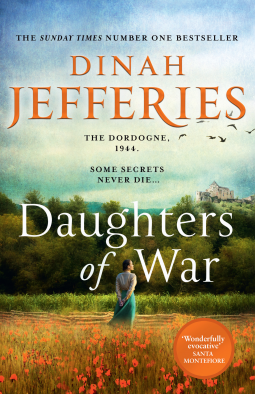
Daughters of War by Dinah Jefferies

After six novels set in Asia, all of which I’ve read and enjoyed, Dinah Jefferies has recently switched her focus to Europe during World War II. Last year’s The Tuscan Contessa was set in 1940s Italy; her new book, Daughters of War, is the first in a new trilogy set in wartime France.

It’s 1944 and France is occupied by the Nazis. In a cottage in the Dordogne live three sisters, all in their twenties, who are each doing their best to protect themselves and their friends and neighbours and to ensure that they all survive the war. Hélène, the eldest, took on the responsibility of caring for the other two after their father died and their mother departed for England, and as well as trying to look after her little family, she also works as a nurse alongside the village doctor. Élise is the rebellious and daring sister, the one who is determined to do whatever she can to help the Resistance, whether that is hiding weapons in the cottage grounds or intercepting and passing on messages. Finally there’s Florence, the innocent and kind-hearted dreamer, who is always happiest when she is at home, spending time in the kitchen or the garden.

As the Occupation continues and liberation still seems like a distant dream, the sisters are faced with a series of important decisions to make. Should they give shelter to Tomas, a deserter from the German army? Can they trust Jack, a British SOE soldier who arrives injured at the cottage one night, asking for help? All they can do is follow their instincts and try to find a balance between keeping themselves safe and working to regain France’s freedom. Along the way, each of the sisters has her own set of personal challenges to overcome, family secrets are exposed and the bonds between the three of them are tested. As the first in a trilogy, not everything is resolved in this book, but the foundations are laid for the characters and ideas to be developed further in the second and third novels.

The book is written from the perspectives of all three sisters; we spend a few chapters with one, then a few chapters with another. I felt the closest to Hélène, although each of the sisters is a strongly drawn character with a distinct personality of her own. Élise has potentially the most exciting storylines, but I would have liked to have read about her activities with the Resistance in more detail – they are skimmed over quite quickly and I thought this was a missed opportunity. I also found it unconvincing that the sisters are so ready to trust and confide in everyone they meet, even when it appears that someone around them might be a traitor; I would have expected them to have shown more caution.

Those are the negatives, but there were also plenty of positives; I particularly loved the descriptions of the beautiful countryside and villages of the Périgord Noir, the region of France where the story is set. I’m sure I’ll be reading the other two books in the trilogy, whenever they are available.

Thanks to HarperCollins UK for providing a copy of this book for review via NetGalley.

Book 42/50 read for the 2021 Historical Fiction Reading Challenge.


The Country of Others by Leïla Slimani

I’ve never read anything by Leïla Slimani until now, but her latest book, The Country of Others, sounded appealing to me – and as it’s translated from French, it means I can contribute to this year’s #WITMonth (Women in Translation Month).

Originally published as Le pays des autres and available now in an English translation by Sam Taylor, the novel is set in France and Morocco during the 1940s and 50s. Mathilde is a young woman from the Alsace region of France who, in the final years of World War II, falls in love with a Moroccan soldier, Amine, who has been fighting for the French. Bored with her life and looking for adventure, Mathilde marries Amine and moves with him to Meknes in Morocco where he has inherited some farmland. Here, as she struggles to settle into her new home, Mathilde begins to think she has made a huge mistake; this is certainly not the romantic, idyllic life she’d imagined herself leading. Loneliness, hostile neighbours, financial difficulties, an unhappy, abusive husband and political upheaval as Morocco tries to gain independence from France are just some of the problems Mathilde has to deal with.

Mathilde finds that the other French people in Meknes look down on her for marrying a Moroccan Muslim, while Amine’s Moroccan friends are suspicious of his white, European, Catholic wife. It’s not an easy situation for Amine either and he becomes torn between admiration for Mathilde and embarrassment at her refusal to behave the way he believes a woman should, which leads to some unpleasant scenes of domestic violence and cruelty. The novel is written from the perspectives of both Mathilde and Amine, as well as several more characters, all of whom are trying to find a place for themselves in this ‘country of others’: these include Aïcha, Mathilde and Amine’s daughter, who is aware that her mixed race makes her different from the other children at school; Selma, Amine’s teenage sister, a young woman who feels trapped in this male-dominated society and is desperate for freedom; and Omar, their brother, a fierce and violent man who has joined the fight for Moroccan independence and wants the French out of his country.

Although I did have a lot of sympathy for the circumstances in which most of the characters found themselves, many of them were such unlikeable people I found myself less moved by their stories than I would have expected. It didn’t help that the book is written in a strangely detached, passionless style, which I suppose is appropriate for the bleak and miserable events that are being described, but didn’t enable me to form any real emotional connection with any of the characters, not even Mathilde or Aïcha. Sometimes I almost felt that I was reading a work of non-fiction rather than a novel – and in fact, I discovered when I was halfway through the book that it’s the first in a planned trilogy drawing on Slimani’s own family history, which probably explains why it felt like a memoir.

Despite not particularly enjoying or even liking this book, I still found it interesting. I wasn’t really prepared for something so relentlessly depressing and completely without hope and I probably won’t continue with the other two books, but I do feel that I learned a lot from this one – about the challenges faced by interracial couples, the place of women in 1940s Moroccan society, and the political situation as the country moved towards independence. This was a worthwhile read, but I don’t think Slimani is an author for me.

Book 36/50 read for the 2021 Historical Fiction Reading Challenge.

St Martin’s Summer by Rafael Sabatini

St Martin’s Summer is a term used to describe a period of unusually warm weather taking place in early November – but the title of this Rafael Sabatini novel from 1909 has a double meaning, as the name of our hero is also Martin: Martin Marie Rigobert de Garnache. When a young heiress, Valerie de la Vauvraye, writes to the Queen of France requesting urgent help, Garnache is the man the Queen sends to her assistance. Valerie is betrothed to Florimond de Condillac, but Florimond has been away fighting in Italy for the last three years and in his absence his stepmother, the Marquise de Condillac, has been trying to marry the girl to her own son, Marius, instead. Can Garnache rescue Valerie from the Marquise’s clutches and reunite her with Florimond?

Having read Rafael Sabatini’s most famous novels, Scaramouche, Captain Blood and The Sea-Hawk, I have moved on to his lesser known titles and have had mixed success with the ones I’ve chosen so far; some I have enjoyed, while others have been disappointing. I had high hopes for St Martin’s Summer, which seemed to be a popular one and came highly recommended by a blog reader (thank you, Cheryl T) – and I’m pleased to say that it definitely lived up to my expectations.

First of all, it’s a lot of fun to read. Set in early 17th century France, the story itself is quite simple and straightforward, revolving entirely around Garnache’s attempts to free Valerie from her imprisonment in the Chateau de Condillac and the Marquise’s attempts to thwart him. What makes the book so entertaining, though, are the lengths both sides go to in their efforts to get one step ahead: there are duels, disguises, impersonations and all sorts of other tricks and deceptions, some of which are obvious to the reader, but not to the characters, who repeatedly fall into each other’s traps!

Garnache is a wonderful character. Like many of Sabatini’s heroes, he has great courage, a quick brain and an array of other skills and talents, but also one or two serious flaws – in this case an inability to keep his temper under control:

The greatest stumbling-block in Garnache’s career had been that he could never learn to brook opposition from any man. That characteristic, evinced early in life, had all but been the ruin of him. He was a man of high intellectual gifts, of military skill and great resource; out of consideration for which had he been chosen by Marie de Medicis to come upon this errand. But he marred it all by a temper so ungovernable that in Paris there was current a byword, ‘Explosive as Garnache.’

Garnache’s temper gets him into trouble and ruins his plans again and again, which is frustrating to watch but makes him a more believable and sympathetic character than he would otherwise have been. At the beginning of the book he also has a low opinion of women – he has remained single to the age of forty – but as he spends more time in the company of Valerie, as well as being forced to pit his wits against such a formidable female opponent as the Marquise de Condillac, he begins to change his views! The Marquise is obviously a great villain, but I also liked Garnache’s quick-thinking servant Rabecque, who is sometimes more perceptive than his master, and Monsieur de Tressan, the Seneschal of Dauphiny, a cowardly man who tries to ‘run with the hare and hunt with the hounds’.

I really enjoyed this book – it was so much better than my last Sabatini, The Minion, and I hope my next choice will be another good one!

~

Book 22/50 from my second Classics Club list

Book 35/50 read for the 2021 Historical Fiction Reading Challenge.
Book 8/20 of my 20 Books of Summer 2021

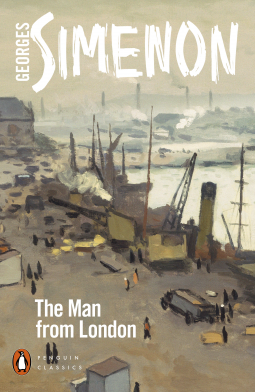
The Man from London by Georges Simenon – #NovNov

I’ve been struggling to concentrate on longer novels for most of the year, despite having more time than ever before to read them! This month’s Novellas in November (hosted by Cathy of 746 Books and Rebecca of Bookish Beck, ) seemed like a perfect opportunity for me to get through some of the shorter books on my TBR, beginning with this one – a Belgian classic from 1934 reissued today by Penguin Classics.

The Man from London is my first Georges Simenon book (I haven’t read any of the Maigret novels, though I feel that I should have done by now), so I didn’t really know what to expect from it. I was pleased to find that it was suspenseful, atmospheric and, in this translation by Howard Curtis, very readable.

The story begins on a cold, foggy night in Dieppe, where railway signalman Louis Maloin is sitting alone in his watchtower, looking down on the docks at the ferry just arriving from England. It’s a sight Maloin observes every day, but tonight something is different: he watches one of the newly arrived passengers fight with another man and knock him into the water, along with the suitcase he is holding. Aware that he appears to be the only person who has seen this happen, Maloin retrieves the case from the water when nobody is around and takes it home with him. When he discovers what the case contains, the decision he makes could have consequences that will change his life forever.

Although there is an element of mystery to the book, with questions over the identities of the two men and where the contents of the case came from, this is really more of a psychological thriller than a crime novel. The fight Maloin witnesses and his reaction to it provides a starting point for an exploration of the state of Maloin’s mind as the process he has set in motion spirals out of control. He experiences every conceivable emotion over the course of the story, ranging from guilt at not telling the police what he has seen and allowing a murderer to walk free, excitement at gaining possession of the case for himself, and terror, knowing that someone could discover what he has done at any minute.

The atmosphere Simenon creates is wonderful, with the tension building and building as Maloin tries to go about his normal life, while being confronted at every turn by the face of the man he has come to think of as ‘the man from London’. The wet, foggy December weather adds to the overall mood, as do the descriptions of the places and people Maloin encounters as he moves around Dieppe trying to avoid the murderer and the police.

The short length of the book meant it held my interest from beginning to end and although I think the potential was here for a longer and more complex novel, I still found it quite satisfying. I’m glad my first experience of Georges Simenon’s work was a good one and I’m definitely interested in reading more of his books now.

Thanks to Penguin Classics for providing a copy of this book for review via NetGalley

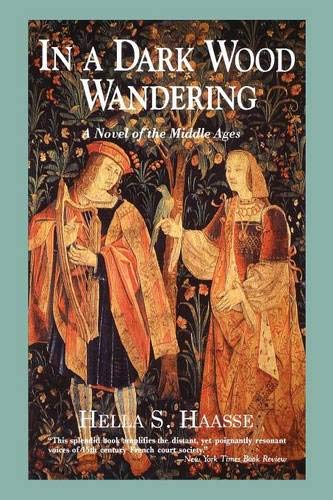
In a Dark Wood Wandering by Hella S Haasse

“Doesn’t it seem to you that we have, all of us – the King and I and our good friends – wandered off into a forest of the night, filled with wolves and sly foxes? The darkness holds endless danger, we are stranded with no torch to protect us…We are lost in the Forest of Long Awaiting, a wilderness without prospect.”

Hella S Haasse’s In a Dark Wood Wandering was the book chosen for me in the last Classics Club Spin just before Christmas, a result I was very happy with as I’d wanted to read this book for years. The deadline for finishing our Spin books was the end of January, but I knew I would need longer as I could tell when I started reading that this was the sort of book that required concentration and couldn’t be rushed.

First published in Dutch in 1949, an English translation by Lewis C Kaplan appeared in 1989 and although, sadly, I am unable to read the book in its original language, it doesn’t feel as though anything has been lost in translation – certainly not the beauty of the writing.

Set during the Hundred Years War, mainly in France but later in England, the novel begins in 1394 with the birth of a son to Louis, Duke d’Orléans and his wife, Valentina Visconti. Louis’ brother, Charles VI of France, suffers episodes of madness which leave him unfit to rule and Louis, at this time, is one of the most powerful men in France. However, there are others who are also able to wield influence over the king and Louis seems to be locked in never-ending conflict with the royal houses of Burgundy, Bourbon and Berry. It is into this world of power struggles, political intrigue and shifting alliances that little Charles d’Orléans is born.

Charles is still in his teens when his father, Louis, is murdered by Jean of Burgundy and, as the eldest son, the responsibility for the future of the House of Orléans falls on his young shoulders. Charles and his brothers swear to seek revenge against Burgundy, but then comes 1415, the Battle of Agincourt and a French defeat. Charles is captured by the victorious English and taken to England as a prisoner of war, where he will remain for decades. During this time, he occupies himself by writing the poetry for which he will become famous, but he never loses hope that one day France and England will be at peace and that he will be ransomed and allowed to return home.

In a Dark Wood Wandering is an amazing achievement. As readers of my blog will know, I enjoy reading historical fiction of all types, but my favourites tend to be older books like this one as I find that they are often better at immersing the reader in a bygone time without using inappropriately modern slang or projecting modern attitudes onto historical characters. That is certainly true of this book; both Hella S Haasse’s recreation of early 15th century France and her portrayal of the key historical figures of the period feel completely real and believable. This might be a problem for some readers as it means that the women – with the exceptions of Joan of Arc and, at times, Isabeau of Bavaria – are not particularly strong characters and, after the prologue, are kept largely in the background. Having said that, Charles himself is a passive, introspective character, often no more than an observer of things going on around him, a personality much more suited to writing poetry than to leading armies. Not everyone can be a hero or a heroine, after all.

Telling the story from Charles of Orléans’ perspective has its limitations as the parts of the Hundred Years War in which Charles plays a more active part, such as Agincourt, are vividly described while others, particularly events taking place in France during his time of exile, have to be either related to Charles from a distance or seen through the eyes of other characters. One of these is Dunois, Charles’ younger half-brother, known as the Bastard of Orléans; I have to admit, I found him a much more interesting and engaging character than Charles and wished we had seen more of him.

I loved the imagery Haasse uses in her writing; her descriptions of poppies glowing in green fields, sunlight sparkling on clear water and reflections of clouds in the river unfold like medieval tapestries while the idea of being lost en la forêt de longue attente or in ‘the Forest of Long Awaiting’ (a better title for the book in my opinion) is used very effectively throughout the novel. It forms the subject of the poetry Charles writes during his imprisonment in England and is also a metaphor for his state of mind and for the state of the Orléans family and France as a whole. By the time the novel draws to a close, France is beginning to head out of the dark forest of the Middle Ages towards the light of the Renaissance. As for Charles himself, although his life may seem to have been a story of missed opportunities and wasted potential, history tells us that the fortunes of the House of Orléans would soon start to rise again.

Now I want to read more of Hella S Haasse’s novels. Not all of them have been translated into English, but of those that have I particularly like the sound of The Scarlet City, a novel about Rome and the Borgias. Has anyone read that one – or any of her other books?

This is book 15/50 read from my Second Classics Club list.

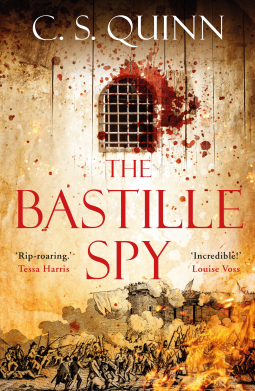
The Bastille Spy by CS Quinn

Set during the French Revolution and featuring an almost super-human female spy and a handsome, charismatic pirate, this book feels like a cross between The Scarlet Pimpernel, James Bond and Pirates of the Caribbean. As the first in a new series – Revolutionary Spy – I’m not sure whether I really liked it enough to want to continue with the next one, but it was certainly entertaining.

Our heroine Attica Morgan is the illegitimate daughter of a British nobleman and an African slave. Raised and educated in England, Attica wants to make the most of the opportunities she has been given and do everything she can to help relieve the suffering of others, whether they are those who are born or sold into slavery, or those who have become political prisoners. With her impressive range of skills and abilities, as well as her intelligence and fearlessness, Attica has been admitted to the secret society known as the Sealed Knot and as the novel opens in 1789, she is preparing to head to France on a new mission.

Armed with her deadly Mangbetu knife and her quick wits, Attica arrives in a Paris where revolution is brewing. A diamond necklace intended for Marie Antoinette has gone missing, something which could have serious repercussions for the monarchy if the jewels are not found. Attica’s task is to locate the necklace, but more important to her is the safety of her cousin Grace, who was sent to Paris on a mission of her own and has disappeared as thoroughly as the diamonds. Meanwhile, a prisoner has been murdered inside the notorious Bastille, but who was he and who was responsible for his death?

As if all of that wasn’t enough, Attica crosses paths with some of the leading figures of the Revolution, including Maximilien Robespierre who is on the trail of an elusive British spy known only by the codename ‘Mouron’, or ‘Pimpernel’. If she is to evade Robespierre’s clutches and survive long enough to complete her mission, Attica needs someone she can trust, but there’s only the pirate Captain Jemmy Avery – and it’s impossible to tell which side he is on and for whom he is really working.

The story moves along at a whirlwind pace, never slowing down for a second as Attica and her friends rush from one adventure to another, trying to stay one step ahead of their enemies. There’s plenty of historical detail in between, but something about the writing style, the language and the characters made the book feel more ‘modern’ than I would have preferred. Attica herself isn’t very believable as an 18th century woman – but then, she wouldn’t be very believable in any other time period anyway! It seems there is nothing she can’t do, from picking locks and wielding weapons to speaking a multitude of foreign languages and decoding secret messages. This makes her fun to spend time with, but I would have liked to have seen a few more flaws and vulnerabilities to round out her character.

Only part of the story is told from Attica’s point of view. There are also some chapters which focus on Robespierre, as well as some in which we follow the adventures of Attica’s cousin Grace. Next to the larger-than-life Attica, Grace is a quieter, less memorable character, but I enjoyed the occasional change of perspective.

I might be tempted to read the next book in this series, but at the moment I don’t think so. However, I’m determined that 2020 will be the year I read Hilary Mantel’s French Revolution novel, A Place of Greater Safety, which I’ve only been putting off reading because of the length.

Thanks to Corvus for providing a copy of this book for review via NetGalley.

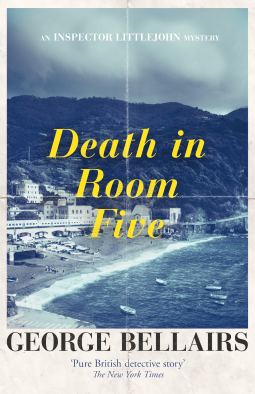
Death in Room Five by George Bellairs

George Bellairs, author of over fifty crime novels, many of them featuring the character of Inspector Littlejohn, seems to be enjoying a resurgence in popularity recently due to various publishers bringing a selection of his titles back into print. This one, Death in Room Five, is the second I’ve read and like my first, A Knife for Harry Dodd, it has been reissued by Agora Books.

In Death in Room Five, first published in 1955, Inspector Littlejohn is looking forward to taking a break from detective work and enjoying the sun, sea and sand of the French Riviera. His holiday has hardly begun, however, when a party of British tourists arrive, one of them is stabbed to death in the street, and Littlejohn finds himself drawn into a murder investigation. The dead man – the Alderman Dawson, from the fictional English town of Bolchester – appears at first to have been a respectable, honourable pillar of the community, but Littlejohn soon discovers that there is no shortage of people who had reasons to dislike Dawson or to benefit from his death.

This is an interesting and well-constructed murder mystery with plenty of suspects all with a possible motive for wanting Dawson dead. In order to understand the background of each suspect’s relationship with the Alderman, Littlejohn has to make a brief journey back to England to interview the residents of Bolchester (leaving the long-suffering Mrs Littlejohn to continue their holiday alone) but most of the action takes place in the south of France. I loved the beautiful descriptions of the Riviera, and the French setting also allows Bellairs to explore an intriguing motive for the murder – Dawson’s involvement with the French Resistance during the war.

It’s quite a complex mystery and although I didn’t find the solution particularly convincing, I appreciated the way Bellairs misleads us with red herrings and keeps us guessing to the end. However, I didn’t enjoy this book quite as much as A Knife for Harry Dodd because I thought the characters in that one were more interesting to read about. Apart from the formidable Mrs Beaumont, I found the characters in this book less memorable and so the novel as a whole was not as entertaining. I did love the setting, though, and was pleased to discover that there are several other Littlejohn mysteries set in France, as well as on the Isle of Man, which is where Bellairs lived after his retirement. I’m looking forward to trying some of them.

Thanks to Agora Books for providing a copy of this book for review via NetGalley.