Joan by Katherine J. Chen

Against all odds, fate has brought us together. You, who are your kingdom’s future, and I who am no one.

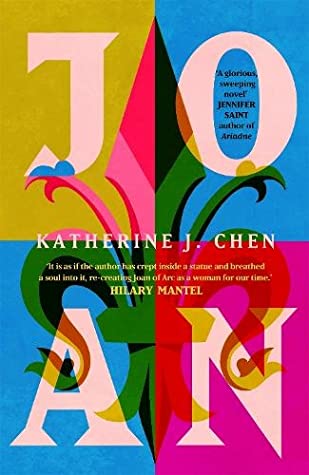
It wasn’t until I started reading this impressive new novel by Katherine J. Chen that I realised how little I know about Joan of Arc; she’s someone I’ve always been aware of, obviously, and I knew a few basic facts but apart from where she has appeared in the background in other historical novels, I’ve never read anything where Joan is the main focus of the book.

After a brief description of the political situation in France in the early 15th century, the novel opens in Domrémy, the small French village where Joan was born. It’s 1422 and France is currently engaged in the Hundred Years’ War, a conflict with England over the succession to the French throne. In quiet Domrémy, Joan grows up far away from the fighting, but faces conflict of her own – with her father, Jacques d’Arc, a violent and abusive bully who has never got over his disappointment that Joan was born a girl and not a boy. Then, one day, the village is attacked and burned by the English, Joan’s sister is raped, and Joan is left swearing revenge on the men she now sees as her enemies: the future Henry VI of England, his regent the Duke of Bedford and Philip, Duke of Burgundy.

A lot of time is devoted to these early years of Joan’s life and I did wonder when we would leave the child Joan behind and meet the warrior Joan, leading her troops into battle – but I can see why it was necessary to cover Joan’s childhood in so much detail. Only by reading about her treatment at the hands of her father, the stories told to her by her beloved uncle, her anger at the fate of her sister and her desire for revenge can we understand what made Joan the strong, determined and inspirational young woman she became. And eventually, of course, we do see Joan meeting the Dauphin of France and riding off with his army to lift the siege of Orléans.

What we don’t see at any point in this novel are miracles, visions or any other religious phenomena of any sort. Katherine J. Chen explains in her author’s note that this was a deliberate decision; her portrayal of Joan is a personal one rather than a traditional one and is a ‘reimagining’ of her life. Removing the religious aspects from Joan’s story makes her feel human, flawed and real, but at the same time the 15th century was a period in which religion was an important part of most people’s daily lives and taking this away from the story of a woman who has been declared a saint seems a bit odd.

This is a beautifully written novel and although I wish authors would stop using the present tense, it does work quite well here, as it did in Annie Garthwaite’s Cecily (a book this one is being compared with – and I would definitely agree with that comparison). It was good to have the opportunity to learn a bit more about Joan of Arc, even if this is only one author’s interpretation and a largely fictional one; if anyone has read any other books about her, I would love to hear your recommendations.

Thanks to Hodder & Stoughton for providing a copy of this book for review via NetGalley.

This is book 33/50 read for the Historical Fiction Reading Challenge 2022.

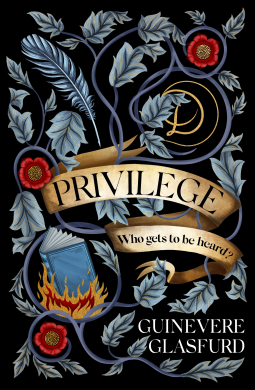
Privilege by Guinevere Glasfurd

I enjoyed both of Guinevere Glasfurd’s previous novels, The Words in My Hand and The Year Without Summer, so I hoped for good things from her latest novel which sounded just as intriguing as the other two. The title Privilege could refer to all sorts of things, but in this case it’s a reference to the system in pre-Revolutionary France where publishers had to obtain a ‘royal privilege’ before a book could be published.

The novel begins in Rouen in 1749, where Delphine Vimond is being raised by her father, having lost her mother at an early age. Delphine’s father runs a pottery, but he is also a collector of books and Delphine inherits from him a love of literature and a desire for learning. Finding the key to his library, she discovers a whole new world of adventure and knowledge in the pages of his books. However, when a volume by Milton on the killing of kings is found in his possession, Delphine understands for the first time that not all books are seen as appropriate and that some are even forbidden.

Meanwhile, in London, we meet Chancery Smith, an apprentice printer. A box of papers from Paris signed only with the letter ‘D’ has been received at the print shop and Chancery is given the job of visiting France to try to identify this mysterious author. It’s not going to be an easy task – as the papers contain potentially dangerous writings, Chancery must avoid letting them fall into the hands of the censors who would see the papers destroyed and the courier punished. On arriving in Paris, his path crosses with Delphine Vimond’s and together they set off in search of ‘D’, while trying to stay one step ahead of the royal censor, Henri Gilbert, and his spies.

Privilege is a thought-provoking read, exploring issues such as censorship, the power of the monarch, and the freedom – or lack of it – to write and think about topics that matter to us. Before reading this novel I didn’t really know how the ‘royal privilege’ system worked and how it lead to books written in France having to be published in other countries and smuggled back in, so I found that aspect of the story fascinating. I also picked up lots of other snippets of information on the early publishing industry along the way – I had never heard of France’s ‘blue library’, for example.

I found the mystery/thriller aspect of the novel slightly less successful, maybe because the identity of the unknown author seemed too obvious. Still, with two engaging protagonists in Delphine and Chancery, as well as a strong cast of secondary characters, and with such an interesting subject at the heart of the story, it’s a book that I enjoyed reading.

Thanks to John Murray Press for providing a copy of this book for review via NetGalley.

This is book 29/50 read for the Historical Fiction Reading Challenge 2022.

The Murder on the Links by Agatha Christie

The May theme for Read Christie 2022 is “a story set in Europe” and The Murder on the Links is the perfect choice as the story takes place almost entirely in France.

First published in 1923, this is a very early Poirot novel (just the second in the series, in fact) and one of several to be narrated by Captain Arthur Hastings. Hastings, a close friend of Poirot’s, is on his way home to England from France when he meets a girl on the train who introduces herself only as ‘Cinderella’. For Hastings, it’s love at first sight, but when they part ways he doesn’t expect to ever see her again.

The next day, Hastings learns that Poirot has just received a letter from a Mr Paul Renauld requesting him to come to his home in France as soon as possible because he believes his life is in danger. The two set off at once, only to discover that Renauld had been murdered the night before, his body found on the new golf course which is under construction near his house. There are several suspects, but when Cinderella reappears and seems to have some involvement in the murder, Hastings will have to choose between his love for her and his loyalty to Poirot.

I enjoyed this, although I don’t think it’s one of the better Poirot novels I’ve read. None of the characters are particularly memorable or appealing; her characterisation would be stronger in later books in the series – maybe at this early stage she was still concentrating on developing the character of Poirot himself. In this book he has a rival – the French detective Monsieur Giraud – and we can see the contrast between their detecting methods. Poirot refers to Giraud as ‘a human foxhound’, someone who ‘sniffs out’ clues like footprints and cigarette ends while failing to see the bigger picture or to consider motive and psychology as well as physical evidence. Meanwhile, Giraud is equally scornful of Poirot’s approach to crime-solving. I’m sure I don’t need to tell you which of the two detectives will eventually solve the mystery!

I usually like the books narrated by Hastings, who is a sort of Watson to Poirot’s Sherlock Holmes. He provides a viewpoint close to Poirot, while also being as mystified as we are by Poirot’s methods and deductions. I did find him slightly irritating in this book, with his tendency to instantly fall in love with every young woman he meets, but the romantic subplot does have a purpose as it leads to Hastings departing for Argentina, only to make occasional reappearances for the rest of the series.

Overall, this is a typically clever and entertaining Christie novel, but probably not one that I’ll be tempted to re-read. As a final note, don’t be put off by the many covers of this book that show people playing golf – apart from the golf course being the location of the dead body, golf has absolutely nothing to do with the plot!

The Dark Queens by Shelley Puhak (non-fiction)

Their ghosts are everywhere; we just need to know where to look.

This is a fascinating dual biography of two little-known medieval queens, Brunhild and Fredegund, who belonged to the Merovingian dynasty and ruled over large swathes of the lands we now know as France and Germany. I don’t often find myself drawn to non-fiction, but this book was a great choice for me as it’s both educational and entertaining – and every bit as readable as fiction.

Most people today have probably never heard of Brunhild and Fredegund and it seems there’s a good reason for that: as Shelley Puhak explains, following the deaths of the two queens, their stories were rewritten – and some of their achievements erased altogether – by the rulers who came after them, including their own son and nephew Clothar II, and later by Charlemagne’s Carolingian dynasty. And yet the influence of these two Merovingian women lived on, in legends and fairy tales, in the naming of roads, and in the character of Brunhild the Valkyrie from Wagner’s opera Der Ring des Nibelungen. Most intriguingly, a battle strategy of Fredegund’s appears to have inspired, whether directly or indirectly, the ‘Birnam Wood comes to Dunsinane’ episode of Shakespeare’s Macbeth.

The two queens came from very different backgrounds. Brunhild was a princess from Visigothic Spain who was married off to King Sigibert of Austrasia in 567 as part of a political alliance. Austrasia was the north-eastern territory of the Kingdom of the Franks; Neustria to the west and Burgundy to the south were ruled by Sigibert’s brothers, Chilperic I and Guntram, respectively. Fredegund, a former slave, rose to power when she married Chilperic of Neustria following the death of his wife under suspicious circumstances. This was only the first of many murders with which Fredegund would be connected; she went on to be associated with a whole series of poisonings, tortures and political assassinations. Brunhild is portrayed as a much more sympathetic character, but the prejudices of the sources do need to be considered!

After the deaths of their husbands, both Brunhild and Fredegund reigned as regents on behalf of their young sons and grandsons. Their kingdoms of Austrasia and Neustria were engaged in war for many years, fuelled by a rivalry between the two queens, which originated in Fredegund allegedly being responsible for the murders of both Galswintha, Brunhild’s sister, and King Sigibert, Brunhild’s husband. However, they were willing to work together where necessary and both queens proved themselves to be strong, intelligent, politically astute women in a world dominated by men.

The Dark Queens is not a particularly academic book. It’s written in the style of narrative non-fiction, drawing on the available primary sources such as the writings of Gregory of Tours and Venantius Fortunatus but sometimes finding it necessary to speculate in order to fill in the gaps. Despite this, it’s clear that Shelley Puhak has carried out a huge amount of research in writing this book and she does include a list of all of her sources, both primary and secondary, at the end, along with a comprehensive section of notes and references. Although The Dark Queens may not satisfy readers who are looking for something more scholarly, I thoroughly enjoyed it and am so pleased I’ve had the chance to get to know Brunhild and Fredegund. I’m surprised they haven’t been written about more widely; they would be wonderful subjects for historical fiction and would make a nice change from the Tudors!

Thanks to Head of Zeus for providing a copy of this book for review via NetGalley.

The Clockwork Girl by Anna Mazzola

The Clockwork Girl is Anna Mazzola’s third novel and, I think, her best so far. Not only is the cover beautiful, the setting is also wonderfully dark and atmospheric and the story is fascinating.

The year is 1750 and Madeleine Chastel, daughter of a Parisian brothel owner, is about to start a new job as a maid in the household of Dr Reinhart, a Swiss clockmaker. Madeleine is pleased to have an opportunity to escape from her mother’s clutches, but this particular job is not one she has chosen for herself – she has been forced to take it by the chief of police, who wants her to spy on Dr Reinhart and report back on any suspicious activities she witnesses. But although Madeleine soon becomes convinced that the police are correct and something strange is going on in the Reinhart household, she finds that she is growing fond of the clockmaker’s daughter, Veronique, and is reluctant to betray her new friend.

The novel is written from the perspectives of three different characters: Madeleine is one, Veronique is another and the third is Jeanne Poisson, better known as Madame de Pompadour, mistress of King Louis XV. I found the choice of narrators very effective as it means we are given insights into every level of Parisian society – the working class, the bourgeoisie or middle class, and the aristocracy. Our story takes place several decades before the French Revolution would begin, but you can see the foundations being laid here as tensions start to simmer. The various locations in which the novel is set are vividly described, with sharp contrasts between the dark, dirty streets where the poor people live in squalor and the luxury and opulence of the royal palaces of Versailles and the Louvre.

Although The Clockwork Girl is a work of fiction, it is inspired by several real historical events. First, the disappearance of children from the streets of Paris in 1750, a scandal known as ‘The Vanishing Children of Paris’. And secondly, the technological advances during the 18th century in the creation of automata – clockwork dolls, animals and other machines with moving parts. Anna Mazzola weaves both of these things into the plot and the result is an engaging and unusual novel that I thoroughly enjoyed reading.

If this book doesn’t appeal, you may prefer Anna Mazzola’s first book, The Unseeing, based on a true crime (the Edgware Road Murder) or The Story Keeper, a novel set on the Isle of Skye. I enjoyed both of them.

Thanks to Orion for providing a copy of this book for review via NetGalley.

This is book 9/50 read for the Historical Fiction Reading Challenge 2022.

The Lady of the Camellias by Alexandre Dumas, fils

Translated by Liesl Schillinger

As a fan of the elder Alexandre Dumas, author of The Count of Monte Cristo, The Three Musketeers and many more, I thought it was time I tried the work of his son, Alexandre Dumas fils. His 1848 novel La Dame aux Camélias – often published in English as The Lady of the Camellias or Camille – was on my Classics Club list and when the Club announced another of their ‘dares’ this February (“Simply read a classic book from your #CClist that you classify as romantic, glamorous, sexy or alluring. It could even be a book or author that you are predisposed to love”) I thought this would be a good opportunity to read it!

The lady of the title is Marguerite Gautier, a Parisian courtesan or ‘kept woman’, who is the mistress of several men including a wealthy duke. Her nickname comes from the fact that she is rarely seen without a bouquet of camellias, red on the days of the month when she is unavailable to her lovers, white when she is free again. One evening at the opera, she catches the attention of a young man called Armand Duval. Armand becomes obsessed with Marguerite and although she informs him that he isn’t rich enough to maintain her extravagant lifestyle, he is determined to become her only lover and put an end to her involvement with other men.

We know from the beginning of the novel that Marguerite will die of consumption (tuberculosis), that she will be in debt at the time of her death and that her possessions will be sold at auction. It’s at this auction that our unnamed narrator buys a book belonging to Marguerite with an inscription by Armand Duval. The purchase of the book leads to a meeting between Armand and the narrator during which Armand tells him the tragic story of his relationship with Marguerite.

Despite knowing that the story was not going to end happily and despite not particularly liking either Armand or Marguerite, I still found The Lady of the Camellias quite gripping and difficult to put down. It’s also beautifully written (and beautifully translated from the original French by Liesl Schillinger in the Penguin Classics edition I read). Although I prefer the style of Dumas père, it’s worth remembering that Dumas fils was only twenty-three years old when he wrote this book, basing it on his own relationship with the courtesan Marie Duplessis, which probably explains the immaturity of the young Armand Duval in the novel.

After falling in love at first sight, in the way only characters in 19th century novels do, and before even getting to know Marguerite, Armand decides that he must ‘possess’ her – and then, once he has her, doesn’t trust her and fails to understand or appreciate the sacrifices she is making for him. My sympathies lay much more with Marguerite, although it took me a long time to warm to her. I think it would have helped if we had been given more information on her background, to explain why she was so obsessed with money and jewels and how she had come to live the frivolous life she was leading. Still, her story is very sad and a good example of double standards between men and women.

If you think this story sounds familiar, it has been adapted many times for stage and screen and was the inspiration for Verdi’s opera La traviata and the 2001 film Moulin Rouge.

This is book 27/50 read from my second Classics Club list.

I, Mona Lisa by Natasha Solomons

Many of us will, on a trip to Paris, have stood in the Louvre in front of Leonardo da Vinci’s Mona Lisa. We may also know some of the details of the painting’s history – its creation in Renaissance Italy, its theft from the Louvre in 1911. However, this new novel by Natasha Solomons adds a whole new dimension to the Mona Lisa story, taking us inside the mind of the painting itself and showing us the world through the eyes that look out from the portrait. Whether or not you enjoy this book will probably depend on whether you can accept that a painting is narrating the story. If you’re happy with that idea, then I think you’ll find I, Mona Lisa an interesting and entertaining read.

Most of the novel is set in 16th century Florence, during the period when Leonardo is working on his most famous masterpiece. From the painting’s own perspective, we get to know some real historical figures such as Lisa del Giocondo, the woman who sits for the portrait; Michelangelo and Raphael, da Vinci’s rivals; Niccolò Machiavelli, who approaches da Vinci with a scheme to divert the Arno River; and Salaì, a student in Leonardo’s workshop who is jealous of his master’s relationship with Mona Lisa. Although Mona is an inanimate object, she is portrayed in the novel as having the thoughts and feelings of a real woman, with an emotional attachment to her creator Leonardo.

When Leonardo eventually dies, leaving her vulnerable and unprotected, Mona embarks on the journey that will lead her to France. As the centuries go by, she spends time at the court of the Sun King in Fontainebleau and then at Versailles during the French Revolution, before finding her way to the Louvre where, as the 20th century dawns, she forms a new friendship with another great artist.

I, Mona Lisa is an unusual novel and a unique way of exploring some key moments in history. However, because so much time is spent in Renaissance Italy, the parts of the novel set in France feel more rushed and the characters less well developed. This was maybe the author’s intention, as Mona finds it difficult to bond with the people she meets after Leonardo’s death and makes it clear that her heart will always be in Florence, but it also meant that I felt less engaged with these sections of the book.

I do think that if you’re going to write a book about a painting with human emotions, the Mona Lisa is a perfect choice as it’s such a realistic and iconic portrait. The Mona of the novel is obviously very limited in what she can see and experience (and with whom she can communicate – just Leonardo and a handful of other painters and paintings), but Natasha Solomons does a great job of bringing Mona and her world to life. This is the third of her books I’ve read – the others are The Novel in the Viola and House of Gold. Three very different books, but I would recommend any or all of them.

Thanks to Hutchinson Heinemann for providing a copy of this book for review via NetGalley.

This is book 4/50 read for the Historical Fiction Reading Challenge 2022.