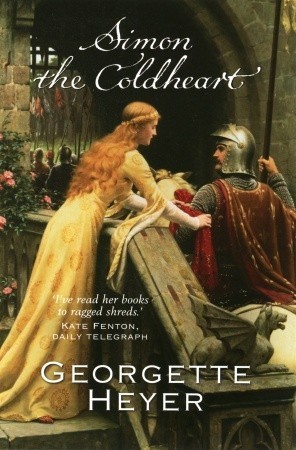
Simon the Coldheart by Georgette Heyer – #1925Club

This week, Karen of Kaggsy’s Bookish Ramblings and Simon of Stuck in a Book are hosting another of their very popular clubs, where we all read and write about books published in the same year. This time it’s 1925! When deciding what to read for the clubs, I usually start by looking to see whether any of my favourite authors had a book published in that year. Georgette Heyer had such a long career there’s nearly always something suitable for whichever year it is and she didn’t disappoint this time.

Simon the Coldheart, published (obviously) in 1925, is one of several straight historical novels Heyer wrote, rather than one of the Georgian or Regency romances for which she’s most famous. It does feel very different and I don’t think it will necessarily appeal to fans of her other books, but I still liked it.

We first meet Simon in the early 1400s when, at the age of fourteen, he presents himself at the castle of Fulk of Montlice, demanding to join his service. Simon is the illegitimate son of Fulk’s bitter enemy, Lord Geoffrey of Malvallet, but Fulk is impressed by his confidence and determination and offers him a position as page. As the years go by, Simon repays Fulk’s faith in him, serving him well for several years before being knighted by the King and gifted lands of his own.

Now known as Sir Simon of Beauvallet (a play on the name of his father, Malvallet, and on the name of his lands, Fair Pastures), Simon has his life in order, exactly as he wants it. His friend Alan, Fulk’s son, and his half-brother Geoffrey, however, believe there’s still something missing from Simon’s life: a wife. Simon insists that he has no interest in women and no plans to get married. But when he meets Lady Margaret of Belrémy, it seems he may have met his match.

I’ve been meaning to read Simon the Coldheart since I read Heyer’s Beauvallet a few years ago – technically a sequel to this book, although it’s set several generations later and features completely different characters. I didn’t find this one as much fun as Beauvallet, which is an Elizabethan pirate novel, but I still found it quite enjoyable. Simon is a strong character, if not particularly easy to like at first – he becomes known as Coldheart for a reason – but later in the book we start to see a more human side to him, first in the close friendships he forms with Alan and Geoffrey, then in his kindness to children and finally his romance with Margaret, which forms a relatively small part of the novel. I also loved his relationship with Fulk, who comes to love him like a son (sometimes, it seems, more than his real son).

As she always does, Heyer attempts to write using language appropriate to the era, which in this case means lots of ‘thees’ and ‘thous’. Today’s historical fiction authors tend not to do this, so it does make the book feel dated – which again won’t be to everyone’s taste, but I didn’t have a problem with it. I didn’t find the romance element of the book particularly satisfying, though; Margaret is introduced quite late in the novel and Heyer’s usual witty dialogue between hero and heroine isn’t much in evidence here. I found Margaret a more interesting character when she’s away having adventures on her own than I did in her scenes with Simon.

Apparently Simon the Coldheart was one of six books Heyer tried to suppress in the 1930s (the others were another historical novel, The Great Roxhythe, and four contemporary novels) as she considered them inferior early works. In 1977, a few years after her death, her son gave permission for this one to be republished. In general I believe an author’s wishes should be respected, but I also think she was maybe being too hard on Simon the Coldheart – it obviously isn’t one of her best, but it’s not a bad book at all. It got my 1925 Club reading off to a good start and I hope to post another review later in the week, as well as looking at some of my favourite reads from previous club years.

They Found Him Dead by Georgette Heyer – #1937Club

This week, Simon of Stuck in a Book and Karen of Kaggsy’s Bookish Ramblings are hosting another of their very popular clubs, where we all read and write about books published in the same year. This time it’s 1937 Club and for my first book I’ve turned to a favourite author who can be almost guaranteed to have had at least one title published in any chosen club year. In 1937, she had two and although An Infamous Army, a novel set before and during the Battle of Waterloo, is one I read a few years ago and didn’t particularly enjoy, I’m pleased to say that I had a much better experience with this one.

They Found Him Dead is one of twelve contemporary detective novels written by Heyer. It begins with the family, friends and business associates of Silas Kane assembling at his country house to celebrate his sixtieth birthday. As with many large gatherings, there are various tensions between members of the group, but when Silas is found dead at the bottom of a cliff after going out for his usual evening walk, the police decide that it was just a tragic accident. Only fourteen-year-old Timothy Harte, half-brother of Silas Kane’s nephew Jim, suspects murder – and when Kane’s heir, Clement, is shot in the head several weeks later, it seems that he could have been right.

Superintendent Hannasyde and Sergeant Hemingway arrive from Scotland Yard to investigate and quickly discover that there’s a large number of suspects including several nephews and nieces in the line of inheritance, some of Kane’s business partners and even his elderly mother, a woman in her eighties. However, they first need to decide whether they really are dealing with two murders or just one – and if there have been two, were they both committed by the same person?

I thought this was an entertaining novel, although I did panic at first due to the huge number of people introduced in the opening chapter. I wished I had drawn a family tree to keep them all straight in my mind, but after a few more chapters everything had settled down anyway and the characters and their relationships became more clearly defined. As a mystery it’s not a very clever or original one – in fact, it’s quite formulaic in many ways, with the country house, family party, motives revolving around inheritances and business deals and the Scotland Yard detectives all being very familiar to anyone who has read a lot of Golden Age crime. The murderer is also quite easy to guess, once you’ve picked up on one very obvious clue.

What I really enjoyed about this book was not the plot but the characters. I particularly loved Timothy, who has an active imagination leading him to see drama and conspiracy in every situation and is nicknamed Terrible Timothy by Sergeant Hemingway. He does actually help to solve the mystery, but not in the way he had expected! There’s also a bit of romance (although it’s quite understated and not a big part of the book), with Timothy’s half-brother, Jim Kane, falling in love with Patricia Allison, companion to Silas Kane’s mother. I liked these two characters as well; in general, the characters in this book are a more pleasant bunch than in the other Heyer mysteries I’ve read! A few of them also appear in her 1951 novel, Duplicate Death, which I read before this one and I’m now wishing I’d read them in the correct order!

I still have a lot of Heyer’s mysteries left to read and am looking forward to them. They don’t really compare to Agatha Christie’s when it comes to plotting a crime, concealing clues and creating red herrings, but they’re still fun to read. This was a great start to the 1937 Club for me and I’m also enjoying my second book, which I’ve almost finished and will be reviewing later in the week.

The Nonesuch by Georgette Heyer – #1962Club

When looking for books to read for this week’s 1962 Club (hosted by Karen and Simon), I hoped there would be a Georgette Heyer I hadn’t read yet – and there was! Like Agatha Christie and Georges Simenon, you can nearly always rely on Heyer to have had at least one book published in whatever the current club year is. The Nonesuch was published in 1962 and I’ve managed to read it just in time to squeeze in my review on the final day!

A nonesuch can be defined as ‘a person or thing without equal’ and Sir Waldo Hawkridge, hero of Heyer’s novel, certainly fits that description – at least in the eyes of fashionable Regency society. Being rich, handsome, athletic and an eligible bachelor, his sudden arrival in the quiet Yorkshire village of Oversett causes quite a stir. He has recently inherited the estate of Broom Hall and has come to inspect it, accompanied by his younger cousin, Lord Lindeth. Ancilla Trent, governess to the beautiful Tiffany Wield, has already formed an opinion of the Nonesuch before she even meets him, but is surprised to find that he’s not really what she expected at all. Ancilla is quickly won over by Sir Waldo’s kindness and calm, sensible nature and he in turn is drawn to the quiet, unassuming governess. However, they are both alarmed when Lindeth seems to be falling for the charms of the lovely but spoiled Tiffany!

The Nonesuch doesn’t really have a lot of plot – unlike many of Heyer’s other novels, there are no encounters with highwaymen, no duels, no masked balls, no abductions or elopements – and the focus instead is on country life and the relationships between the two or three Yorkshire families at the heart of the story. Heyer is often compared to Jane Austen, of course, but I found this book particularly reminiscent of Pride and Prejudice. I tend to prefer her livelier, funnier stories, like The Corinthian or Sprig Muslin, but I did still enjoy following Ancilla and Sir Waldo and watching their relationship develop. Heyer does throw in a misunderstanding to stir things up, but otherwise their romance is completely believable and it’s easy to see why each would be attracted to the other.

In contrast to Ancilla Trent, whom I liked very much, Tiffany Wield is an awful character – selfish, vain, and prone to throwing tantrums when things don’t go her way. It was such a relief when it became clear that she wasn’t going to be the novel’s ‘heroine’, so I didn’t need to try to like her. And I did find myself enjoying her storyline later in the book, after Sir Waldo’s other young cousin, Laurence Calver, arrives from London and Tiffany finds she has met her match!

The Nonesuch doesn’t rank as a favourite by Heyer, but I’m still pleased I managed to fit it in for 1962 Club. I did love the rural Yorkshire setting, which made a change from the more common Regency novel settings of London or Bath.

This is book 42/50 for the 2023 Historical Fiction Reading Challenge.

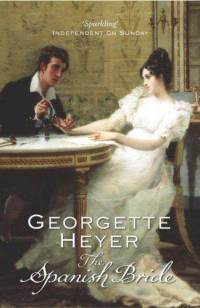
The Spanish Bride by Georgette Heyer – #1940Club

My final read for this week’s 1940 Club, hosted by Simon and Karen, is by an author you can nearly always count on to have had at least one book published in the relevant year! Two Georgette Heyer novels appeared in 1940 – The Corinthian, which I read a few years ago and loved – and this one, The Spanish Bride. I did try to read The Spanish Bride once before and couldn’t get into it, but I thought this would be a good opportunity to attempt it again.

The first thing to say is that this is not a typical Heyer novel at all, which I think is partly why I struggled with it the first time; being very new to Heyer then and enchanted by her witty dialogue, entertaining plots and portrayal of fashionable Regency society, I had expected more of the same and been disappointed to find that this book was so different. This time I was prepared and managed to finish it, but it certainly hasn’t become a favourite.

The Spanish Bride is set during the Peninsular War, the conflict fought on the Iberian Peninsula by the British, Spanish and Portuguese armies against the French, forming part of the Napoleonic Wars. The novel begins with the siege of Badajoz which ended in a French surrender in April 1812. With the victorious troops on the rampage, drinking, looting and raping, fourteen-year-old orphan Juana and her sister seek refuge outside the city at the camp of the 95th Rifles. It is here that Juana meets Brigade-Major Harry Smith, who falls in love with her instantly, and the two are married within days.

Refusing to be parted from her new husband, Juana remains with Harry for the rest of the campaign, riding with him from camp to camp, from battlefield to battlefield. She finds life in the Duke of Wellington’s army challenging – the terrain can be difficult, particularly under the blazing summer sun or in the depths of a freezing winter – but she’s determined not to complain and in the process she wins the hearts of not just Harry but the rest of the regiment as well.

Harry Smith and Juana María de los Dolores de León Smith were both real historical figures. Harry’s life and career is well documented, including in his own autobiography published posthumously in 1901, while Juana is commemorated in the name of Ladysmith, the city in South Africa where Harry later served as the governor of Cape Colony. However, this book doesn’t cover any of that period, concentrating mainly on the Peninsular campaign (with a brief interlude in England where Juana is sent while Harry takes part in the War of 1812 in America) and ending at Waterloo in 1815. In her Author’s Note, Heyer describes her research for the novel, which involved reading the diaries and writings of various members of the Light Division, as well as officers of other regiments and even the Duke of Wellington himself.

The age difference between the two main characters could be a problem for some readers – Harry is twenty-five when he marries Juana, who is eleven years younger – but that’s how old they were in real life and it must have been considered acceptable in nineteenth century Spain even if not today. The ‘romance’ aspect of the book is quite understated compared to the military aspect (and as they get together so early in the story, it’s more of a portrait of an unconventional marriage than a traditional romance in any case). Juana does feel very young and often immature, but at other times she displays wisdom, compassion and courage beyond her years and it’s easy to see why she was so well liked and respected.

No, Harry thought, remembering long marches under molten skies, bivouacs in streaming woods, the fording of swirling rivers, mattresses spread in filthy, flea-ridden hovels, the washing of gangrenous wounds which would have made an English miss swoon with horror: she was not like the girls at home.

This book is as well written as you would expect from Heyer and, as I’ve said, amazingly well researched; my problem with it is entirely down to personal taste and no reflection on the quality of the book itself. I’m just not very interested in military history and while I can cope with a few battle scenes and some brief discussion of tactics and strategies, there was so much of that in this book that I struggled to stay interested at times. But books like this one and An Infamous Army show that Heyer was a much more versatile author than she is often given credit for and I think anyone who has avoided her because they don’t like romantic fiction would be surprised if they tried one of these. And don’t forget she also wrote several mystery novels – although I haven’t read all of them, the three I have read were very enjoyable.

This is book 12/50 read for the 2023 Historical Fiction Reading Challenge.

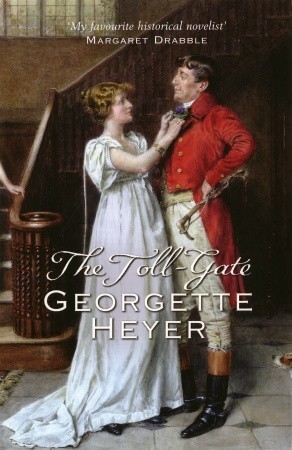
The Toll-Gate by Georgette Heyer – #1954Club

This is the first of two reviews I’ll be posting this week for Simon and Karen’s 1954 Club, one of their twice-yearly events where we all read and review books published in the same year. Georgette Heyer was such a prolific author I find there’s usually a book of hers to read for any year that is chosen! The Toll-Gate is her 1954 novel and one I hadn’t read before.

Like many of Heyer’s novels, this one is set in the Regency period. Our hero, the ‘overpoweringly-large’ Captain John Staple, has just returned from the Peninsular War and is finding it difficult to settle back into the monotony of civilian life. During a particularly tedious dinner party celebrating his cousin’s engagement, John decides to escape the next day and travel north to visit an old friend. Setting off alone on horseback, he becomes lost in the dark and rain and stumbles upon an isolated toll-gate somewhere in the Peak District. A frightened ten-year-old boy is collecting the tolls in the absence of his father, who has disappeared without explanation, so John decides to stay overnight to keep the boy company in the hope that his father will be back in the morning.

When the gatekeeper fails to return the next day, John finds himself helping to man the toll-gate for much longer than he’d expected, encountering highwaymen, thieves and Bow Street Runners. This is so much more exciting than one of cousin Saltash’s boring parties and John soon discovers that he’s in no hurry to leave, particularly when he meets Nell Stornaway, attractive, intelligent and, most importantly, tall – nearly as tall as John himself! Nell lives with her dying grandfather at nearby Kellands Manor and the old man’s heir has recently arrived, accompanied by a disreputable friend. But is it just the inheritance that has drawn them to Kellands or could they be mixed up in the disappearance of the gatekeeper?

Like The Quiet Gentleman, this is a Heyer novel where the focus is on the mystery rather than the romance. The romance is still there, but in a more understated way than usual. However, even though it’s love at first sight, it’s a romance I could believe in, because the hero and heroine seemed perfect for each other. I liked both of them – they are two of Heyer’s more sensible and mature characters, despite John’s love of adventure. And he certainly finds plenty of adventure when he chooses to spend the night at the toll-gate! The opening chapter set at Lord Saltash’s engagement party really doesn’t fit with the rest of the novel at all – it feels as though Heyer is setting up an Austen-style comedy of manners in that chapter, but once John sets out on his journey that aspect of the novel is abandoned and none of the characters we’ve met appear again. I was interested to learn that Heyer wrote the first chapter before deciding on the rest of the plot and had originally intended John’s family background to play a bigger part than it eventually did.

The dialogue is peppered with Heyer’s usual Regency slang, as well as the thieves’ cant used by characters such as Chirk the highwayman, and this adds colour and authenticity to the story. However, although I did enjoy this novel, it hasn’t become a favourite by Heyer; it seemed to lack her usual humour and I do tend to prefer her funnier books! Still, it was an entertaining read and a good choice for me for 1954 Club.

~

Other books from 1954 previously reviewed on my blog:

Jeeves and the Feudal Spirit by PG Wodehouse
Three Singles to Adventure by Gerald Durrell
Mary Anne by Daphne du Maurier

~

This is also book 17/50 read for the Historical Fiction Reading Challenge 2022.

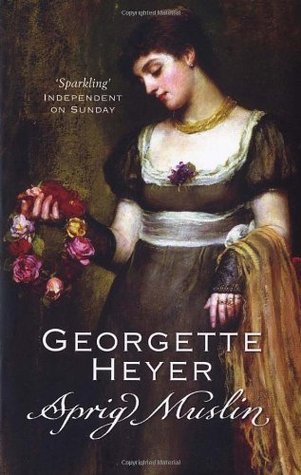
Sprig Muslin by Georgette Heyer

Georgette Heyer is almost always a delight to read and I found this 1956 novel, Sprig Muslin, particularly enjoyable and entertaining. Set in the Regency period she recreated so convincingly, it has all the humour, adventure and romance I expect from her work and although the plot is similar in many ways to the later Charity Girl, the two books are different enough that there’s no risk of confusing them with each other.

It’s been seven years since Sir Gareth Ludlow lost his beloved fiancée in a tragic carriage accident but he is still sure that he will never feel for another woman what he once felt for Clarissa. At the age of thirty-five, he knows he can’t put off marrying any longer so, having given up hope of falling in love again, he makes the decision to propose to his old friend, Lady Hester Theale. Things don’t go quite according to plan, however…

Stopping at an inn on the way to Hester’s estate, Sir Gareth encounters Amanda, who is ‘very nearly seventeen’ and is running away from home as part of a plot to force her grandfather into allowing her to marry the young army officer she loves. Aware of all the dangers that could befall a young lady travelling alone, Sir Gareth insists on taking Amanda with him to Brancaster Park where Hester can take care of her until he is able to discover her full name and return her safely to her family. Furious at what she calls her ‘abduction’ and determined to continue with her plans, Amanda soon escapes from Sir Gareth’s clutches and our hero sets off in pursuit. The rest of the novel follows their escapades as Amanda does her best to stay one step ahead of Gareth, often with hilarious results!

I think the Heyer novels that take place on the road, like this one and The Corinthian, are particularly fun to read. There’s never a dull moment during Amanda and Gareth’s journey and they meet a selection of colourful characters along the way, including Hester’s lecherous uncle, Fabian Theale, the aspiring poet Hildebrande Ross and farmer’s boy Joe Ninfield. As for the main characters, I really liked Sir Gareth who, although he’s not one of my personal favourites, is everything you could want in a Heyer hero, and I also loved the contrast between the book’s two heroines. Amanda is a bit silly, admittedly, but she kept me amused with her imaginative stories and inventions and the way she stumbles from one scrape to another, while I warmed to Hester more and more as the novel progressed and an inner strength was revealed beneath her quiet, gentle exterior.

Now I’m looking forward to my next Heyer; I just need to decide which it will be!

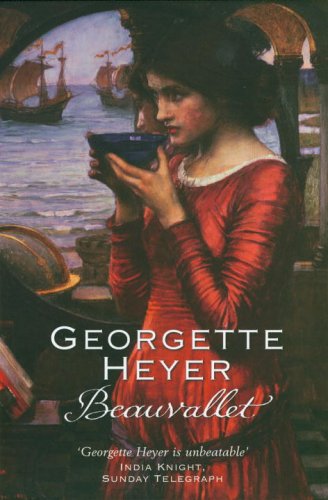
Beauvallet by Georgette Heyer

“All Spain seems to seek me, señor,” answered the stranger merrily. “But who shall slay Nick Beauvallet? Will you try?”

Having read and loved many of Georgette Heyer’s Regency and Georgian romances, I’ve been interested in trying one of her historical novels set in earlier periods – and at the same time, I’ve been a bit wary because they don’t seem as popular or well-liked as the Regencies. I needn’t have worried, though, because I made a good choice with her 1929 novel Beauvallet, set in sixteenth century Spain and England; I can see why it wouldn’t appeal to all Heyer readers, but it was definitely my sort of book!

Sir Nicholas Beauvallet is a notorious English pirate whose name is spoken of in the same breath as Sir Francis Drake’s and at the beginning of the novel his ship, the Venture, is engaged in conflict with the Spanish galleon Santa Maria. The Spanish vessel is captured and the people aboard taken captive, among them the beautiful Doña Dominica de Rada y Sylva and her father, Don Manuel. After a futile attempt to fight off Beauvallet with his own dagger, Dominica knows the situation is hopeless – and so she is very surprised when Beauvallet offers to take them safely home to Spain, swearing to return at a later date to make her his wife. This seems like a ridiculous plan – no Englishman in his right mind would attempt to enter Spain while the two countries are at war – but our hero is not known as ‘Mad Nicholas’ for nothing…

The plot is over the top and not to be taken too seriously, but the book is great fun to read – the perfect way to escape from the pressures of modern day life for a while and retreat into a good old-fashioned adventure story complete with swordfights, sea battles, abductions, imprisonments and daring escapes! Heyer’s attention to period detail is as evident in this novel as in her others, and being set in an earlier century means she has adjusted the language and the dialogue accordingly. While I thought Dominica was quite thinly drawn and not as memorable as many of Heyer’s other heroines, Nick Beauvallet is a wonderful character. He reminded me very much of some of Rafael Sabatini’s irrepressible swashbuckling heroes, particularly Peter Blood – and of course, Captain Blood, another pirate novel, was published just a few years before Beauvallet. As a Sabatini fan, it was probably inevitable that I would enjoy this book!

As a romance, the book is quite predictable; right from their first encounter, where Dominica shouts “I hate you! I despise you, and I hate you!”, it’s easy to guess that her hatred will not last long, especially as Nick is not the sort of man to accept defeat, in love or in anything else. But sometimes predictability is not a bad thing, and there were plenty of other twists and turns along the way to make this an exciting and entertaining read. I would like to read the earlier Simon the Coldheart, about one of Beauvallet’s ancestors, but first I will be heading back to the Regency period as the next Heyer novel I have lined up to read is Sprig Muslin.