Tales from the Underworld by Hans Fallada – #GermanLitMonth

Translated by Michael Hofmann

November is always a busy month with lots of events taking place in the book blogging world, so for German Literature Month (hosted by Caroline of Beauty is a Sleeping Cat and Tony of Tony’s Reading List) I decided to read a short story collection that I could dive into now and then throughout the month in between reading other things. Hans Fallada is probably my favourite German author so I thought Tales from the Underworld would be a good choice.

This collection was published by Penguin Modern Classics in 2014 and contains a large number of Fallada’s short stories which were originally published between 1925 and 1946. The stories have been translated from the original German by Michael Hofmann, who has also translated other Fallada books including Alone in Berlin and A Small Circus. Many of the stories are semi-autobiographical, which I would have guessed from the small amount I know about Fallada’s life, but this is covered in more detail in the foreword by Jenny Williams.

As the title of the book suggests, the focus is on the darker side of life – some of the stories are about thieves, prisoners or drug addicts, while others deal with subjects such as poverty and unemployment. You’re probably thinking that it all sounds very bleak and depressing, but Fallada’s lively, conversational style and sense of humour means it’s much less miserable and much more entertaining than it could have been in the hands of a different author. I think my favourite story was Fifty Marks and A Merry Christmas, a lovely, touching story about a young couple, Mumm and Itzenplitz, who are struggling to make ends meet but determined to have a happy Christmas despite their financial problems. This one reminded me very much of the novel Little Man, What Now? which was published in the same year.

The stories range from the very short, such as the sequence titled Calendar Stories, written in the style of fables with an obvious moral, to the more substantial, such as Short Treatise on the Joys of Morphinism, in which an addict desperately tries to acquire enough morphine to get through the day, looking for pharmacies that will accept fake prescriptions. The addict’s name is Hans, because this is one of the autobiographical stories – Fallada and his wife were both addicted to morphine, which also inspired his 1947 novel, Nightmare in Berlin.

The impact of the two world wars is felt in several of the stories, including The Returning Soldier, where a man comes home from the war with a wounded arm and finds that his father is less sympathetic than he had hoped. Some of the stories deal with urban life – for example War Monument or Urinal? is a satire on the politics and bureaucracy that holds back progress in a small town – while others, such as The Good Pasture on the Right have rural settings and explore the problems facing farmers and the importance of owning land. Fallada also looks at different aspects of marriage and parenthood, with stories like Happiness and Woe, where an unemployed father is tempted into spending the family’s rent money, and The Missing Greenfinches, in which a father tries to teach his young son to value the lives of even the smallest creatures.

I haven’t mentioned even half of the stories here, but I hope I’ve given an idea of how fascinating and varied this collection is. I think it would be a good introduction to Fallada’s work, but if, like me, you’ve already read some of his books, it’s interesting to see how many of these topics come up again in his longer fiction and how many are drawn from his own life. It was a good choice for German Literature Month, just as I hoped it would be!

The Predicament by William Boyd

After finishing last year’s Gabriel’s Moon, I was pleased to learn that William Boyd was writing a second book about Gabriel Dax. I’ve now read it and enjoyed it even more than the first.

The Predicament begins in March 1963 with travel writer Gabriel trying to lead a peaceful life in a small East Sussex village. However, his parallel life in the world of espionage just won’t leave him alone. His Russian contact, Natalia Arkadina of the KGB, still believes he is a double agent working on behalf of Russia and has requested a meeting with him to give him his latest assignment. Meanwhile, Faith Green of MI6 has also approached him with a new mission: to go to Guatemala and interview Padre Tiago, the man expected to win the upcoming presidential election there.

Gabriel is not thrilled about getting involved in spying again, but agrees to the Guatemala plan as he’ll be able to combine the trip with some research for his new book on the world’s rivers. Unfortunately, things go badly wrong and he leaves the country in a hurry, having made himself the target of some unscrupulous people. It’s not long before he is given a new task, though – this time he must go to Germany and try to prevent an assassination attempt on President Kennedy, who is visiting West Berlin.

I don’t often choose to read spy thrillers, but one of the things I find compelling about this series is that Gabriel is such a reluctant and accidental spy. He never intended to get mixed up in international espionage and is really not very good at it! We do see him adding to his skill set in this book, though, being trained on how to lose someone who is trying to follow him and how to use everyday items as weapons. And although his Guatemala mission is disastrous, he does play a part in foiling the conspiracy to kill JFK in Berlin (I’m sure it’s not a spoiler to say that it was foiled as everyone knows that he wasn’t assassinated in Germany). Boyd does a good job of creating tension in the Berlin sections, despite it already being obvious what the outcome is going to be!

Gabriel’s Moon probably had slightly more depth, as it also featured a storyline about a childhood trauma that affected Gabriel’s mental health, but I preferred this book overall – possibly because when I read the first one I was comparing it unfavourably with Boyd’s previous and very different novel, The Romantic, which I loved. And although the mental health storyline is pushed into the background in this book, Gabriel does find himself facing some other personal predicaments: he is being accused of plagiarism by another travel author, who is not pleased that Gabriel has written about the same group of islands; his ex-girlfriend Lorraine is trying to rekindle their relationship; and Gabriel himself is continuing to struggle with his feelings for his MI6 handler, Faith Green. Faith is an enigmatic character – is she really romantically interested in Gabriel or is she just stringing him along for her own purposes?

The Predicament is an entertaining read with some fascinating settings – Guatemala on the brink of a political revolution and post-war Berlin shortly after the construction of the Berlin Wall. Throughout the book, Gabriel’s Russian contacts, Natalia and Varvara, keep pushing for him to also visit Moscow, so maybe that will finally happen in the next book! This is apparently intended to be a trilogy, so hopefully we’ll get answers to some of the other questions in the final novel too. Something to look forward to.

Thanks to Viking for providing a copy of this book for review via NetGalley.

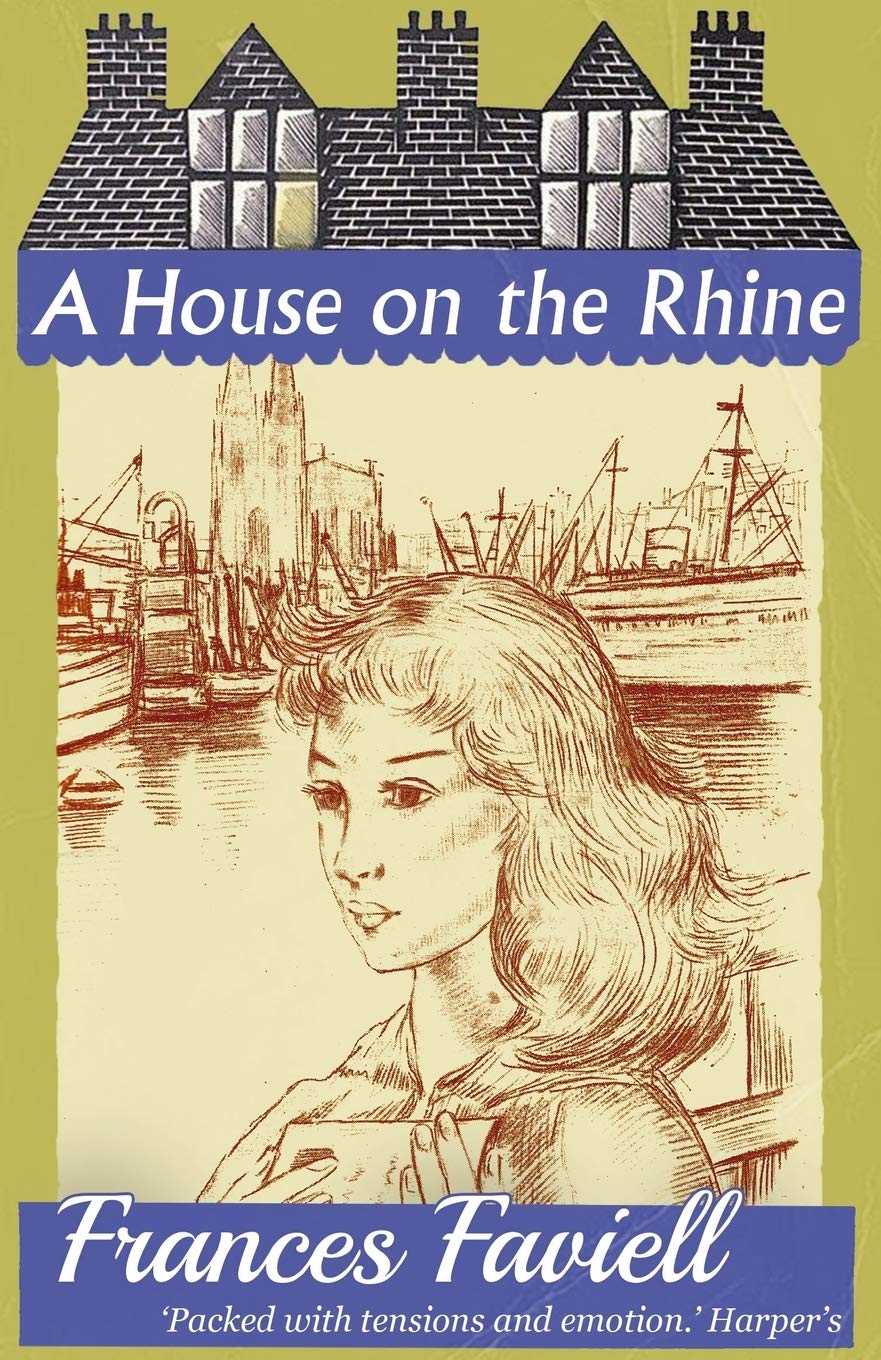
A House on the Rhine by Frances Faviell – #DeanStreetDecember24

My previous experience with Frances Faviell has been limited to her Second World War memoir, A Chelsea Concerto, so I was curious to see what her novels were like. There are several currently available from Dean Street Press and as Liz is hosting her Dean Street December event this month, I decided it was a good time to give one of them a try.

A House on the Rhine, first published in 1955, tells the story of a family trying to adjust to life in postwar Germany. After their home was destroyed during the war, the family – Joseph and Moe and their twelve children – spent four and a half years living in an air raid shelter and have now been rehoused by the authorities in a village outside Cologne. Moe once received a medal from the Nazis for having more than ten children (large Aryan families being seen as the Nazi ideal), but now it seems that almost every member of that large family is embroiled in trouble of some sort and it’s anything but a happy, harmonious household.

Seventeen-year-old Katie is raising her young son alone after his father, a Belgian soldier, left her and went back to his own country. She sees the little boy as a burden preventing her from getting a job like her siblings and is envious of her older sister, Anna, whose own illegitimate child died. She can’t rely on her mother to help her with childcare because Moe is too distracted these days – she’s having an affair with their lodger, the much younger Rudi, and the whole family knows about it, including Joseph. And so, determined to have some fun and the chance to make some money, Katie has started sneaking out at night with several of her brothers to join a gang of other young people who engage in theft and violence under the cover of darkness.

Katie’s foster sister, Krista, has no memory of her own parents or her early life, having been found unconscious by Joseph during an air raid on Cologne. She has grown up with Joseph and Moe’s children, but is still seen as different and not quite like the others. Krista is in love with Paul, an American soldier, but is afraid to take their relationship any further because she knows her foster father doesn’t approve. Paul is confused. Is it his nationality that’s the problem – or is it because Joseph’s own feelings for Krista are not purely paternal?

I wasn’t prepared for this book being so dark! As well as the affairs, the unwanted pregnancies and the gang violence, some of the siblings also become implicated in a murder, while another, little Carola, is suffering from polio in hospital. It’s very bleak and the only characters I really liked, apart from the very young children, were Krista and Paul. Katie, her brother Hank, and the gang leader Leo were particularly horrible! The narrative moves around from one character to another so we have a chance to get to know all of the major players and I found Joseph, the patriarch of the family, the most complex and interesting. It’s clear that the war – and the time he spent in a prisoner of war camp in France – has affected him deeply, as has the loss of pride he has suffered in not being able to house his own family and the discovery that his children are now earning more than he is himself.

This is certainly not the usual gentle, comforting read I’ve come to associate with the Dean Street Press Furrowed Middlebrow imprint. I found it quite disturbing at times, though also very gripping. It’s a novel with a lot of depth and multiple layers and I know I’ve barely scratched the surface of it here. I can find very few other reviews of it, so if you’ve read it I would love to hear what you thought!

This edition of the book also contains a short story, The Russian for Sardines, originally published in the London Evening Standard in 1956 and also set in Germany after the war – a much more optimistic and uplifting story than A House on the Rhine! I’ll look forward to reading Frances Faviell’s other two novels published by DSP, Thalia and The Fledgeling, as well as her other memoir, The Dancing Bear.

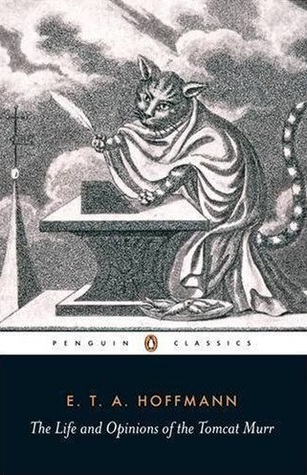
The Life and Opinions of the Tomcat Murr by ETA Hoffmann

Translated by Anthea Bell

Last year I read a book based on ETA Hoffmann’s The Nutcracker and although I wasn’t impressed, it left me longing to read something by Hoffmann himself. I wasn’t sure whether I really wanted to read The Nutcracker, so I decided to see whether one of his other books appealed to me more. That’s how I came across his 1819 novel, The Life and Opinions of the Tomcat Murr, which sounded absolutely fascinating!

This very unusual novel could almost be described as two books in one. First of all, it’s the autobiography of Murr, an exceptionally intelligent tomcat who lives with the magician and alchemist Master Abraham. As a kitten he secretly teaches himself to read and write and proceeds to educate himself from his master’s library. Having had a series of adventures, he decides it’s time to write his memoirs…but his pages accidentally become mixed up with pages from a very different book:

When Murr the cat was writing his Life and Opinions, he found a printed book in his master’s study, tore it up without more ado, and, thinking no ill, used its pages partly to rest his work on, partly as blotting paper. These pages were left in the manuscript – and were inadvertently printed too, as if they were part of it.

This other book turns out to be a biography of Kapellmeister (conductor) Johannes Kreisler, a musical genius and friend of Master Abraham’s. Kreisler’s story unfolds alongside Murr’s, with a few pages of one followed by a few pages of the other, often breaking off mid-sentence as the end of the page is reached. Murr’s sections are marked with ‘M. Cont’ while Kreisler’s are headed ‘W.P.’ (Waste Paper). However, despite the Kreisler biography being printed on ‘waste paper’ and seemingly finding its way into Murr’s book by chance, the two stories are linked by the character of Master Abraham and, towards the end, there are hints of a much stronger connection between the two.

I found Murr’s story great fun to read. He has a strong and unique narrative voice, being vain, precocious and over-confident, but still with the qualities of the cat he is and always will be – he has an instinctive wariness of dogs and is easily tempted by a bowl of milk. His memoirs are told in chronological order, describing his kittenhood, his self-education, his romance with a beautiful female cat and his uneasy but close friendship with Ponto the poodle, who is less well-read but wiser in the ways of the world.

Kreisler, by contrast, is a very different personality – quiet, nervous and melancholic. His story becomes very convoluted, being intertwined with the lives of German royalty as he finds himself at the fictitious court of Prince Irinaeus of Sieghartshof and is drawn to two young women, Princess Hedwiga and her friend Julia Benzon. I found this much less interesting to read than Murr’s story, although if I’d had more knowledge of early 19th century German society and its intricacies it’s possible that I would have appreciated it more. At times I struggled to stay engaged with the Kreisler sections of the book and found myself looking forward to rejoining Murr. I’ve read that Hoffmann apparently based Kreisler on himself and used him as a character in several of his other books – and again, maybe if I’d know more about Hoffmann himself this would have had more significance for me.

My Penguin Classics edition of the novel contains two volumes of The Tomcat Murr which were published between 1819-1821. Sadly, Hoffmann died in 1822 and a planned third volume was never completed. That’s not really a problem, because the second volume does have quite a satisfactory ending, but there are still a lot of loose ends that aren’t tied up and it’s slightly frustrating not knowing how the story would have concluded! If you’re interested in reading the book, I can recommend this particular edition – the translation by Anthea Bell is very readable and there’s an excellent introduction by Jeremy Adler (best read after finishing the book), as well as notes and suggestions for further reading.

Have you read this or anything else by Hoffmann? I would love to hear your thoughts!

This is book 34/50 from my second Classics Club list and also counts towards this year’s German Lit Month hosted by Lizzy’s Literary Life

The Magician by Colm Tóibín

The Magician is probably a book I would never have chosen to read if it hadn’t appeared on first the longlist then the shortlist for this year’s Walter Scott Prize for Historical Fiction. I’ve read and enjoyed other books by Colm Tóibín: Brooklyn, about a young Irish immigrant in 1950s New York and House of Names, a retelling of the Oresteia. This one, though, a fictional biography of the author Thomas Mann, sounded less appealing to me, particularly as I’ve read very little of Mann’s work (only Death in Venice and Other Stories) and wasn’t sure if I was really interested in reading about his life. There was only one way to find out…

The Magician begins with Thomas Mann’s childhood in the German city of Lübeck towards the end of the 19th century, then takes us through his entire adult life as he marries, has children, becomes a successful author and leaves Germany for first Switzerland and then the US, where the family will live for several years. The childhood chapters help us to see what shapes Thomas into the man he will later become. His father dies in 1891, leaving Thomas and his siblings with their mother, a Brazilian woman who doesn’t quite conform to the expectations of their quiet, staid community in Lübeck, so they move to Munich where Thomas meets and marries Katia Pringsheim, the daughter of a Jewish mathematician.

A lot of time is devoted to Mann’s relationship with Katia and the six children they have together, but also to his sexual desires for young men, something Katia must have been aware of but seems to have ignored. Some of Mann’s repressed feelings for these men find their way into his writing, such as in Death in Venice where the middle-aged von Aschenbach becomes infatuated with the beautiful young Tadzio. Katia herself also inspires her husband’s work; her stay in a Swiss sanatorium after becoming ill in 1911 forms the basis of The Magic Mountain, a book I haven’t read. No knowledge of Mann’s work is required, but when I came across references like that, I did feel that if I’d been more familiar with his books it would have added something extra to the experience of reading The Magician.

The novel also explores Mann’s relationship with his older brother, Heinrich, another writer, and later in the book, the focus switches more and more to Thomas and Katia’s children, giving us a glimpse of what Thomas was like as a father – but only a glimpse, because Thomas remains a remote and distant figure throughout the novel. I felt that he never fully came to life and although I did learn a lot about him, there was no warmth and I wasn’t able to connect with him on an emotional level. I think a non-fiction book on Mann would probably have worked better for me.

However, as well as telling the story of Thomas Mann’s life, Tóibín also tells the story of the first half of the 20th century; not much time is spent on World War I, but I did find it interesting to see World War II unfold from the perspective of the Manns, a family who leave Germany for their own safety and become part of the German émigré community in Los Angeles. Although it takes Thomas a while to come to terms with what is happening in his home country, once he does he becomes a public critic of the Nazi regime. He also worries about the future of his own books and the loss of the freedom to write material that everybody is able to read:

He contemplated the idea that someday in the near future his books would be withdrawn in Germany, and it frightened him. He thought back to Buddenbrooks and The Magic Mountain, the books for which he was most famous, and realized that they would have been paler books, less confident, less intense, had he known when he was writing them that no German would be permitted to read them.

The Magician is a book that I admired, but not one that I loved. I’ll continue to read other books by Tóibín, but I think I prefer the way he writes about fictional characters rather than real ones.

This is book 40/50 read for the Historical Fiction Reading Challenge 2022.

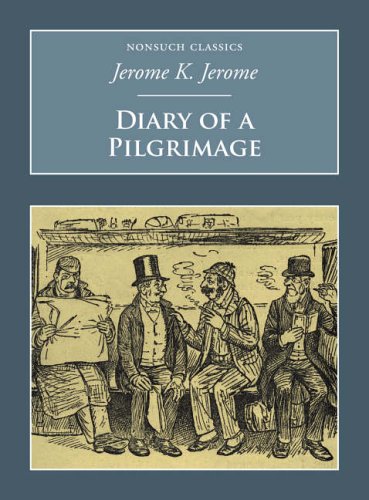
Diary of a Pilgrimage by Jerome K. Jerome

I ought, of course, to sit down in front of this diary at eleven o’clock at night, and write down all that has occurred to me during the day. But at eleven o’clock at night, I am in the middle of a long railway journey, or have just got up, or am just going to bed for a couple of hours. We go to bed at odd moments, when we happen to come across a bed, and have a few minutes to spare. We have been to bed this afternoon, and are now having another breakfast; and I am not quite sure whether it is yesterday or to-morrow, or what day it is.

Jerome K. Jerome’s hilarious Three Men in a Boat is one of my favourite novels from the late Victorian period. I have since tried several of his other books – Three Men on the Bummel, The Idle Thoughts of an Idle Fellow and now this one, Diary of a Pilgrimage – hoping to find another one as good, and although I’ve found them slightly disappointing in comparison, they are still amusing and entertaining. His books also tend to be much shorter than the average Victorian classic and are perfect if you need something light and uplifting between longer, more challenging reads.

Diary of a Pilgrimage, first published in 1891, is very similar to the Three Men books in structure and style. Our narrator, J, is off on his travels again, this time on a ‘pilgrimage’ to Germany to see the famous Passion Play at Oberammergau, a performance which has been regularly taking place there since the 17th century. Accompanied by his friend, known only as B, J travels first from London to Dover, then across the English Channel to Ostend and on to their destination by train. Along the way they stay in several hotels, visit some places of interest including Cologne Cathedral and, of course, find themselves in plenty of ridiculous and embarrassing situations.

Only a short section of the book is devoted to the Passion Play itself because, as J tells us, it has already been written about many times before. He spends much more time describing the places they pass through on the journey, the funny things that happen to them and the people they meet – such as the very boring man who never stops talking:

After the dog story, we thought we were going to have a little quiet. But we were mistaken; for, with the same breath with which he finished the dog rigmarole, our talkative companion added:

“But I can tell you a funnier thing than that -”

We all felt we could believe that assertion. If he had boasted that he could tell a duller, more uninteresting story, we should have doubted him; but the possibility of his being able to relate something funnier, we could readily grasp.

But it was not a bit funnier, after all. It was only longer and more involved. It was the history of a man who grew his own celery; and then, later on, it turned out that his wife was the niece, by the mother’s side, of a man who had made an ottoman out of an old packing-case.

A lot of J’s anecdotes involve his struggles to make himself understood in various foreign languages (he finds it particularly difficult to order an omelette) and the cultural differences he notices between Germany and England. The train journey also poses lots of problems, such as buying the right tickets, finding that other passengers have taken the best seats, and trying to interpret confusing timetables:

“Drat this 1.45! It doesn’t seem to go anywhere. Munich depart 1.45, and that’s all. It must go somewhere!”

Apparently, however, it does not. It seems to be a train that starts out from Munich at 1.45 and goes off on the loose. Possibly, it is a young, romantic train, fond of mystery. It won’t say where it’s going to. It probably does not even know itself. It goes off in search of adventure.

“I shall start off,” it says to itself, “at 1.45 punctually, and just go on anyhow, without thinking about it, and see where I get to.”

Diary of a Pilgrimage is not what I would describe as a ‘must-read classic’ but it’s a bit of light-hearted fun, which I think we all need now and then!

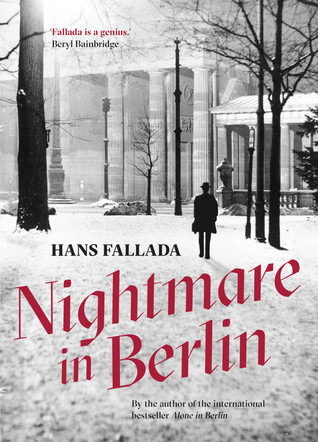
Nightmare in Berlin by Hans Fallada

The war had destroyed everything, and all that was left to him were the ruins and the ugly, incinerated detritus of former memories.

For this year’s German Literature Month, hosted by Lizzy and Caroline, I decided to read a book by one of my favourite German authors, Hans Fallada. Nightmare in Berlin was one of his final novels, written just before his death in 1947, and although I don’t think it’s as good as some of his others – particularly Alone in Berlin and Little Man, What Now? – I did find it an interesting and powerful read. This 2016 translation by Allan Blunden is the first time the book has been made available in English.

Nightmare in Berlin begins in the spring of 1945, just as the war ends and the Red Army march into Berlin. Dr Doll, who had been a successful author before the war, and his much younger wife Alma, live in a small rural town and, unlike most of their neighbours, choose to welcome the Soviet troops into their home. Doll is rewarded by being appointed mayor of the town, but soon finds that he is being viewed with suspicion and resentment by his fellow Germans. Eventually, they decide that it’s time to move back to Berlin, having fled from the city to the countryside during the war. When they arrive in Berlin, however, they discover that someone else has moved into their apartment and that it’s going to be much harder than they’d expected to pick up the threads of their old life.

As Doll sets out to look for help in finding somewhere to live and in getting medical treatment for his wife’s injured leg, he is struck by the greed and selfishness of many of the people he encounters, who think nothing of cheating other Germans to get what they want. Disillusioned and depressed, Doll is overcome with shame and apathy, beginning to despair for Germany’s future.

In this time of the country’s collapse and defeat, no feelings last for long; the hatred passed away, leaving only emptiness, deadness, and indifference behind, and people seemed remote, out of reach.

Although this is obviously quite a bleak novel, it does have its more uplifting moments: there are times when Doll is shown some kindness and compassion, restoring his faith in human nature at least temporarily. The relationship between Doll and Alma is portrayed as a warm and loving one, so that no matter what is going on around them, they know they can always rely on each other. However, the Dolls are also both reliant on drugs, taking morphine and sleeping pills to escape from reality and get through the day, and the middle section of the novel follows their experiences in the hospitals and sanatoriums where they are being treated for their addictions. This part of the book was of much less interest to me (I wanted to see more of post-war Berlin, rather than the inside of a hospital) and I felt that it seemed to come out of nowhere – drugs were never mentioned until the Dolls left their rural town to return to Berlin and yet they had apparently both been addicts for a long time.

Nightmare in Berlin seems to be a very autobiographical novel. Hans Fallada (born Rudolf Wilhelm Friedrich Ditzen) struggled with morphine addiction himself, as did his younger second wife, Ursula Losch. Like Dr Doll, he was appointed mayor of a small country town shortly after the Soviet invasion and then spent the remainder of his life going in and out of hospital. I think the book might have worked better as non-fiction rather than a novel, but maybe Fallada found it easier to write about his own experiences by disguising them as fiction. Still, this is a fascinating novel and worth reading for the insights it offers into the mood of the German people in the aftermath of the war.

This is book 24/50 from my second Classics Club list.