The Eagle and the Hart by Helen Castor

The Eagle and the Hart is a dual biography of two English kings, Richard II and Henry IV (also known as Bolingbroke). Cousins born just a few months apart, they were both grandsons of Edward III, so their lives were linked from the beginning, although their paths to the throne were very different. In this biography, which was longlisted for last year’s Women’s Prize for Non-Fiction, historian Helen Castor explores the stories of the two kings, with the title of the book inspired by their heraldic emblems, Richard’s white hart and Henry’s golden eagle. The book moves forward chronologically, beginning with the childhoods of both kings then continuing through Richard’s reign and deposition by Henry, finally ending just after Henry’s death in 1413.

Richard II is shown very much as he usually is: a weak, unpopular king whose reign was marked by high taxation and accusations of favouritism, his only shining moment being his handling of the Peasants’ Revolt; a man who believed in his divine right to rule, who liked the status and power that came with being king but didn’t have the personal qualities needed to be a good leader. Castor doesn’t challenge any of these ideas and her sympathies are clearly more with Henry, portrayed as having all the abilities Richard lacks but the misfortune to be born to a younger son and not in the direct line of succession. However, when Henry eventually seizes his chance to become king, his own reign is also beset with problems and he spends his time dealing with various plots, assassination attempts and rebellions.

Although I’ve read historical fiction featuring Richard II and Henry IV and both have popped up in some general non-fiction I’ve read about the period (such as The Plantagenets by Dan Jones), this is the first time I’ve read a full biography of either of them. It wasn’t quite what I would have preferred, though. The book is described in the blurb as ‘the story of one of the strangest and most fateful relationships in English history’, so I would have liked more focus on this relationship, more direct comparison of their backgrounds and discussion of how this shaped their different political and leadership styles, some analysis of their meetings and interactions etc. In fairness, as Castor points out in her introduction, it’s difficult to draw a psychological portrait without access to diaries, private letters or memoirs. What we get, then, is a book that feels like two separate biographies unfolding in parallel, with little crossover between the two, and I found the writing style generally quite dry and impersonal.

The Eagle and the Hart is a long book and I took my time reading it as there’s so much information to take in. There’s also some additional material at the front of the book including maps, family trees, a list of illustrations and at the back, taking up the final 25% of the book, a bibliography, directory of the main players in the royal and noble families, notes and an index. I think for anyone wanting to make a serious study of the period, this book could be a very useful resource. For the general reader, there’s maybe a bit more detail than is really necessary, but it obviously depends on the type of book you prefer and are looking for. The other book I’ve read by Castor, She-Wolves, was more enjoyable but I did get a lot out of reading this one as well.
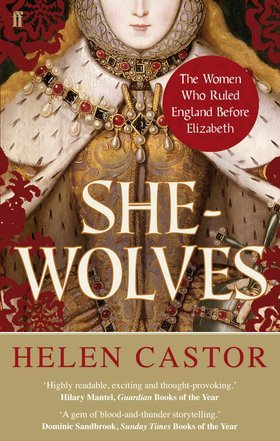
She-Wolves: The Women Who Ruled England Before Elizabeth by Helen Castor

She-Wolves As the title suggests, this is a book about four medieval women who ruled – or attempted to rule – England in the centuries before Elizabeth I.

* Matilda, daughter and heir of King Henry I, was known as ‘Lady of the English’. She was never actually crowned Queen of England but fought her cousin, Stephen of Blois, for the throne in a period of civil war described as The Anarchy.

* Eleanor of Aquitaine was married to two kings – first Louis VII of France and then Matilda’s son, Henry II of England. Two of her sons – Richard I (the Lionheart) and John – also became King, and Eleanor effectively ruled England as regent while Richard was away fighting in the crusades.

* Isabella, the daughter of King Philip IV of France, came to England as Edward II’s young queen but found that her husband was so obsessed with his favourites (Piers Gaveston and Hugh Despenser) that he was prepared to put them before not only his wife but also his kingdom. Isabella eventually staged a rebellion with her lover Roger Mortimer and deposed Edward in order to put her young son, the future Edward III, on the throne.

* Margaret of Anjou was Henry VI’s queen consort and played a major part in the Wars of the Roses. With Henry unable to provide the strong leadership the country needed and possibly suffering from an unspecified mental illness, it fell to Margaret to rule in his place and to lead the Lancastrian faction against their Yorkist rivals.

In She-Wolves (the title refers to a term which has been used to describe both Isabella of France and Margaret of Anjou) Helen Castor looks at the lives of each of these queens in turn, before examining their role in history and how they possibly opened the way for Mary I and Elizabeth I to reign in their own right. Unlike Mary and Elizabeth, the four women covered in this book never ruled as sole monarchs but found themselves in a position of power as the daughters, wives or mothers of kings who, for one reason or another, were unable to rule themselves. Henry I died without a male heir and his nephew Stephen was never fully accepted by the English nobility; Richard I spent much of his reign abroad; Edward II lost the support of his barons due to his choice of favourites; and Henry VI was simply incapable of being an effective ruler. In each case, a woman stepped in to fill the gap.

She-Wolves takes us on a fascinating journey through medieval history, but I have to confess that I didn’t read this book in the way it was intended to be read. As I had just finished reading Isabella by Colin Falconer, the queen I was most interested in was Isabella of France, so I read her section of the book first before turning back to the beginning to read the rest. This wasn’t a problem for me as I’m familiar with all four periods of history, but I would still recommend reading the book in order (unless you’re desperate to read about one particular woman, as I was). The final section of the book, which describes the reigns of Mary and Elizabeth, ties everything together and looks at how times had changed enough by the Tudor period for a woman to finally rule alone.

I thought She-Wolves was slightly dry in places but I did find the book well written, interesting and easy to read. Each section starts with a map showing the relevant areas of Britain and Europe and a family tree to help clarify the complex relationships between characters. As this is a work of non-fiction, however, I was surprised by the lack of notes and references – although there is a list of suggestions for further reading at the back of the book and some sources are named directly in the text. These sources include anonymous chronicles such as Vita Edwardi Secundi (Life of Edward II) and the Gesta Stephani (Deeds of King Stephen) and as Helen Castor points out, medieval chroniclers struggled with the idea of women wielding power and tended to focus on the men, which is why we have so little information on the women’s own experiences and actions.

Approaching the end of the book, I was ready to praise Helen Castor for avoiding bias and speculation…until I came across the statement that the Princes in the Tower were ‘murdered by Edward’s youngest brother and most trusted lieutenant, Richard of Gloucester’, stated as fact. It could be true, of course, but I would have preferred an acknowledgment that it might not be and this made me wonder whether the earlier sections of the book had been as unbiased as I’d thought or whether I just didn’t notice as I have less knowledge of those other periods of history.

I don’t think I’m ever going to decide that I prefer non-fiction to fiction, but I did enjoy reading this book and have learned a lot about Matilda, Eleanor, Isabella and Margaret. Can anyone recommend any other good biographies of any or all of these women?