Monstrous Tales: Haunting Encounters with Britain’s Mythical Beasts

This is a great new collection of short stories inspired by British folklore. I was drawn to it because it included several authors whose work I’ve previously enjoyed, but I was pleased to find that the stories by authors who were new to me were just as strong. The book has also given me the opportunity to learn about lots of creatures from British myth that I’d never come across before; only one or two of them were familiar to me.

I’ll start with the three stories by authors I hadn’t tried before. I particularly enjoyed Jenn Ashworth’s Old Trash, set in the Pendle area of Lancashire where a mother has taken her troubled teenage daughter camping for the weekend, hoping to keep her away from the bad influence of an older boyfriend. Ashworth does a wonderful job of creating a creepy atmosphere as darkness falls over the hills and Rachael and Mae listen to tales of the gytrash, a huge black dog thought to be an omen of death. Abir Mukherjee’s The Doctor’s Wife is another highlight, following a doctor and his wife who move to a small village in the Highlands of Scotland. Once there, the doctor becomes obsessed with the fate of his predecessor and a mysterious woman dressed in red. This story combines a British setting with elements of Hindu mythology, which is fascinating and adds some diversity to the book.

Sunyi Dean’s Eynhallow Free didn’t work for me quite as well as the others, which I think is due to the story being written in second person (addressing the reader directly as ‘you’, putting us in the position of the protagonist, a style I never really get on with). I did love the Orkney setting, though; it’s a very eerie story, incorporating figures from Orkney folklore such as the Goodman of Thorodale and the Finfolk. There’s one more story also set in Scotland: These Things Happen by Dan Jones. I’ve read some of Jones’ history books, but this is my first experience of his fiction. I disliked the main character which put me off the story a little bit, but I was fascinated by the descriptions of the Cat Sith, the large black cat of Scottish mythology that walks around on its hind legs.

Welsh folklore is represented by the Fad Felen, or yellow plague, which appears in Rosie Andrews’ story, The Yellow Death. The story is set at the end of the First World War and the Fad Felen can be seen as a metaphor for the yellow of mustard gas. This is one of only two stories in the book with historical settings. The other is Rebecca Netley’s Mr Mischief, in which ten-year-old Bessie moves to a big house on the Yorkshire moors with her Uncle Kit who has a job as gamekeeper. Here she learns about a mysterious being known only as Mr Mischief and the lengths the superstitious locals go to in order to keep him happy.

I think my favourite story in the book was probably Boneless by Janice Hallett, about a writer investigating reports of a giant slug in Derbyshire. Written in Hallett’s usual style incorporating emails, articles, texts etc, it explores issues such as climate and habitat change and how animals are forced to adapt and evolve. The ending is great – I hadn’t expected the story to go in that direction at all. I also liked The Beast of Bodmin by Jane Johnson, which is set, like a lot of Johnson’s work, in Cornwall. Gina moves into a cottage on the edge of Bodmin Moor, hoping to make a new start in life, and almost immediately her black cat, Roxy, goes missing.

The collection is completed by Stuart Turton’s Deaths in the Family. It follows the story of Ben and his family, who gather together for Christmas every year, barricading themselves indoors while an army of grotesque and murderous Redcaps amasses outside. I wasn’t sure what to make of this story as it was so strange and felt different in tone from the others in the book, but it was certainly entertaining!

Nine stories in this collection, then, and although I inevitably enjoyed some more than others, there wasn’t a single bad one here. I’m looking forward to exploring more of Ashworth, Mukherjee and Dean’s work now, so if you can recommend anything please let me know.

Thanks to Raven Books for providing a copy of this book for review via NetGalley.
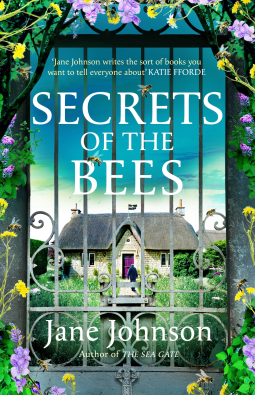
Secrets of the Bees by Jane Johnson

Ezra Curnow is almost eighty years old and has spent his whole life living in a little cottage on the Trengrose estate in Cornwall. It was home to his father and grandfather before him and Ezra can’t imagine living anywhere else. His cottage has no modern appliances or conveniences, not even a television, but Ezra doesn’t see the need; he spends most of his time outdoors with his cat and tame jackdaw, growing his own fruit and vegetables and tending to his bees in their hive.

Ezra’s peaceful life is shattered when Eliza Rosevear, mistress of Trengrose House, dies without leaving a will. The estate goes up for sale and is bought by Toby Hardman, a London businessman, who arrives with his wife Minty, an interior designer, and their teenage son, Dom. As soon as they move in, they begin converting part of the estate into a glamping site and looking for other ways to bring in tourists. Ezra is horrified, particularly when they remove the ancient Celtic cross that gives Trengrose its name. Worse still, it seems that the Hardmans also have their eye on Ezra’s cottage and with no official paperwork to prove that it’s his, he could be at risk of losing his home.

Secrets of the Bees is Jane Johnson’s latest novel and one of several, including The White Hare, that are set in her native Cornwall. Her love for the Cornish landscape, history, customs and people comes through strongly in her descriptive writing and in her creation of Ezra Curnow. Ezra represents tradition and a way of life that has almost disappeared; he has very little in terms of material possessions, but is happy and content. The Hardmans are the complete opposite – they represent change and progress, they have money, cars, technology, yet what they don’t have is happiness. Toby and Minty’s marriage is strained and lacking in trust, while Dom has been expelled from his expensive school for dealing drugs. Although Toby is the villain of the book and seems to be a lost cause, there’s still hope for Minty and Dom and we see them begin to improve and grow as people through their association with Ezra and the Cornish countryside. Dom even became one of my favourite characters, which I certainly hadn’t expected at first.

It’s very common, of course, for residents to object to new developments in their area, particularly ones that could damage the environment or cause noise and disruption, but Ezra takes his protests a step further. He comes up with some very inventive and amusing ways to throw the Hardmans’ plans into disarray, which adds some humour to a serious subject. Proving ownership of his cottage is much more difficult for him – there’s always been an understanding between the Rosevears and the Curnows but apparently nothing has been put in writing. It’s only when we are given some glimpses into the lives of Eliza Rosevear and her family – and into Ezra’s own past, including his National Service in Cyprus in the 1950s – that the truth about the Trengrose estate begins to emerge.

Although the book seemed slow at first and it took a while for things to really start moving, I gradually became completely immersed in the story. I could picture the setting so vividly and I loved everything Jane Johnson had to say about human beings and our relationship with the natural environment. I’ve enjoyed everything I’ve read by Johnson so far, whether set in Cornwall or in other parts of the world, historical or contemporary. I must find time to go back and read the remaining books of hers that I haven’t tried yet.

Thanks to Head of Zeus/Apollo for providing a copy of this book for review via NetGalley.

The Black Crescent by Jane Johnson

Jane Johnson is a British author who has set several of her novels in Morocco, her husband’s country, with each book exploring a different period in Morocco’s history. The Black Crescent is set in the 1950s, during the time of the French protectorate, when support for Moroccan independence was building momentum.

Our narrator, Hamou Badi, grows up in the remote mountain village of Tiziane, a place where the people still cling to ancient traditions and superstitions. Due to the lines on his hands, Hamou himself is said to be a ‘zouhry’, a legendary figure blessed by a djinn and capable of locating treasure and detecting sources of water. However, it is not treasure that eleven-year-old Hamou finds one day in 1939, but the body of a woman, hidden amongst the palm trees by a dried up riverbed. The lack of interest shown by the French authorities in trying to solve this murder leads to Hamou’s decision to become a police officer and ensure that future victims of crime are given the justice they deserve.

Several years later, in 1955, we rejoin Hamou in Casablanca, where he is now working for the Sûreté, the police force of the French colonialists who are still ruling the country. Hamou takes his job seriously, trying to maintain law and order on the streets of Casablanca, but he quickly discovers that many of his fellow Moroccans see him as a traitor and someone not to be trusted. As the independence movement continues to gather force, Hamou finds himself caught between the two sides and must decide which is most important to him – loyalty to his country or to the employer who pays his wages.

The Black Crescent is a fascinating novel, particularly as I previously had such limited knowledge of French-ruled Morocco. I knew nothing about the work of the Istiqlal (independence) Party or the tensions and unrest following France’s exile of Sultan Mohammed V in 1953. Hamou is the perfect choice of narrator, with one foot in both worlds, showing us that there are good and bad people on both sides. Johnson has clearly researched this period thoroughly (she provides a list of her sources in her author’s note) and writes with an understanding and sympathy for the aims of the Moroccans in attempting to overthrow their French occupiers, but without condoning the violence used by some groups such as the ‘Black Crescent’ of the title.

Hamou is portrayed as an honourable, kind-hearted man trying to navigate his way through a difficult situation and I found him easy to like. He also has a love interest – a young woman he meets in Casablanca – but it only plays a small part in the book and I was just as captivated by the relationship he forms with Madani, the little black cat he rescues and adopts. The book did feel very slow-paced and took much longer to read than I’d expected based on the length, but it held my interest throughout and I learned a lot from it. I wish I’d known there was a glossary at the end of the book, but I was able to understand most of the Moroccan terms from the context anyway, so that wasn’t too much of a problem!

I think The Sultan’s Wife, set in 17th century Morocco, is still my favourite Jane Johnson book so far, but there are three of her earlier novels I haven’t read yet, so that could change!

Thanks to Head of Zeus for providing a copy of this book for review via NetGalley.
This is book 49/50 for the 2023 Historical Fiction Reading Challenge.

The White Hare by Jane Johnson

‘Once you’ve lived in this valley, you’ll never be free of it. Its uncanny beauty gets inside you, right into the marrow. It has its own climate, its own peculiar character. In the same way as people can draw you in and repel you at the same time; both beguile and frighten you.’

I love Jane Johnson’s books; they always have such fascinating settings – 17th century Morocco in The Sultan’s Wife, 15th century Spain in The Court of Lions, and the author’s native Cornwall in The Tenth Gift. She returns to Cornwall again for her new novel, The White Hare, a book steeped in the myths and legends of that region of England.

The novel begins in 1954, with Mila Prusik, her mother Magda and five-year-old daughter Janey arriving at White Cove near Eglosberyan on the Cornish coast. Having left Poland for England during World War II, the family had been settled in London until a disastrous relationship with a married man left Mila desperate to make a fresh start. She and Magda have bought a neglected old house in the Cornish countryside and are planning to restore it to its former glory and turn it into a guest house. However, not everyone is happy to see the house under new ownership and the Prusiks receive a hostile welcome.

As Mila and her mother begin their restoration work, they hear hints from their neighbours that the house has a sinister past and should be left alone. The two women think this is nonsense and continue with their plans, but Mila becomes increasingly concerned about the changes in Janey’s behaviour – particularly her obsession with Rabbit, a stuffed toy that seems to have a mind of its own. How is all of this related to sightings of the legendary White Hare and to the strange symbols and carvings Mila finds all over the house and its grounds?

The White Hare is one of the most atmospheric books I’ve read for a while, not just because of the supernatural aspects – which are subtle, ambiguous and unsettling – but also because of the way the setting is so beautifully described. As Jane Johnson explains in her author’s note, the town of Eglosberyan and its valley are not real but are inspired by several real places. I could picture the white house surrounded by dark woodland, the stream tumbling between mossy rocks, the lonely beach framed by granite cliffs – they are all brought so vividly to life.

I also found it interesting to follow the relationship between Mila and Magda. When they first arrive in Cornwall, Mila is timid and submissive, allowing herself and Janey to be bullied by the hard and domineering Magda, but both characters do grow and change throughout the novel as the valley works its magic on them. There’s also a love interest for Mila, but although I did like him I felt that this part of the story took too much of a dramatic turn towards the end. Still, this is a very enjoyable novel and, while it’s quite different from the other Jane Johnson books I’ve read, being set entirely in one period and not as far into the past, I liked it just as much.

I still have three novels by Jane Johnson left to read: The Sea Gate, The Salt Road and Pillars of Light. If you’ve read any of them, please help me decide which I should read next!

Thanks to Head of Zeus for providing a copy of this book for review via NetGalley.

The Tenth Gift by Jane Johnson

When we think about slavery it’s not usually the capture and sale of white Europeans that comes to mind, but that is the topic at the heart of Jane Johnson’s The Tenth Gift. In August 1625, a church in Mount’s Bay, Cornwall was raided by Barbary pirates who took sixty men, women and children into captivity to be sold at the slave markets of Morocco. In The Tenth Gift, Johnson imagines the story of one of these captives – a young woman called Catherine Anne Tregenna.

When we first meet Catherine, or Cat as she is known, she is working as a lady’s maid at a large manor house in Cornwall. A marriage has been arranged for her with her cousin, Robert Bolitho, but Cat wants more out of life. Her skills with a needle have won her a commission from the Countess of Salisbury and she dreams of joining a guild and becoming a master embroiderer, even if she has to leave Cornwall to do it. However, she is soon to travel further from Cornwall than she could ever have imagined. Abducted from church by Barbary corsairs along with her friends, family and neighbours, Cat finds herself on a ship heading towards North Africa, her fate to be decided by the corsair captain.

But Cat’s is not the only story to be told in this novel. In the present day, we meet Julia Lovat, a woman who has been having an affair with Michael, her best friend’s husband, a seven-year relationship which has just come to an end. As a parting gift, Michael gives her an old book of embroidery patterns, but when Julia opens the book she is confronted by something unusual – a series of diary entries written in the margins by someone called Cat who lived in the seventeenth century. Julia is soon engrossed in reading about Cat’s ordeal, but it is only when she visits Morocco herself that she is able to put together all the pieces of Cat’s story.

I found a lot to enjoy in The Tenth Gift, which isn’t surprising as I’ve previously enjoyed two of Jane Johnson’s other Moroccan novels, The Sultan’s Wife and Court of Lions. She writes so vividly about Morocco, describing all of the sounds, sights and smells with a vibrancy that really brings the setting to life. Her depiction of seventeenth century Cornwall is equally well done and it’s obvious that she knows both places very well. The two storylines – past and present – fit together perfectly and the links between them don’t feel too contrived, although there are some supernatural undertones, particularly towards the end, that I thought seemed unnecessary.

I liked Cat and found her story fascinating but, as happens so often with these dual timeframe novels, I thought the present day one was much weaker. I never really managed to warm to Julia and didn’t have much sympathy for her relationship problems; I did become more invested in her story once she arrived in Morocco, but I think the book would have worked better as a straight historical novel without the modern day sections. Cat’s adventures are so interesting and I appreciated the way Jane Johnson tries to give an explanation for why the corsairs behaved the way they did and explores both the similarities and differences between Christian and Islamic cultures.

If you do read this book and enjoy it, you might also enjoy The Sealwoman’s Gift by Sally Magnusson, which deals with a different pirate raid, this time on Iceland’s Westman Islands in 1627, or The Sea-Hawk by Rafael Sabatini, a wonderfully entertaining novel which also takes us from Cornwall to the Barbary Coast.

Thanks to Head of Zeus for providing a copy of this book for review via NetGalley.

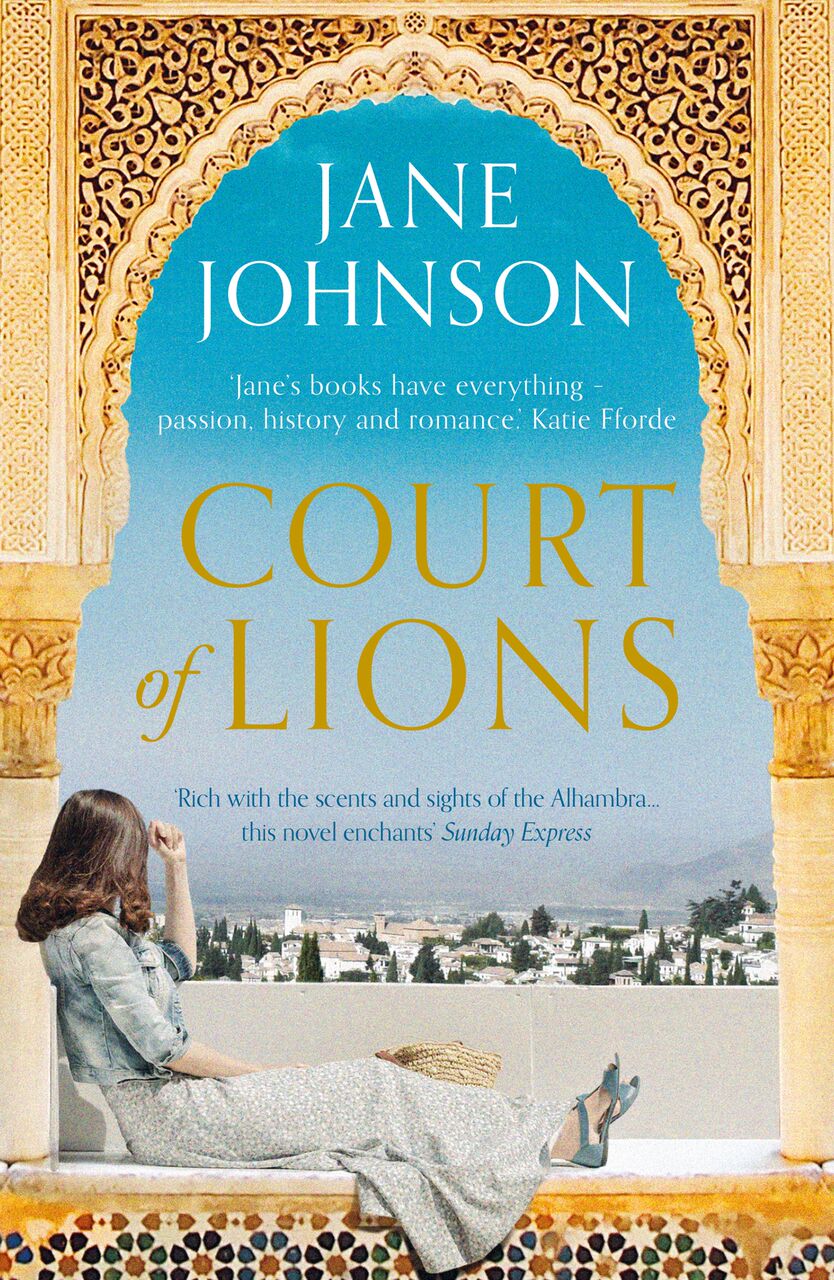
Court of Lions by Jane Johnson

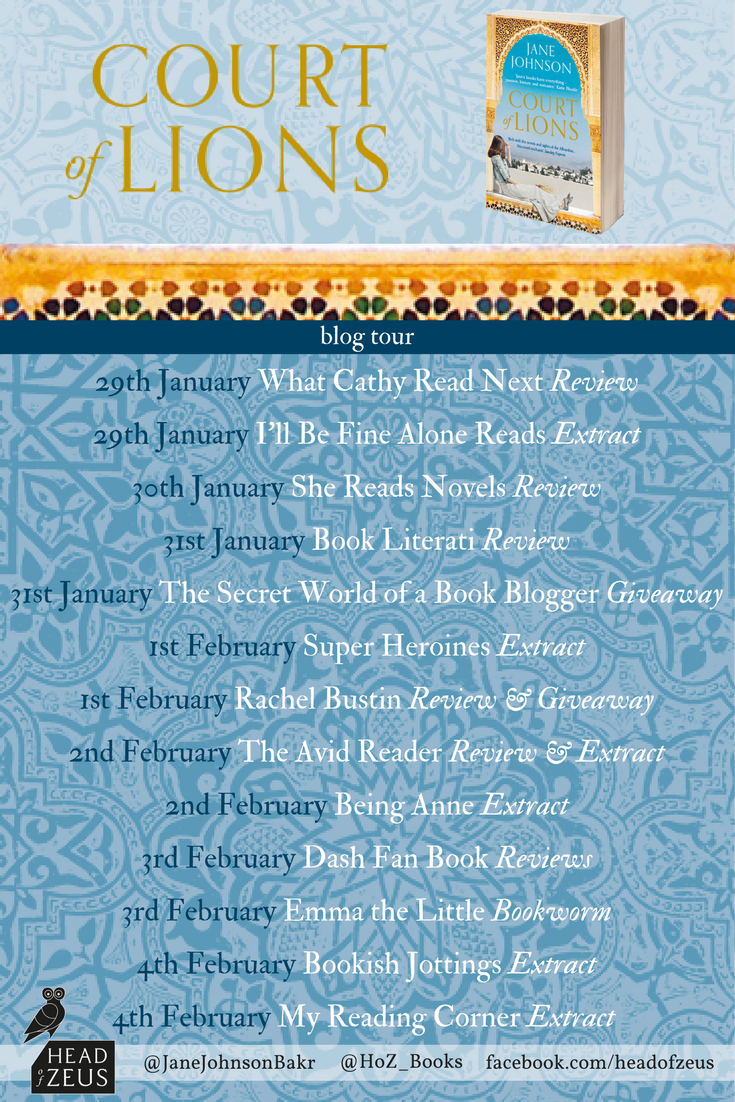
The Court of the Lions is part of the Alhambra, the magnificent palace and fortress in the Spanish city of Granada which forms the setting for Jane Johnson’s latest novel. Having read and enjoyed one of her previous books (The Sultan’s Wife, set in 17th century Morocco), I’m pleased to have had the opportunity to read Court of Lions as part of a blog tour organised by publisher Head of Zeus. You can see the schedule for the other stops on the tour at the end of this post.

Court of Lions is a novel set in two different time periods. First, in the present day, we meet Kate Fordham, who has fled from a troubled marriage in England and is working in a bar in Granada, hoping she has done enough to prevent her husband from finding her. One day, exploring the gardens of the Alhambra, she discovers a scrap of paper pushed into a crack in a wall. Written on it is a message in an unfamiliar language and although Kate is unable to translate it, she senses that it could be important. And she is right, because her discovery leads her to form new relationships and to find the strength she needs to move on.

Alternating with Kate’s story is another story, set in the late 15th century and introducing us to Abu Abdullah Mohammed, the last Sultan of the Emirate of Granada, given the name Boabdil by the Spanish, but referred to in the novel as Momo. We get to know Momo from the point of view of a fictional character, Blessings, a slave child brought from Morocco to be his companion. Growing up together at the Alhambra, Momo and Blessings become close friends – and a loyal friend is what Momo desperately needs as he prepares to face the challenges which await him: a struggle for the throne against his own father and uncle, and war with Catholic Spain, led by King Ferdinand and Queen Isabella.

I found the 15th century storyline completely fascinating and compelling. I have read a little bit about the fall of Granada before, but not from this perspective, so most of it was new to me. The sequence of events leading up to the surrender of the city is described in just the right amount of detail and left me wanting to explore the period further, which is something all good historical fiction should do. Momo’s personal life, his marriage and the fates of his children are also given some attention, all seen through the eyes of Blessings – who is not exactly an unbiased observer as it quickly becomes clear that what he feels for the young Sultan is more than just friendship. Blessings himself is also an interesting character and although I don’t want to say too much here, there are revelations later in the book which answered some of the questions I had about him.

The modern day sections of the novel were slightly less successful. I did like Kate and enjoyed watching as she made new friends in Granada and learned about their culture and lifestyle, but I found the storyline involving her disastrous marriage very melodramatic (again I don’t want to give too much away). Although some of the threads linking the two time periods together are a bit too coincidental to be convincing, I liked the fact that the two share common themes such as religious conflict, prejudice and tolerance – things which were relevant in Momo’s day and are still just as relevant in ours.

The descriptions of Spain and the Alhambra itself are beautifully written. One of my aims for 2018 is to read more fiction set in countries other than my own so I have taken a step towards achieving that aim by reading Court of Lions. Thanks to Head of Zeus for providing a copy for review.

The Sultan’s Wife by Jane Johnson

The Sultan’s Wife is set in Morocco in the year 1677 and is narrated by two different characters. The first is Nus-Nus, a eunuch slave in the palace of the Sultan Moulay Ismail and the second is Alys Swann, an Englishwoman who has been captured at sea by corsairs and given to the Sultan as a gift. Amidst the dangers and conspiracies of Ismail’s court, Nus-Nus and Alys form a friendship and try to help each other survive.

I haven’t read any of Jane Johnson’s previous novels and chose to read this one purely because the setting sounded so interesting. I’ve never read a novel set in 17th century Morocco and I fell in love with the setting from the very first chapter. Everything was described so vividly, I wasn’t surprised to find that the author lives in Morocco herself and has already written two other books set in the same country. I learned so many fascinating little facts about Moroccan history and culture and about the building of the historic city of Meknes (which was intended to rival Versailles). There are also a few chapters where the action moves to England and the court of Charles II in Restoration-period London. It was interesting to be shown the English court through the eyes of Nus-Nus and to see the ways in which it was both different and similar to the Moroccan court. But although there are lots of descriptions of food, clothing, furnishings etc, the pace of the story never slows down and there’s always something happening.

Nus-Nus and Alys are fictional characters but Moulay Ismail, the Sultan, was a real person and is considered to be one of the cruelest rulers in history (one of his nicknames is ‘the bloodthirsty’). This is something that Jane Johnson portrays very convincingly – based on some of the things he does in this novel, living in his household must have been a terrifying experience! Nus-Nus and the other slaves and courtiers are constantly in fear of their lives, knowing that they are at the mercy of his whim, and they have learned to be extra careful when they see him dressed in yellow as this indicates he’s in a particularly murderous mood. Ismail’s wife, Zidana, is also portrayed as a villain; a jealous, scheming person who uses poisons and witchcraft to attack her enemies.

Of the two narrators, I didn’t find Alys Swann a very memorable character but I did really like Nus-Nus. In fact, he was the main reason why I enjoyed this book as much as I did. Nus-Nus was captured from his Senufo tribe as a young man and before coming to the Sultan’s palace had spent some time assisting a British doctor who taught him to read and write and to speak English. These skills make him invaluable to both Ismail and Zidana and are the reason why he’s in a position where he’s able to befriend and help Alys. As a black slave and a eunuch, Nus-Nus is often treated unkindly by other members of the court, but still has a lot of dignity and courage. I thought he was a wonderful character.

The story does touch on some controversial subjects including slavery, racism and prejudice, torture and cruelty (some of the things described in the novel are very brutal and characters lose their lives in some gruesome ways) but I thought everything was handled sensitively. The only criticism I really have is that Alys didn’t have a very distinctive voice; sometimes she didn’t sound any different from Nus-Nus and I didn’t immediately realise the narrator had changed. Apart from that, The Sultan’s Wife was exciting, informative and swept me away to another time and place, which is what I’m always looking for in historical fiction. I loved it!