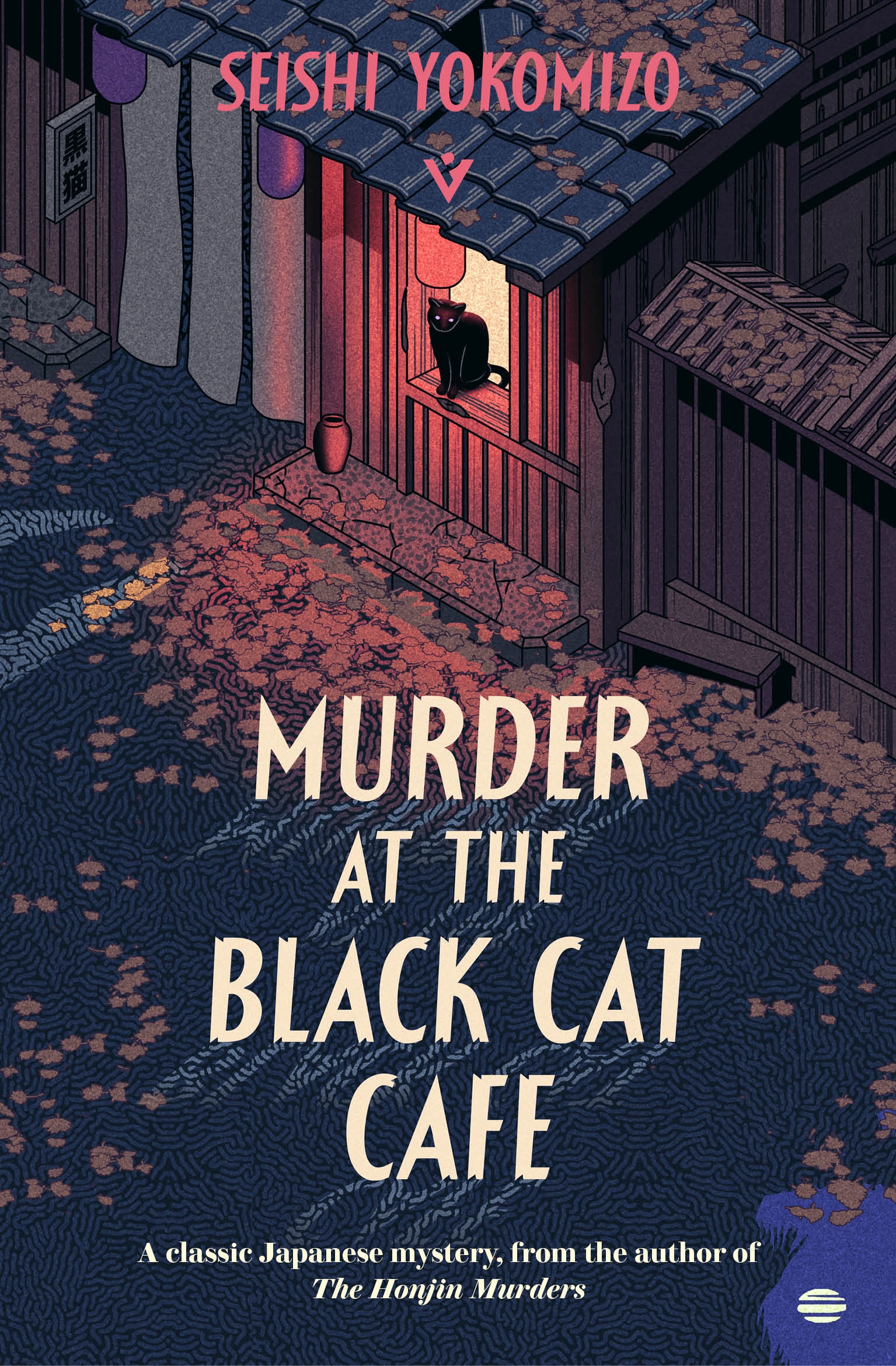
Murder at the Black Cat Cafe by Seishi Yokomizo

Translated by Bryan Karetnyk

Over the last few years, Pushkin Press have been publishing Seishi Yokomizo’s Kosuke Kindaichi mysteries in new English translations. This is the latest, but I found it different from the previous ones in several ways.

First, where the other books are full-length novels, Murder at the Black Cat Cafe is a novella (this edition also includes another short story, Why Did the Well Wheel Creak?, to make the book more substantial). Yokomizo’s detective, Kosuke Kindaichi, plays a prominent role in the first story, but a very small one in the second – in fact, I wouldn’t really call that one a Kindaichi mystery at all as he only appears right at the end. Both stories belong to the type Yokomizo refers to in the prologue as ‘faceless corpse’ mysteries – in other words, where the murder victim has had their face destroyed so they can’t be identified.

The other main difference is in the setting. Usually the Kindaichi mysteries are set in rural Japan – a small village, a country house, a remote island – but Murder at the Black Cat Cafe has a city setting: Tokyo’s red-light district, an area known as the Pink Labyrinth. First published in 1947, the story takes place just after the war and begins with a policeman on patrol discovering the faceless body of a woman in the garden of the Black Cat Cafe, an establishment owned until very recently by the Itojimas, who have just sold it and moved away. Beside the corpse is the body of a black cat, which has also been killed. It’s assumed that the cat is the famous mascot of the Cafe – until the Cafe’s black cat emerges alive and well. Where did the other cat come from and who is the dead woman?

I enjoyed the post-war urban setting, but with the second story, Why Did the Well Wheel Creak?, we are back on more familiar ground with a family living in a remote village. The patriarch, Daizaburo, has two sons – one legitimate and one illegitimate – who are almost identical apart from their eyes. When both young men go to war and only one returns alive, having lost both eyes, questions begin to be asked. Is this man who he says he is or could he be pretending to be his brother?

Both of these stories, then, feature mistaken or stolen identities and people who may or may not be impostors and both have enough twists and turns to keep the reader guessing until the truth is revealed. The first one was probably the stronger mystery, but I did enjoy the second one as well and liked the way the story unfolded through letters sent from a sister to her brother. I’m already looking forward to the next Kindaichi book, She Walks at Night, coming next year.

Thanks to Pushkin Vertigo for providing a copy of this book for review via NetGalley.

Book 2 for RIP XX

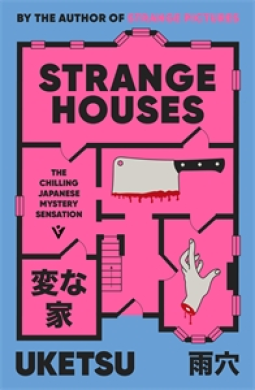
Strange Houses by Uketsu

“I can’t tell you how many people have told me their scary house stories.

But none of them can compare to the houses in this story. These strange, strange houses.”

I loved Uketsu’s Strange Pictures when I read it earlier this year, so I was excited to see another of his books, Strange Houses, available on NetGalley. Like the first book, this one has been translated into English from the original Japanese by translator Jim Rion. Also like the first book, it contains a number of illustrations and diagrams that form an important part of the story.

The novel begins with our narrator, a freelance writer, being approached by his friend Yanaoka, who is searching for a suitable house in which he and his wife can raise their first child. Having viewed a house in a quiet residential area of Tokyo, Yanaoka and his wife have both fallen in love with it but are confused by the floor plan which shows a ‘dead space’ – in other words, a tiny hidden room with no doors. The narrator has another friend, Kurihara, who is an architect, so he decides to ask his opinion.

When Kurihara studies the floor plans, he picks up on several other unusual features of the house. These, together with the hidden room, lead him to form a bizarre but terrifyingly logical explanation for the design of the building. Yanaoka chooses not to buy it, but the narrator is intrigued and continues digging into the house’s history, uncovering connections with some other equally strange houses!

I really enjoyed the first half of this book, almost as much as Strange Pictures. It has a similarly interactive feel, where we are encouraged to look at the illustrations and identify the clues in them along with the narrator. Although Kurihara’s theory about the design of the Tokyo house seems ridiculously far-fetched, it does also make sense when you consider the layout of the rooms, the positions of doors and windows and the location of the house itself. I would never have imagined that floor plans could be creepy, but the ones in this book certainly are!

A difference between this book and Strange Pictures is that the other book is made up of several separate but interconnected stories, while this one consists of just one plot and one set of characters. The change in format means this book feels less varied and innovative, but it also allows us to follow the story of one family – the family who built the houses – through to the end. In the second half of the book, the focus moves away slightly from the plans and layouts and concentrates more on the history of the family. Things become quite convoluted, with complex relationships between the family members, rivalries between different branches and tales of curses and traditions going back several generations. I was reminded of Seishi Yokomizo’s mystery novels and I wonder if these, as well as Yukito Ayatsuji’s Bizarre House series, have influenced Uketsu.

In an interview, translator Jim Rion has talked about how Uketsu wants his writing to be easy to read and accessible to all readers and I think Rion has done a great job of keeping that same clarity in his translations. I’ve also discovered that a third book, Strange Buildings, is coming soon. Something to look forward to!

Thanks to Pushkin Vertigo for providing a copy of this book for review via NetGalley.

Book 6/20 for 20 Books of Summer 2025.

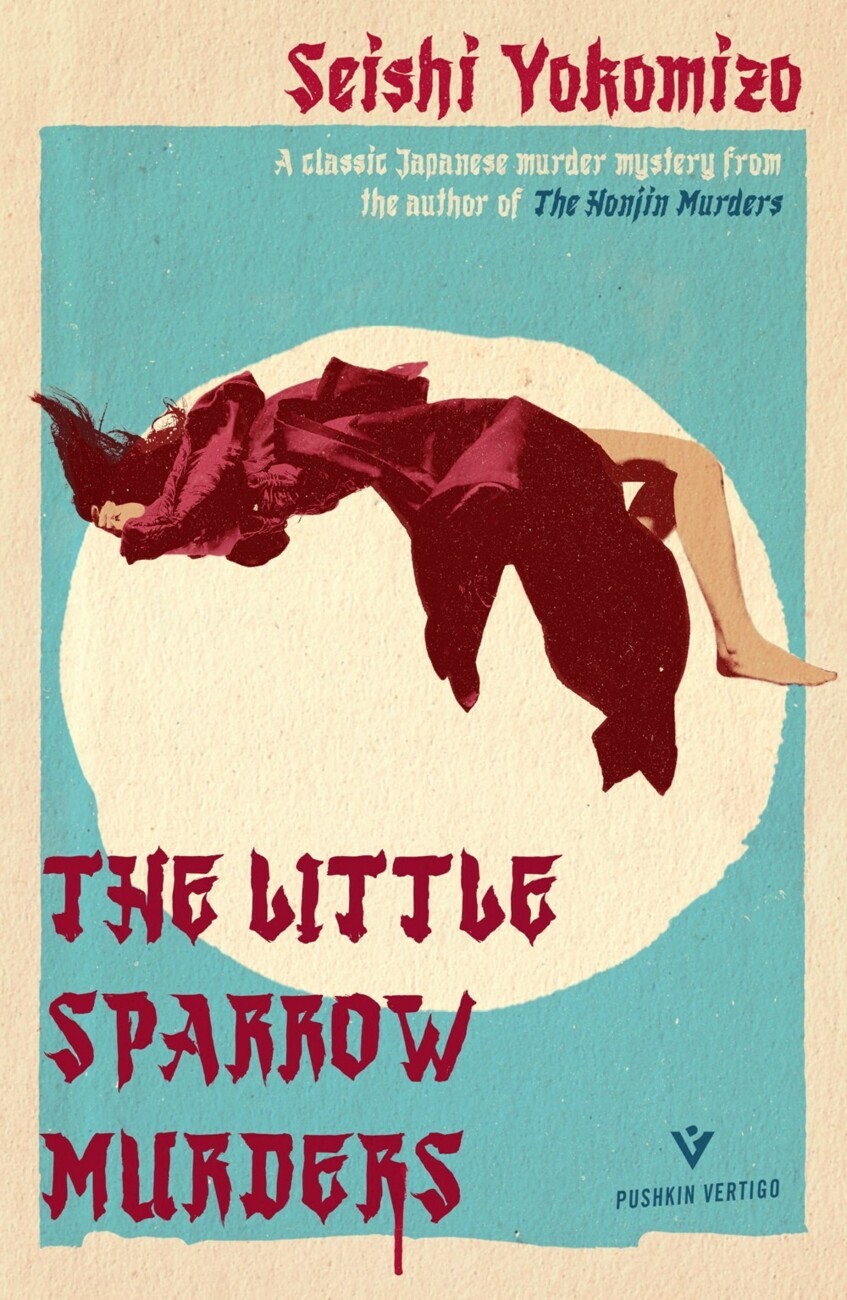
The Little Sparrow Murders by Seishi Yokomizo

Translated by Bryan Karetnyk

I’ve read all five of Seishi Yokomizo’s Kosuke Kindaichi mysteries that have previously been published by Pushkin Press in new English translations. This is the sixth, with another due later this year, and I decided to read it for the Japanese Literature Challenge being hosted this month and next by Dolce Bellezza.

The Little Sparrow Murders was originally published in Japanese in 1959 and is set a few years earlier in the village of Onikobe in Okayama Prefecture. Private detective Kosuke Kindaichi is taking a break from crime-solving and has decided to travel to Okayama to visit his old friend, Inspector Isokawa, at the prefectural police headquarters. Isokawa gives him the address of a nearby inn to stay at, run by Rika Aoike, a widowed friend. Although Kindaichi had been hoping to relax and avoid any mysteries for a while, he finds himself drawn into one when he learns that Rika’s husband, Genjiro, was murdered twenty years earlier – and the killer was never found.

As Kindaichi hears more about the events before and after Genjiro’s death and gets to know some of the people involved, another murder takes place, coinciding with the disappearance of the village chieftain and a sighting of a mysterious old woman on a mountain path. It seems that Kindaichi’s relaxing break is over before it even started. He and Isokawa begin to investigate, convinced that the key to the present day mystery lies in determining what really happened to Rika’s husband all those years ago.

Having read a lot of older Japanese crime novels over the last few years, thanks mainly to Pushkin who are doing a wonderful job with their new translations, I’ve found that many of them – most notably the ones I’ve read by Yukito Ayatsuji and Soji Shimada – are more concerned with solving seemingly impossible crimes and complex puzzles than with characters and motives. Yokomizo, I think, usually finds a better balance between the two; although his books still have intricate plots, the focus is often not so much on working out how the murders were committed, but rather on why they were committed and who could have had a reason for doing so. The impossible crime books can sometimes be fun as well, but I personally prefer the more character-driven ones. In this particular novel, the murders take place out in the open, not in locked rooms, and there’s almost no discussion of alibis, timings or similar things that can sometimes bog down a plot.

One thing I loved about The Little Sparrow Murders is that Yokomizo builds the story around a children’s rhyme – a device that Agatha Christie also often used. The killer in this novel is inspired by a temari song (a song sung by children in Japan while bouncing colourful embroidered temari balls). It begins “In the trees in the garden behind our house, Three little sparrows came to stay” and goes on to describe three young women from different families, who were “all of them sent away” – in other words, murdered. The deaths in the book correspond to the rhyme, which adds some extra interest to the mystery. I hadn’t heard of temari songs or balls before so, as always, a Yokomizo novel has contributed to my knowledge of Japanese culture.

This is one of my favourite Yokomizo novels so far, along with The Honjin Murders and The Inugami Curse, but I did have one problem with it – trying to keep track of the huge number of characters! There are five families in the book and it’s not easy to remember which family each character belongs to and how they’re connected to people in the other families. If you’re reading the ebook version (or maybe even if you’re not), I recommend taking the time to draw some family trees using the character list at the front of the book before you start, then you can easily refer to them as you read. I would have been lost otherwise, I think.

I’m now looking forward to the next Yokomizo book, Murder at the Black Cat Café, coming in September. Pushkin Vertigo also have another Ayatsuji novel, The Clock House Murders, on the way, as well as others by authors I haven’t tried yet, so 2025 should be a good year if you’re a fan of Japanese mysteries!

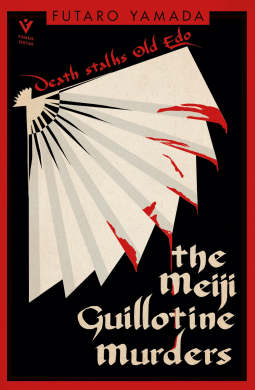
The Meiji Guillotine Murders by Futaro Yamada

Translated by Bryan Karetnyk

It’s 1869 and Japan has entered the Meiji era. The Tokugawa shogunate has fallen and the Emperor Meiji has been restored to the throne. After centuries of isolation, Japan is finally opening up to foreign trade and undergoing social, industrial and military reform. In Tokyo, a group of corrupt rasotsu (policemen) have found ways to exploit this period of change and upheaval for their own gain. With the arrival of two Chief Inspectors from the Imperial Prosecuting Office, Kawaji and Kazuki, it seems that the rasotsu will be forced to mend their ways – although the two men have other things to occupy their time as well as dealing with corruption.

With a number of bizarre murders taking place around Tokyo, Kazuki and Kawaji (based on a real person who is considered the founder of Japan’s modern police system) engage in a friendly competition to see who can solve the crimes first. A separate chapter is devoted to each case, which at first seem to be unrelated, making the book feel almost like a collection of short stories. There are five cases for the two detectives to solve, with the help of Esmeralda, a young Frenchwoman from a family of executioners whom Kazuki has brought to Japan along with that most deadly of French weapons: the guillotine. Despite the title, the guillotine is not necessarily used to carry out all of the murders in the book, but it represents the changes that Japan is experiencing as the country becomes exposed to modern, western influence. It also provides a reason for Esmeralda’s presence in Tokyo, which is important as she has a significant role to play in the solving of the mysteries.

The Meiji Guillotine Murders was first published in 1979 and is one of several Japanese crime novels that have recently been made available in English by Pushkin Press. However, although I’ve loved some of the others, I didn’t enjoy this one quite as much. Bryan Karetnyk’s translation is clear and readable (I’m already familiar with his work through some of his other translated novels), but I had problems with other aspects of the book. I struggled with the number of characters, particularly as so few of them have clearly defined personalities and with more and more of them being introduced with each new case the detectives investigate. My lack of engagement with the characters made it difficult for me to concentrate on following the plot, which is important as all of the separate cases are quite complex and you do need to be paying attention! I persevered and was rewarded with the final section of the book where, after some surprising twists and turns, everything is tied together perfectly.

I did like the historical setting of the book and felt I was learning a lot about Japan during the Meiji era. At times it seemed more like historical fiction than a murder mystery, which was fine with me, but I think someone picking the book up expecting a more traditional crime novel may be surprised by the amount of historical detail. It’s an interesting, unusual book, and although I’m not sure whether I would read any more by Yamada, I do hope more of them are translated into English for those readers who loved this one. I’m enjoying discovering Japanese crime authors through Pushkin and so far my favourites have been Seishi Yokomizo and Akimitsu Takagi.

Thanks to Pushkin Vertigo for providing a copy of this book for review via NetGalley.

This is book 7/20 of my 20 Books of Summer 2024.

Book 24/50 for the Historical Fiction Reading Challenge 2024

The Noh Mask Murder by Akimitsu Takagi

Translated by Jesse Kirkwood

My 20 Books of Summer reading is off to a good start with this 1949 Japanese locked room mystery, now available from Pushkin Press in a new English translation. Thanks to Pushkin, I’ve been able to try several Japanese classic crime authors over the last few years, including Seishi Yokomizo, Yukito Ayatsuji and Soji Shimada. The Noh Mask Murder is the first book I’ve read by Akimitsu Takagi and I thoroughly enjoyed it.

The novel opens with a discussion between Koichi Yanagi, a chemist who has recently returned to Japan after serving in Burma during the war, and his old school friend, Akimitsu Takagi (yes, the author himself, who appears as a character in his own novel – just like Anthony Horowitz in his Horowitz and Hawthorne series). Akimitsu explains to Koichi that he wants to write a new kind of detective novel, one based on a mystery he has solved for himself in real life:

‘I’d tackle some fiendish real-life mystery, then set down precisely how I solved it in the form of a novel. My readers would be provided with the exact same evidence as the author. They’d be able to follow the detective-narrator’s train of thought, assess the appropriateness of his actions – and even come up with their own alternatives. But I don’t imagine an opportunity like that will ever present itself…’

His opportunity comes sooner than he had imagined when Koichi stumbles upon a mystery at the Chizui family mansion, where he has been staying since returning from the war. The head of the household, Professor Chizui, who was once a friend of Koichi’s, died ten years earlier and the house is now inhabited by his two children and the family of his younger brother, Tajiro. The first sign that something is wrong within the Chizui mansion comes when an eerie figure wearing a sinister Noh mask is seen at one of the windows. Soon after this, Tajiro is found dead inside a locked room, with a smell of jasmine in the air and a Noh mask lying on the floor beside him. Akimitsu Takagi joins Koichi at the house to investigate the murder, but when they discover that someone has called the undertaker to order three coffins, it seems that there’s going to be more than just one murder to investigate!

The mystery is a fascinating one and although some time is spent discussing the mechanisms of how the locked room murder took place, the story never becomes too bogged down by the puzzle aspect; the focus is on the characters, their relationships and their motives. I did find the structure slightly confusing at times as we know we’re reading a book within a book written by Akimitsu Takagi (as both character and author), but within that there’s a journal written by Koichi and a long letter written by Hiroyuki Ishikari, the public prosecutor, so the narrative is sometimes three layers deep. There are some clever twists towards the end, however, which might not have worked if it had been structured differently.

Apart from the mystery, I found it interesting to learn about the different types of mask used in Japanese theatre and how although the Noh mask, which represents a demon, cannot change expression the actors can still use it to show various emotions by tilting the mask up and down and by the clever use of lighting. With the story being set in the post-war period, it’s also interesting to hear the characters reflect on the irony of being so concerned with the death of one person after living through a war in which millions died. If you kill a man in peacetime you’re considered a murderer, says Tajiro’s son, Rintaro, but if you kill a man on the battlefield you’re given a medal.

I really enjoyed The Noh Mask Murder, then, but be warned – in the prologue, where Takagi is discussing his plans for a detective novel, he casually spoils the solution of Agatha Christie’s The Murder of Roger Ackroyd. Not a problem for me as I’ve already read it, but I wish authors wouldn’t do that!

Thanks to Pushkin Vertigo for providing a copy of this book for review via NetGalley.

This is book 1/20 of my 20 Books of Summer 2024.

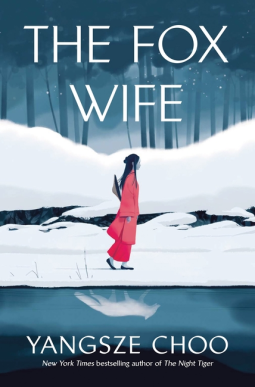
The Fox Wife by Yangsze Choo

The famous scholar Ji Yun, who was obsessed with foxes, said: Humans and things are different species, and foxes lie between humans and things; darkness and light take different paths, and foxes lie in between darkness and light.

Like Yangsze Choo’s previous two novels, The Ghost Bride and The Night Tiger, The Fox Wife is a fascinating blend of history, fantasy and folklore. It takes as its premise the idea that fox spirits, who play a large role in Chinese and Japanese mythology, really exist and can take on the appearance of human beings.

Beginning in Manchuria in the winter of 1908, one thread of the novel follows Bao, an elderly private detective who has been called in to investigate the death of a young woman. The woman’s body was found frozen in the doorway of a restaurant and people are already starting to whisper that she was lured to her death by foxes. Ever since he visited a shrine to a fox god as a child, Bao has been blessed, or maybe cursed, with the ability to detect truth from lies. Now, he hopes he can use that gift to find out what happened to the woman found dead in the cold.

In chapters that alternate with Bao’s, we meet Snow, or Ah San, a white fox spirit who is searching for the man she blames for the death of her daughter two years earlier. Snow has taken the form of a human woman and joined the household of a Chinese medicine seller. In her position as maid, she is able to accompany the family on a trip to Japan where she hopes for an opportunity to take her revenge.

At first, the two threads of the novel are very separate; Bao’s story is written in the third person and focuses on his investigations, with some flashbacks to his childhood; Snow’s narrative is in first person, giving it a more intimate feel. Eventually, their paths begin to converge, producing some interesting plot twists and revelations. We also find that there’s not just one fox in this story, but who are the others and what is their relationship with Snow? It takes a long time for everything to unfold and for a while in the middle of the book I thought it was starting to drag, but the pace does pick up again towards the end.

My knowledge of Chinese folklore is sadly very limited, so I enjoyed learning more about the significance of fox spirits, their characteristics and powers, and some of the myths and folktales that have been told about them. With the novel being set partly in Japan as well as in China, we also see how similar myths and legends about foxes cross over into Japanese culture. It’s all very fascinating, and whenever my attention was starting to wane due to the slow, meandering plot, there would be another passage about foxes that would grab my interest again.

I had mixed feelings about The Fox Wife, then, but I’m pleased to have had the opportunity to learn something new! It’s definitely worth considering this one – and Yangsze Choo’s others – if you have any interest in Chinese myth.

Thanks to Quercus Books for providing a copy of this book for review via NetGalley.

Book 6/50 for the Historical Fiction Reading Challenge 2024

Silence by Shūsaku Endō

Translated by William Johnston

One of my resolutions for 2024 is to read more historical fiction in translation and where better to start than with a book for the Japanese Literature Challenge (hosted by Dolce Bellezza throughout January and February).

First published in Japanese in 1966 and in English in 1969, Shūsaku Endō’s Silence is set in the 17th century and tells the story of a Portuguese Jesuit priest, Sebastian Rodrigues, who travels to Japan to investigate claims that his old mentor, Father Ferreira, has committed apostasy – in other words, renounced his faith. Rodrigues and his friend Francisco Garrpe, another priest, can’t believe that their teacher would do such a thing. Certain that there must be some mistake, the two set out from Lisbon on the long journey to Japan, where they hope to learn what has really happened to Ferreira.

Rodrigues and Garrpe reach Japan in 1639 and quickly discover that the local Christian communities are being persecuted and forced to hide their religion from the authorities. Anyone the officials suspect of being a Christian is told to trample on an image of Christ, known as a fumie, and if they refuse they are imprisoned and tortured by being suspended upside down over a pit. On his arrival in Japan, Rodrigues goes into hiding with the other Christians, carrying out his missionary work and helping them to worship in secret, but he knows it’s only a matter of time before he is caught and has his own faith put to the test.

Silence is both beautifully written and beautifully translated. From beginning to end, I was completely immersed in another time and place; there’s no jarringly modern language to pull the reader out of the story and everything feels authentic and real. I was intrigued by Endō’s decision to write the novel from the perspective of Rodrigues (first in the form of letters written by the priest and then in the third person) rather than the Japanese Christians and it was interesting to see how Endō viewed his country, its people and its customs through the eyes of a stranger.

I am not a particularly religious person but you don’t need to be to be able to appreciate this novel. I was very moved by the internal struggles Rodrigues faces as he begins to question why God is remaining silent in the midst of so much torture and persecution and whether renouncing his faith, under certain circumstances, could actually be the right thing to do if it helps alleviate the suffering of others. As you can imagine, it’s quite a bleak story, but I loved it and although it’s only been a few days since I finished it, I don’t think it’s a book I’ll ever forget. I would like to try more of Endō’s work and am pleased to see that some of his other novels are also available in English translations.

I read this book for the Japanese Literature Challenge 17 and the Historical Fiction Reading Challenge.